LinkedIn thought leader ad examples
220 thought leader ads are live on LinkedIn right now, from 8,902 companies. Browse real ones, filtered by industry.
- Öschger · Präzise LohnfertigungSince 28 Oct 2026
"Unsere Lohnfertigung ist nie zu 100 % ausgelastet. Und das ist ein Prinzip: Ich plane nicht mit 100 % Auslastung von Personal und Maschinen. Das hat zwei Gründe: 1. In den Sommermonaten überschneiden sich viele Urlaube. 2. Und wenn nicht Sommer ist? Dann ist immer jemand krank. Wenn ich mit 100 % Auslastung planen würde, könnten wir zwar viel mehr Aufträge annehmen. Doch wir würden kein einziges Lieferziel erreichen. Qualität, Liefertreue und Verlässlichkeit wären dann nichts als leere Versprechen. PS: Falls ihr auf der Suche nach einem verlässlichen Lohnfertiger seid, schaut mal bei uns vorbei: https://oeschger-gmbh.de
- Öschger · Präzise LohnfertigungSince 28 Oct 2026
Meine Mitarbeiter haben Angst vor der Zukunft. Und ich manchmal auch. Wie auch nicht? Liest man morgens die Nachrichten, findet sich wenig Erfreuliches. Politik, Krieg, Wirtschaft, Klima ... es nimmt kein Ende. Da ist es nur natürlich, dass Skepsis und Pessimismus geschürt werden. Aus diesem Grund: Ist es meine oberste Priorität, meinen Mitarbeitern Sicherheit zu geben. (In meinem Wirkungsfeld.) Wie mache ich das? Ich investiere in das Unternehmen: ➔ Viel von meiner Zeit. Es gibt immer wieder heiße Phasen, in denen ich mich und meine Person zurückstelle. ➔ Geld. Wir investieren viel Geld in den Ausbau von Öschger Lohnfertigung und den Erhalt unserer Qualität. Zu meinen täglichen To-Dos gehört ein "Lauf durch das Unternehmen". Dabei versuche ich, die Grundstimmung einzufangen. Und auch im persönlichen Gespräch Sicherheit zu vermitteln. Denn: Jeder in unserem Unternehmen hat eine Daseinsberechtigung. Jeder ist wirklich wichtig. (Sonst wäre er ja nicht da.) Hin und wieder ist es auch wichtig, das zu kommunizieren. Wie gibst du deinen Mitarbeitern Sicherheit?
- AssemblyAISince 28 Oct 2026
Productivity at AssemblyAI has taken a hit recently... We've been having WAY too much fun testing our new Text-to-Speech model 👀 Experimenting with different voices, cloning each other, and making the model say increasingly ridiculous things. Good news: today we're launching AssemblyAI-TTS-1, so now everyone else can get distracted too 🚀 And while we've been having fun, the team has built something pretty incredible: 🎙️ Natural, expressive, human-like speech 🎯 Leading accuracy on independent benchmarks ⚡ <100ms time to first audio 🗣️ Instant voice cloning and 4,000+ voices ♾️ Unlimited concurrency, no minimum commitments 💰 Just $15 per million characters We've spent years helping developers build agents that can hear and understand their users. Now we're helping those agents speak back. Go have some fun with it. Promise it'll be worth it 👇 https://lnkd.in/ghNAX93i
- ParviSince 28 Oct 2026
Why do agency reports ignore sales?
- YolkSince 28 Oct 2026
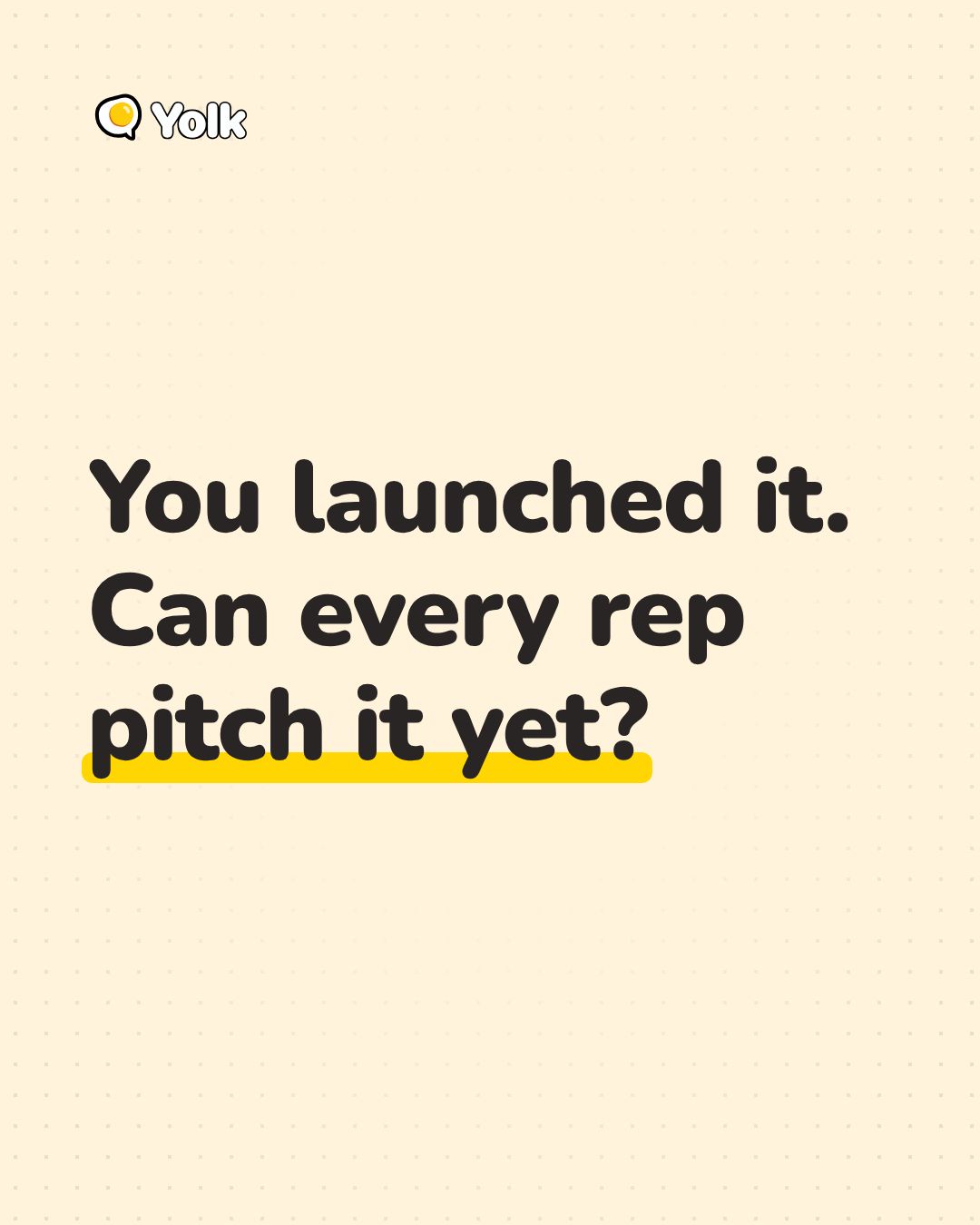
Another thing I've noticed while building Yolk: product launches often leave sales teams behind. Product has the demo, marketing has the new deck. And sales reps usually get a 30-minute training call and a link to the slides. A week later, a customer asks about the new feature, and the rep isn't sure how to explain it. This is another problem we're trying to solve at Yolk. With AI roleplays, reps can practice the new pitch and the questions customers will ask before they talk to real customers. Managers can see who is ready and who needs more practice. When your company launches something new, how do you make sure every rep can pitch it? Book a demo: https://lnkd.in/gzv_x6wk
- ParviSince 28 Oct 2026
If AI does the work, what am I paying for?
- TerrakottaRecorded 30 Oct 2026
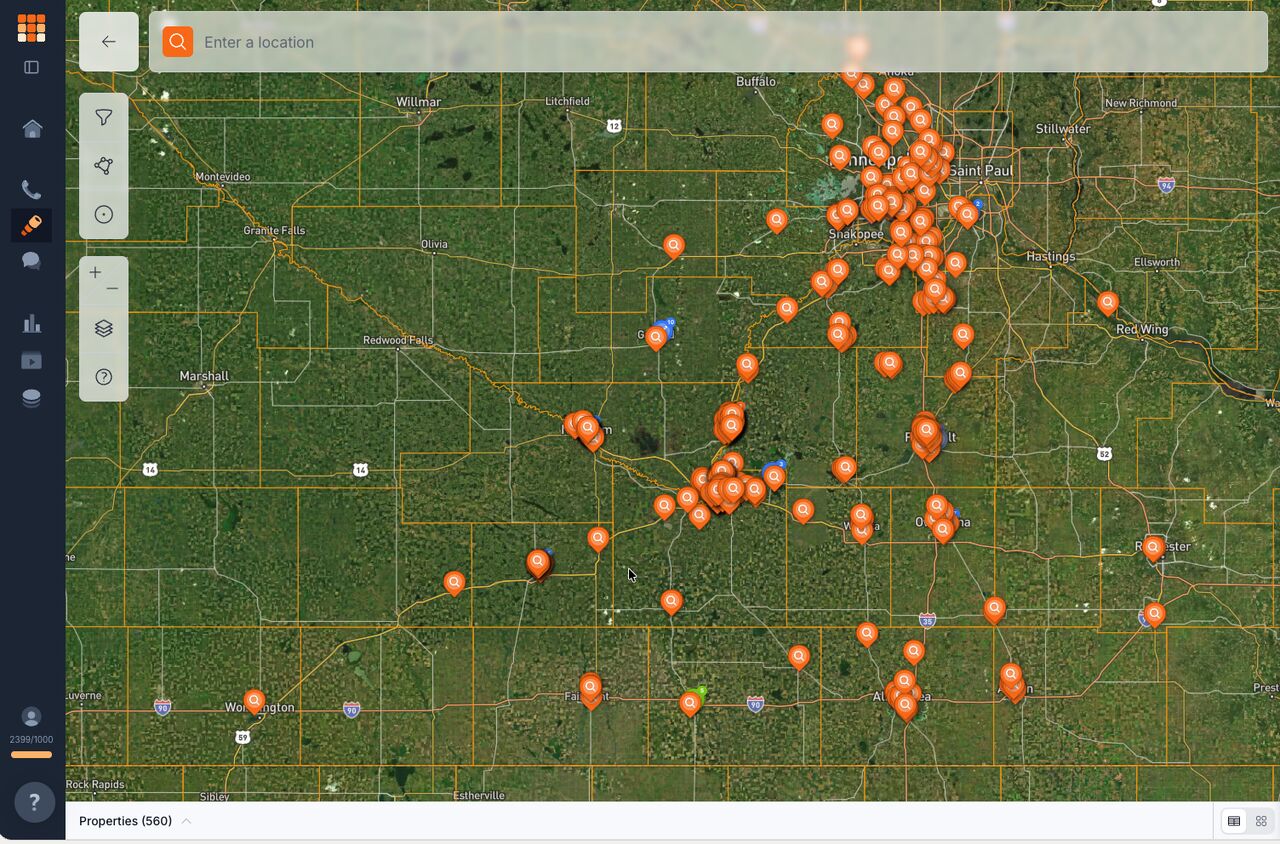
I’m excited to share my recent milestone in Commercial Real Estate: I’ve officially surpassed 400+ calls in 1 month! Full prospecting stats I achieved using Terrakotta: → 443+ calls made → 500+ owners researched → 40+ leads generated I’ve had 1 other goal for a while now. It's been to learn about AI automations for CRE. So I finally took a stab at it. Here’s what I’ve managed to automate with AI: (Particularly Terrakotta, Claude) 1. Building lists of motivated sellers 2. Skip-Tracing LLCs 3. Pulling comps for every call I really wish I had learned this sooner… So I’m happy to share a Free Guide on my Top 3 Claude AI automations for CRE. Comment 'Guide' & I’ll send it over! → This month’s goal: 1,000+ calls. 🚀 Onwards
- TDK VenturesSince 28 Oct 2026
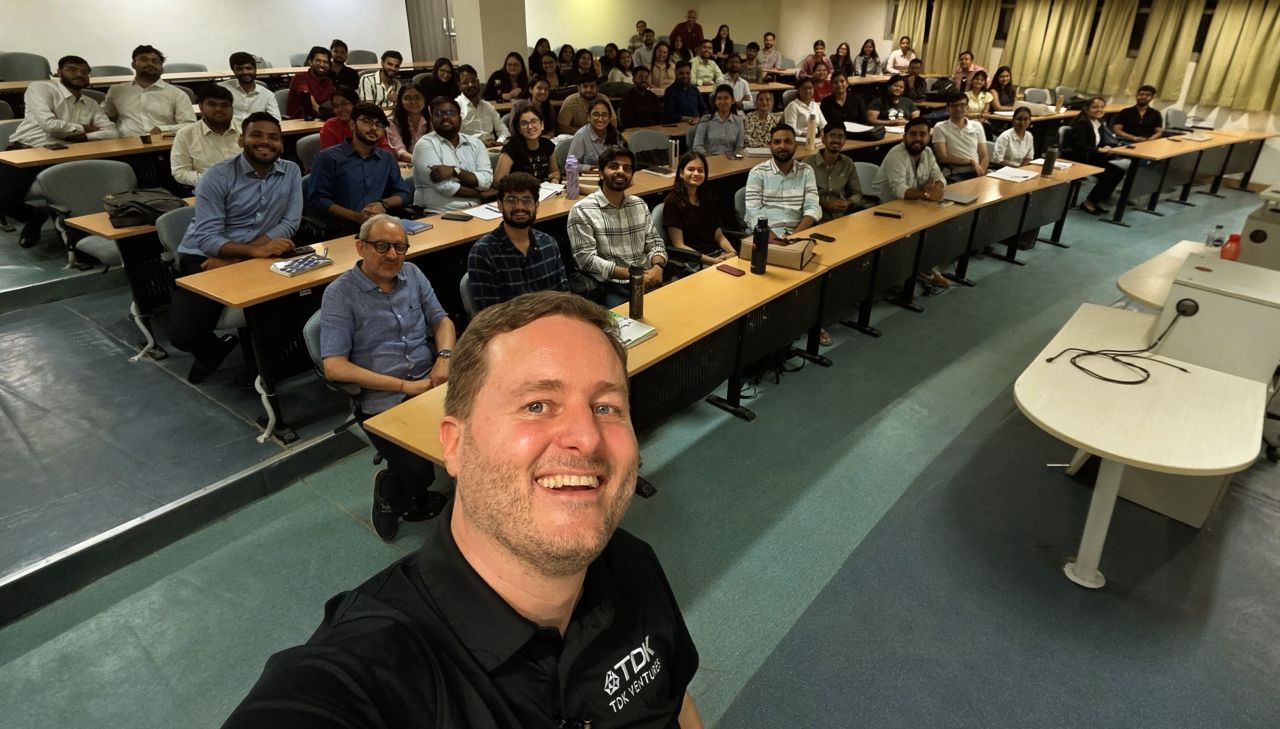
In 2003, I lost £20 in a London Business School classroom. What I learned helped me ask a good friend on a date. Professor Zeger Degraeve had offered a wager involving a drawing pin hidden beneath a cup. Before revealing the result, we spent roughly two hours examining whether my decision to play made sense. Eventually, the full class agreed that it did. Then the cup was lifted. I had lost, and the class changed its verdict. The information available when I made the decision had not changed. Knowing the outcome had changed how we judged it. I recently shared this story with students at BML Munjal University. Their questions brought us to a challenge that matters well beyond investing. A good outcome can teach a team the wrong lesson. A founder wins a customer through unsustainable customization. An investor earns a return despite weak diligence. A corporate project succeeds because colleagues absorb an extraordinary workload. The result may deserve celebration. The method still deserves examination. Before your next consequential decision, record what you know, what you believe, and what would make you reconsider. When the result arrives, ask: * What did we know? * What did we not know? * What did we believe to be true? * What happened? * What will we change? Include successful decisions in that review. They shape what your team will repeat. I have shared the fuller story, including the personal decision it helped me make, and a practical five-question decision note in From Frontier to Iconic. Thank you to Professor Kulbir Lamba and the BML Munjal University students for such a thoughtful conversation. Read "Before We Knew How It Would End": https://lnkd.in/gQctEG3n Which successful decision would your team learn most from examining again?
- WflowSince 28 Oct 2026
Na konci loňského roku jsme s Ipsosem udělali výzkum mezi 300 českými firmami. Data, data, data. Ale co se v nich vlastně skrývá? 🔎 Pro mě osobně toho bylo strašně moc. 💡 Začal jsem si výsledky dávat do souvislostí s tím, co slýchám na obchodních jednáních. A postupně se mi potvrzoval jeden opakující se vzorec: 🚨 98 % firem automatizuje. Aktuální přehled o financích v reálném čase má ale jen 26 % z nich. A to hlavně těch velkých. Firmy automatizují. Jenže automatizace sama o sobě ještě neznamená, že vedení dokáže řídit firmu podle aktuálních dat. 📉 A není to jen číslo z výzkumu. Tenhle vzorec vidím i v praxi. Firmy často vědí, kde ztrácejí čas při zpracování dokladů. Méně často už řeší, jak změnit celé fungování finančního oddělení tak, aby místo rutiny přinášelo firmě větší hodnotu. 👉 I z těchto poznatků vznikla moje přednáška o tom, jak během několika měsíců změnit fungování finančního oddělení. ⁉️ A pokud vás zajímá, jak si v tomhle stojí vaše firma, připravili jsme CFO Index. 11 otázek, přibližně 4 minuty. Zjistíte, jak si vaše finanční procesy vedou ve srovnání s ostatními českými firmami a kde máte největší prostor ke zlepšení. Odkaz najdete v komentáři.
- DLG (Digital Luxury Group)Since 28 Oct 2026
Luxury talks endlessly about clienteling, private appointments and “the experience”. Yet in many boutiques, the training is still about the object, not the person in front of it. Hospitality has worked that muscle for decades: anticipating, reading the room, turning a transaction into a relationship. The reverse is true too. Hospitality can learn from luxury how to build a brand people want to belong to, and a career path to match. 76% of the alumni we surveyed say their employer has enhanced their profile. Only 55% see a clear path up. That’s what we explored in the Luxury & Hospitality Career Index, which my DLG (Digital Luxury Group) colleague Dominic Weir developped with Anouck Weiss, Christophe Julliard, and the Glion Institute of Higher Education and Les Roches teams. The talent already moves between the two industries. But when we asked alumni where they most want to work, 65% of mentions went to hotel groups. Luxury houses got 8%. Are luxury maisons ready to hire the people who already live by the highest hospitality standards? Right now, maisons are barely on their radar.
- TransPerfectSince 28 Oct 2026
What does it mean to be a great manager? At TransPerfect, we coach that a great manager is someone who helps their people achieve more than they would on their own. On this National Leadership Day, it's a good time to step back from the day-to-day and appreciate what a truly daunting job being a manager really is—when you manage someone, you are literally holding their career in your hands. I've made countless mistakes and seen managers make countless mistakes—some of them are unavoidable and even essential to learning. However, there is one trait that I have learned that will help managers overcome missteps and succeed: Taking a personal and vested interest in seeing your people progress to the next level. This cannot be faked—it can't be phoned-in—it must be seen—and ever-present in a manager's daily words and deeds. Management is a soft science—it is people-based so it can never be truly mastered. But while perfection can never be reached, managers can dedicate themselves to constantly learning. I've been doing this for 34 years, and now manage over 10,000 people—and every month without fail, I learn something that helps me be a better manager. #NationalLeadershipDay #PeopleLeadership #LeadershipDevelopment
- Virtual VaultsSince 28 Oct 2026
𝐃𝐞𝐚𝐥 𝐬𝐮𝐜𝐜𝐞𝐬𝐬 𝐝𝐨𝐞𝐬𝐧’𝐭 𝐬𝐭𝐚𝐫𝐭 𝐢𝐧 𝐭𝐡𝐞 𝐝𝐚𝐭𝐚 𝐫𝐨𝐨𝐦. 𝐈𝐭 𝐬𝐭𝐚𝐫𝐭𝐬 𝐦𝐨𝐧𝐭𝐡𝐬, 𝐬𝐨𝐦𝐞𝐭𝐢𝐦𝐞𝐬 𝐲𝐞𝐚𝐫𝐬, 𝐞𝐚𝐫𝐥𝐢𝐞𝐫. Too often, companies only start preparing when the buyer is already at the table. By then, the stress takes over, documents go missing, and valuable time is lost. What I’ve learned from hundreds of transactions is this: 𝐭𝐡𝐞 𝐛𝐞𝐬𝐭 𝐌&𝐀 𝐚𝐝𝐯𝐢𝐬𝐨𝐫𝐬 𝐬𝐜𝐚𝐥𝐞 𝐭𝐡𝐫𝐨𝐮𝐠𝐡 𝐩𝐫𝐞𝐩𝐚𝐫𝐚𝐭𝐢𝐨𝐧. Not just financial readiness, but data readiness. Clean structures. Version control. A team that knows exactly where to find what. When data is structured and connected, due diligence becomes faster, more predictable, and more valuable. Add AI-driven tools, and preparation turns into a continuous discipline, not a last-minute scramble. Scaling advisory means doing more deals, with less friction and greater confidence. That’s how we help dealmakers grow, not just in size, but in strength. If you’re advising, buying, or selling, think beyond execution. Ask yourself: are we truly ready for what’s next? 🎧 Full conversation in the What's up, Corporate Finance? Podcast: https://lnkd.in/ePDmrDfv
- SVE CorpSince 27 Oct 2026
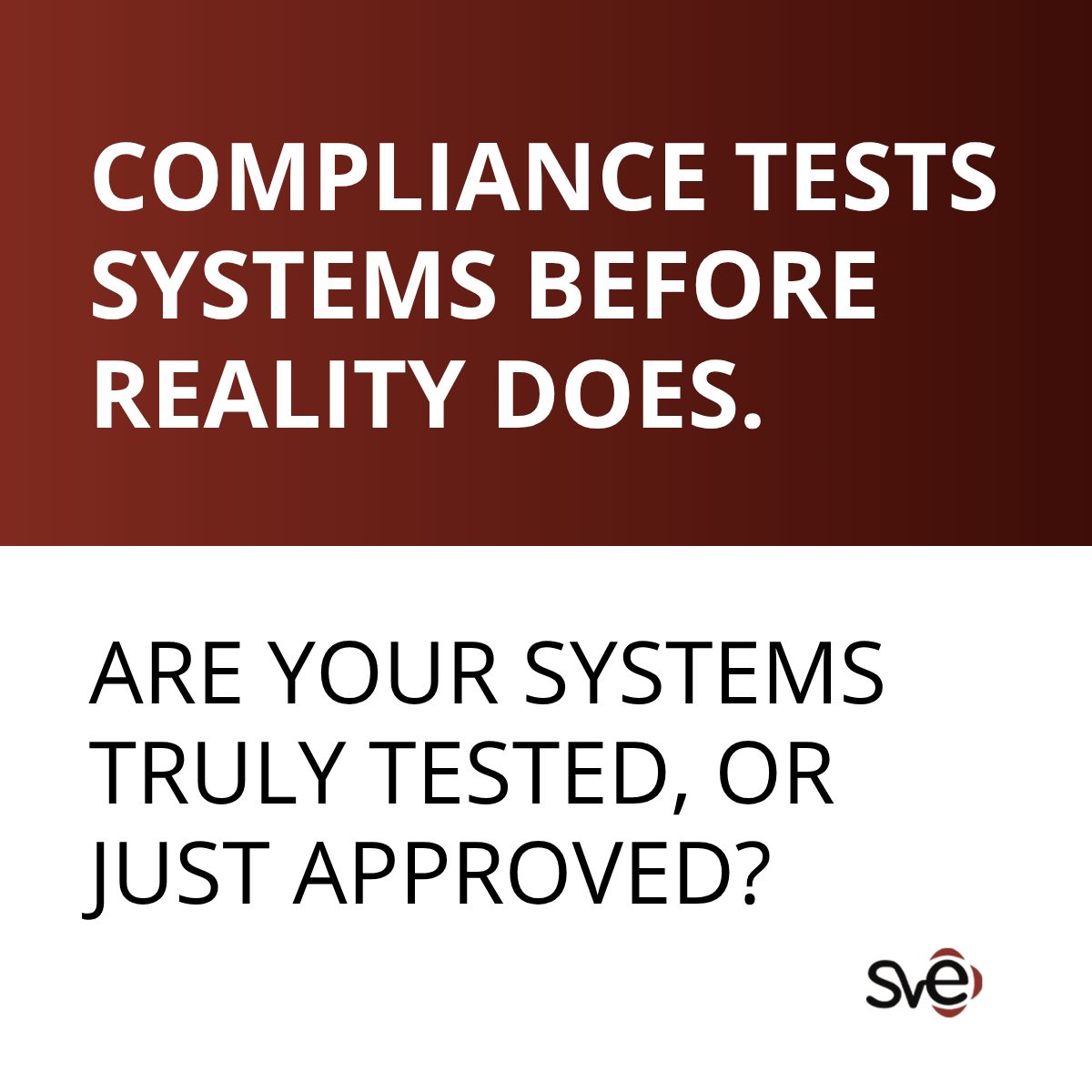
👉 In our industry, compliance is often seen as merely a box to tick, sometimes even as a burden... Nothing could be further from the truth. In fire protection, certifications and regulations serve a very critical purpose. ✔️ Required testing can push systems to perform under the harshest conditions. ✔️ They can challenge assumptions, expose wekanesses and leave nothing to chance. Reliability is not something you claim, it should be something you earn. Take a look at our porven reliability: https://lnkd.in/eweiE3Km #FireProtection #Reliability #SafetyEngineering #CriticalInfrastructure
- SVE CorpSince 27 Oct 2026
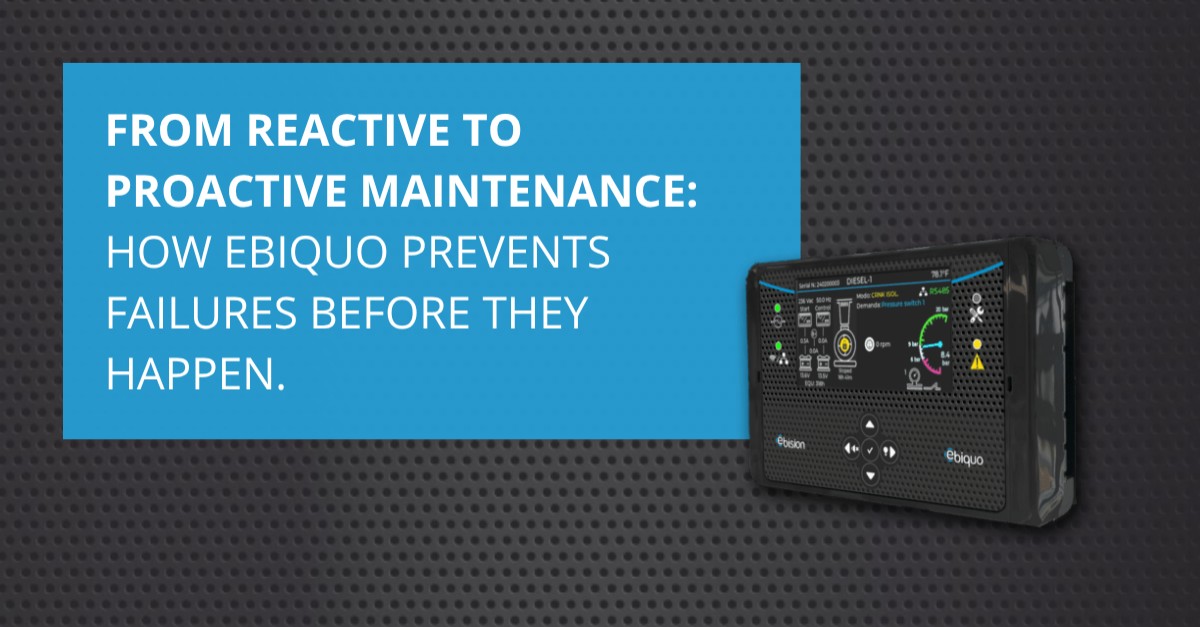
I've been in this sector for years, and there's a question I keep asking myself: why do we still accept reactive maintenance as the norm, when the technology to anticipate problems already exists? For decades, the standard has been to inspect critical systems on a fixed schedule, and hope nothing fails between visits. The problem is that failures don't give warning. 👉🏼 They build up silently, until one day it's too late. At SVE Corp, we've been working to change that logic for some time. With #Ebiquo, we don't wait for the next inspection: systems communicate constantly, and that information makes it possible to act before a problem becomes an emergency. I'm not saying this as a sales pitch. I'm saying it because I firmly believe that in sectors where #reliability saves lives (like fire protection), continuing to do things "the way we've always done them" is no longer a reasonable option. The future of good maintenance is not having to react at all. What's your take? Do you think the industry is moving fast enough toward predictive maintenance? 🔗 More detail here: https://lnkd.in/emR6GXDe
- LobsterSince 27 Oct 2026
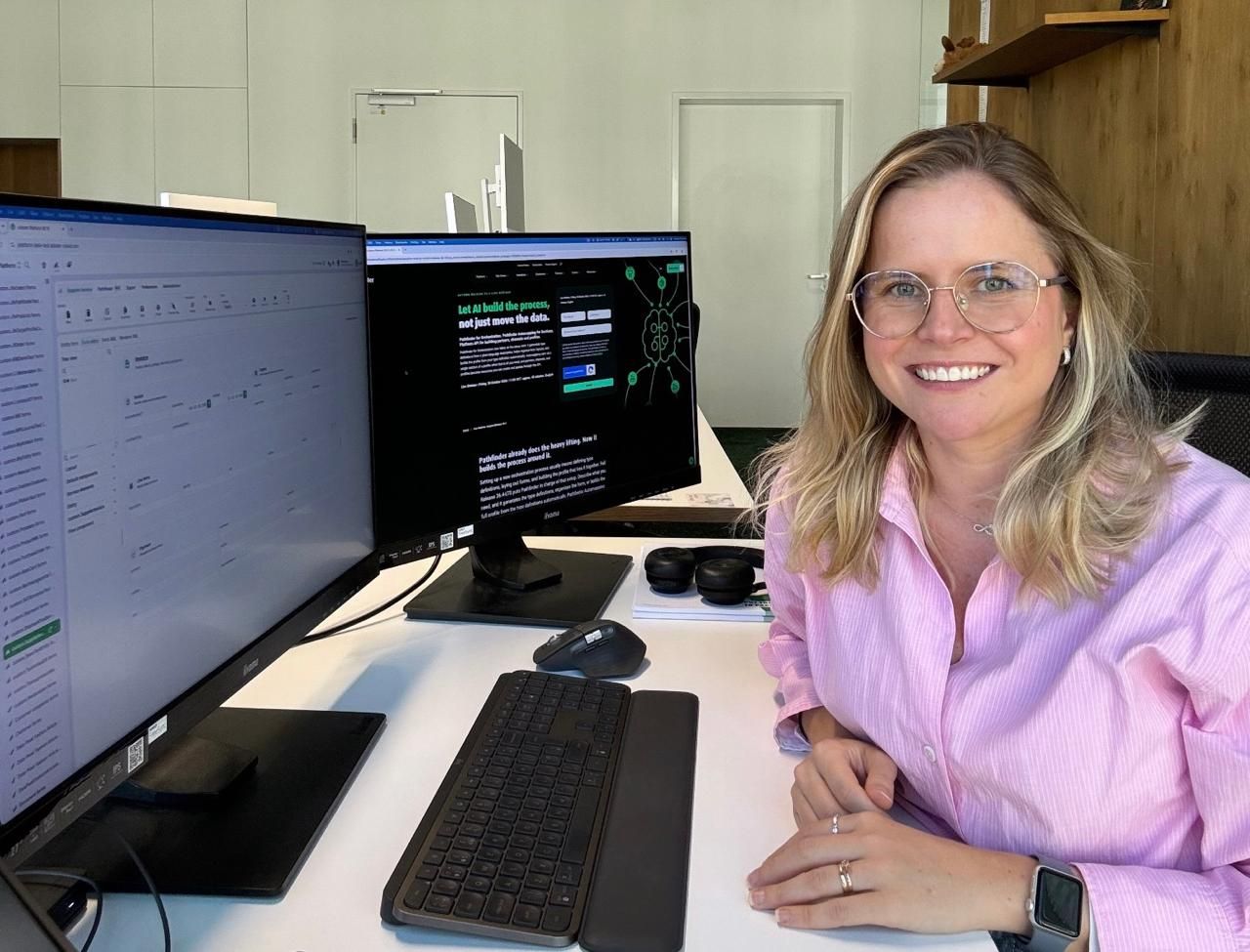
Lobster’s Autumn Release 26.4 is just around the corner! Join our webinar on October 30 to learn more: https://lnkd.in/ek6qpFbE While working on the final touches for our Autumn Release, I found myself thinking about how much Pathfinder has evolved this year. With Release 26.3, we introduced the ability for Pathfinder to generate data mapping suggestions. Starting with Release 26.4, we’re expanding Pathfinder’s capabilities to help users set up orchestration processes by generating custom type definitions, optimizing form layouts, and automatically building the Profile that ties everything together. This means AI is not only helping our users map their data, but also enabling them to configure and shape their entire process within Lobster. And I believe expanding Pathfinder to support these steps can make a real difference in helping users build and manage integrations more efficiently. Learn more about Pathfinder for Orchestration and all the other capabilities included in Lobster’s Autumn Release 26.4 during our webinar on October 30. See you there!
- PlainSince 27 Oct 2026
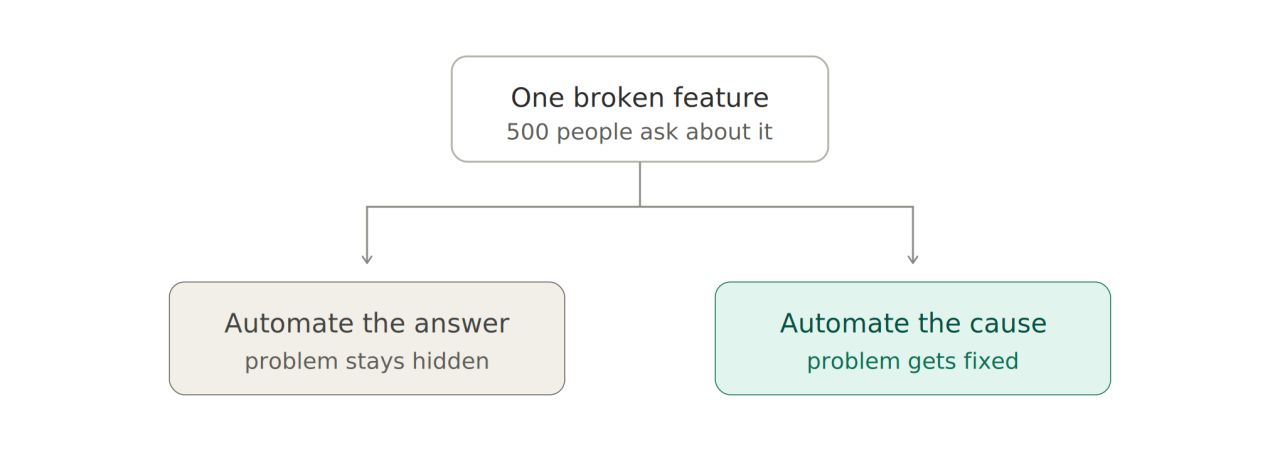
Every AI support company is racing to automate answers. I don't see many putting the same effort into stopping those questions from happening in the first place. When an AI agent solves the same question 500 times in a day, people celebrate it as a win. 500 deflections. Or maybe 500 customers just hit the same confusing flow or broken feature, and the AI handled it so smoothly that nobody in product ever noticed. One thing I've learned is that repetitive support work is product feedback. Before AI, answering the same question over and over created pressure. Someone got tired of it, filed the bug, improved the documentation, or escalated the problem. The repetition was telling us where the product was falling short. If AI quietly handles every repeat question, it's easy to lose that signal. Your support metrics look great. Customers get answers faster. Meanwhile the same product issue keeps generating the same conversations because nobody is connecting the dots. The teams I think are getting AI right are using it for that too. They're clustering similar conversations, spotting patterns, and giving product teams a much clearer picture of what customers are actually struggling with. That's a much more interesting future than an AI that just closes tickets faster.
- Meala FoodtechSince 27 Oct 2026
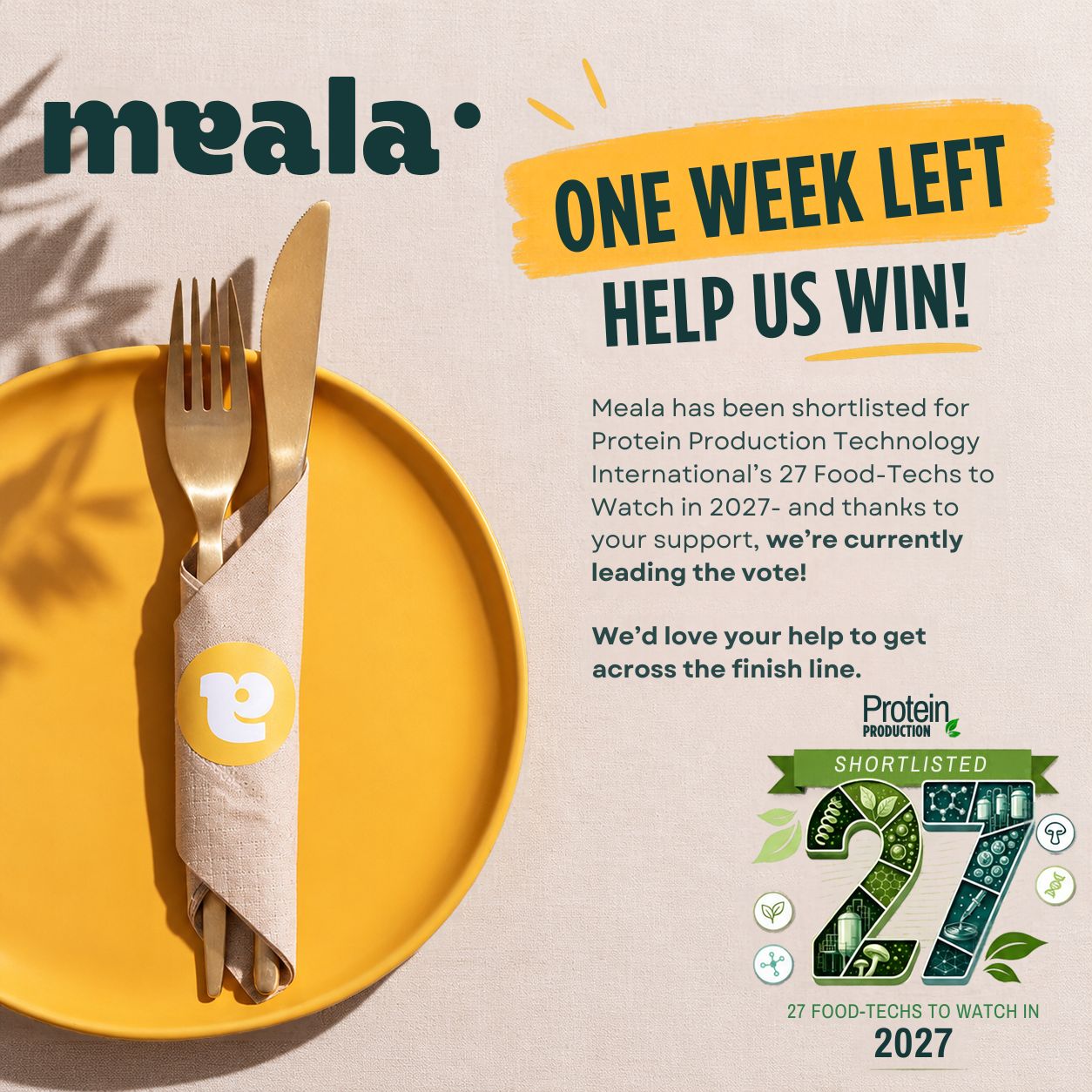
Excited to see Meala Foodtech shortlisted for 27 Food-Techs to Watch in 2027! 🚀💚Proud of our team and everything we’re building! I’ll also be attending the The Future of Protein Production conference and would love to connect with fellow food innovators, partners, and industry leaders. If you’re going to be there, come say hi! And in the meantime, help us keep the momentum going! Every vote counts. 🙌🗳️ Vote for Meala: https://lnkd.in/d7GB2ir9
- HaskoningSince 27 Oct 2026
PFAS contamination is not confined to water. It is a growing land quality issue with direct implications for development, transactions and regulatory compliance. Because PFAS do not naturally degrade, they persist in soil, migrate to groundwater and can enter the food chain. For landowners and developers, this raises complex questions around liability, duty of care and long-term risk management. Common sources of PFAS to soil and groundwater include fire fighting foams, sewage application and accidental spills. Identifying historical activities is often the starting point for understanding potential exposure. In the latest blog by colleagues Edwin de Baat and Bart Hoogenberg, we outline a structured approach: preliminary assessment, targeted soil investigation, source tracing and evaluation of remediation options such as excavation, soil washing, thermal treatment or immobilization. There is no universal solution. Each site demands a context-specific strategy grounded in regulation, technical feasibility and sustainability. At Haskoning, we support clients with end-to-end land quality services and long-term PFAS management planning. Read more here: https://lnkd.in/emPmECFK #PFAS #LandQuality #SoilRemediation #EnvironmentalCompliance #RiskManagement
- ScoroSince 27 Oct 2026
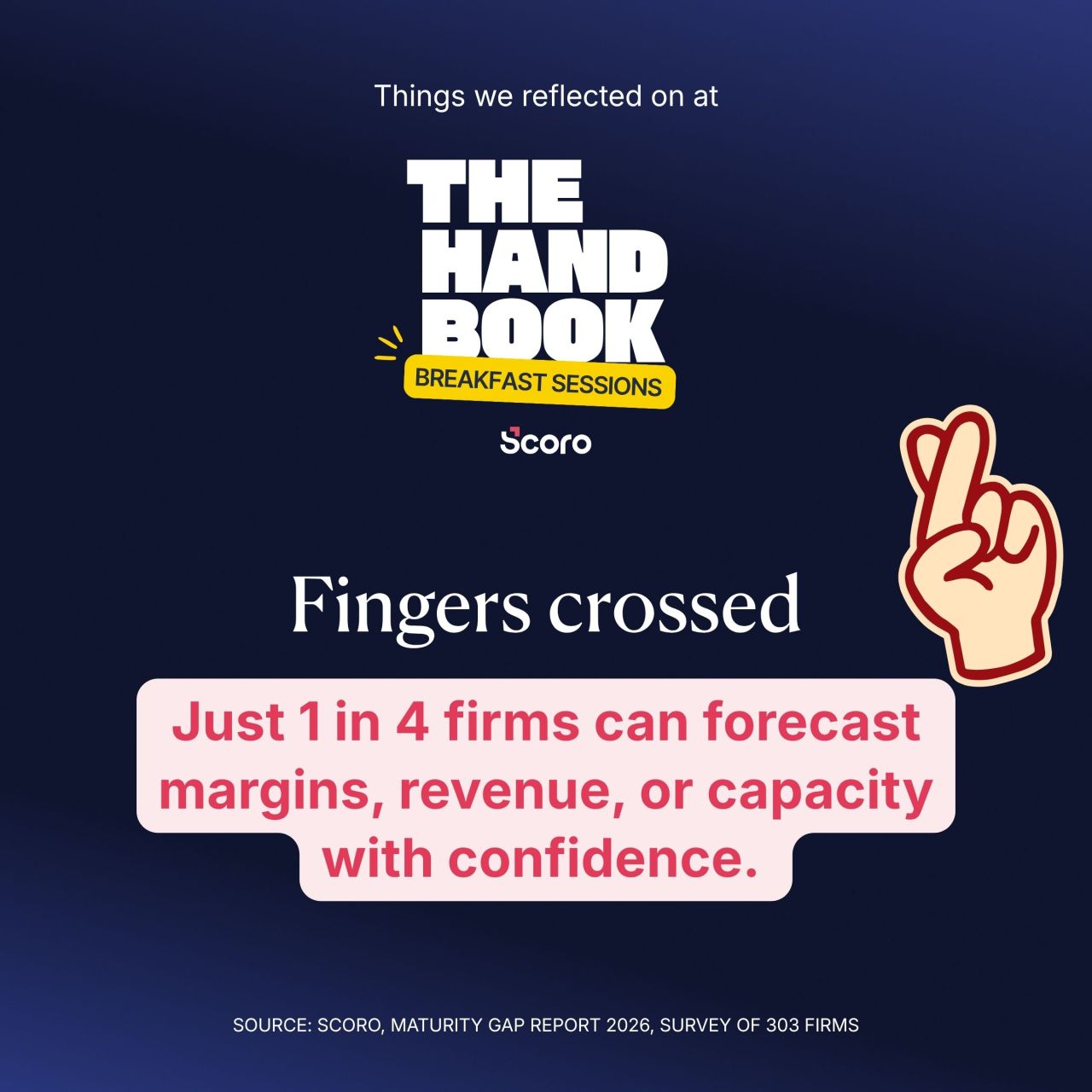
'Are we going to hit the number this quarter?' 🤷🏽 I’ve spent the past few months travelling around the country hosting 'The Handbook: Breakfast Sessions' with ops and finance leaders. Forecasting has come up at almost every one – and nobody, at any size of firm, claims to have it cracked. That matches what we found in The Maturity Gap Report: Just 24% of firms surveyed said they can forecast margin, revenue, or capacity with confidence. 😕 Amongst 50+ headcount firms, it's hardly better – 28%. 😬 Among the least mature, it’s 4%. 💀 A few patterns have kept coming up in conversation: 1️⃣ Confidence is low to middling. Not a complete disaster, but not properly solved. 2️⃣ Firms are better at looking back than looking forward. Most can report on what’s already happened. Predicting what's coming up is harder. 3️⃣ Revenue forecasting is ahead of capacity forecasting. Plenty of firms have a decent handle on the sales pipeline but not resourcing. The firms with the strongest grip on this tend to get two things right – something FinOps expert Rich Brett has been telling me for the past year: 💡 They resource every project, so they can see their team’s capacity well ahead. That makes it much easier to answer 'can we take this on?' or 'do we need to bring someone in?' Bonus if you're using Scoro to run your biz: those bookings effectively become timesheets with the option to quickly adjust for accuracy where needed. 💡 They treat the resource plan as part of the revenue forecast. If revenue is forecast for a project but no one’s booked to deliver it, that’s a red flag – either the revenue isn’t deliverable, or people need assigning immediately. And if people are booked with no revenue attached, that needs answering too: is it unbilled work? A sale that hasn’t been set up properly? Or a placeholder nobody removed? The two should be checked against each other regularly. You can hear more from Rich and upskill your team on FinOps and forecasting by signing up for The Missing Finance Course (it's free). And check out The Maturity Gap Report to see how you stack up against the top firms. Links to both 👇🏽 The Missing Finance Course: https://learn.scoro.com The Maturity Gap Report: https://lnkd.in/etH3ZWst
- ConverterTecSince 26 Oct 2026
𝐀 𝐥𝐨𝐨𝐤 𝐛𝐚𝐜𝐤 𝐚𝐭 𝐨𝐮𝐫 𝐰𝐞𝐞𝐤 𝐢𝐧 𝐇𝐚𝐦𝐛𝐮𝐫𝐠 𝐰𝐢𝐭𝐡 𝐨𝐮𝐫 𝐭𝐞𝐚𝐦 𝐢𝐧 𝐚𝐜𝐭𝐢𝐨𝐧.👇 Customer meetings, conversations at the booth, and discussions that continued well beyond the scheduled time. Hamburg was also a great opportunity to show where we are heading. At ConverterTec, we are expanding our multibrand portfolio and continuing to develop state-of-the-art products and services to support wind assets throughout their lifecycle, including spare parts, repairs, upgrades, converter condition monitoring and predictive maintenance. For me personally, it was good to see the interest in what we are developing and to discuss directly with customers what comes next. Explore our converter lifecycle solutions: https://lnkd.in/eQ4CTXAp #ConverterTec #ConverterTecAftermarket #WindEnergyHamburg #Aftermarket #Multibrand
- The MBB Offer Machine™Since 26 Oct 2026
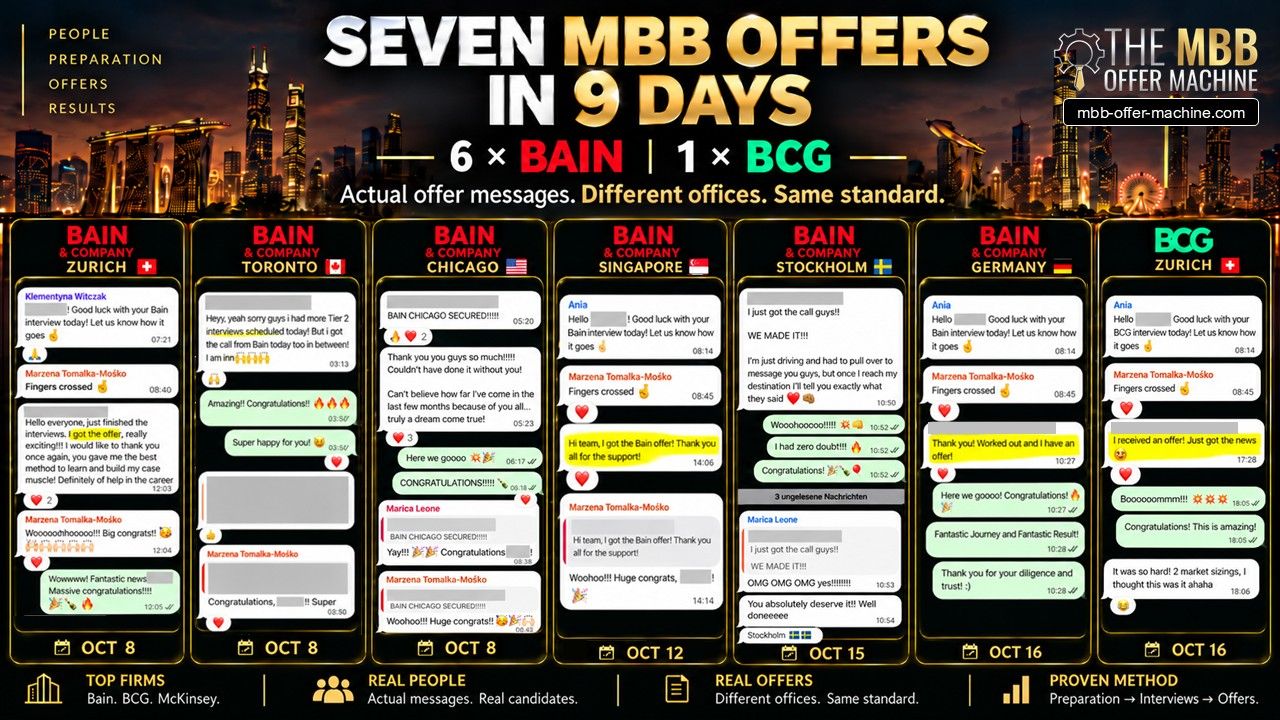
BAIN. BAIN. BAIN. BAIN. BAIN. BAIN. BCG. SEVEN MBB OFFERS. NINE DAYS. At The MBB Offer Machine™, the last 9 days have been absolutely ridiculous. Bain Toronto. OFFER. Bain Chicago. OFFER. Bain Zurich. OFFER. Bain Singapore. OFFER. Bain Stockholm. OFFER. Bain Germany. OFFER. BCG Zurich. OFFER. Seven offers. Six from Bain alone. 🤯 Different geographies. Different interviewers. Different processes. Same prep system. And somewhere out there, another MBB applicant just completed their 78th practice case and proudly added it to their Excel tracker. Congratulations. I'm sure the interviewer will be impressed. What I learned from sitting on the interviewer side at McKinsey and BCG: An astonishing number of candidates are exceptionally well prepared for interviews that exist only in their casebooks. Give them a "profitability case" (the term itself is nonsense btw...), and they'll confidently walk you through their memorized framework. Then give them a genuinely unfamiliar business problem - and watch what happens. The structure falls apart. The analysis becomes superficial. The conclusions sound like something copied from a consulting prep website. And suddenly, those 78 practice cases aren't worth very much. Yet the entire case interview prep industry keeps feeding candidates the same garbage. More frameworks. More casebooks. More mental math drills. More mock interviews with people who have never interviewed a single candidate for McK, BCG, or Bain. And candidates keep swallowing it. Because counting practice cases feels like progress. Until the rejection email arrives. Then comes the usual diagnosis: "I probably need 20 more cases." Good luck with that. At The MBB Offer Machine™, we've spent years training candidates to think at the level we used to expect from applicants when WE were interviewing them. Our mentees learn how to approach unfamiliar problems from rigorous principles and without memorized templates. How to extract meaningful business insights from data. How to defend their reasoning when an experienced interviewer starts challenging every assumption. And yes, that requires serious work. Our mentees earn their offers. Every single one of them. But they also benefit from being trained by people who actually know what the interviewers are looking for. We keep producing results across offices, countries, and recruiting cycles. So here's my message to everyone currently preparing for MBB: You can spend another six months collecting practice cases and congratulating yourself on how much you've improved. Or you can start asking a much more itchy question: Who is actually QUALIFIED to tell you whether you're good enough? Because a former Junior Associate's enthusiastic "Great job, 9/10!" won't mean a damn thing when an MBB Partner decides otherwise. Meanwhile, our mentees keep collecting offers. Six from Bain. One from BCG. Nine days. And counting. --- The MBB Offer Machine™ Dr. Sidi S. Koné | Dr. Jörn Kobus
- The MBB Offer Machine™Since 26 Oct 2026
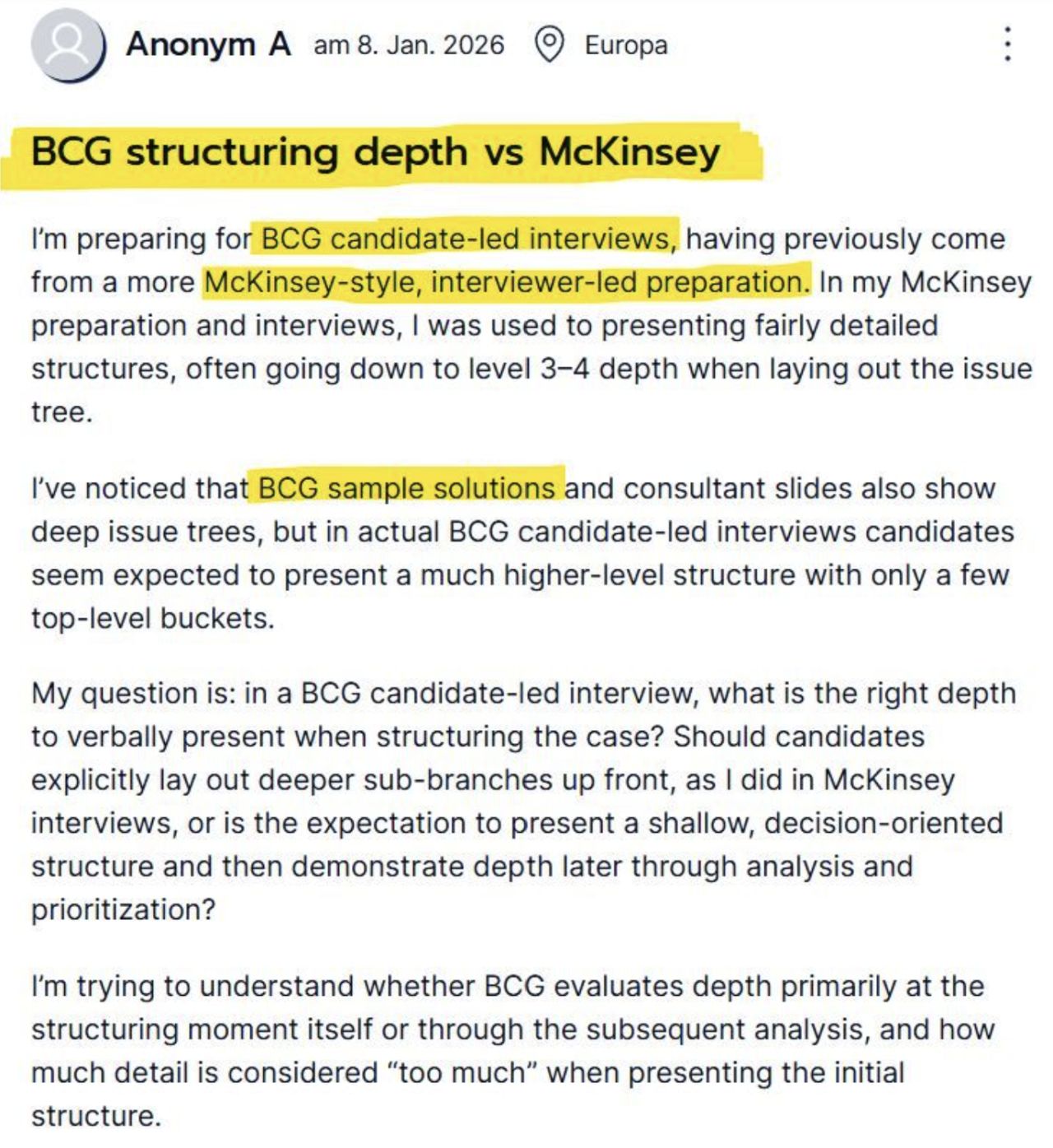
Most people who teach MBB case interviews got the offer. Almost none of them know why. They passed the process, as candidates. They joined the firm. Then they left before they ever reached the seniority to sit on the other side, where you assess candidates, argue about them in wash-up meetings, and decide who actually gets hired. So they reverse-engineer their own success from memory. They write casebooks, share "real MBB cases" and post confident advice. The prep industry packages it all as doctrine: "McKinsey wants deep trees." "BCG wants high-level buckets." "Bain wants the hypothesis first." Candidates think they're preparing for the actual interviews. They're preparing for ghosts. You can see it in the questions they ask. I saw this one on a prep forum: "In McKinsey interviews I presented level 3-4 issue trees. BCG seems to expect only a few top-level buckets. What's the right depth? How much is too much?" It's a smart, careful question. And it's aimed at an interview that doesn't exist. No BCG interviewer thinks: "Two levels. Very BCG." No McKinsey interviewer thinks: "Four levels. Very McKinsey." Nobody in the room is counting your branches! They're asking one thing: Does this person know where this problem needs to go? Depth is a decision, not a layer count. A weak candidate draws a massive tree covering market, customers, competition, revenue, costs, operations, risks and implementation. It looks thorough and says nothing, because every branch carries the same weight, so none of them matters. A strong candidate says: "The decline comes from one of three things: the market shrinking, us losing share, or our margins eroding. Each points to a completely different answer: a growth problem, a competitive problem, or a unit economics problem. I'd start with share, because if we're losing share in a growing market, that changes everything else we look at." That's one level, and it's deeper than four levels of boxes. The depth isn't in the structure. It's in the judgment: what matters, what doesn't, and where to go first. That call is exactly what's being tested, at McKinsey, BCG and Bain alike. This is the gap. People who only ever sat in the candidate's chair teach what they could see: the tree, the framework, the format. They teach candidates to perform structure. Interviewers want candidates to think through structure. That difference decides offers. So stop asking ghost questions. Not "How many levels should I present?" But "Can the interviewer see I know where this case needs to go?" Not "What does BCG prefer?" But "What would a strong consultant do with this client?" Because underneath every case, at every firm, the interviewer is asking the same question: "Would I put this person in front of my client next Monday?" Everything else is ghosts. --- The MBB Offer Machine™
- ScoroSince 27 Oct 2026
AI doesn't replace automation. You need both. AI also doesn't fix a messy tech stack. It just gives your mess a more confident voice. We've just gone live with the latest module of The Missing Finance Course, and this one's all about technology, automation, and AI – the stuff that underpins everything else we've covered in the course. This module walks through: – Why tech stacks evolve the way they do – What fragmentation costs you – The difference between PM platforms, PSAs, and ERPs – Why "connecting your tools with AI and MCP" isn't a shortcut to your data problem – How to get AI working for your FinOps – accurately, not just confidently 👉🏽 And hot topic: whether you should vibe code your own system The Missing Finance Course is co-produced with FinOps expert Rich Brett, is completely free, and is designed to be embedded into your team training. With 3 learning paths (leadership, delivery leads, individual contributors) you can get everyone on the same page with how the business makes money – and the role they play in it. Get started: https://learn.scoro.com
- Performa_ITRecorded 29 Oct 2026
Hoje não tem mais desculpa pra você entrar em uma reunião despreparado. No Performa Q. Pod. na CBN Campinas, conversando com Raphael Alcantara, fundador e proprietário do Grupo Sempre, apareceu uma aplicação de IA que, na prática, muda o nível de profundidade com que decisões são construídas dentro das empresas. A maioria ainda enxerga IA como uma ferramenta de execução, focada em ganhar velocidade ou reduzir esforço operacional, o que de fato já gera bastante valor. Mas, quando você começa a usar IA para enriquecer e criticar as suas próprias ideias, você expande a forma como pensa. Você deixa de operar só com o seu repertório e passa a incorporar diferentes perspectivas no mesmo processo, aumentando profundidade e reduzindo pontos cegos. Isso eleva o nível da análise. No final, a decisão continua sendo humana, passa pelo seu filtro, pela sua validação e pelo seu contexto. É uma decisão muito mais bem construída, potencializada por uma tecnologia que é extremamente eficiente em identificar padrões e gerar variações de pensamento. O episódio está cheio de insights práticos como esse, vale conferir! #Lideranca #AltaPerformance #TransformacaoDigital #EstrategiaEmpresarial #IA




Other LinkedIn formats
Watch the companies you care about.
Filter every ad by industry, country, format and network, and get alerts when a company you watch starts running new ads.