Not on air · 2 of 3 networks checked
The MBB Offer Machine™
- mbb-offer-machine.com
- DE
- 8 employees
The MBB Offer Machine™’s ads on LinkedIn, Meta and Google, recorded by adsrunning. Browse the latest here for free. Sign up free to see all 221. Watch The MBB Offer Machine™ with Starter to get each new one in your feed.
Watchlist with Starter · $49/mo
| Network | Status | Live ads | Nov 2025LinkedIn activity · 52 weeksOct 2026 | Checked | Next step |
|---|---|---|---|---|---|
| None recorded | 0 | Checked 31 Oct 2026 | See all 221 ads → | ||
| Meta | Not checked | — | |||
| Recently | 77 | Ads on the Google Ads Transparency Center | Checked 4 Oct 2026 | Collect them with the API → |
The MBB Offer Machine™ has no live LinkedIn ads. We recorded 77 Google ads on 4 Oct 2026.
Latest ads
- LINKEDIN · IMAGESince 27 Oct 2026
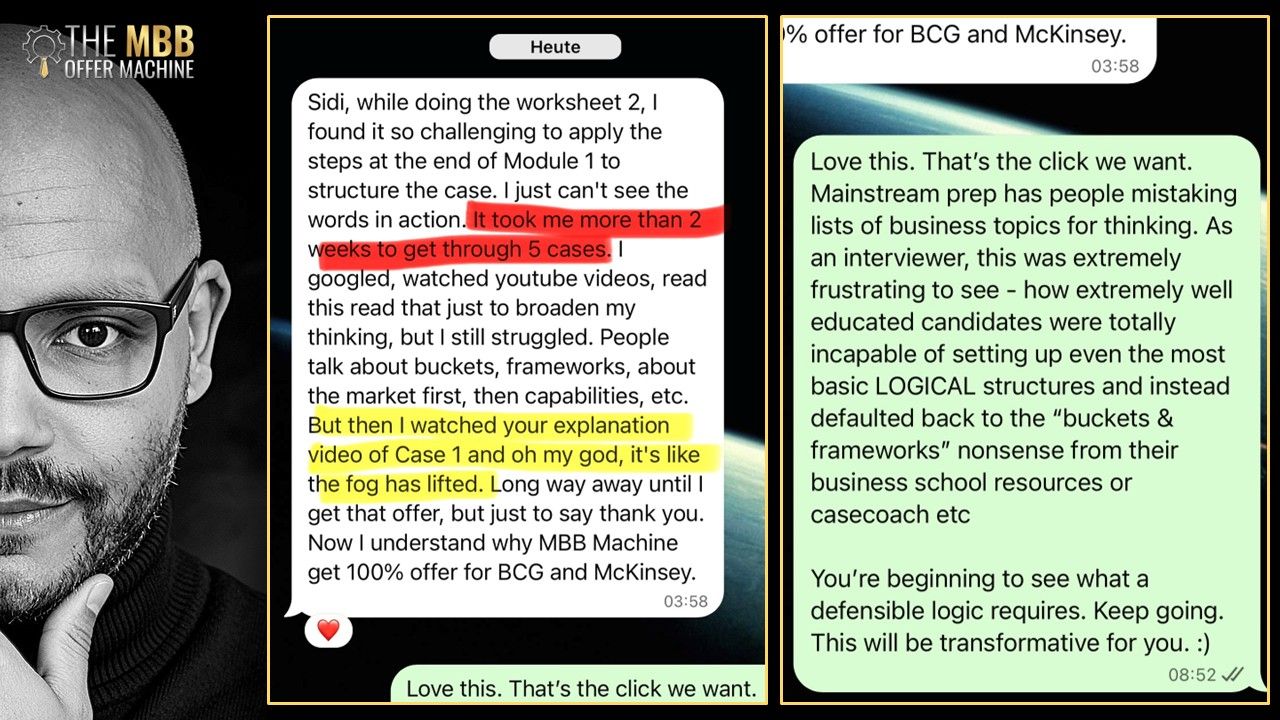
Mainstream case prep has made smart people exceptionally fluent in nonsense. I saw it firsthand as an interviewer at McKinsey, and also at BCG. Highly educated candidates would confidently announce: “I’d look at the market, competition, and capabilities.” Then struggle to explain why those exact topics would resolve the client’s problem. They had rehearsed that routine so often that it felt like thinking to them. And every practice partner using the same casebook folklore reinforced it. This morning, a mentee sent me the message below. She had finished our foundational content and started her first major structuring exercise. Five cases took her... more than two weeks of work. She searched Google and YouTube for help. Something we actively warn against! What did she find? More buckets. More frameworks. The same nonsense - endlessly recycled. Then she watched our in-depth explanation of the first case. “𝙊𝙝 𝙢𝙮 𝙜𝙤𝙙, 𝙞𝙩’𝙨 𝙡𝙞𝙠𝙚 𝙩𝙝𝙚 𝙛𝙤𝙜 𝙝𝙖𝙨 𝙡𝙞𝙛𝙩𝙚𝙙.” That’s the moment I LOVE. When someone starts seeing how to build an argument from the actual problem. How each question connects back to a central criterion. Why every branch belongs. At The MBB Offer Machine™, we demand that logic from the first exercise. Explain what you need to establish and how the answer would affect your recommendation. Understand why asking for data at the start of a case is the biggest nonsense under the sun. “It's part of the framework” gets you nowhere. I’ll put my name behind this: If you want to learn to structure unfamiliar problems PROPERLY, come learn it from us. I have yet to find a SINGLE prep resource out there that teaches this to the standard I expected from candidates as an MBB interviewer. And I refuse to lower that standard for our mentees. Look at her message. She is at her FIRST major exercise. And she can already see why the advice she found elsewhere left her stuck. That is why we insist on getting this right at the beginning. Every case you practice builds a habit. Repeat faulty logic for six months and you become very confident defending something that falls apart under the first serious question. When I intervieed at McKinsey, I had to reject candidates every week who executed their prep books perfectly. Think about how badly this industry has failed you when following its advice is exactly what gets you rejected. That’s why we built The MBB Offer Machine™. --- The MBB Offer Machine™ Dr. Jörn Kobus | Dr. Jörn Kobus * Just so you understand the magnitude of the gap I am talking about: the "100%" she references in her last sentance was 𝘁𝗵𝗲 𝗼𝗳𝗳𝗲𝗿 𝗼𝘂𝗿 𝗺𝗲𝗻𝘁𝗲𝗲𝘀 𝗮𝗰𝘁𝘂𝗮𝗹𝗹𝘆 𝗮𝗰𝗵𝗶𝗲𝘃𝗲𝗱 𝗮𝘁 𝗠𝗰𝗞𝗶𝗻𝘀𝗲𝘆 𝗮𝗻𝗱 𝗕𝗖𝗚 𝗶𝗻 𝘁𝗵𝗲 𝗹𝗮𝘀𝘁 𝗟𝗼𝗻𝗱𝗼𝗻 𝘂𝗻𝗱𝗲𝗿𝗴𝗿𝗮𝗱𝘂𝗮𝘁𝗲 𝗰𝘆𝗰𝗹𝗲 (in that same cycle, the overall offer rate for London applicants was way below ONE PERCENT!).
- LINKEDIN · IMAGESince 26 Oct 2026
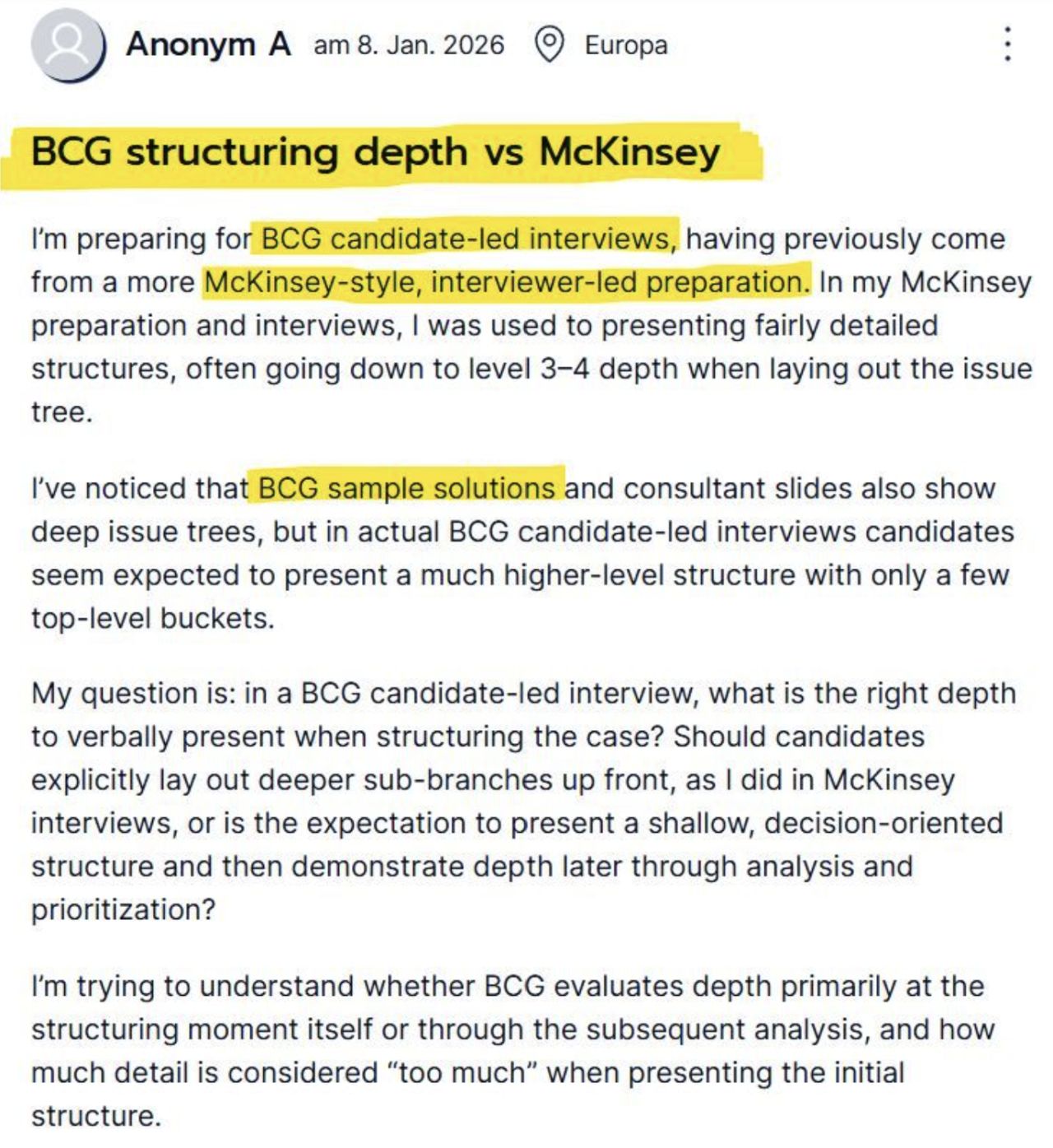
Most people who teach MBB case interviews got the offer. Almost none of them know why. They passed the process, as candidates. They joined the firm. Then they left before they ever reached the seniority to sit on the other side, where you assess candidates, argue about them in wash-up meetings, and decide who actually gets hired. So they reverse-engineer their own success from memory. They write casebooks, share "real MBB cases" and post confident advice. The prep industry packages it all as doctrine: "McKinsey wants deep trees." "BCG wants high-level buckets." "Bain wants the hypothesis first." Candidates think they're preparing for the actual interviews. They're preparing for ghosts. You can see it in the questions they ask. I saw this one on a prep forum: "In McKinsey interviews I presented level 3-4 issue trees. BCG seems to expect only a few top-level buckets. What's the right depth? How much is too much?" It's a smart, careful question. And it's aimed at an interview that doesn't exist. No BCG interviewer thinks: "Two levels. Very BCG." No McKinsey interviewer thinks: "Four levels. Very McKinsey." Nobody in the room is counting your branches! They're asking one thing: Does this person know where this problem needs to go? Depth is a decision, not a layer count. A weak candidate draws a massive tree covering market, customers, competition, revenue, costs, operations, risks and implementation. It looks thorough and says nothing, because every branch carries the same weight, so none of them matters. A strong candidate says: "The decline comes from one of three things: the market shrinking, us losing share, or our margins eroding. Each points to a completely different answer: a growth problem, a competitive problem, or a unit economics problem. I'd start with share, because if we're losing share in a growing market, that changes everything else we look at." That's one level, and it's deeper than four levels of boxes. The depth isn't in the structure. It's in the judgment: what matters, what doesn't, and where to go first. That call is exactly what's being tested, at McKinsey, BCG and Bain alike. This is the gap. People who only ever sat in the candidate's chair teach what they could see: the tree, the framework, the format. They teach candidates to perform structure. Interviewers want candidates to think through structure. That difference decides offers. So stop asking ghost questions. Not "How many levels should I present?" But "Can the interviewer see I know where this case needs to go?" Not "What does BCG prefer?" But "What would a strong consultant do with this client?" Because underneath every case, at every firm, the interviewer is asking the same question: "Would I put this person in front of my client next Monday?" Everything else is ghosts. --- The MBB Offer Machine™
- LINKEDIN · IMAGESince 26 Oct 2026
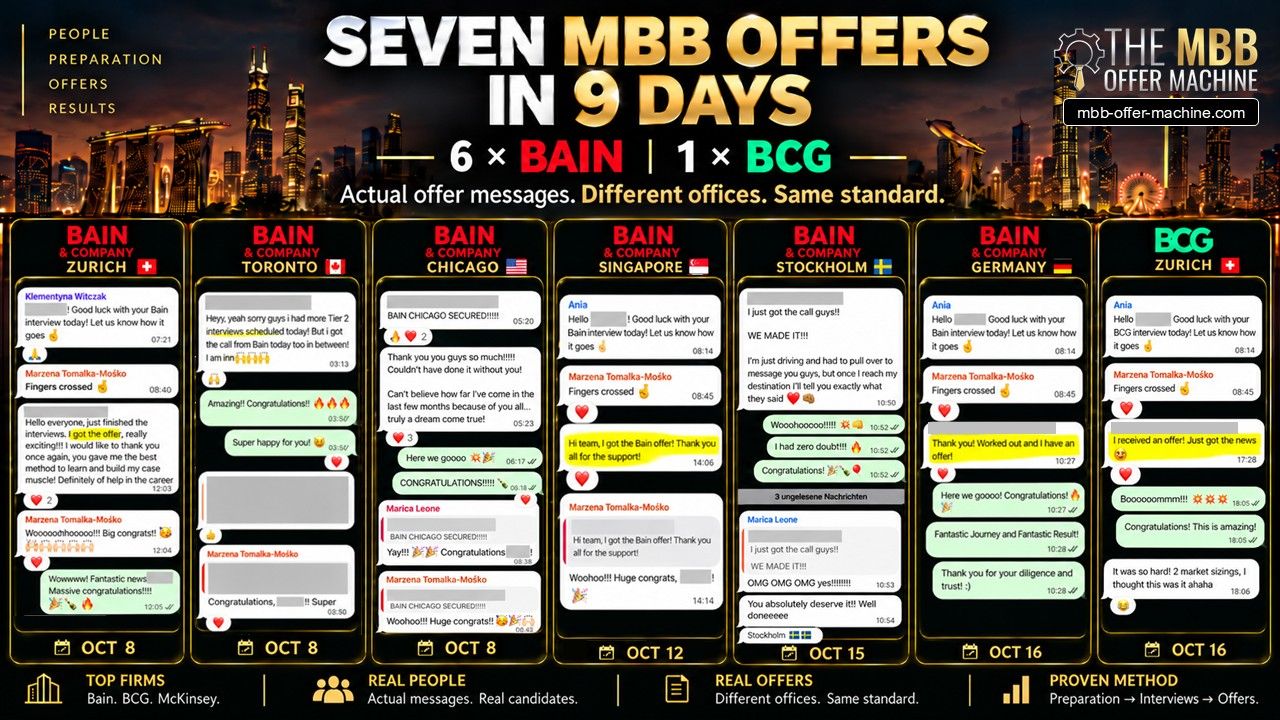
BAIN. BAIN. BAIN. BAIN. BAIN. BAIN. BCG. SEVEN MBB OFFERS. NINE DAYS. At The MBB Offer Machine™, the last 9 days have been absolutely ridiculous. Bain Toronto. OFFER. Bain Chicago. OFFER. Bain Zurich. OFFER. Bain Singapore. OFFER. Bain Stockholm. OFFER. Bain Germany. OFFER. BCG Zurich. OFFER. Seven offers. Six from Bain alone. 🤯 Different geographies. Different interviewers. Different processes. Same prep system. And somewhere out there, another MBB applicant just completed their 78th practice case and proudly added it to their Excel tracker. Congratulations. I'm sure the interviewer will be impressed. What I learned from sitting on the interviewer side at McKinsey and BCG: An astonishing number of candidates are exceptionally well prepared for interviews that exist only in their casebooks. Give them a "profitability case" (the term itself is nonsense btw...), and they'll confidently walk you through their memorized framework. Then give them a genuinely unfamiliar business problem - and watch what happens. The structure falls apart. The analysis becomes superficial. The conclusions sound like something copied from a consulting prep website. And suddenly, those 78 practice cases aren't worth very much. Yet the entire case interview prep industry keeps feeding candidates the same garbage. More frameworks. More casebooks. More mental math drills. More mock interviews with people who have never interviewed a single candidate for McK, BCG, or Bain. And candidates keep swallowing it. Because counting practice cases feels like progress. Until the rejection email arrives. Then comes the usual diagnosis: "I probably need 20 more cases." Good luck with that. At The MBB Offer Machine™, we've spent years training candidates to think at the level we used to expect from applicants when WE were interviewing them. Our mentees learn how to approach unfamiliar problems from rigorous principles and without memorized templates. How to extract meaningful business insights from data. How to defend their reasoning when an experienced interviewer starts challenging every assumption. And yes, that requires serious work. Our mentees earn their offers. Every single one of them. But they also benefit from being trained by people who actually know what the interviewers are looking for. We keep producing results across offices, countries, and recruiting cycles. So here's my message to everyone currently preparing for MBB: You can spend another six months collecting practice cases and congratulating yourself on how much you've improved. Or you can start asking a much more itchy question: Who is actually QUALIFIED to tell you whether you're good enough? Because a former Junior Associate's enthusiastic "Great job, 9/10!" won't mean a damn thing when an MBB Partner decides otherwise. Meanwhile, our mentees keep collecting offers. Six from Bain. One from BCG. Nine days. And counting. --- The MBB Offer Machine™ Dr. Sidi S. Koné | Dr. Jörn Kobus
- LINKEDIN · IMAGESince 24 Oct 2026
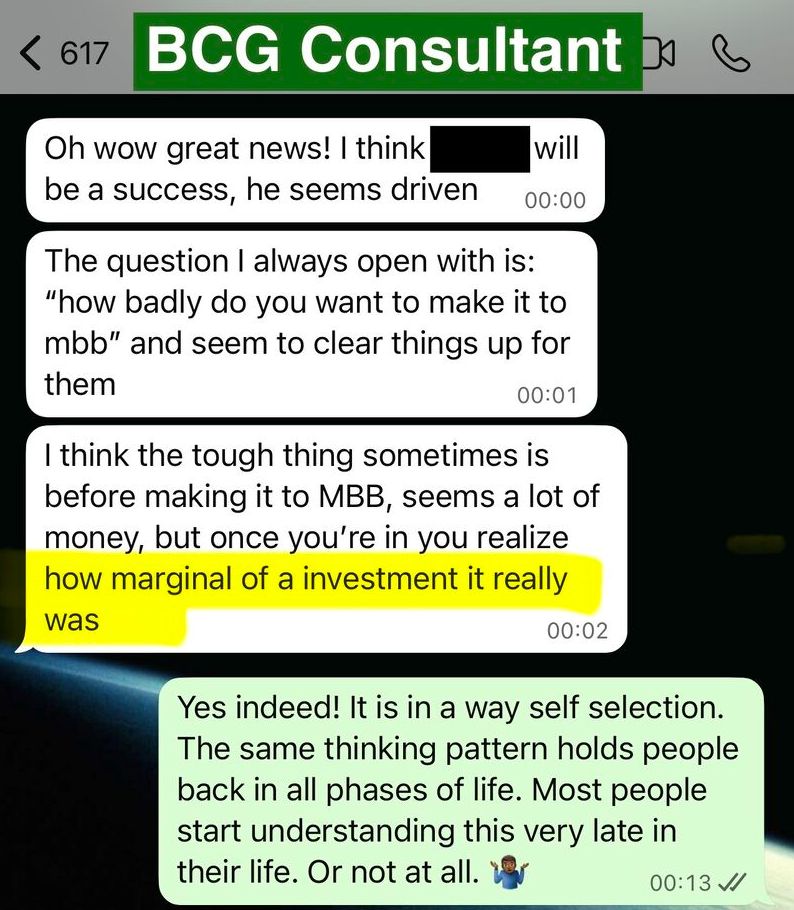
A BCG consultant sent me this: "Before MBB, it seems like a lot of money. Once you're in, you realize how MARGINAL the investment really was." We coached him to his BCG offer. He hesitated for WEEKS AND WEEKS before signing up. Today he's at BCG, referring a friend to us. He sees the salary now. The bonuses. The doors that opened. Looking back, the only thing he can't explain is why he was so afraid to sign up. I see that hesitation every week. Candidates sharp enough to land MBB interviews stall the moment they see a price. They spend weeks, months, or years "thinking about it." They look for the budget route into the most selective firms in the world. They plan to out-prepare thousands of rivals with YouTube videos and free frameworks. Most of them come back. Sometimes months later: interview in 10 days, asking for a crash course. Or years later: three rejections in, having lost 10x more in time and salary than the fee they tried to avoid. Over time I have come to realize: The fee is almost never the real obstacle. It's a mirror. It shows how you decide under uncertainty. How you weigh a known cost against an uncertain upside. How you think about asymmetric payoffs. That's exactly what MBB will test you on. So run it like a case: → ~$2-4K today → $120–250K first-year compensation → A career trajectory worth multiple seven figures over time You'd tell a client to take that bet in a heartbeat. Why won't you take it yourself? As I told him, it's self-selection. The same pattern holds people back in every part of life. The gap between people who get in and people who don't is rarely talent. I regularly watch candidates with "weaker" profiles outprepare and outperform people with perfect GPAs and Ivy League degrees. The gap is usually one decision: "I'll do what maximizes my success chances" vs. "Let me think about it". He said one question clears everything up: How badly do you want this? And you know what? Right now, today, a candidate with half your credentials just committed. In 6–12 months, they'll be messaging me from inside McKinsey, BCG, or Bain. Where will you be on that day? --- The MBB Offer Machine™
- LINKEDIN · IMAGESince 24 Oct 2026
2:37 AM. Another McKinsey candidate is rushed into our emergency room. Clutches 14 casebooks to his chest and screams: "MY INTERVIEW IS ON THURSDAY!" The nurse checks his pulse. Normal. Blood pressure. Elevated. Ability to structure an unfamiliar problem. Flatline. Welcome to the 𝗠𝗕𝗕 𝗘𝗠𝗘𝗥𝗚𝗘𝗡𝗖𝗬 𝗗𝗘𝗣𝗔𝗥𝗧𝗠𝗘𝗡𝗧. Unfortunately, tonight we're fully booked. --- 𝗣𝗔𝗧𝗜𝗘𝗡𝗧 #𝟬𝟬𝟭: 𝗧𝗛𝗘 𝗙𝗥𝗔𝗠𝗘𝗪𝗢𝗥𝗞 𝗝𝗨𝗡𝗞𝗜𝗘 NURSE: Doctor, this one has completed 93 practice cases. ME: Ask him how he'd evaluate if a logistics company should acquire a competitor. PATIENT: First, I'd analyze the market, then the product, competitors, and the company's capabilities. ME: Why? PATIENT: It's the standard buckets from my casebooks. ME: What decision criteria are you trying to establish? PATIENT: Market. Competition. Capabilities. ME: He's repeating himself. NURSE: Should we administer another casebook? ME: GOOD LORD, NO. That's what caused this. DIAGNOSIS: 𝗦𝗲𝘃𝗲𝗿𝗲 𝗙𝗿𝗮𝗺𝗲𝘄𝗼𝗿𝗸 𝗣𝗼𝗶𝘀𝗼𝗻𝗶𝗻𝗴. SYPMPTOMS: Extremely confident in his prep | Memorized every framework ever published | Gets visibly uncomfortable when asked WHY TREATMENT: Immediate removal of all memorized templates. Reintroduce independent thinking under strict supervision. --- 𝗣𝗔𝗧𝗜𝗘𝗡𝗧 #𝟬𝟬𝟮: 𝗧𝗛𝗘 𝗟𝗔𝗦𝗧-𝗠𝗜𝗡𝗨𝗧𝗘 𝗠𝗜𝗥𝗔𝗖𝗟𝗘 𝗦𝗘𝗘𝗞𝗘𝗥 NURSE: Doctor, this candidate has a BCG final round in 72 hours. ME: How long has he wanted to join BCG? PATIENT: About 2 years. ME: When did you start serious prep? PATIENT: Yesterday. ME: I see. And what happened during the previous 729 days? PATIENT: I was waiting to see if I got invited. DIAGNOSIS: 𝗖𝗵𝗿𝗼𝗻𝗶𝗰 𝗣𝗿𝗲𝗽 𝗣𝗿𝗼𝗰𝗿𝗮𝘀𝘁𝗶𝗻𝗮𝘁𝗶𝗼𝗻. SYMPTOMS: Knew for a year that applications were coming | Spent the last months "waiting to see if I get invited" | Now urgently requests a miracle ME: Nurse, prepare the operating room! NURSE: Brain surgery? ME: Time Machine. PATIENT: But Doctor, can't you fix this with 3 coaching sessions? ME: I'm a former MBB interviewer. Not Jesus Christ. --- 𝗣𝗔𝗧𝗜𝗘𝗡𝗧 #𝟬𝟬𝟯: 𝗧𝗛𝗘 𝗙𝗥𝗘𝗘-𝗔𝗗𝗩𝗜𝗖𝗘 𝗢𝗩𝗘𝗥𝗗𝗢𝗦𝗘 NURSE: Doctor, this one's watched 200 YouTube videos on case interviews. ME: Ask him how he'd structure an unknown problem. PATIENT: Well, according to this YouTuber... ME: I asked what YOU think. PATIENT: Oh. Well, another expert recommends... ME: YOUR reasoning. PATIENT: Can I check Reddit? ME: Nurse, we've lost him. DIAGNOSIS: 𝗧𝗲𝗿𝗺𝗶𝗻𝗮𝗹 𝘀𝗲𝗰𝗼𝗻𝗱𝗵𝗮𝗻𝗱 𝘁𝗵𝗶𝗻𝗸𝗶𝗻𝗴. SYMPTOMS: Can quote 17 gurus verbatim | Treats anonymous Reddit comments like McKinsey Partner feedback | Experiences acute cognitive paralysis when asked to think for himself TREATMENT: Immediate digital detox. Confiscate YouTube subscriptions, Reddit access, and all downloaded casebooks. Begin independent-thinking rehabilitation. Strictly prohibit the phrase "But I heard somewhere that..." (continued in first comment)
- LINKEDIN · IMAGESince 23 Oct 2026
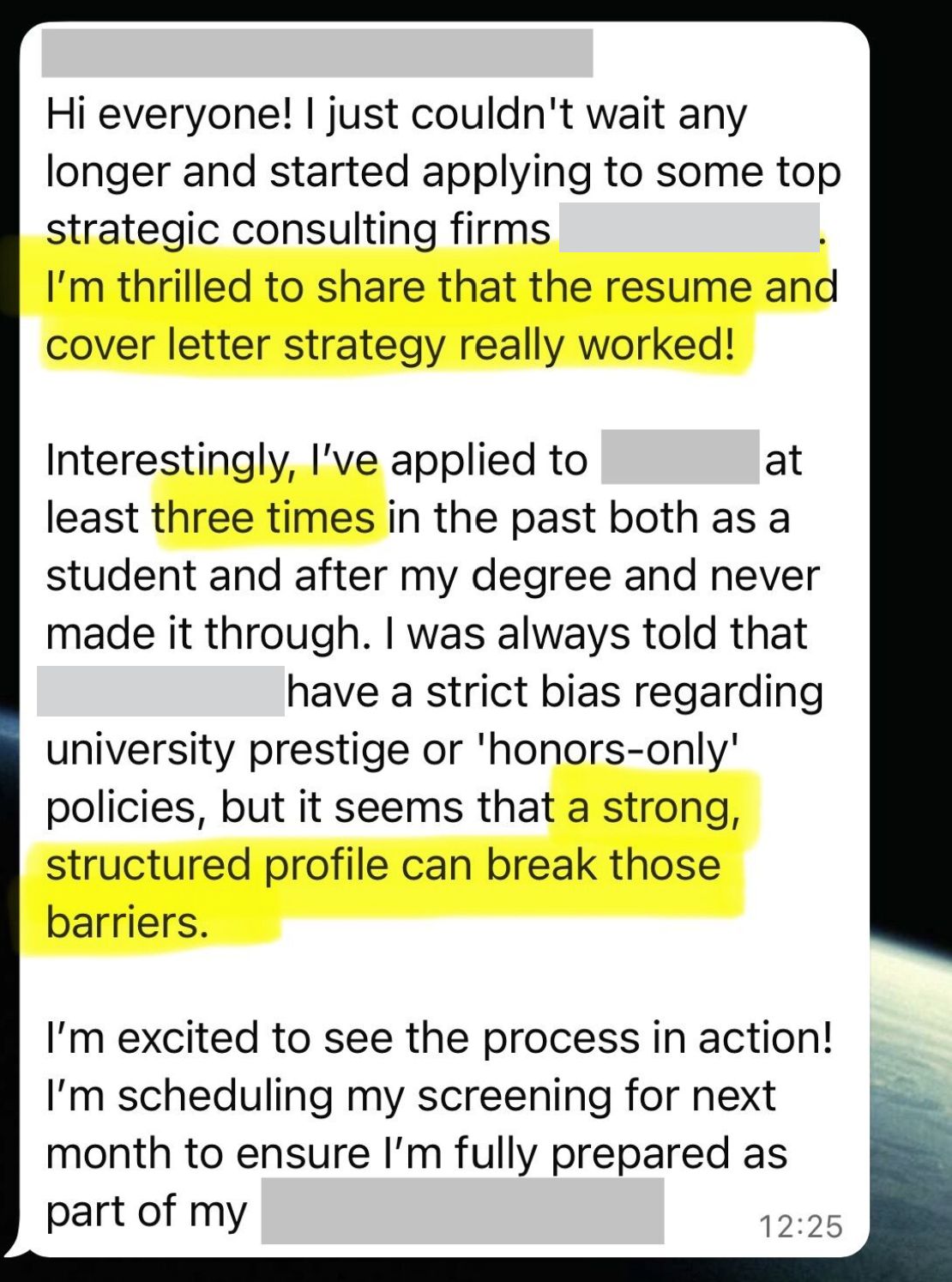
He had applied to the same top consulting firm THREE times. Rejected. Rejected. Rejected. After the third attempt, the explanation seemed obvious: His university simply wasn't prestigious enough. Then he joined The MBB Offer Machine™. We worked on his positioning. His CV. His cover letter. The way his experience was translated into signals a consulting recruiter could actually evaluate. And a special shoutout to our incredible Marzena Tomalka-Mośko. She has a rare ability to spot strengths candidates themselves often underestimate, and turn them into a positioning that immediately makes sense to a recruiter. Sometimes that means adding something. Very often, it means leaving something out. The result: A mentee movint into interviews with the same firm that refused to even speak with him three times before. Look at what changed. His university didn't change. His degree didn't change. His work experience didn't magically improve overnight. The PRESENTATION of that evidence changed. This is where the typical advice to non-target candidates usually becomes dangerously simplistic: “Your school isn't prestigious enough.” “Your profile isn't competitive.” “MBB mostly hires from target universities.” University pedigree can absolutely strengthen your initial signal. I learned that myself, coming from a no-name university in the MBB sense. But pedigree is not the verdict. From the recruiting side at McKinsey and BCG, I saw the actual question behind the CV screen: “Does this person give me enough evidence to justify an interview?” Your university is one signal. So is trajectory. Leadership Impact Achievement Commercial exposure. International experience. And critically: how clearly those signals are surfaced. A strong candidate can bury outstanding evidence under a very mediocre CV. Because a CV is not the table of contents of your life. LEAVING THINGS OUT can actually make it materially stronger. Another candidate can take comparable raw material and make the strongest signals impossible to overlook. That difference can decide whether somebody keeps reading. And this is why generic application advice fails so many non-traditional candidates. Someone who entered consulting through Harvard, Oxford or INSEAD may have useful advice. But they may never have had to solve the same problem. A candidate from an unknown university has to construct the argument differently. I know this personally. And over the years, I've watched candidates from universities most recruiters outside their country would struggle to name receive interviews and offers from McKinsey, BCG and Bain. This screenshot is a pretty good example. Three previous attempts. Same candidate. Then one fundamental change: He finally made the strength of his profile impossible to miss. --- The MBB Offer Machine™

6 of 221 adsSign up to see every The MBB Offer Machine™ ad, filter by format and date, and get alerts on new ones.
See all 221 adsWatch the companies you care about.
Filter every ad by industry, country, format and network, and get alerts when a company you watch starts running new ads.