LinkedIn thought leader ad examples
49 thought leader ads are live on LinkedIn right now, from 95 companies. Browse real ones, filtered by industry.
- G2Since 29 Oct 2026
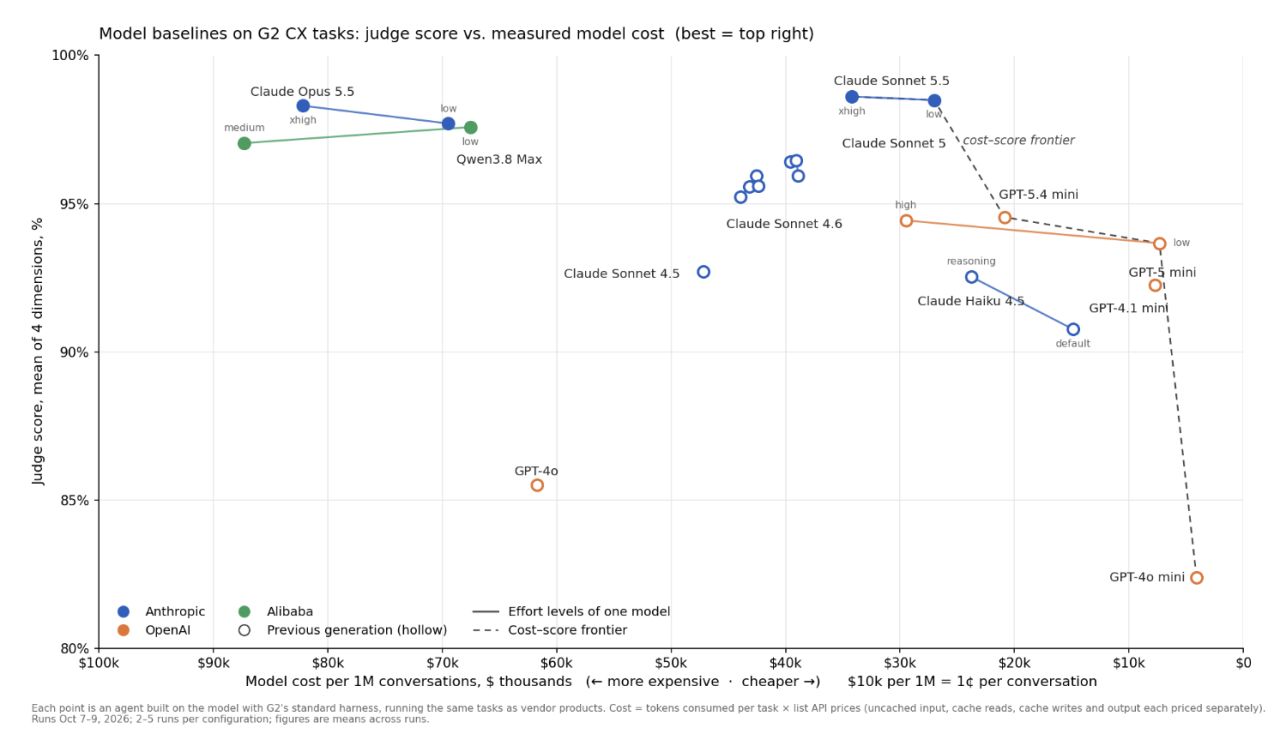
What does it cost to run a frontier model as a customer support agent? Our G2 agent evaluations team measured it. We built an agent on 12 foundation models (22 configurations) from Anthropic, OpenAI and Alibaba. Each got the same one-page support policy and 38 live tools, and ran the same tasks as the vendor products on our CX AI agent leaderboard. Then we priced every token at list API rates. Five takeaways: 1. 𝗧𝗵𝗲 𝗯𝗲𝘀𝘁 𝘀𝗰𝗼𝗿𝗲 𝗱𝗶𝗱 𝗻𝗼𝘁 𝗰𝗼𝗺𝗲 𝗳𝗿𝗼𝗺 𝘁𝗵𝗲 𝗺𝗼𝘀𝘁 𝗲𝘅𝗽𝗲𝗻𝘀𝗶𝘃𝗲 𝗺𝗼𝗱𝗲𝗹. Claude Sonnet 5.5 scored highest at 98.6% for 3.4¢ per conversation. Claude Opus 5.5 cost 2.4x as much at the same effort setting for a slightly lower score. 2. 𝗠𝗼𝗱𝗲𝗹 𝗰𝗼𝘀𝘁 𝗶𝘀 𝘀𝗺𝗮𝗹𝗹 𝗻𝗲𝘅𝘁 𝘁𝗼 𝘁𝗵𝗲 𝘁𝗶𝗰𝗸𝗲𝘁. 0.4¢ to 8.7¢ per conversation, vs. $0.99 per resolution for a leading CX agent and $5 to $10 for a human-handled ticket. 3. 𝗡𝗲𝘄𝗲𝗿 𝗺𝗼𝗱𝗲𝗹𝘀 𝘀𝗰𝗼𝗿𝗲 𝗵𝗶𝗴𝗵𝗲𝗿 𝗔𝗡𝗗 𝗰𝗼𝘀𝘁 𝗹𝗲𝘀𝘀. Across four Sonnet releases, the score rose about six points while cost per conversation fell 27% to 43%. 4. 𝗧𝘂𝗿𝗻𝗶𝗻𝗴 𝘂𝗽 𝗲𝗳𝗳𝗼𝗿𝘁 𝗺𝗼𝘃𝗲𝗱 𝗰𝗼𝘀𝘁 𝗺𝗼𝗿𝗲 𝘁𝗵𝗮𝗻 𝗾𝘂𝗮𝗹𝗶𝘁𝘆. GPT-5 mini at high effort cost 4x as much for 0.7 points. 5. 𝗧𝗵𝗲 𝗯𝗶𝗹𝗹 𝗶𝘀 𝗺𝗼𝘀𝘁𝗹𝘆 𝗶𝗻𝗽𝘂𝘁 𝘁𝗼𝗸𝗲𝗻𝘀. The policy, tool definitions and conversation history are present every turn, so cached-input pricing sets the economics. The line I find most telling: the gap between the cheapest configuration and the best is about 3¢ per conversation, and 16 points of quality. For a support desk, choose quality first. Caveat: these are Tier 1 support tasks. Longer, harder tasks will raise costs for every model, and we expect the gaps to widen. Thank you to Cyril Delattre and our G2 agent evals team for building this. Full analysis and chart below.
- Digital Ratio GmbHSince 27 Oct 2026
Der wichtigste Button im KI-Service könnte heißen: Mit einem Menschen sprechen. Stell dir eine Kundin vor, die ihre Stromrechnung nicht versteht. Sie öffnet den KI-Assistenten. Bevor sie ihre Frage eintippt, sucht sie den Weg zu einem Menschen. Sie findet ihn. Und beginnt das Gespräch mit der KI. Das wirkt widersprüchlich. Die sichtbare Alternative könnte ihr aber genau die Sicherheit geben, es auszuprobieren. Sie behält die Entscheidung. Sie muss keine Angst haben, im System festzustecken. Das legt eine Studie mit 3000 Teilnehmern zum Kundenservice nahe (link zur Studie im Kommentar). Eine menschliche Alternative verbesserte die Bewertung des KI-Angebots und verringerte Bedenken. Wie wichtig dieser Weg ist, zeigt der Vergleich zweier Serviceprozesse. Im ersten fehlt der Weg zum Menschen. Die KI versteht die Rechnungsfrage nicht. Die Kundin formuliert um. Wieder dieselbe Antwort. Irgendwann schließt sie das Fenster. Die Rechnung bleibt ungeklärt. Im zweiten übernimmt eine Mitarbeiterin. Sie bekommt den bisherigen Dialog und die offene Frage mit. Die Kundin muss ihre Geschichte nicht noch einmal erzählen. Die Mitarbeiterin klärt die Rechnung. Wer ausschließlich vermiedene Mitarbeiterkontakte zählt, könnte den ersten Verlauf besser bewerten. Kein Mensch beschäftigt. Automatisierungsziel erreicht. Das Dashboard feiert. Die Kundin hat aufgegeben. Ein vermiedener Mitarbeiterkontakt kann auch ein verlorener Kunde sein. Service zu entlasten ist sinnvoll. Nur sollten wir dabei erkennen, ob Arbeit erledigt wurde oder ein Kunde mit seinem Problem verschwunden ist. Aus meiner Sicht gehört deshalb der gesamte Verlauf in die Auswertung. Also drei Ausgänge: durch die KI gelöst, nach einer Übergabe geklärt oder abgebrochen mit unbekanntem Ausgang. Dazu kommen die gesamte Lösungszeit und erneute Kontakte zur selben Frage. Eine Übergabe ist ein sinnvoller Teil des Service, wenn sie zur Lösung führt. Dafür braucht es einen sichtbaren Zugang, den bisherigen Gesprächskontext und klare Zuständigkeiten. Außerhalb der Servicezeiten gehört eine verlässliche Rückrufoption dazu. Das Serviceversprechen dahinter ist einfach: Du kannst hier anfangen. Und wenn du nicht weiterkommst, übernehmen wir. Wie siehst du das, Weiterleitung zum Mensch anbieten oder konsequent auf KI setzen?
- SpeyaSince 27 Oct 2026
Most supplier shortlists have the same blind spot: the suppliers nobody contacted. I learned that early. At uni I ran a small clothing brand and spent weeks trying to find a factory. Directories, trade fair lists, cold emails. I wrote to a handful, chased the ones that didn't answered, and picked the best of a tiny sample. I never knew what I’d missed. Procurement teams do the same search for hundreds of categories a year, with far more at stake, and most of it still happens in email and spreadsheets. On Friday we shipped RFx in Speya. Describe what you need, and Speya finds and vets the right suppliers, then sends the request to all of them at once. We tested it on our own cleaning contract: one request, 100 providers, and several quotes beat what we pay today. I can now do in minutes what I couldn’t do back then. More importantly, so can a category manager with 40 open requests. If your team still runs RFQs by hand, I’d like to hear where it hurts most.
- Digital Ratio GmbHSince 28 Oct 2026
Stell Dir vor, Dein nächster Kollege braucht Zugriffsrechte, aber keinen Arbeitsvertrag. Du bereitest ein Onboarding vor. Name, Aufgabe, Zugänge. Diesmal für einen KI-Agenten. Er soll Kundenanfragen vorbereiten, offene Vorgänge verfolgen und Deinem Team Arbeit abnehmen. Klingt gut. Bis Du im Formular bei den Berechtigungen ankommst. Kundendaten lesen ist schnell angekreuzt. Angebote verschicken, Rabatte zusagen und Vorgänge schließen brauchen schon etwas mehr Nachdenken. Microsoft macht dieses Gedankenexperiment mit dem angekündigten Copilot Autopilot greifbar. Der Agent soll eine eigene Identität bekommen und mit steuerbaren Berechtigungen arbeiten. Laut Ankündigung vom 25. September war dafür zunächst eine private Vorschau vorgesehen. Die Aussicht auf Entlastung ist nachvollziehbar. Nur sitzt Du jetzt vor einer Führungsaufgabe. Du musst festlegen, welche Arbeit Du abgibst. Und wer für das Ergebnis geradesteht. Nehmen wir die Vorbereitung eines Kundenangebots. Der Agent sammelt Vertragsdaten und formuliert einen Entwurf. Dann findet er zwei unterschiedliche Preisstände. Ohne klare Regel könnte aus einer Zeitersparnis eine falsche Zusage werden. Ich würde deshalb für den ersten Einsatz vier Dinge auf einem Blatt festhalten: Die Aufgabe wird konkret beschrieben. Zum Beispiel ein prüffähiger Angebotsentwurf mit nachvollziehbaren Quellen. Damit lässt sich beurteilen, ob die Vorarbeit tatsächlich hilft. Die Zugriffsrechte passen zu dieser Aufgabe. Vertragsdaten lesen kann dazugehören. Preise ändern und Angebote versenden bleiben getrennte Freigaben. Für Rückfragen gibt es klare Auslöser. Bei widersprüchlichen Daten oder einer fehlenden Kondition stoppt die Bearbeitung. Eine benannte Person entscheidet über das weitere Vorgehen. Auch die Kontrolle bekommt einen Verantwortlichen. Jemand prüft Ergebnisse, schaut auf Fehler und Nacharbeit und kann den Agenten bei Bedarf stoppen. Sonst wandert die eingesparte Arbeit unbemerkt in die Korrekturschleife. Das lässt sich mit einem überschaubaren Vorgang ausprobieren. So wird sichtbar, wo der Agent entlastet und wo die Delegation noch unklar ist. Wer Arbeit an KI delegiert, muss Verantwortung verteilen können. Der Firmenausweis ist schnell ausgestellt. Wenn Du einen solchen Einsatz vorbereitest, lass uns an einem konkreten Vorgang Aufgabe, Zugriffsrechte und Freigaben durchgehen.
- EPMwareSince 27 Oct 2026
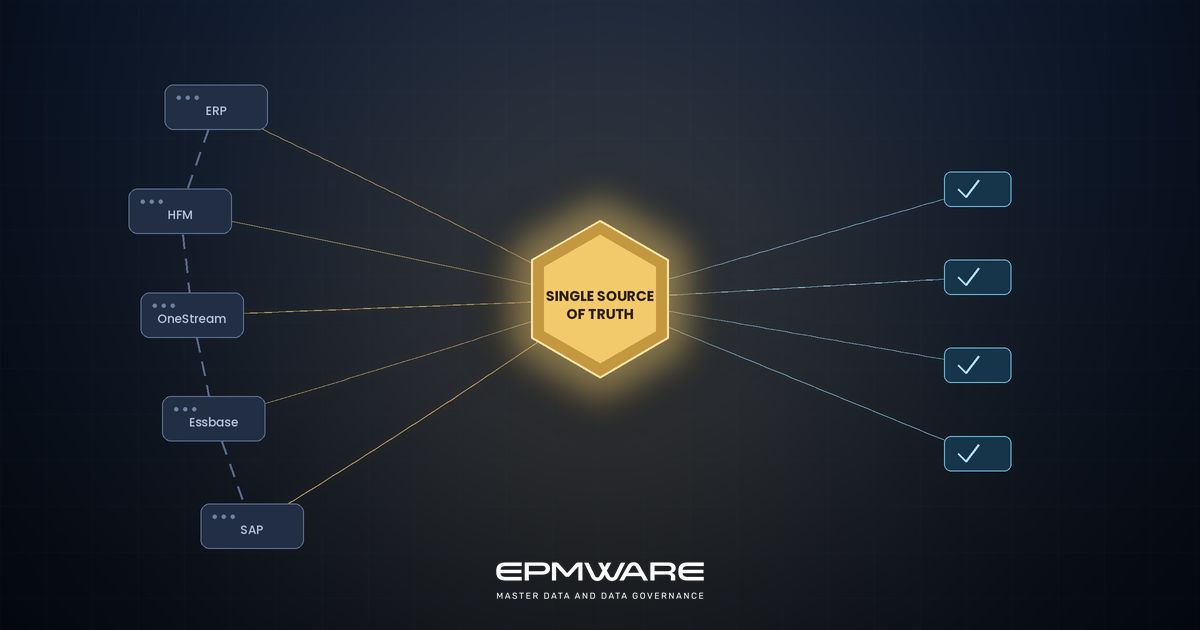
I've lost count of the 11 p.m. close week calls from clients that started the same way: a consolidation load failed, and no one could say why. It's almost never the team. It's almost never the tool. It's usually one cost center that got created in the source system last Tuesday and never made it into the hierarchy the consolidation depends on. Someone hand-edits a flat file, reruns the load, and goes home. The number is wrong until it quietly isn't. After years around financial systems, I've come to believe this isn't an effort problem. It's a master data problem. The accounts, entities, and hierarchies underneath your close are the scaffolding for every number you report. When every system keeps its own copy and people maintain them by hand, they drift... and drift becomes failed loads, restated numbers, and audit findings. More people checking spreadsheets won't fix it. One governed source of truth that feeds every EPM and ERP system will. I wrote down how I think about it... link in the comments. If your close still runs on flat files and macros, I'm always up for comparing notes. #OfficeoftheCFO #FinancialClose #MasterDataManagement
- EPMwareSince 27 Oct 2026
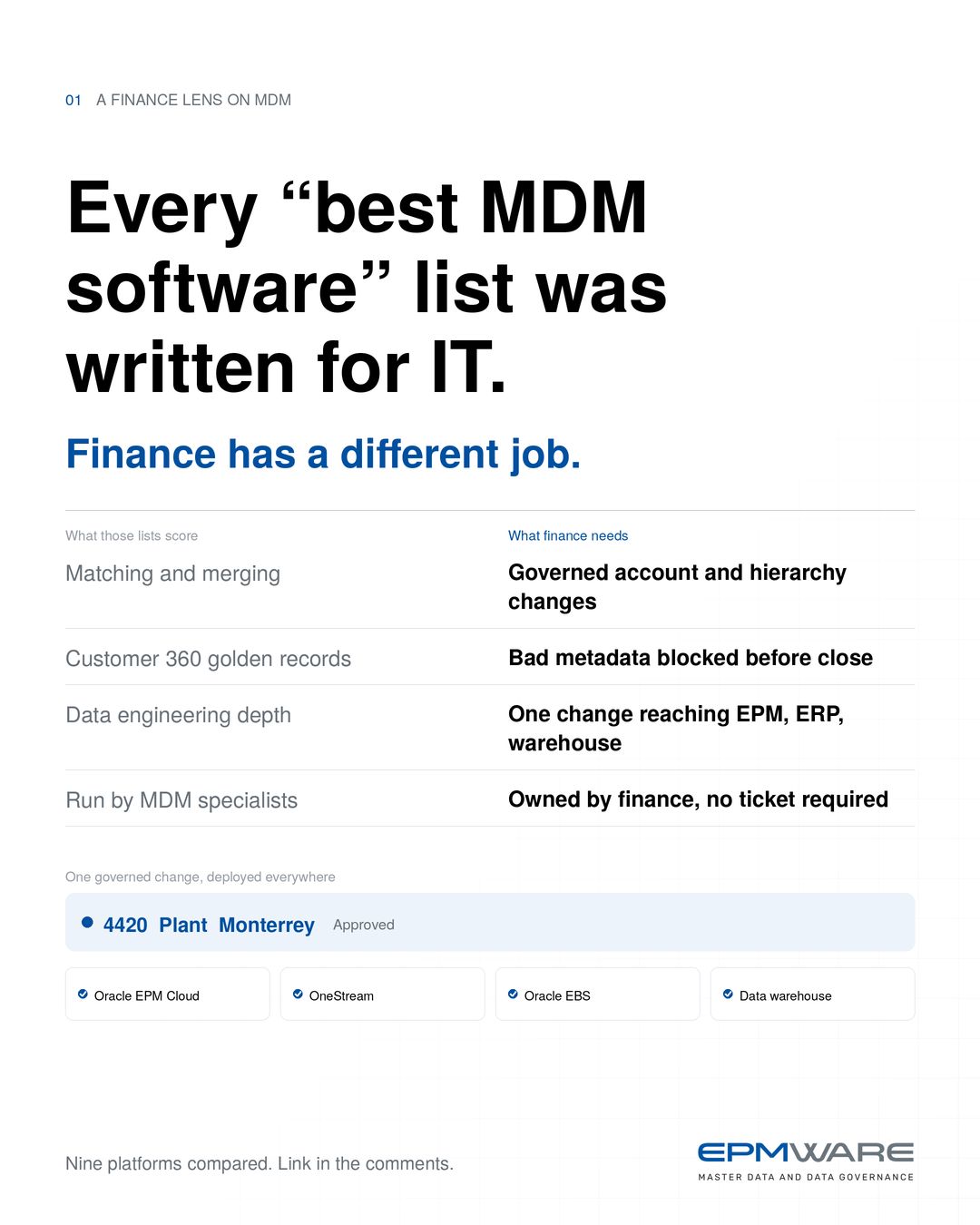
Every "best master data management software" list I have read this year has the same problem. It was written for enterprise data teams reconciling customer records. Finance was an afterthought. Finance has a different job. The chart of accounts, legal entities, cost centers, and hierarchies have to stay correct across the ERP, the EPM applications, and the warehouse, on a close calendar that does not move. So we wrote the comparison we could not find: nine platforms, judged on the six things finance actually needs. 1. Governance workflow. Can a change be requested, approved, and deployed through an audited path? 2. Data quality. Is bad metadata blocked at entry, or found during close? 3. Enterprise integration. Does it reach Databricks, SAP, Oracle EPM, OneStream, and your ERP without a build? 4. Business-user ownership. Can finance run it without a ticket? 5. Audit and versioning. Who, what, when, why. 6. Cost and licensing. Does the pricing model punish growth? We covered Informatica, Profisee, Semarchy, SAP MDG, Oracle EDM, Ataccama, Reltio, Stibo, and EPMware. Yes, EPMware is ours, and we say where each of the others is the better choice. The pattern that emerged: most of these are excellent platforms built for IT. Only a couple are built for the close. Full guide in the comments. #MasterDataManagement #FinanceTransformation #OfficeoftheCFO #DataGovernance
- DCA Market IntelligenceSince 28 Oct 2026
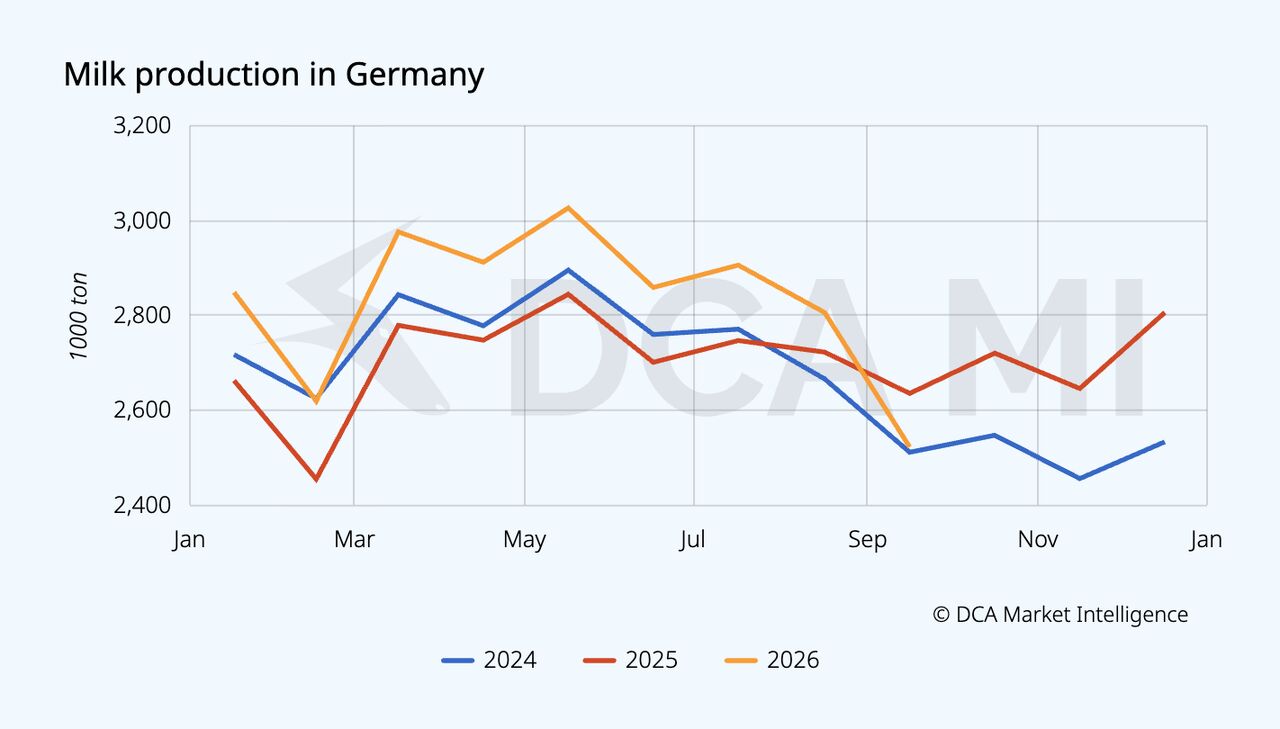
𝗠𝗶𝗹𝗸 𝗽𝗿𝗼𝗱𝘂𝗰𝘁𝗶𝗼𝗻 𝗴𝗿𝗼𝘄𝘁𝗵 𝘄𝗲𝗮𝗸𝗲𝗻𝗲𝗱 𝗮𝗰𝗿𝗼𝘀𝘀 𝗘𝘂𝗿𝗼𝗽𝗲𝗮𝗻 𝗰𝗼𝘂𝗻𝘁𝗿𝗶𝗲𝘀 𝗶𝗻 𝗦𝗲𝗽𝘁𝗲𝗺𝗯𝗲𝗿 Germany recorded the biggest change, with collections down 4.3% year-on-year after rising 3.1% in August. France was almost unchanged, while Poland increased. Year-to-date production is still above 2025 levels in all three countries, mainly because of stronger growth earlier in the year. Milk prices remain under pressure, despite recovering from August. Feed costs have eased in several markets, but lower milk prices continue to put pressure on margins. Read the full DCA Market Intelligence analysis by Santiago Morales Hilarión: https://lnkd.in/ePpn_Jjb #DairyMarkets #MilkProduction #MilkPrices #EuropeanDairy #FarmgateMilk #DCAMarketIntelligence
- AstronomerSince 27 Oct 2026
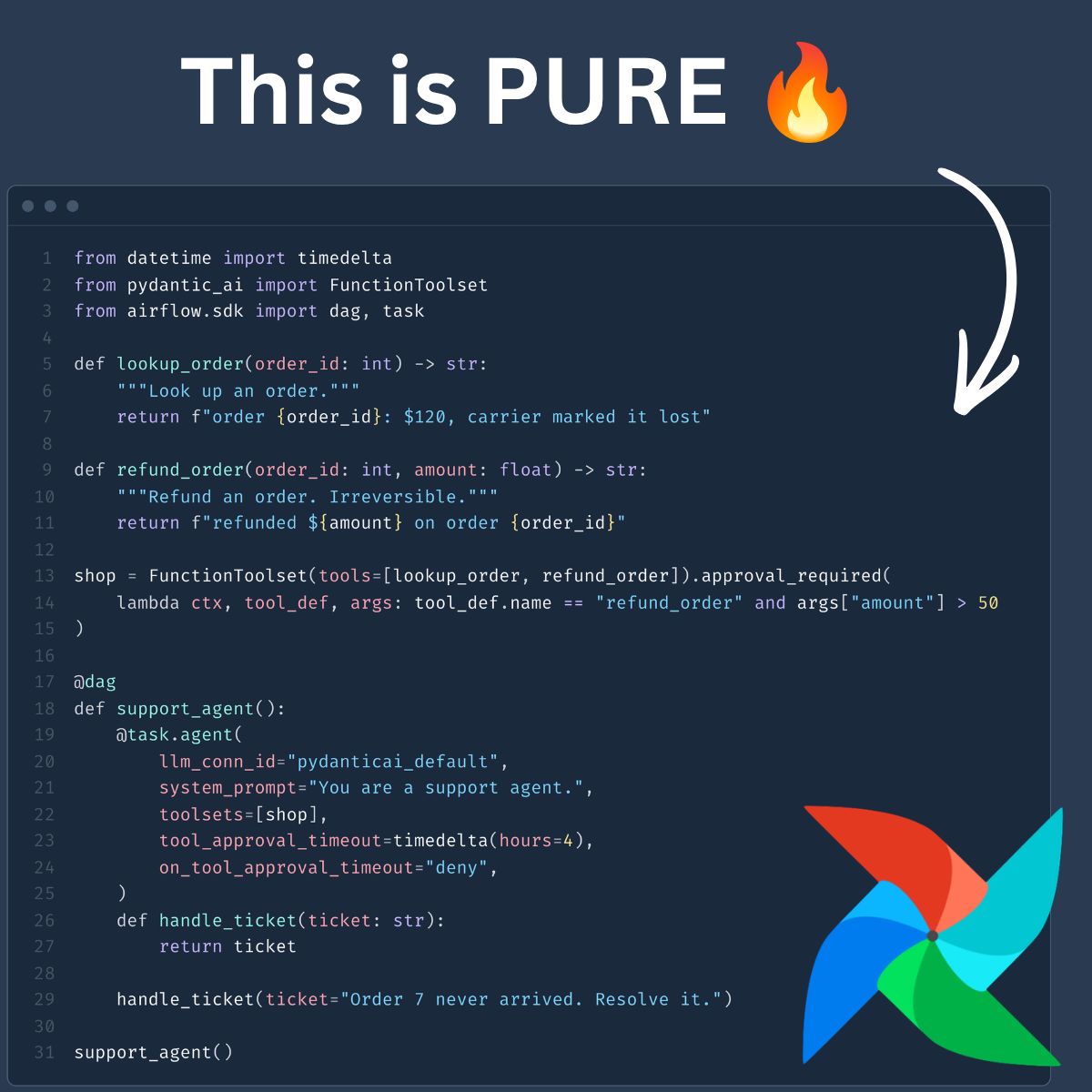
Your agent calls many different tools, BUT some are dangerous! Now you can review a given tool call before any disaster 👇 Airflow just introduced tool-call approvals 🤗 Works on @task.agent and AgentOperator available in Airflow 3.3+. How does it work? Simple: ✅ toolset.approval_required(func) on any toolset, SQLToolset and MCPToolset included ✅ Tool(refund_order, requires_approval=True) inside a FunctionToolset for a single function Let's say we have a refund_order tool. The function gets the tool name and the arguments, and requires human review for refunds over $50 in one line. What happens at the call: 1️⃣ The task pauses in awaiting_input 💡 No worker slot held, like a deferred task 2️⃣ The request shows up on Required Actions 💡 Tool name and arguments, secrets masked Then you: 3️⃣ Approve 💡 The call runs, the agent carries on 4️⃣ Reject 💡 The task doesnt fail. The agent is told your reason and carries on without the call You can specify tool_approval_timeout to define the wait. On timeout, you get fail or deny, and you can even set tool_approval_assigned_users to who can decide 😎 Now you can finally better control your agent! Try it, you gonna love it Enjoy ❤️ P.S: Like and share to help your teammates #airflow #apacheairflow #dataengineer #dataengineering
- AstronomerSince 27 Oct 2026
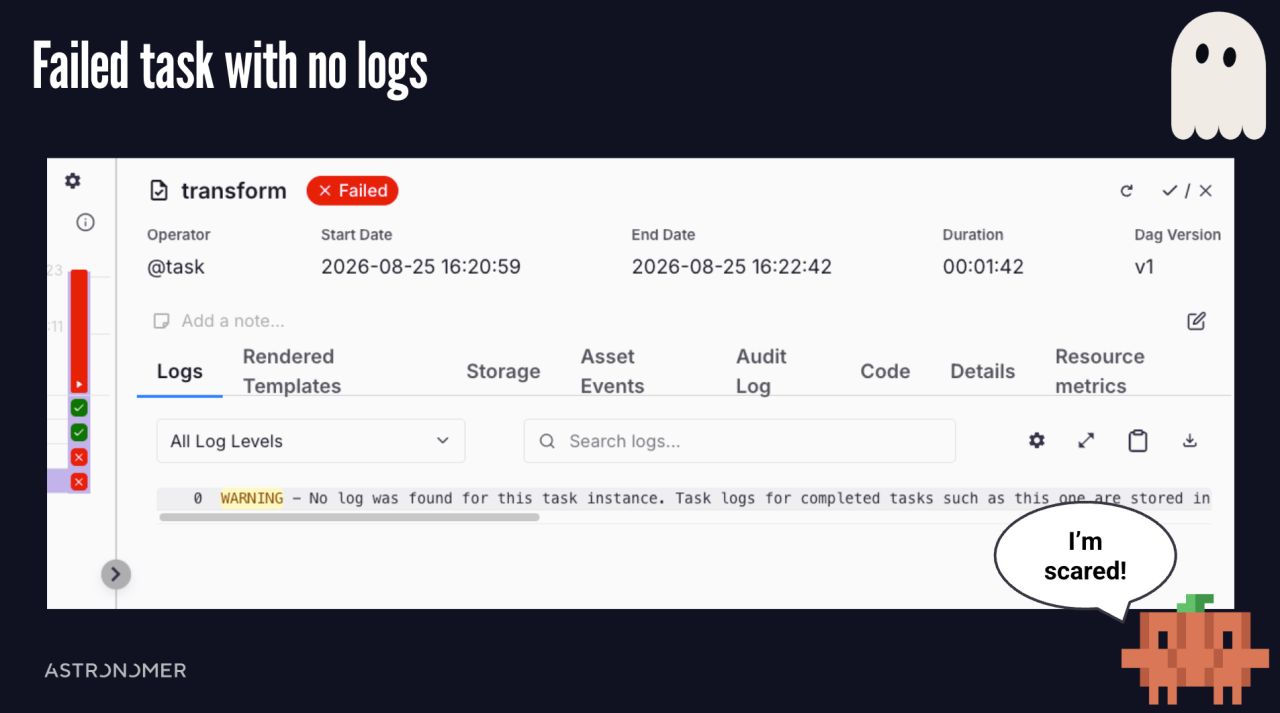
👻 Sneak peak from the webinar this Thursday: Debugging Apache Airflow's scariest issues! It is spooky season and Kenten Danas and I selected some of the spookiest errors we've encountered to tackle together with our agentic friends! You'll learn how to tackle the kind of issues where the error trace does not help (or does not exist) as well as how to give your agents the best shot at being helpful assistants in debugging Airflow. Join us live on Thursday Oct 29th at 11am ET / 4pm CET! Or register and watch the recording afterwards (but this one is much more fun live 😄 ) Link in the comments!
- DCA Market IntelligenceSince 28 Oct 2026
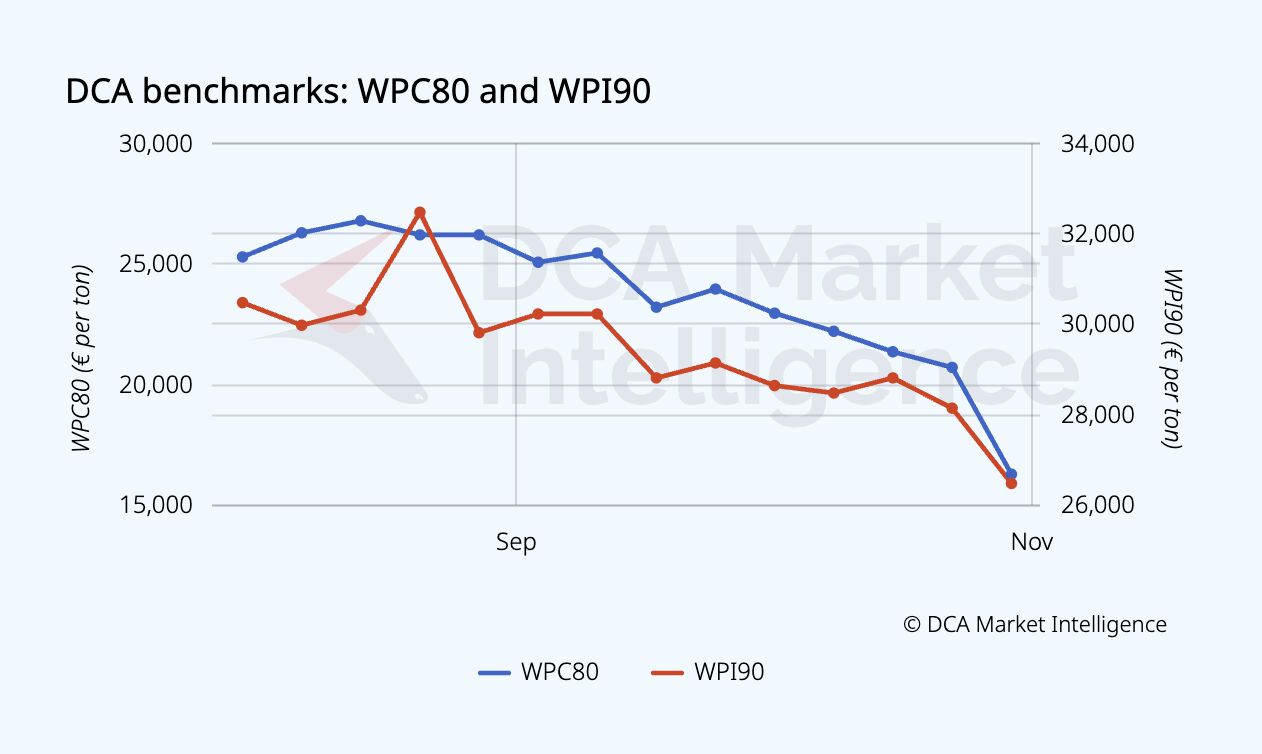
𝗪𝗣𝗖𝟴𝟬 𝗳𝗮𝗹𝗹𝘀 𝘁𝗼 𝗶𝘁𝘀 𝗹𝗼𝘄𝗲𝘀𝘁 𝗽𝗼𝗶𝗻𝘁 𝗮𝘀 𝗯𝘂𝘆𝗲𝗿𝘀 𝗵𝗼𝗹𝗱 𝗯𝗮𝗰𝗸 The DCA WPC80 benchmark fell by 21.3% in week 44, reaching its lowest level since its implementation in late March. Trading activity remains limited. Contributors report that buyers are still holding back, with expectations of further price declines keeping many out of the spot market. WPI90 has been more resilient, declining by 5.9% over the week. This has widened the price gap between WPC80 and WPI90 considerably. At the same time, the gap between WPC80 and MPC has narrowed as protein users have increasingly reformulated products in response to previously high WPC80 prices. What does this mean for buying decisions and production strategies going into 2027? Read the full DCA Market Intelligence analysis: https://lnkd.in/e2pve-tj #DairyProteins #WPC80 #WPI90 #Whey #Protein #ProteinMarket #DairyBenchmarks #DCAMarketIntelligence #SportsNutrition
- OmniSince 28 Oct 2026
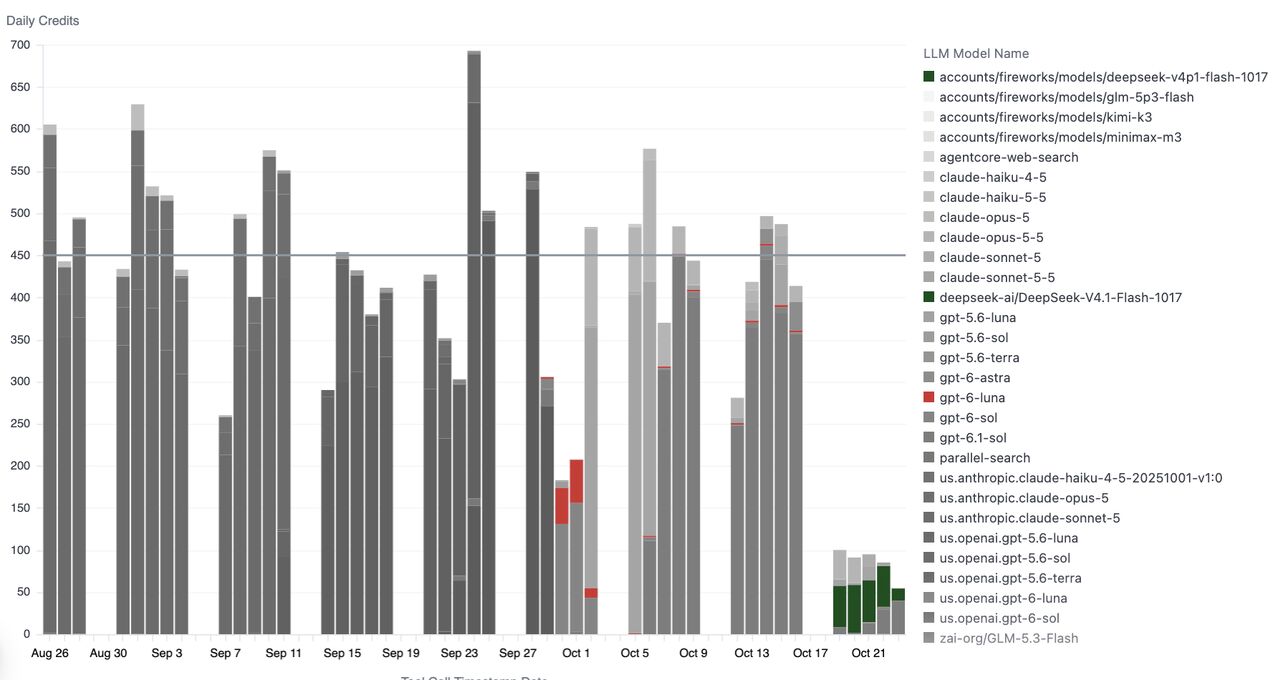
Omni dropped our internal data token spend by more than 80% this week. I mentioned a couple weeks ago intelligence was getting free. We tested Luna as our workhorse model - extremely cheap, less intelligent. We indeed saw a bunch of savings, but underneath that was an enormous user preference to back the model off and select something more intelligent (red bars on Sept 30, Oct 1 below --> grey back-off). Unfortunately that also meant the typical $450 / day was only down to $200 / day. Put simply, Luna wasn't smart enough. Fast forward literally two weeks and we've been running a similar test with Deepseek Flash 4.1 (green bars this week). The results have been incredible. The back-off rates we saw before have dropped to fewer than 10% of queries (largely app building). The net is that we can now use less than $100 / day across all models (less than half on Flash). Run rate dropped from $500 daily to less than $100. We've found our new everyday model. We're in incredible times where core workflows can drop in cost by 80% overnight. Excited for the future. PS. Yes, we swap our internal models a lot.
- TableauSince 27 Oct 2026
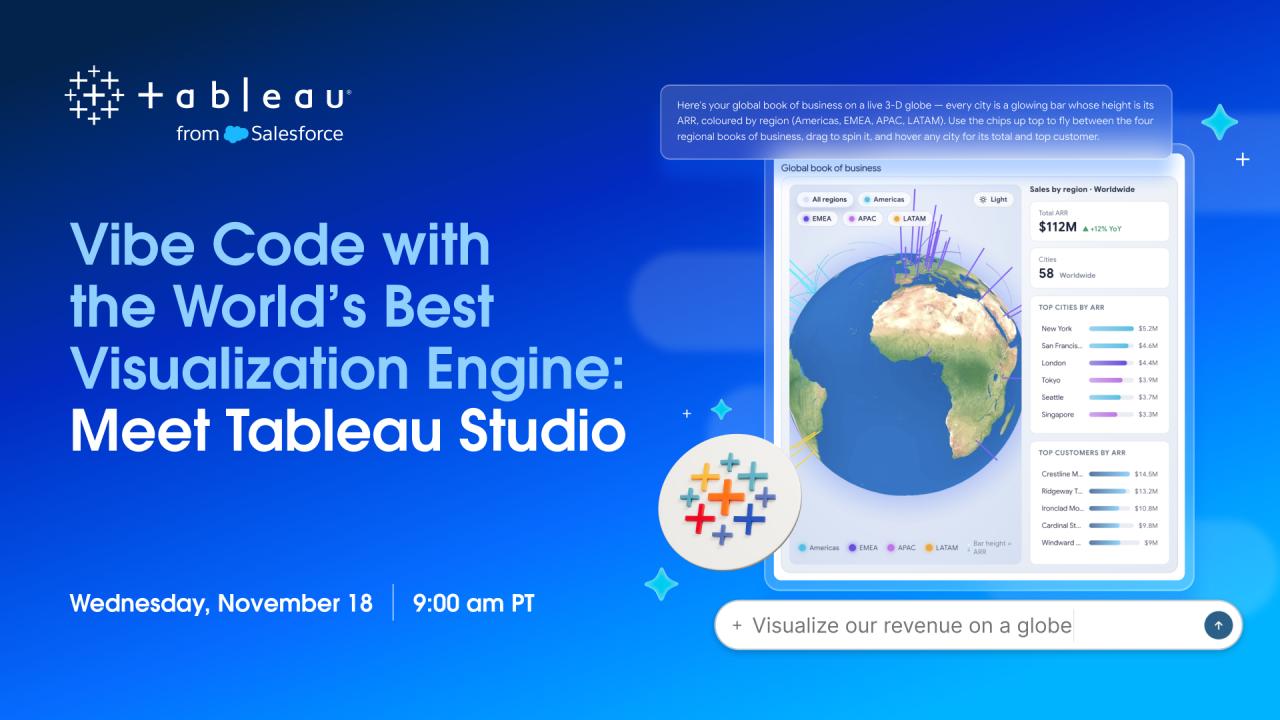
Fast dashboards are easy now. Trusted ones are not. With Tableau Studio, you can now build anything at the speed of AI without giving up accuracy or control. Create, deliver, and scale analytics your team can actually act on, using the world's best visualization engine, now reimagined for the agentic era. Join me, Southard Jones , Katie Hughes , and Tableau Community Leader Jonathan Drummey live on November 18 for a closer look at how Tableau Studio empowers you to build custom, AI-driven data apps at the speed of thought, without sacrificing enterprise trust. Save your spot: https://lnkd.in/gFbWp7dJ
- Inphinity ∞Since 27 Oct 2026
Inphi AI is coming! When we decided to include AI in our portfolio, our customers made it clear: end users need an intuitive AI assistant right where their plan is, helping them create or adjust it. And admins asked for connectivity to their own LLMs. So, here we are. Me playing with Inphi is the last internal stage before we give access to Inphinity Champions and others involved in the Tech Preview. Based on their feedback, we’ll refine it further and release it for everyone at the beginning of December. Have you noticed I’m using it on-prem? 😉 Yes, we’re bringing embedded AI to all our customers, regardless of their deployment type. If you want to see it live, find me in Paris at the Qlik Partner Ambassador and Luminary meetup, send me an email, or message me here. And if you’d like to join the Tech Preview, let me know. I can still sneak you in. 😉 #Qlik #EmbeddedAI #AIPlanning #QlikPartnerAmbassador
- CATAPULTSince 26 Oct 2026
Is your Amazon traffic down this year, but sales hold steady anyway? You're not alone. I've had this exact conversation in a pitch meeting recently, and the reaction in the room is always the same: alarm, followed immediately by someone asking what broke in content or media. Here's the thing. We pulled the numbers across our full client base, comparing numbers from 2024, 2025, and 2026. Traffic dropped in the large majority of accounts. Conversion rate rose by nearly the same margin. Units sold held steady or grew. This showed up across categories, price points, and brand sizes, not in one lucky account. There's a specific mechanic behind this, tied to how Amazon's search algorithm changed and what "traffic" actually measures on a dashboard today versus a few years ago. Once you see it, a falling traffic chart stops looking like a red flag and starts reading as something else entirely. We wrote up the full mechanism, the data patterns, and a 5-point checklist for telling a real problem apart from an algorithm working in your favor, in a new whitepaper. If your business review this quarter has a traffic chart everyone's nervous about, read this before you touch your content or media budget. 👉 Download the free whitepaper here: https://lnkd.in/egXERW-q
- OmniSince 26 Oct 2026
If you read nothing else: Omni will soon support 100% custom data viz. That means if you can describe it, our AI can build it, and it runs on the definitions in your semantic layer. I’ve spent over 20 years working on data visualization software. Data visualization sits at the intersection of computer science, design, and data analysis. Because chart libraries are usually consumed by highly opinionated viewers, building a single chart that satisfies everyone is already difficult. In BI, coupling chart building to a generic tool is even harder - your library must handle data shapes it hasn't seen before. To use a video game analogy: this isn't hard mode, it's nightmare mode. You can’t make everyone happy all the time, so eventually you need a custom data viz escape hatch. That’s exactly what we’re building. Want a bespoke version of classic cartesian charts? Now you can have it. Want to create a one-off data viz to tell a story for your report? Go for it. Want to replicate your CEO’s favorite Economist chart aesthetic? Yep, you can do that too. Of course, we’re coupling this to Blobby, our AI agent. We're also making it available through our MCP connectors so you can use AI to build whatever you want, wherever you want. All of this stays backed by our governed data model, ensuring the right data is visualized for just the right viewers.
- IntellertsSince 22 Oct 2026
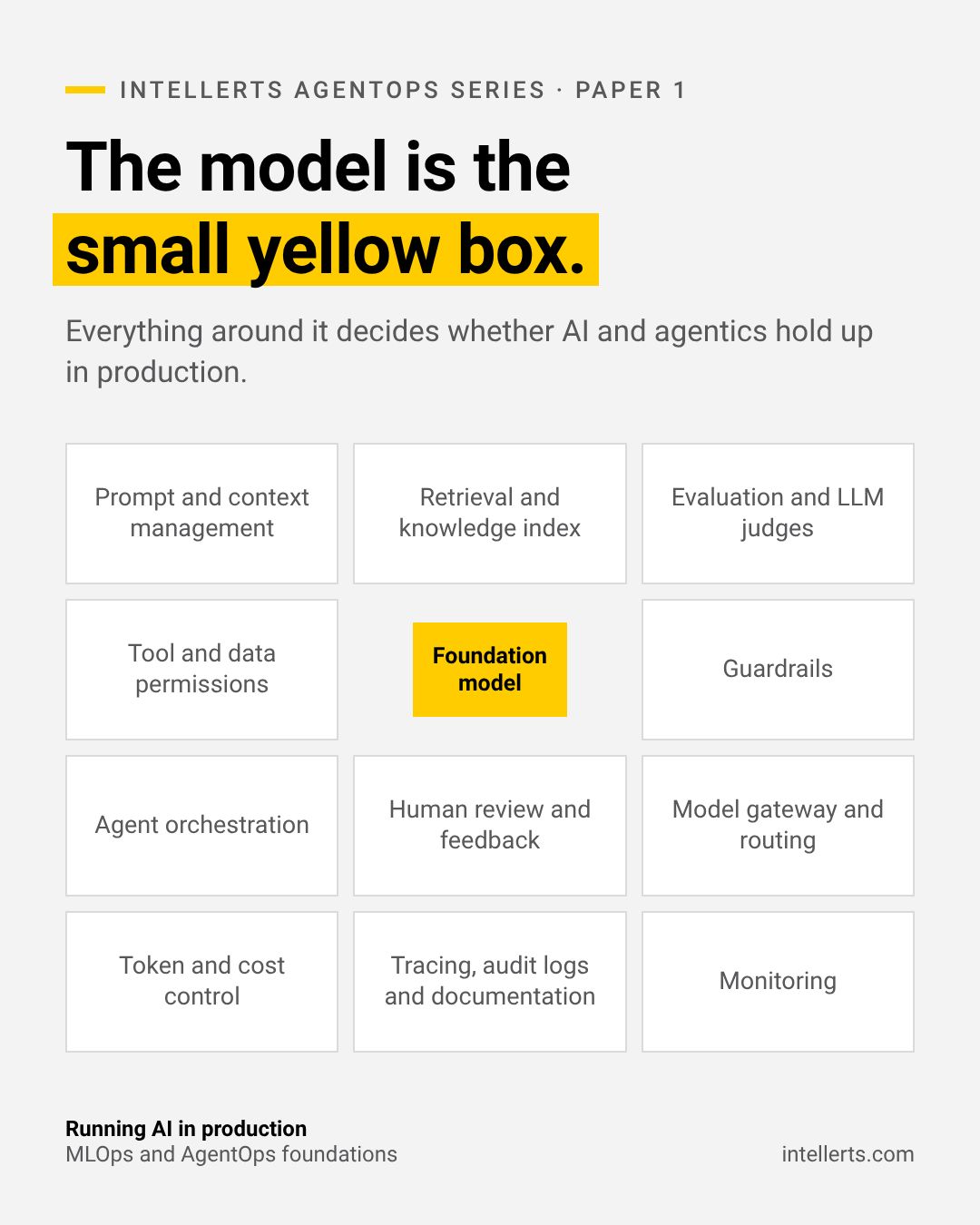
Most AI architecture diagrams have one small yellow box in the middle. That box is the model, and it gets almost all the attention. In every production AI system I have seen, the hard work sits in the boxes around it: evaluation, guardrails, tool permissions, tracing, cost control, monitoring. That is where pilots either become dependable systems or quietly stall. The numbers show it. McKinsey's State of AI 2026: 44% of organisations say AI is scaling across the enterprise, yet only 37% see any EBIT impact. One in five say running costs already hold them back. Agentics makes this layer even more important. Once AI plans, calls tools and acts on its own, you need to know what it did, what it was allowed to do, and what each completed task cost. That operating discipline is AgentOps. Today we publish paper 1 of our AgentOps Series, written by Partnership Professor @Darius Dilijonas for CTOs and heads of AI, data and platform. In fact it's written for anyone who is interested to learn more about the inner workings of Agent- and MLOps. Three questions from it that I'd put to any leadership team this quarter: → Does every production AI system have a named owner and a budget? → Can you show the cost per completed task for your agents? → Has anyone tested how to stop an agent? If any answer is "not yet", the article is a good place to start. https://lnkd.in/epyn2_Jz For those who want the depth, there is a free download of the full research report on our blog. #AgentOps #Agentics #MLOps #AIinProduction
- honeycomb.ioSince 22 Oct 2026
Honeycomb has always been about teams. 🐝 From day one, we’ve believed that strong teams are built when a group of people with different roles, instincts, and expertise can get to a shared understanding of what’s happening around them. (That belief is rooted in the delta between me and Charity: two very different engineers, trying to make sense of the same messy system.) The agentic era changes who’s on the team, but to me it’s another variation on the same theme. Everyone has their own agent these days (and should!)—and that raises a fun set of questions about how all the pieces fit together: how humans and agents with different views of the world and different expertise collaborate, hand work off, and pass along what they’ve learned... while staying grounded in the same view of what’s real. Back in the early days, my LinkedIn bio described Honeycomb as “the next best member of your team.” I still think about it that way... there are just a lot more teammates in the picture now. Charity and I are digging into all of this Nov 3–4, and we’ll be announcing some very cool stuff along the way ✨ Day 1: Agents on your team. Instrumentation, context, and building trust in what your agents are doing. Day 2: The AI ecosystem at scale. Visibility across the whole fleet, keeping costs in check, and what platform teams need to observe all of it. There’s a live Q&A, so bring your questions (or your "well, actually"s). Join us! https://go.hny.co/4dsMocn
- HarmonicSince 24 Oct 2026
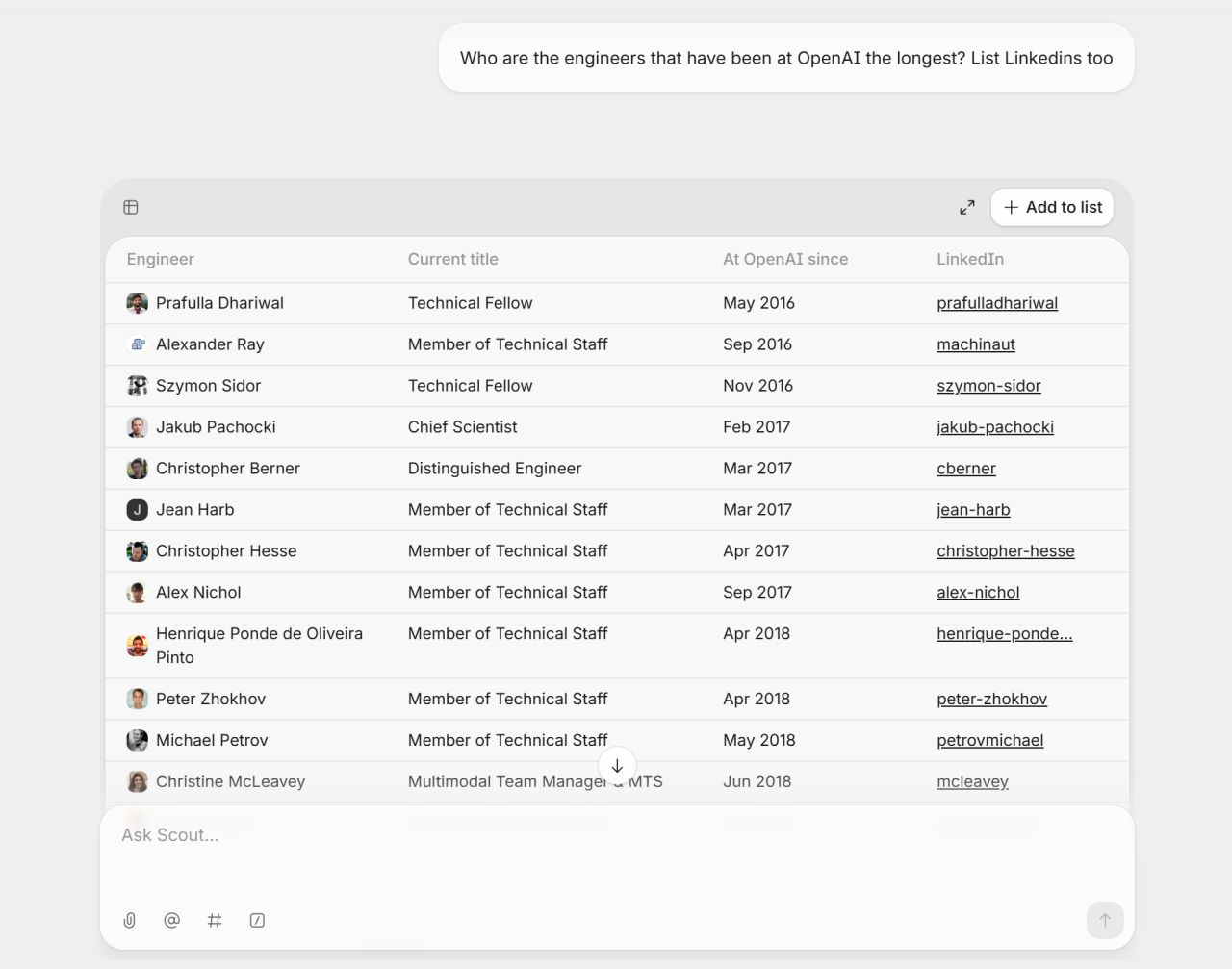
I just pulled every long-tenured OpenAI engineer (name, title, start date and LinkedIn). This is where the startup mafias come from. Two reasons why: 1) I imagine that most of these engineers will leave soon to go back to 0 to 1 building 2) They are likely fully vested so they do not have to stay at OpenAI to receive their huge payouts I got the below list using Harmonic’s research tool. I then put this into an active list so that I could get more enriched data on each person that updates automatically (it updates once a week with new details from Linkedin). This info is tablestakes in today's venture game. In case you want to check it out yourself: www.harmonic.ai/try cc: Harmonic #harmonicpartner #venturecapital #sourcing #startup
- HarmonicSince 24 Oct 2026
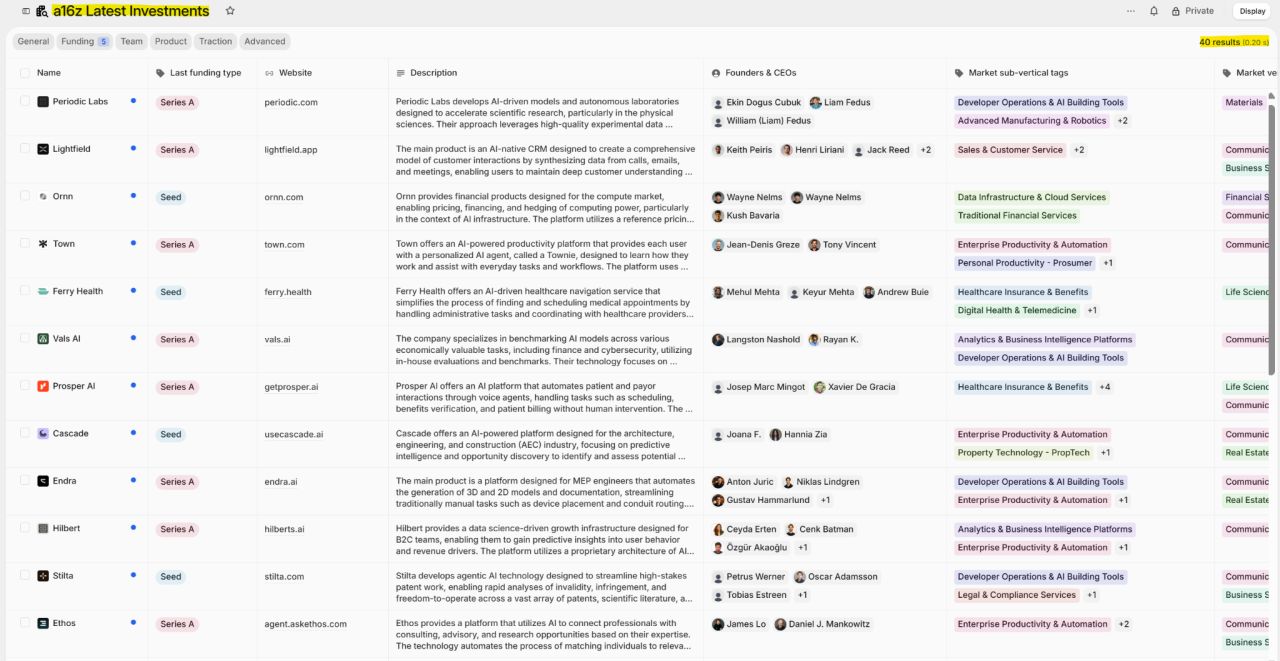
Andreessen Horowitz is a king-maker and everyone in VC hates it. The industries they invest in inevitably become hot. I just got access to all the early stage deals (preseed to Series A) that a16z has done in the last 6 months. With this data you can: 1. See what companies and industries the best VCs are excited about 2. Study the types of founders they are backing 3. See if there are select tech companies or universities that are creating these top founders 4. Analyze the co-investors that a16z is investing alongside of In case you want to check it out yourself: www.harmonic.ai/try Cc: Harmonic #harmonicpartner #venturecapital #founder #startup #sourcing
- definitySince 22 Oct 2026
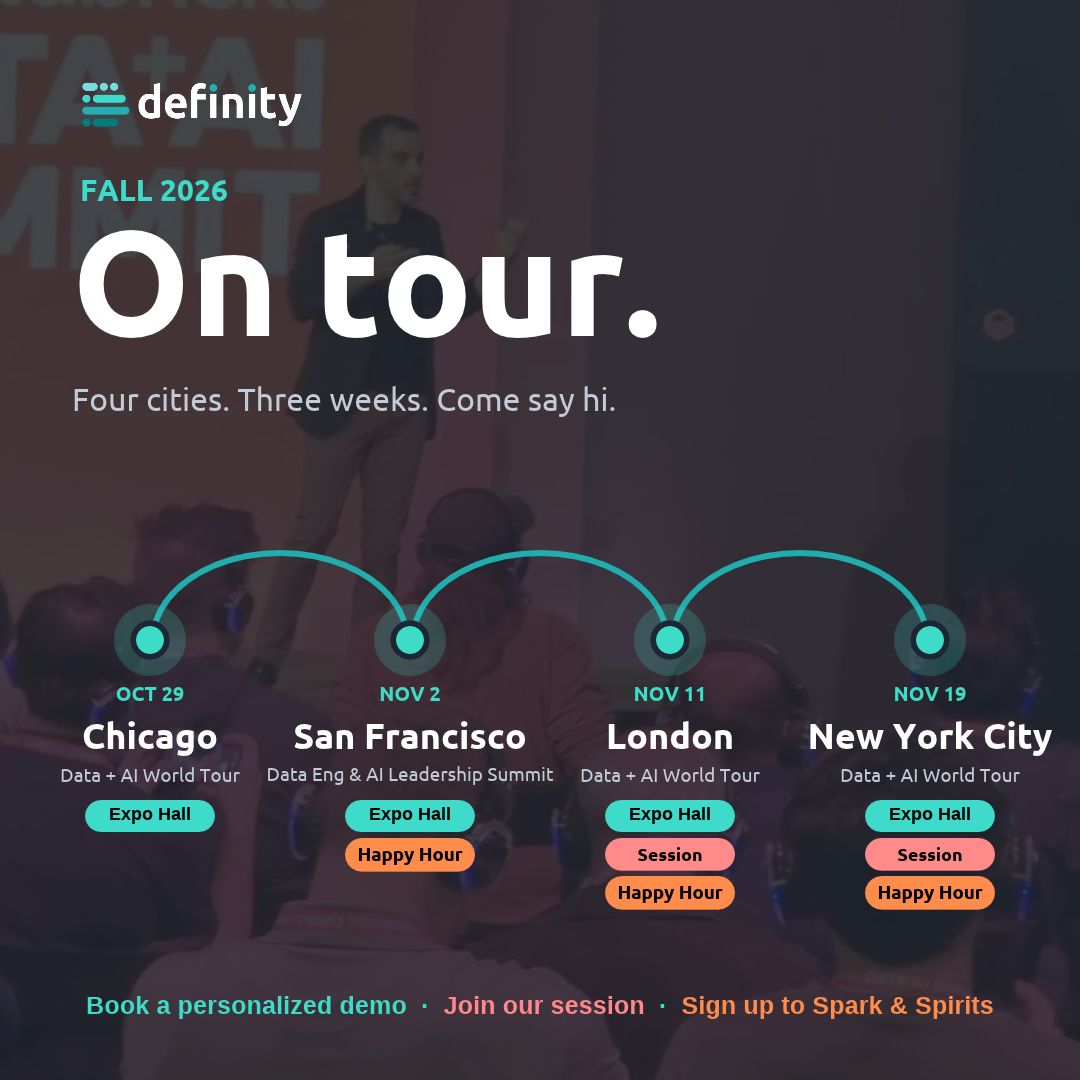
This fall, we’re on the road: 𝗖𝗵𝗶𝗰𝗮𝗴𝗼 → 𝗦𝗮𝗻 𝗙𝗿𝗮𝗻𝗰𝗶𝘀𝗰𝗼 → 𝗟𝗼𝗻𝗱𝗼𝗻 → 𝗡𝗲𝘄 𝗬𝗼𝗿𝗸. ⠀ A packed few weeks with live demos, Spark & Spirits happy hours, and deep technical conversations. ⠀ I’ll also be on stage in London and NYC, talking about 𝗔𝗴𝗲𝗻𝘁𝗶𝗰 𝗖𝗼𝘀𝘁 𝗢𝗽𝘁𝗶𝗺𝗶𝘇𝗮𝘁𝗶𝗼𝗻 𝗳𝗼𝗿 𝗦𝗽𝗮𝗿𝗸 𝗮𝗻𝗱 𝗗𝗮𝘁𝗮𝗯𝗿𝗶𝗰𝗸𝘀. ⠀ One of my favorite parts of the job – connecting in person with the Databricks and Data Engineer Things communities. ⠀ 𝗕𝗿𝗶𝗻𝗴 𝘂𝘀 𝘆𝗼𝘂𝗿 𝘁𝗼𝘂𝗴𝗵𝗲𝘀𝘁 𝗽𝗶𝗽𝗲𝗹𝗶𝗻𝗲. 𝗪𝗲’𝗹𝗹 𝗼𝗽𝘁𝗶𝗺𝗶𝘇𝗲 𝗶𝘁.
- Altinity, Inc.Since 22 Oct 2026
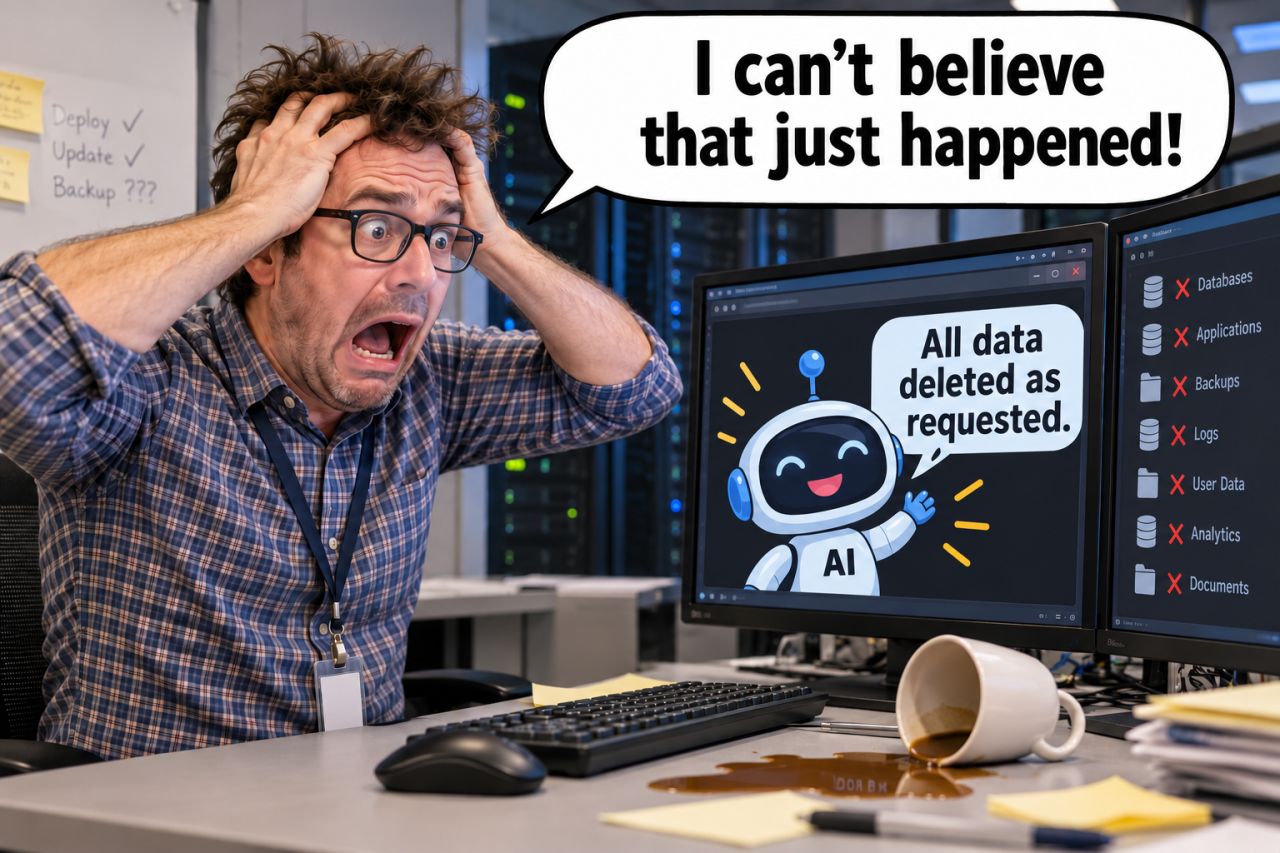
Will AI end up destroying humanity? I don't know, and I doubt anyone else does either. What I do know for certain is AI will destroy valuable data along the way. Database applications have built-in gates to reduce the chance of accidental deletion. The big danger is database administration. At Altinity, Inc. we have seen multiple cases where customer AI agents with admin credentials erased production data. The people running the agents were employees, not attackers. As Pogo said, "we have met the enemy and he is us." Solving the problem is going to be hard. Database administration commonly involves manual procedures and custom scripts--lots of both, often with very high privileges. The working assumption is that very paranoid humans carry these out. That's no longer true when AI agents enter the house. The quick solution is simple: don't use agents for database administration. That includes using ChatGPT and Claude to generate procedures. Of course people will do so anyway, because it's convenient. The fallback is to test the living daylights out of anything you get from an AI agent. Make sure your backups are good, too. The longer solution? For that we need to understand how AI is changing database administration, then start to build in protections systematically. Some of the possibilities include new database security checks, AI watchdog agents, and baking human oversight into the loop. We'll figure it out and the result will be better administration of data. But it will take time. Losing production data is horrible. I did it on a grand scale in my first IT job thanks to a mistake in running backups. So I have some simple advice if you are adding agent-based administration on data you value. Follow the advice of the old Eagle song: "take it easy." And stay paranoid. Paranoia never goes out of style when you manage data. p.s., The image was generated by ChatGPT. It does a good job, but I don't let it anywhere near data. #opensource #databases #ai #chatgpt #claude #disasterrecovery #agentic
- Altinity, Inc.Since 22 Oct 2026
OSA Con 2026 is coming up on November 2nd at the AWS Builder Loft in San Francisco. Matt Topol from Columnar will be doing a talk on Arrow Database Connectivity or ADBC for short. https://lnkd.in/gv2hqd8U If you work on data and don't yet know the Apache Arrow project, you absolutely need to attend this talk. Arrow is replacing 4 decades of incompatible, slow TCP/IP client protocols with a shared protocol for moving columnar data fast. The word "revolution" is pretty overused in tech but it's deserved here. #apache #arrow #opensource #analytics #databases #aws
- ClarityQ Agentic Data AnalysisSince 20 Oct 2026
Your context layer was correct on the day you built it. That much is most likely true, but here is what likely happened since: -> An engineer renames a column in your most used table. The layer still points at the old name. -> Finance changes how a subscription tier is bucketed. The metric definition is now silently wrong. -> A new SKU category launches. Every "by category" breakdown is missing it. None of these are edge cases, they are Tuesday morning cases. A context layer is as far from "one-off" effort as it can get. It's a living system with a maintenance surface, which means at minimum: 1. Schema drift detection. When the warehouse changes underneath, the affected definitions are flagged, not discovered by a wrong answer. 2. Change-aware analyses. If you rerun an analysis from last month and the context it depended on has changed since, you should see an alert, not a different number with no explanation. 3. Version history on every definition. Who changed what, when, and what did the previous version say. Rolling back a metric definition should be as easy as rolling back a commit. 4. Sync with whatever semantic or context layer already exists. Most companies already have some of the knowledge in tools like dbt, Tableau, or alike. And on top, a smart harness with an efficiency layer that tells the agent where exactly to dig in the context, to avoid draining the tokens. The uncomfortable truth: even the most sophisticated agent needs constant care - someone, or something, or both, monitoring and testing the context continuously.
- ClarityQ Agentic Data AnalysisSince 20 Oct 2026
Everyone talks about how the context layer drives accuracy. Almost nobody talks about what it costs to use one. In our opinion, retrieval efficiency - how the agent finds what it needs in the layer - deserves the same attention as the context itself. The tokens spent on a question are set by how much the agent has to read before it finds the right definitions. Take "what was ARPU by region last quarter, excluding internal test accounts". Everything needed is in the layer. The cost depends entirely on how the agent gets to it. With naive retrieval, the agent is like a new employee on day one - smart, but with no one to ask, so it reads everything to answer anything: 1. Finds four revenue-related definitions. Reads all four to decide which is the source of truth. 2. Reads the dimension definitions to learn how region is represented, and whether country, geo or market is the live one. 3. Looks for the test-account rule. It is in the layer, but filed under "internal traffic exclusion", so the search misses it and the agent reads on. 4. Generates, hits an error on a column name it read fifty turns ago and no longer has in context. Re-reads, regenerates. Every step is paid for. The answer may well be correct, but it costs many times what it needed to, takes longer, and gets less reliable as the window fills with material the question never needed. This is why, in our view, retrieval is not a layer you bolt on. It is part of the harness - the tools the agent works through. How it searches. What it uses. When to search again, when to stop, and what to do when nothing is good enough. Done right, the agent receives, before generating anything: - The single source-of-truth definition, not four candidates - The valid dimensions and their real column names - The business rules in scope, even those stored under a different name - The relevant skills: proven ways to answer this, including the SQL All this searching and filtering runs as plain code, outside the model. Code is cheap. Model calls are not, so the less the model reads, the less the question costs. Three more things that keep the cost down: -> Work with the models' cache. Prompt caching rewards stable, well-ordered context. Making the repeating parts hit the cache is a real cost lever, and easy to get wrong. -> Turn research into context. When a metric is not in the layer, the agent researches it from scratch. If people keep asking, that research and the warehouse queries behind it repeat. The agent should notice and propose adding the metric to the layer. -> Promote repetition out of the agent. If "weekly retention by cohort" is asked every Monday, it should stop being an agent query. The agent can notice the pattern and propose a dashboard, same for repetitive reports. The savings depend on schema size and question complexity, but the gap between naive and efficient retrieval is real money. It is the difference between a tool everyone can use freely and one the company has to restrict.





Other LinkedIn formats
Watch the companies you care about.
Filter every ad by industry, country, format and network, and get alerts when a company you watch starts running new ads.