On air · 1 of 3 networks
Intellerts
- intellerts.com
- Data
- NL
- 10 employees
Intellerts’s ads on LinkedIn, Meta and Google, recorded by adsrunning. Browse the latest here for free. Sign up free to see all 36. Watch Intellerts with Starter to get each new one in your feed.
Watchlist with Starter · $49/mo
| Network | Status | Live ads | Nov 2025LinkedIn activity · 52 weeksOct 2026 | Checked | Next step |
|---|---|---|---|---|---|
| Running | 1 | Checked 29 Oct 2026 | See all 36 ads → | ||
| Meta | Not checked | — | |||
| Recently | 5 | Ads on the Google Ads Transparency Center | Checked 1 Oct 2026 | Collect them with the API → |
Intellerts has 1 live LinkedIn ad. We recorded 5 Google ads on 1 Oct 2026.
Latest ads
- LINKEDIN · IMAGESince 22 Oct 2026
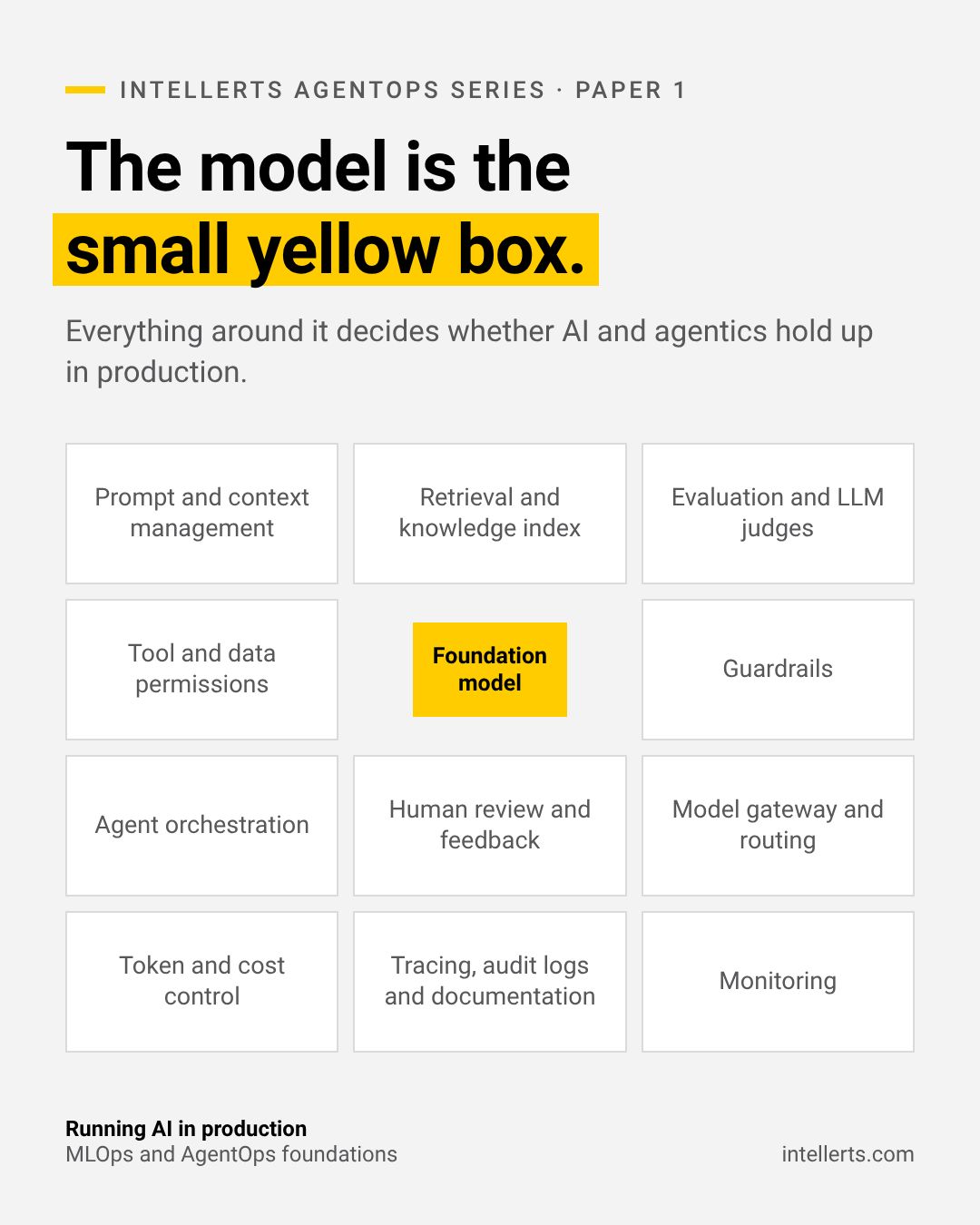
Most AI architecture diagrams have one small yellow box in the middle. That box is the model, and it gets almost all the attention. In every production AI system I have seen, the hard work sits in the boxes around it: evaluation, guardrails, tool permissions, tracing, cost control, monitoring. That is where pilots either become dependable systems or quietly stall. The numbers show it. McKinsey's State of AI 2026: 44% of organisations say AI is scaling across the enterprise, yet only 37% see any EBIT impact. One in five say running costs already hold them back. Agentics makes this layer even more important. Once AI plans, calls tools and acts on its own, you need to know what it did, what it was allowed to do, and what each completed task cost. That operating discipline is AgentOps. Today we publish paper 1 of our AgentOps Series, written by Partnership Professor @Darius Dilijonas for CTOs and heads of AI, data and platform. In fact it's written for anyone who is interested to learn more about the inner workings of Agent- and MLOps. Three questions from it that I'd put to any leadership team this quarter: → Does every production AI system have a named owner and a budget? → Can you show the cost per completed task for your agents? → Has anyone tested how to stop an agent? If any answer is "not yet", the article is a good place to start. https://lnkd.in/epyn2_Jz For those who want the depth, there is a free download of the full research report on our blog. #AgentOps #Agentics #MLOps #AIinProduction
- LINKEDIN · IMAGESince 21 Sept 2026
For over a decade we've watched AI initiatives stall on "the data." Duplicate records, conflicting dashboards, metrics that never reconcile. Leaders call it poor data quality. More often it's the technical residue of a business disagreement nobody ever resolved, and we watch the organisation slowly paint itself into a corner. Ask five departments in the same company "who is an active customer?" and you'll get five answers. Each one correct, yet probably different. Traditional reporting could absorb years of ambiguity, because teams quietly worked around each other's definitions, or found more subtle, unspoken ways to stay aligned. AI tends to consume every domain entirely, with little of that between-the-lines nuance. So every unresolved question about ownership and truth becomes operational overnight. That's a problem if you're trying to implement AI or optimise your data stack. And a tricky one to climb out of, if I may add. AI projects usually don't have a data problem. They have an alignment problem. The evidence is hard to ignore: → MIT: 95% of enterprise GenAI pilots produced no measurable P&L impact → McKinsey: only 37% of firms attribute any EBIT to AI, flat year on year → Gartner expects 60% of AI projects without AI-ready data to be abandoned The organisations pulling ahead aren't buying better models. They're redesigning how work gets done, and agreeing on what the business actually believes to be true before the first line of code. Or at least getting as close to it as they can. Skip that step and you build something we've started calling AI debt. The first project survives. The second gets harder. The fourth becomes impossible to trust. Eventually you spend more effort validating outputs than generating value from them. Sound familiar? So here's a test worth running before your next AI project. Put four things in front of your team: 1. the problem you're solving 2. what success looks like 3. the data it depends on 4. who owns the truth Then see if the four answers actually match. If they do, you're further ahead than most. If they don't, you've got a bit of a mountain to climb, and that's the part we find most interesting. Always glad to compare notes with anyone carrying this kind of mandate. Full article here on our article page: https://lnkd.in/eiA4Hv77 #AITransformation #DataStrategy #AILeadership
- LINKEDIN · IMAGESince 15 Sept 2026
This week we published yet another article that goes deeper into the challenges of building Enterprise grade AI and the Data stacks that need to support it. Excuse the cheesy AI generated illustration, but someone in my team thought it was nice... We found that most organisations still treat AI like 'software'. They evaluate it, buy it, switch it on, expect it working by Friday. That mental model is where the trouble starts. Someone provided us with a very nice 'garden' analogy in one of our earlier articles, which we are keen on borrowing. You see, AI behaves less like a product you install and more like a crop you grow. It draws everything it needs from the ground beneath it. If that ground is thin or compacted, nothing you plant on top will grow, no matter how good the seed (at least not in the long run). And by today's standard, the seed is rarely the problem. Capable models are abundant and often free to start with. The reason so many AI initiatives stall in the same place, somewhere between an impressive pilot and anything that runs in daily operations, is that the ground was never prepared. Our latest piece looks forward, at the foundation worth building on purpose: why a warehouse is not a platform, what governance actually speeds up, and why roughly half of an AI-ready platform is not technology at all. If there is one lesson to take with you: AI tools are not magic, and outcomes are engineered. A capable model on a weak foundation produces fragile results that never earn the trust required to run a business. A modern, governed, well-owned data platform produces the opposite, and it keeps producing long after any single project ends. The most useful question isn't whether the models are good enough. They almost certainly are. It's whether the ground beneath them is ready. Read the full article below. https://lnkd.in/eqZYEwND
- LINKEDIN · IMAGESince 9 Sept 2026
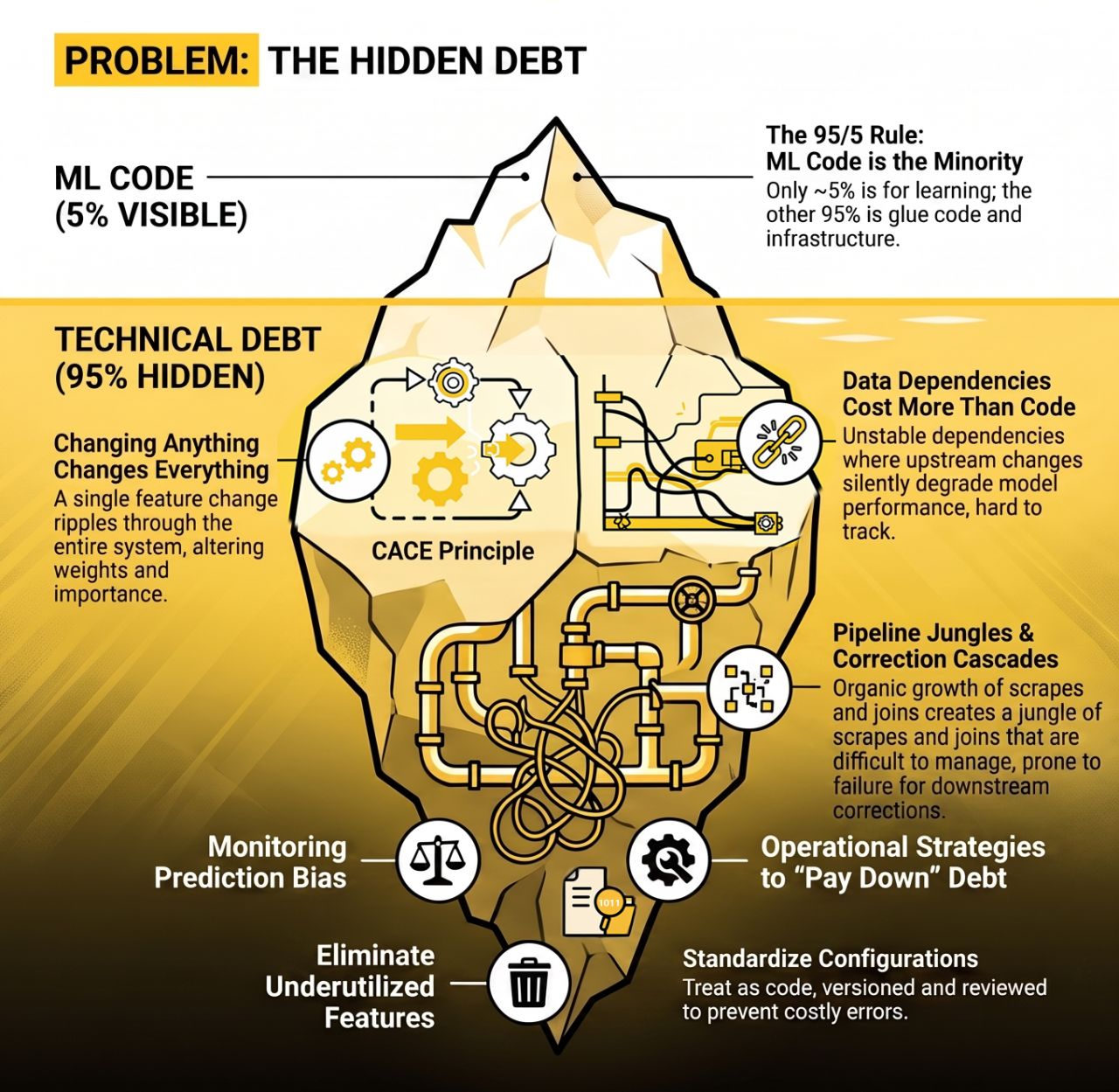
Teams keep telling me their AI projects aren't delivering, so we go and look at the model. The model is almost never where it breaks (exceptions aside). It's usually underneath, in the data foundation everyone assumed was fine, or that got blatantly ignored under the pressure to ship. Hidden technical debt rarely announces itself, causing silent data dependencies with pipelines that got tangled over years of "we'll clean it up later." Or things like a metric that quietly means something different for different departments in different countries they operate in. None of this shows up as a crisis. Rather it shows up as friction, with reports taking longer and business processes that quietly stop behaving the way they used to. Confidence in the numbers erodes a little at a time. Every new use case costs more than the last, because they're building on things nobody wants to touch. Then someone suggested to put AI on top, and AI doesn't forgive ambiguity the way a human analyst does. It scales whatever is underneath it, including the mess. Getting themselves stuck... Sorting it out is mostly unglamorous and unpopular work. It takes clear ownership of data, definitions that hold across business units and markets, pipelines you can change without holding your breath, and a AI-ready data stack solid enough to cope with the supercharger you're strapping on top. With governance built in from the start rather than bolted on later makes a huge difference. All of that is slower than building a demo, of course, but it's the version that survives contact with production. We wrote a more in-depth piece on what this technical debt looks like up close, why it compounds. Worth the read if you're scaling on a stack you're not fully sure of: https://lnkd.in/eFJ3eGNX And if any of this feels familiar, DM me or reach out to the team at https://lnkd.in/e39cCm8e. Happy to talk it through.
- LINKEDIN · VIDEOSince 26 Aug 2026
Google's research on hidden technical debt in machine learning systems showed that the actual ML code is a small piece of what a production system needs. Configuration, data verification, feature extraction, resource management, monitoring, serving infrastructure: all of it sits around the model, and all of it needs to be maintained. Nearly a decade later, this hasn't changed. If anything, it's proven more relevant than ever. Generally, AI systems look simple from the outside. At least that's what they're often polished up to appear: a model, some data, a prediction, and perfect output. By now most are catching on that the engineering reality is different. In this video, Martin does a short walkthrough of that framework and what it means for teams scoping AI work. Worth watching to make sure you avoid technical debt in your AI project. If you're interested to learn more about what our team has developed in terms of papers, guides, and more, feel free to reach out.
- LINKEDIN · VIDEOSince 26 Aug 2026
Generally, AI systems look simple from the outside. At least that's what they're often polished up to appear: a model, some data, a prediction, and perfect output. By now most are catching on that the engineering reality is different. Google's research on hidden technical debt in machine learning systems showed that the actual ML code is a small piece of what a production system needs. Configuration, data verification, feature extraction, resource management, monitoring, serving infrastructure: all of it sits around the model, and all of it needs to be maintained. Nearly a decade later, this hasn't changed. If anything, it's proven more relevant than ever. In this video, Martin does a short walkthrough of that framework and what it means for teams scoping AI work. Worth watching to make sure you avoid technical debt in your AI project. If you're interested to learn more about what our team has developed in terms of papers, guides, and more, feel free to reach out.


6 of 36 adsSign up to see every Intellerts ad, filter by format and date, and get alerts on new ones.
See all 36 adsWatch the companies you care about.
Filter every ad by industry, country, format and network, and get alerts when a company you watch starts running new ads.