On air · 1 of 3 networks
TDK Ventures
- tdk-ventures.com
- Fintech & Financial Services
- US
- 65 employees
TDK Ventures’s ads on LinkedIn, Meta and Google, recorded by adsrunning. Browse the latest here for free. Sign up free to see all 456. Watch TDK Ventures with Starter to get each new one in your feed.
Watchlist with Starter · $49/mo
| Network | Status | Live ads | Nov 2025LinkedIn activity · 52 weeksOct 2026 | Checked | Next step |
|---|---|---|---|---|---|
| Running | 227 | Checked 30 Oct 2026 | See all 456 ads → | ||
| Meta | Not checked | — | |||
| None recorded | 0 | No ads found on the Google Ads Transparency Center | Checked 16 Oct 2026 | Collect them with the API → |
TDK Ventures has 227 live LinkedIn ads. We recorded no Google ads on 16 Oct 2026.
Latest ads
- LINKEDIN · IMAGESince 28 Oct 2026
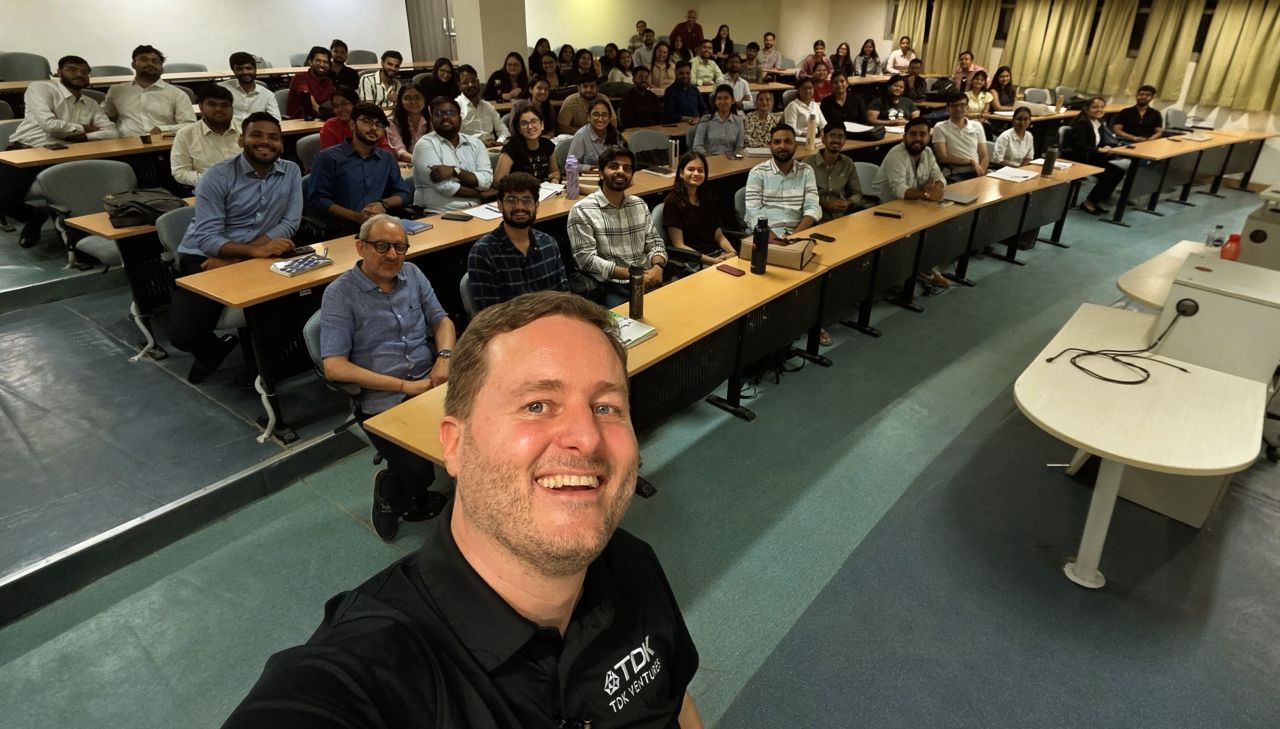
In 2003, I lost £20 in a London Business School classroom. What I learned helped me ask a good friend on a date. Professor Zeger Degraeve had offered a wager involving a drawing pin hidden beneath a cup. Before revealing the result, we spent roughly two hours examining whether my decision to play made sense. Eventually, the full class agreed that it did. Then the cup was lifted. I had lost, and the class changed its verdict. The information available when I made the decision had not changed. Knowing the outcome had changed how we judged it. I recently shared this story with students at BML Munjal University. Their questions brought us to a challenge that matters well beyond investing. A good outcome can teach a team the wrong lesson. A founder wins a customer through unsustainable customization. An investor earns a return despite weak diligence. A corporate project succeeds because colleagues absorb an extraordinary workload. The result may deserve celebration. The method still deserves examination. Before your next consequential decision, record what you know, what you believe, and what would make you reconsider. When the result arrives, ask: * What did we know? * What did we not know? * What did we believe to be true? * What happened? * What will we change? Include successful decisions in that review. They shape what your team will repeat. I have shared the fuller story, including the personal decision it helped me make, and a practical five-question decision note in From Frontier to Iconic. Thank you to Professor Kulbir Lamba and the BML Munjal University students for such a thoughtful conversation. Read "Before We Knew How It Would End": https://lnkd.in/gQctEG3n Which successful decision would your team learn most from examining again?
- LINKEDIN · ARTICLESince 27 Oct 2026
📰 For a startup, a six-week wait can mean two payrolls. In this edition of Corporate Venturing Insider, Benji Coetzee from KPN shares how her experience as a founder shaped her approach to corporate partnerships. 💡 We discuss why paid pilots matter, how internal sponsors build support, and when founders should walk away, or return when the timing is right. "Is it a no for now, or is it a no forever?" 🎧 Read the highlights below and follow the link to our full conversation.
- LINKEDIN · IMAGESince 26 Oct 2026
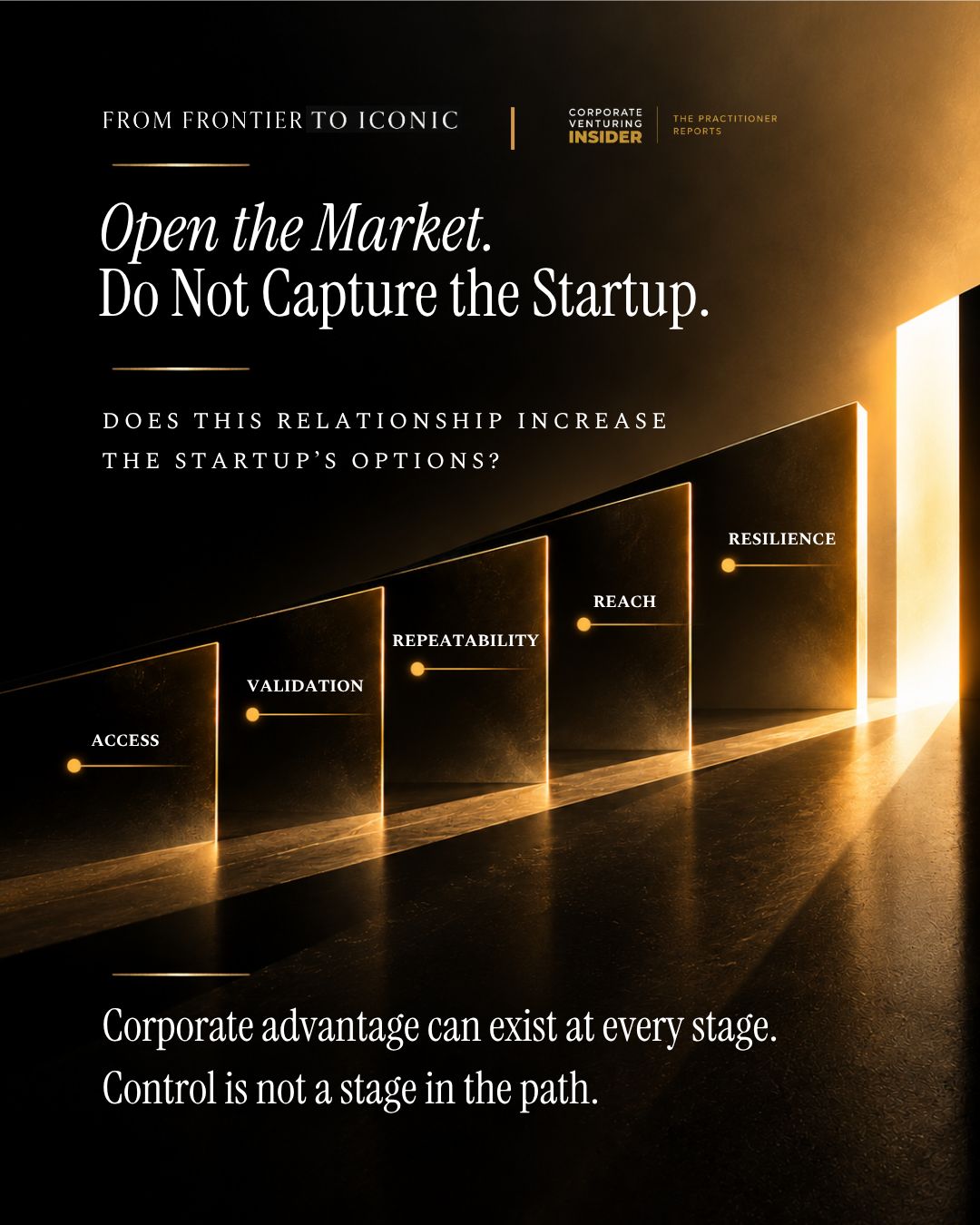
A corporate partnership can become a startup's strongest bridge to the market. It can also become a wall around the company. The same corporate logo can open the next door or close the others. The same custom project can create valuable proof or consume the product roadmap. The same strategic right can protect a real corporate commitment or signal that the startup is no longer fully independent. The problem is not closeness. Deep integration can be enormously valuable. The real question is whether that integration increases or reduces the startup's options. 💡 A strong corporate relationship should create two results at once: a justified advantage for the corporation and a larger opportunity set for the startup. Drawing on practitioner conversations across automotive, aerospace, agriculture, industrial technology, financial services, and other sectors, I synthesized a five-stage Market-Opening Path: Access → Validation → Repeatability → Reach → Resilience The corporation opens a real operating environment. The startup earns credible proof. That proof becomes a reusable capability. The capability reaches additional customers and markets. The company becomes more resilient and less dependent on any single relationship. Corporate advantage can exist at every stage. Control is not a stage in the path. Before deepening a corporate-startup partnership, I would ask: 🔎 Is the custom work producing reusable capability, or only serving one corporation? 📌 Are special rights matched by measurable commitments, narrow scope, and a clear expiration? ⚙️ Can the startup use the relationship as proof with other customers and investors? 🛑 Could the terms discourage reasonable competitors, future financing, or independent decisions? 🌐 If this corporation becomes the startup's largest customer, will its involvement make the next customer easier or harder to win? One principle from GM Ventures captures the balance well: aim to become the startup's first and best customer, but never its only customer. This is the subject of my new From Frontier to Iconic article and the third Corporate Venturing Insider Practitioner Report: Open the Market. Do Not Capture the Startup. The article is public and provides practical guidance for founders, investors, and corporate leaders. The complete report, including the partnership framework and 24-point diagnostic, becomes available when a reader introduces six new subscribers to From Frontier to Iconic. 🔗 Read the article and learn how to unlock the report: https://lnkd.in/gvwWk8Fc
- LINKEDIN · IMAGESince 23 Oct 2026
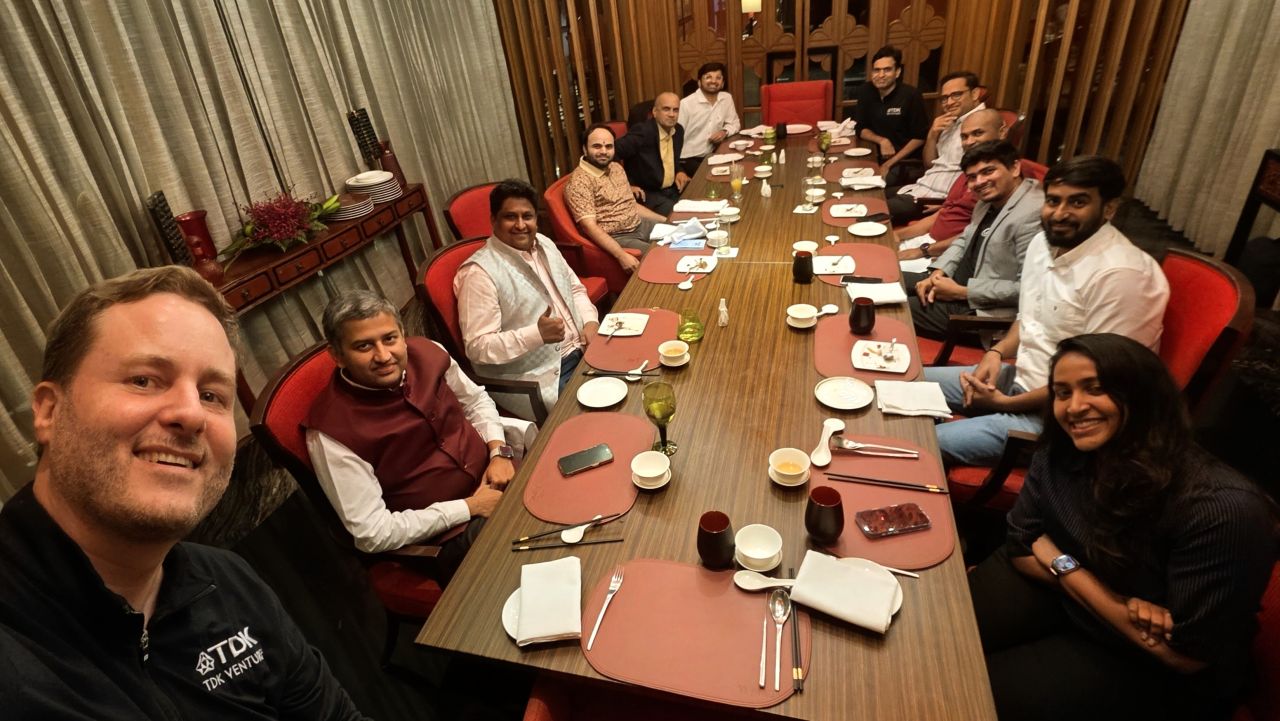
At a recent founders' dinner in Hyderabad, I asked everyone a simple question: Is building your company in India an advantage or a disadvantage? Most said it was an advantage. But their reasons were remarkably different. Some pointed to customers willing to adopt new technologies. Others mentioned specialized engineering talent, infrastructure built over decades, emerging local suppliers, or the ingenuity of accomplishing more with limited resources. One exchange was particularly interesting. A founder building quantum computers described how difficult it can be to source highly specialized equipment. Across the table, another founder developing advanced optical systems suggested that a manufacturer in his network might have relevant capabilities. They began comparing technical requirements. No promise of a partnership, with the technical fit still uncertain at the end of the dinner. But the conversation illustrated something important: Sometimes a disadvantage for one startup becomes the opportunity for another to build a capability that many companies could eventually benefit from. Three questions I took away for entrepreneurs everywhere: 1️⃣ What constraint have I learned to accept that might actually be a business opportunity? 2️⃣ Could solving that problem create a valuable capability for customers beyond my first market? 3️⃣ Who else is facing a related challenge, and what could we learn from one another? I wrote my field notes from the dinner, drawing on the founders' experiences across space optics, high-altitude platforms, quantum computing and sensing, advanced energy, and autonomous aircraft. I believe their insights will be useful to other entrepreneurs thinking about how to build globally competitive companies. My thanks to all the founders for such generous and thought-provoking conversations, to Dharsha Udayakumar and the T-Hub community for bringing everyone together, and to Ravi Jain and Vasan Churchill for engaging in this special evening. When one startup's solution makes the next startup easier to build, an ecosystem begins to compound. My field notes: https://lnkd.in/g9XE-kbT
- LINKEDIN · VIDEOSince 22 Oct 2026
The ambition behind 100X is to help founders deliver two orders of magnitude improvements for society and our planet. 🌍 Louis Lehot captured that spirit beautifully in his reflections on 100X 2026. Thank you, Louis and the Foley & Lardner LLP team, for joining our 100X partnership program and for sharing the golden nuggets with a wider community. I'm grateful for both your support and the care you took to explain what we are working toward. Two insights from Louis's article stayed with me: ⚡ AI's progress depends on the energy infrastructure supporting it. Power availability, grid capacity, and deployment realities increasingly shape what becomes possible. 🤝 Breakthroughs reach scale through relationships built over time. His account of Chuck Mattera's session highlights the patience and discipline behind decades of company building. For a founder, these ideas belong together. The path to a much larger impact often runs through a constraint that another organization understands deeply. That leaves me with a practical question: which partner could help a founder overcome the next barrier to deploying their technology? This is what we want 100X to make possible: founders, investors, industry leaders, and partners learning from one another and finding ways to build together. Louis, thank you for helping those conversations reach beyond the room. Sharing what we learn gives more people a chance to build on it. For those building or backing companies where energy and AI meet, his article connects the infrastructure challenges with lessons from experienced company builders. Well worth reading. 👇 https://lnkd.in/gFSJcB5J
- LINKEDIN · IMAGESince 21 Oct 2026
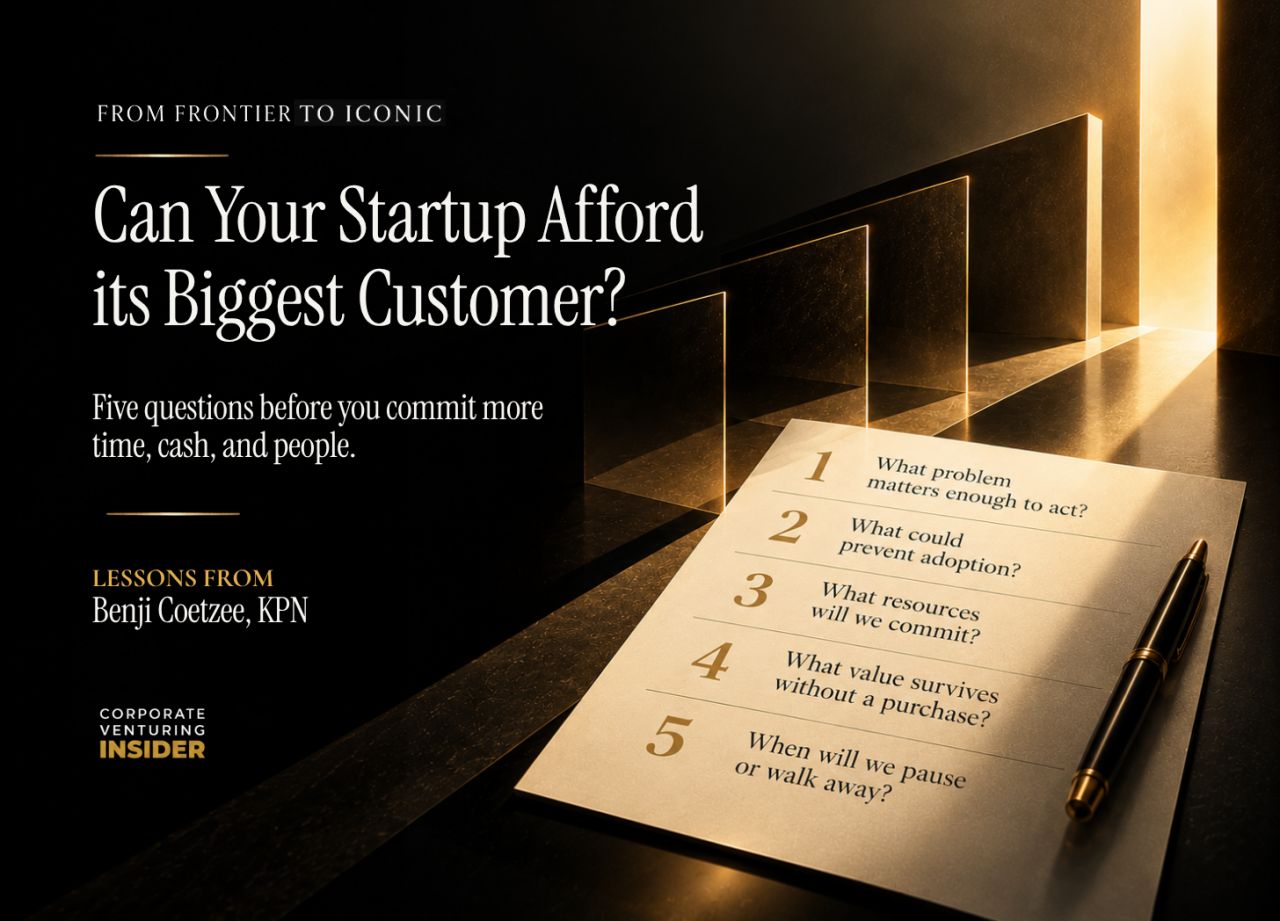
🔎 Can your startup afford its biggest prospective customer? When a prospective corporate customer suggested meeting again in six weeks, Benji Coetzee counted two payroll runs. A CFO then offered to pay for the proof of concept. She described it as a saving grace. In our Corporate Venturing Insider conversation, Benji, KPN's Chief Strategy and Growth Officer, explained how that founder experience shaped her approach to corporate partnerships. 💡 Before committing more resources, ask what value the startup would retain if the pilot succeeded but no larger contract followed. Payment may be part of the answer. Useful learning, access to data, or evidence that opens a new market may also justify the work. The answer should be specific enough to guide how much time, cash, and team attention you commit. In the article, I bring her observations into five questions founders can use to assess a corporate opportunity, identify barriers to adoption, and set a limit on the resources they put at risk. I also explore how corporate sponsors can make the relationship more viable. 📖 Read "Can Your Startup Afford Its Biggest Customer?" in From Frontier to Iconic. Subscribe there for practical reflections on how frontier technologies become global companies. https://lnkd.in/g9NuFBhm

6 of 456 adsSign up to see every TDK Ventures ad, filter by format and date, and get alerts on new ones.
See all 456 adsWatch the companies you care about.
Filter every ad by industry, country, format and network, and get alerts when a company you watch starts running new ads.