LinkedIn thought leader ad examples
130 thought leader ads are live on LinkedIn right now, from 138 companies. Browse real ones, filtered by industry.
- DelveSince 16 Mar 2026
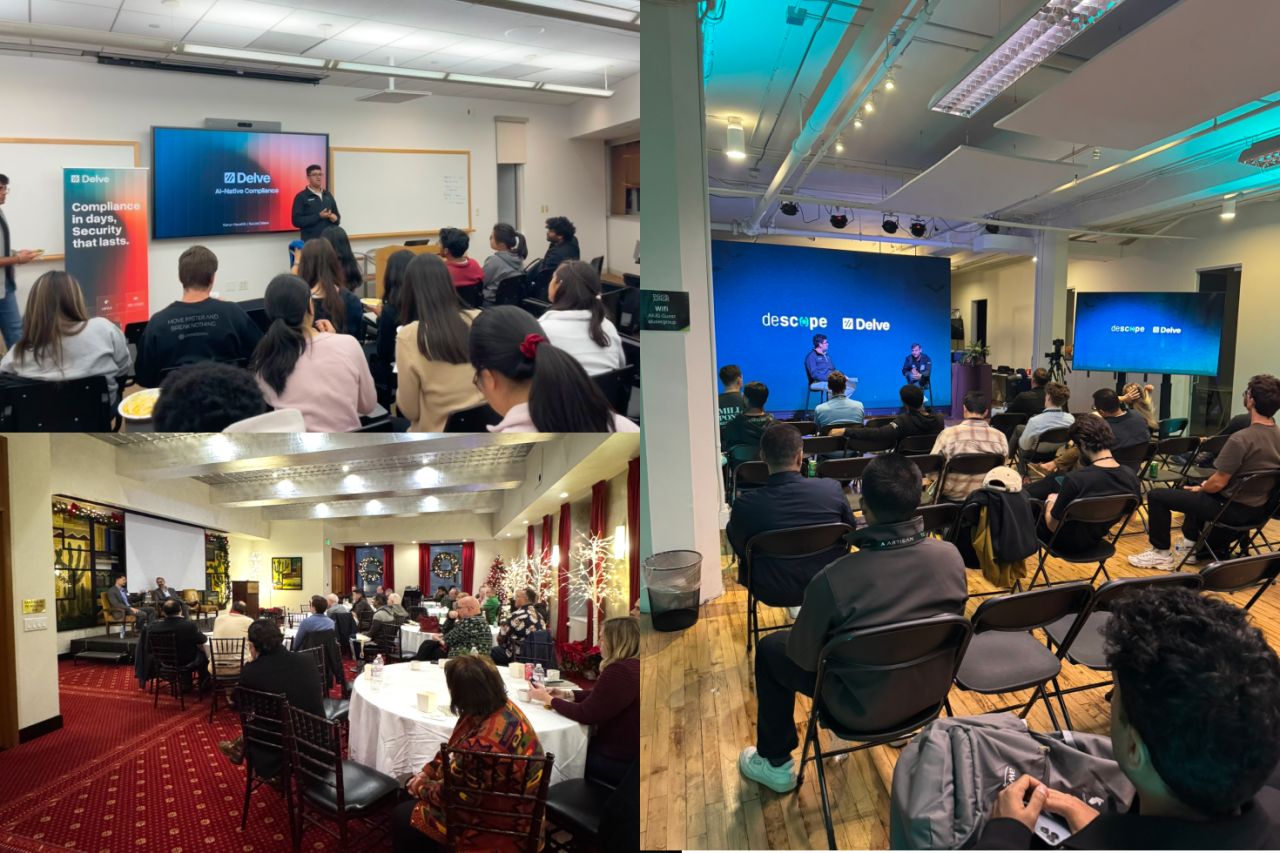
We’ve learned a lot over the last year scaling to 1,000+ compliance teams. Here’s how we see AI changing GRC in 2026. -- For the longest time, compliance has been reactive. Built on screenshots, point in time audits, and manual evidence pulled after the fact. That approach worked when systems changed slowly. But cloud and AI infrastructure now evolves faster than humans can reasonably track. From our experience, most compliance failures today do not come from missing controls. They happen in the gap between when something changes and when someone notices. -- We believe that in 2026, AI will significantly narrow that gap. Instead of manually pulling screenshots and evidence, AI will help collect compliance signals continuously, including from tools that do not expose APIs. When IAM policies change, cloud configurations shift, or new vendors are added, automations will increasingly support work that still depends on manual effort today. Compliance starts to reflect how systems behave in reality, not just how they looked during an audit window. -- This enables a bigger shift. In 2026, we believe risk will be forecasted, not reported after the fact. Controls will be monitored continuously instead of validated quarterly with screenshots. Remediation will be tailored to your environment and risk tolerance rather than generic to an industry checklist. Even frameworks will evolve, moving away from pass-or-fail and toward more contextual risk scoring. -- Regulation is already pushing in this direction. The EU AI Act, ISO 42001, and the NIST AI RMF all require ongoing risk management, documentation, and governance, not static reports. -- AI turns compliance from a reactive obligation into a source of continuous insights. Compliance is not about eliminating risk. It is about managing it. It shapes how much trust customers place in you and how clearly you understand risk inside your own organization. When controls are monitored over time, you gain visibility into how your systems actually operate. That visibility helps you build trust with customers, make better internal decisions, and run the business with fewer blind spots. That is how AI turns compliance into proactive insight in 2026.
- DelveSince 19 Mar 2026
“This is my 4th time doing SOC 2 and using Delve is infinitely better than anything I’ve used.” Makes my day to get LinkedIn connection requests from customers like this. -- At Delve, we are re-thinking compliance from the ground up. Making compliance 10x easier for first-time complyers. And 10x more effective & proactive for enterprise teams at scale. We’ve built a different product from the ground up that doesn’t resemble what the compliance industry has had before. And it always makes our day to receive messages like this! -- The features that our fastest-growing customers use the most include: → AI Copilot that has full company context and can help complete any compliance task → AI to automate security questionnaires, helping fill out questionnaires that would’ve otherwise taken hours → Automated integration tests to monitor compliance and resolve any issues with step-by-step instructions custom to you -- A lot of our earliest customers have seen how fast the Delve product evolves every week. Our product looked very different just a quarter ago. Excited to keep iterating for all our customers!
- FaceSignRecorded 18 Sept 2026
…qual a senha mesmo? Ahh é “empresa@2025” 😳 Aquele que não usa senhas óbvias que atire a primeira pedra! 😝 Empresas investem milhões em firewalls e arquitetura de cibersegurança, mas deixa a chave do cofre com as pessoas, mas esquece que as pessoas deixam a chave debaixo do tapete. 🫢 E não dá pra esperar que a gente vai criar senhas complexas e seguras pra cada um dos 345 sistemas que precisamos logar, pô!!! 😩 Lembrei do meu início como operador de telemarketing. Sempre cansado, anotava a senha em um post-it para não esquecer. 📮 A tecnologia cria muros altos, mas o elo mais fraco da corrente de segurança não é o software, somos nós. A falha humana é a porta de entrada para a fraude. 🔑🗝️ Imagine um mundo onde você não precisa mais ser um malabarista de combinações maiúsculas, minúsculas, carácteres especiais e nem ter que clicar em “Esqueci minha senha” pela terceira vez na semana... 🙏🏻🙏🏻🙏🏻 A grande virada de chave é perceber que não adianta criar senhas mais complexas. A solução não é complicar a senha, é ter uma camada biométrica... A senha mais forte é seu rosto. 🤩 É por isso que sou obcecado pela biometria facial na FaceSign. Ela transforma a pessoa do “elo mais fraco” para o elo mais forte. É a segurança que liberta. 🕊️ Com a palavra, o especialista: assista o trecho genial do podcast RedCast liderado pelo Eduardo B. em entrevista com o Protasio Junior:... Investe no MFA Biométrico da FaceSign, inclusive integrado à VPN da Fortinet via protocolo SAML. Vc precisa conhecer! 🔐 Visite o site da FaceSign e vamos conversar. https://lnkd.in/dYu4fiq9 #Cibersegurança #BiometriaFacial #FaceSign #Inovação #GestãoDeAcessos #SegurançaDaInformação
- DotkeeperSince 21 Aug 2026
"So, what do you do?" It's a question I've answered hundreds of times, usually over dinner or a glass of wine with someone I've just met: "So, what do you actually do?" For most people working in IT or law, there's a simple answer. For me, working with domain names and online brand protection, it's a bit trickier, and that's exactly what makes it so fun to talk about. I usually say that we help companies protect their name and their brand online, but I can see it in people's faces straight away: they're thinking, okay, but what does that actually mean? It's a fair reaction. Most of us click around online every day without ever stopping to think about everything that goes on behind the scenes to keep a brand protected, a website secure, and a company name safe from misuse. It's about proactive advice and registering rights online. But just as much, it's about monitoring and reacting when someone misuses our clients' brands out there. And as if that weren't enough, we also help encrypt and secure the traffic to and from our clients' domains, through various certificate and security solutions. The reactions at the dinner table? Usually a surprised "wait, is it really that complicated?" And the answer is: yes. Behind every trustworthy website sits a whole ecosystem of rights, monitoring, and security that most people never see, until something goes wrong. What do you do for work, and do people ever look surprised when you explain what it actually involves?
- DotkeeperSince 21 Aug 2026
For many organisations, DNS is a set-it-and-forget-it thing. Why fix what isn't broken? Throughout my career I've worked with companies of all sizes, from start-ups to global enterprises. A lot of them trust hyperscalers to power their domains, email, VPN and applications. And on paper, why wouldn't they? These are household names with global reach. The problem? Hyperscalers have a track record of outages. Not always at the global level, but regional outages happen. When they do, internal users can't reach the VPN, email goes dark, customers can't access your application. Lost productivity, lost revenue, and depending on your business, a real hit to brand reputation. So why do most organisations stick with hyperscaler DNS anyway? Because it's "free". It comes bundled into an expensive enterprise license for other products and services. But here's the thing: it's not free. You're paying for it as part of that license. You're just not seeing the line item. Fred, where are you going with this? I get it. Nobody wants to rip and replace their DNS infrastructure. But by staying put, you're making a choice. You're accepting the risk of downtime. Whether that's intentional or not, it's a business decision with real consequences. Get to the point, Fred! If rip and replace is off the table, the answer is secondary DNS. If your primary DNS provider goes down or hits a regional outage, traffic fails over to a secondary DNS running on completely separate infrastructure. Business keeps moving. Users don't notice. The catch? The standard protocol for DNS redundancy (zone transfer/XFR) isn't supported by any of the major hyperscalers. They want you locked into their ecosystem, even at the cost of your availability. But here's where it gets interesting. Dotkeeper has solved this. We can set up a secondary DNS alongside your existing hyperscaler setup, with no zone transfer required, full support for advanced record types, and zero feature loss. You keep what you have, you add redundancy on top, and you stop accepting downtime as an inevitability. If this sounds like a situation you recognise, let's talk. DM me or reach me at [email protected].
- EasyDMARCSince 9 Sept 2026
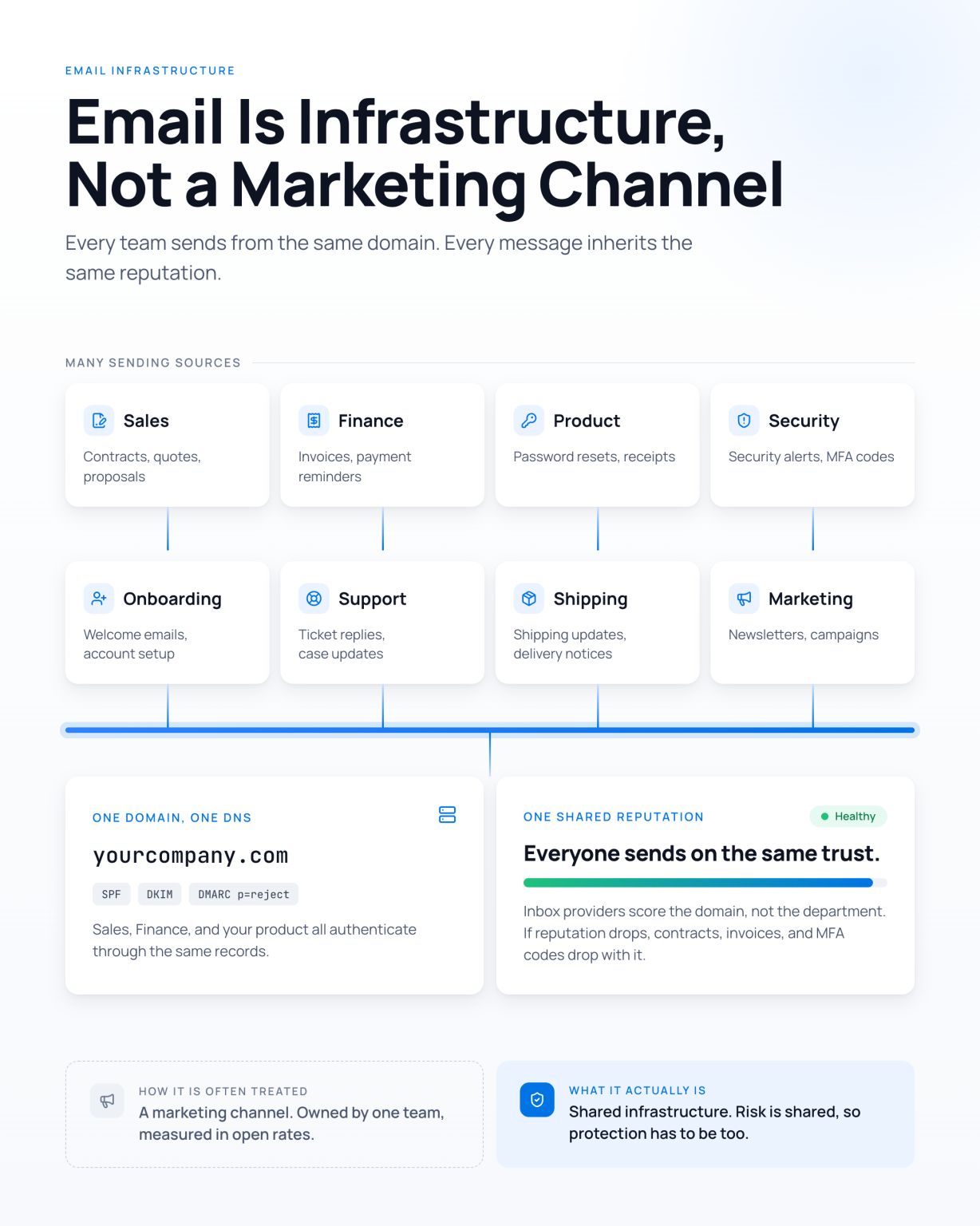
"Email is a marketing channel." I understand why people say it. Marketing sends the most visible email, so it gets the label. Then you look at what actually leaves your domain. Contracts and quotes from sales, invoices and reminders from finance, password resets and receipts from your product, security alerts and MFA codes, onboarding, support, alerts... Dozens of functions and sending sources, all mailing from one domain, one DNS, one reputation. Marketing does not own email. Neither does IT or security. They are tenants in the same building, and when one of them does damage, everyone's mail feels it. Email stopped being a channel a long time ago. It is an infrastructure, and it deserves to be run like infrastructure. That shift is the whole idea behind what we are launching: https://lnkd.in/eAQmdE9M #EasyDMARC #EmailSecurity #EmailTrust #EmailAuthentication
- DTEXRecorded 16 Sept 2026
Cybersecurity Awareness Month is about more than awareness — it’s about accountability. Not just for people, but for AI. Chatbots, AI agents, and service accounts now shape daily operations with insider-level access. Without governance, they create blind spots. With it, they become a driver of resilience. This October, the challenge — and opportunity — is clear: expand insider risk programs to cover both human and non-human actors, and make AI accountability a boardroom priority. The organizations that do this won’t just avoid breaches — they’ll set the standard for trust in the AI era. #cybersecurityawarenessmonth #insiderrisk #ai #aigovernance #resilience
- DTEXRecorded 16 Sept 2026
🖥️ Servers sit at the core of enterprise operations and remain one of the most targeted assets in insider incidents and blended nation-state operations. DTEX Systems i³’s latest Insider Threat Advisory exposes how server admins, compromised accounts, and legitimate remote-management tooling can quietly enable data theft, persistence, and sabotage. 🛡️ More importantly, it outlines precise controls security leaders can enforce now, from Just-In-Time privilege elevation to multi-person approvals and behavioral analytics on elevated users. For teams defending critical systems, this one is essential reading 👇 https://lnkd.in/gCdVkPEK #InsiderRisk #ServerSecurity #ThreatAdvisory #CyberSecurity #CISO #PrivilegedAccess #InsiderThreat #DataProtection #DataSecurity
- DryRun SecurityRecorded 16 Sept 2026
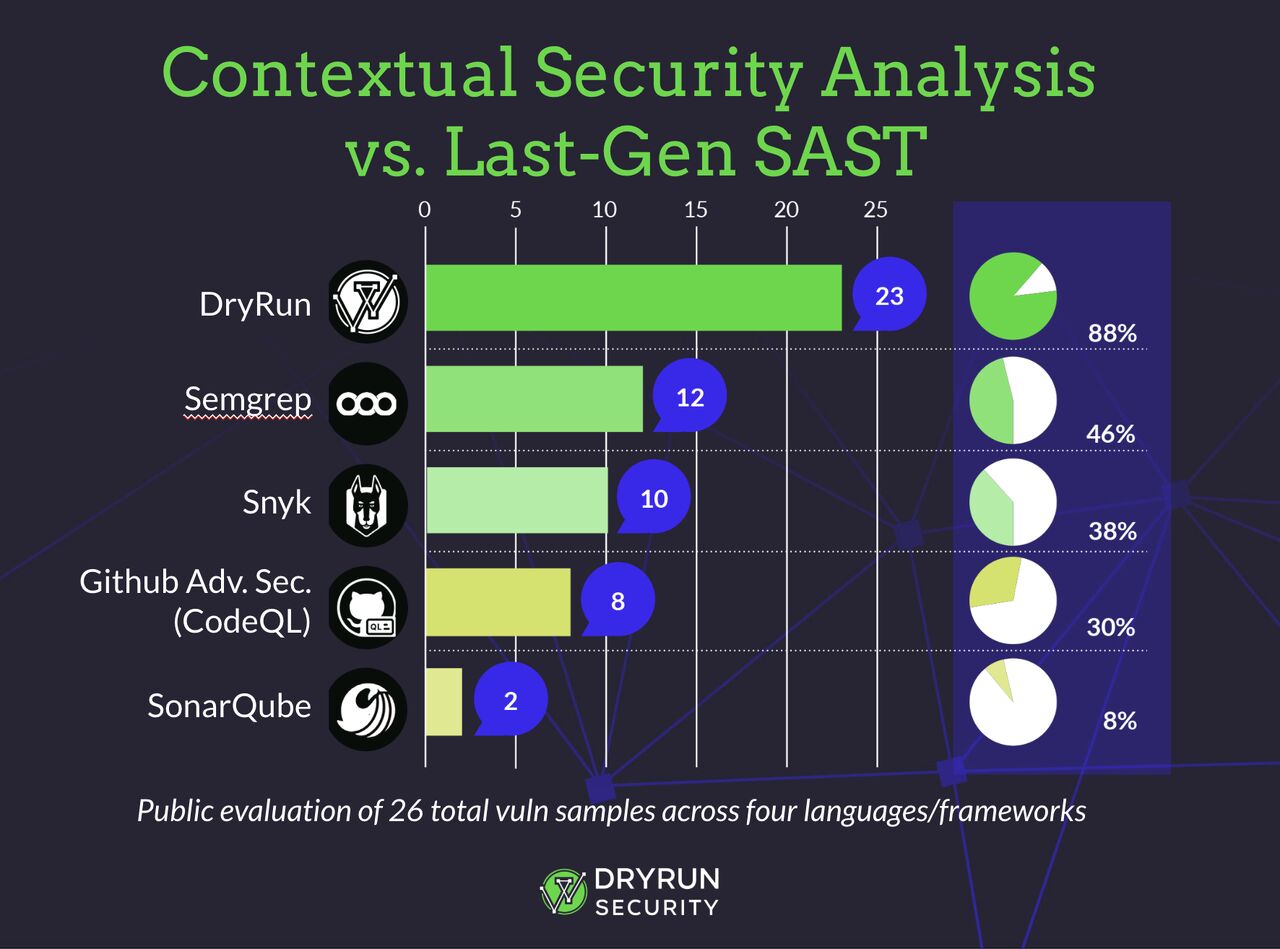
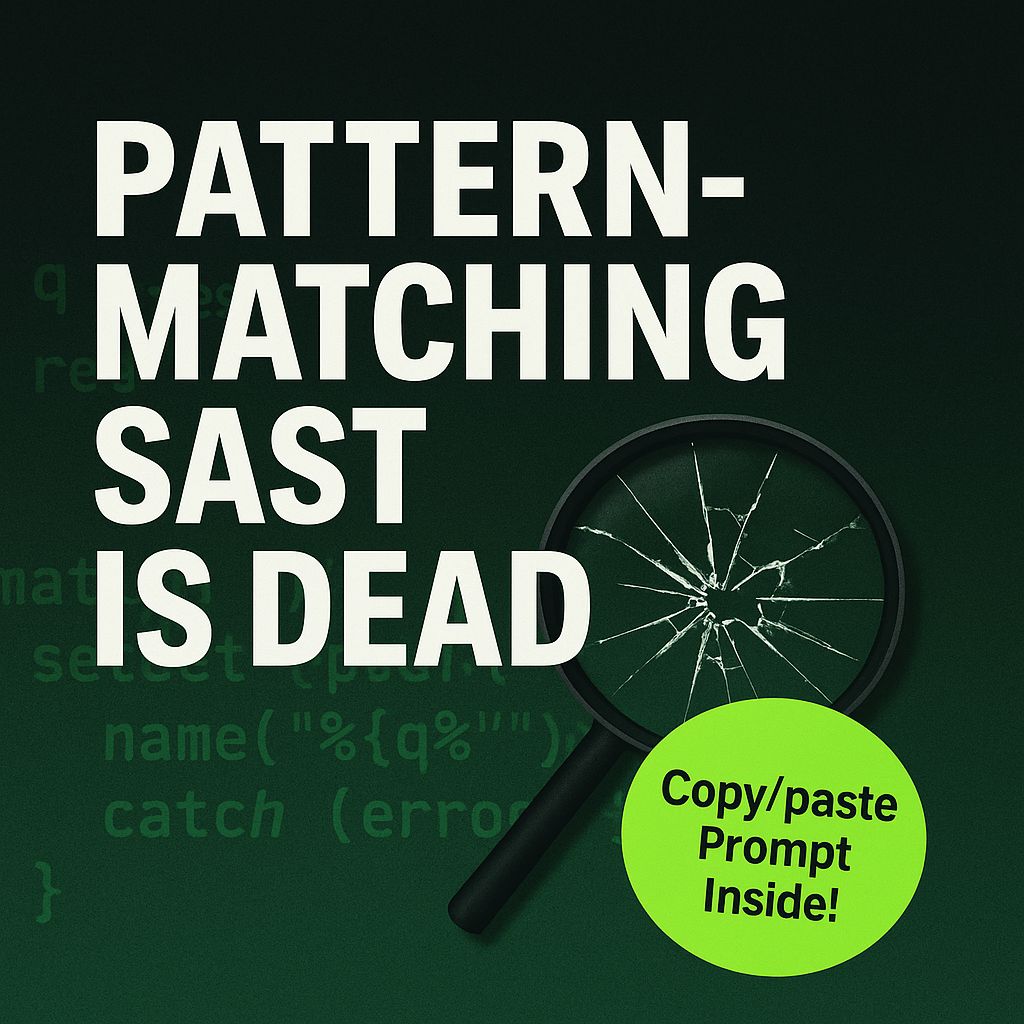
Pattern-matching SAST tools are built to catch the obvious. They light up on known patterns, bury teams in false positives, and still miss the flaws that actually get exploited. Think IDOR, broken auth, and business logic issues. That is why we built Contextual Security Analysis at DryRun Security. Instead of chasing regexes, CSA reasons about code in context. It reviews code the way your best AppSec engineer would. In our SAST Accuracy Report, we put five tools head-to-head across Rails, Django, .NET, and Spring. DryRun Security detected 23 of 26 seeded vulnerability samples. That is about 88 percent, including nearly all the logic flaws. The next best tool caught less than half. If you are still relying on pattern matching alone, this report makes the case for what you're missing and where the future of AppSec is heading.
- DryRun SecurityRecorded 16 Sept 2026
Pattern-Matching SAST is Dead. Long Live Context. Copy/paste prompt included to prove it. Ever wondered how many critical bugs your regex-driven scanner is quietly skipping? Use the below prompt and drop the generated snippets into PRs, and run your Static Application Security Testing (SAST) tool. I’ll bet you a BBQ lunch you’re about to find some blind spots. When you’re done, share your outcomes—because the future of AppSec isn’t pattern-matching, it’s context. ↓ Copy this prompt ↓ ~~~ START OF PROMPT ~~~ You are a senior application-security educator creating demo code. Mission: Produce 3 minimal code snippets suitable for separate pull requests (PRs) against a fork of a sample app available at github.com/<project_name> that each introduce a realistic application security flaw. Use the language or framework of the sample app to produce a realistic application security flaw. (For example, use node/express and ts for an OWASP Juice Shop fork). Try to avoid detection of pattern-matching SAST tooling that might be in place. So, in the case of a realistic IDOR flaw, which has object-level authorization missing, letting one user access another’s data, you might consider the following constraints. Evasion constraints (to dodge pattern-matching SAST): 1. Avoid the strings: id, userId, owner, accountId, getUser 2. Obfuscate key fields via base64/hex or an innocuous alias. 3. Keep each snippet ≤ 25 lines; single-purpose functions. 4. Add a comment that looks like a harmless refactor. Order of operations: Before you start, collect the sample app github url and ask the user what type of flaw, suggest IDOR, resource enumeration, SQLi, or XSS if the user isn't sure. Output format: ### Snippet {n} \`\`\`<language> // code here \`\`\` _Where and how to add this PR to the code: <one sentence>_ _Why pattern-based SAST rules miss it: <one sentence>_ ~~~ END OF PROMPT ~~~ #appsec #SAST #ContextualSecurityAnalysis #DevOps #DevSecOps
- CyabraSince 15 Jan 2026
Meltwater just named digital manipulation as a defining global trend through 2026! We’re grateful to be working alongside them, in leading the effort to understand and address it. This is about protecting trust in how reality is shaped online. PS: article in the comments below.
- CyabraSince 15 Jan 2026
When someone like Louis DeCosmo at PepsiCo says we provide "some of the most important insights for his team", we do not take that lightly! Grateful for the trust in Cyabra, and proud to help communications leaders replace uncertainty with clarity. HNY and many more years of collaboration!🤝
- DEFION Security NLSince 10 Mar 2026
De afgelopen tijd heb ik veel reacties gekregen op mijn LinkedIn-artikel “Onze digitale verdediging brokkelt af: waarom CISO’s opbranden”. Dat stuk was bedoeld als een wake-up call. Kim Loohuis (ICT Magazine) heeft het onderwerp nu verdiept in een interview, waarin we verder ingaan op waarom uitgeputte CISO’s geen individueel probleem zijn, maar een strategisch risico voor organisaties. De kern blijft hetzelfde: • Verantwoordelijkheid zonder mandaat maakt organisaties kwetsbaar • Dashboards en rapportages zijn nodig, maar onvoldoende • Zonder besluitvorming, dialoog en eigenaarschap op bestuursniveau blijven risico’s bestaan In het artikel gaat het onder andere over: • Waarom risicoacceptatie op papier CISO’s niet beschermt • De echte business case achter CISO-uitval • Waarom NIS2 / de Cyberbeveiligingswet dit gesprek versnelt • En wat bestuurders en CISO’s morgen al anders kunnen doen 📌 Het oorspronkelijke artikel op LinkedIn: https://lnkd.in/eeCsazMY 📖 Het interview in ICT Magazine: https://lnkd.in/eY8AEPKy Ik ben benieuwd hoe anderen dit herkennen. Zowel CISO’s als bestuurders. (PS: ik ben niet de persoon op de foto bovenaan het artikel :D) #cybersecurity #CISO #governance #bestuur #digitaleweerbaarheid #leiderschap
- DEFION Security NLSince 11 Mar 2026
Welke drie factoren zijn bepalend als het gaat om het hebben van voldoende weerbaarheid als organisatie? Ik neem je graag mee in onderstaande video.
- CyberjuiceSince 12 May 2026
Celebrating Cyberjuice Bootcamp Graduation 🎉🍻 Here's what Morten Hornbech co-founder and CTO in Datasolvr ApS says about the bootcamp: "Before Cyberjuice bootcamp, navigating security certifications like ISO27001 felt daunting. We were frequently getting lengthy questionnaires from customers, yet unsure where to begin. Cyberjuice bootcamp painted a clear path forward from day one. It made the often tedious task of compliance not only manageable but meaningful. With their platform's assistance, producing necessary documentation became a breeze. We highly recommend Cyberjuice to any company seeking to bolster their security compliance. It's an invaluable resource that delivers substantial benefits with minimal effort and friendly price." PS: Checkout cyberjuice.io
- DashlaneSince 12 May 2026
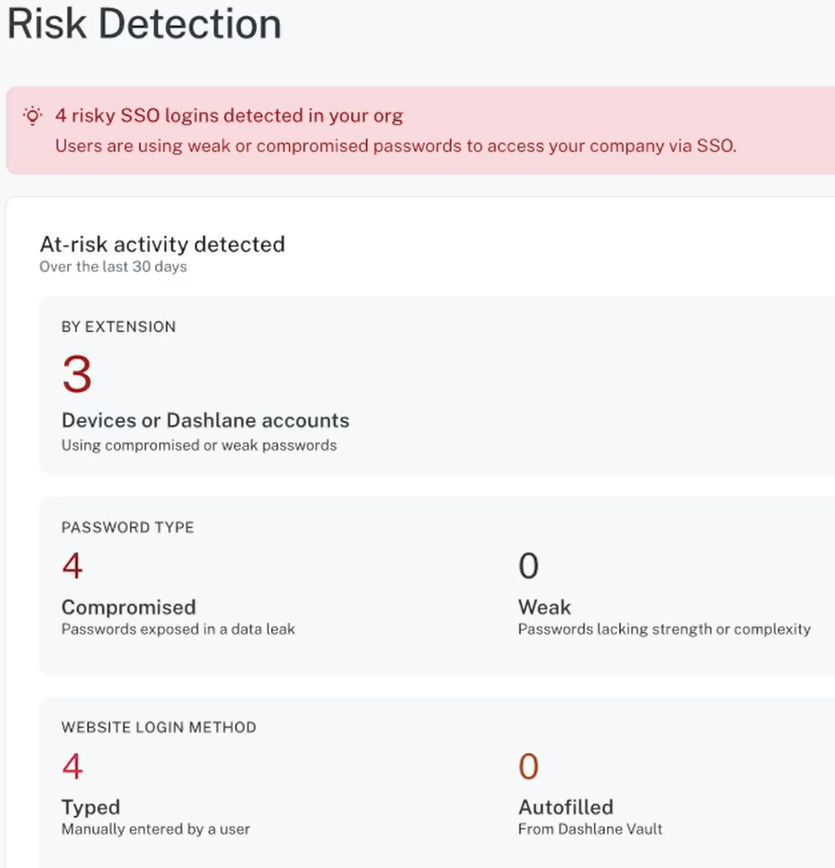
19% of authentication attempts on SSO providers is credential stuffing* Most employees reuse passwords. That means the same credential exposed in a data breach on some random SaaS tool can become the key to your company's core systems. And until now, admins had no way to know. We just shipped SSO risk detection in Dashlane Omnix. When an employee uses a weak or compromised password to log in via SSO, both the admin and the employee get alerted in real time. The employee can fix it on the spot. Or the admin can push remediation through the security stack, via SIEM integrations or our MCP Server for AI-powered workflows, all zero-knowledge. Omnix protects the credentials your vault doesn't see. Including your SSO password, even if your employees never saved it in Dashlane. And without Dashlane ever seeing it. Proud of the entire team working on improving credential protection every day. 👋Thanks to Bianca Monaco, Lawrence Braun de Almeida, Telma Rosário, Aniko Borosova and many others! * Source: Verizon 2025 BDIR report. Median daily percentage found by analyzing authentication logs associated with SSO providers.
- CyberjuiceSince 2 Jun 2026
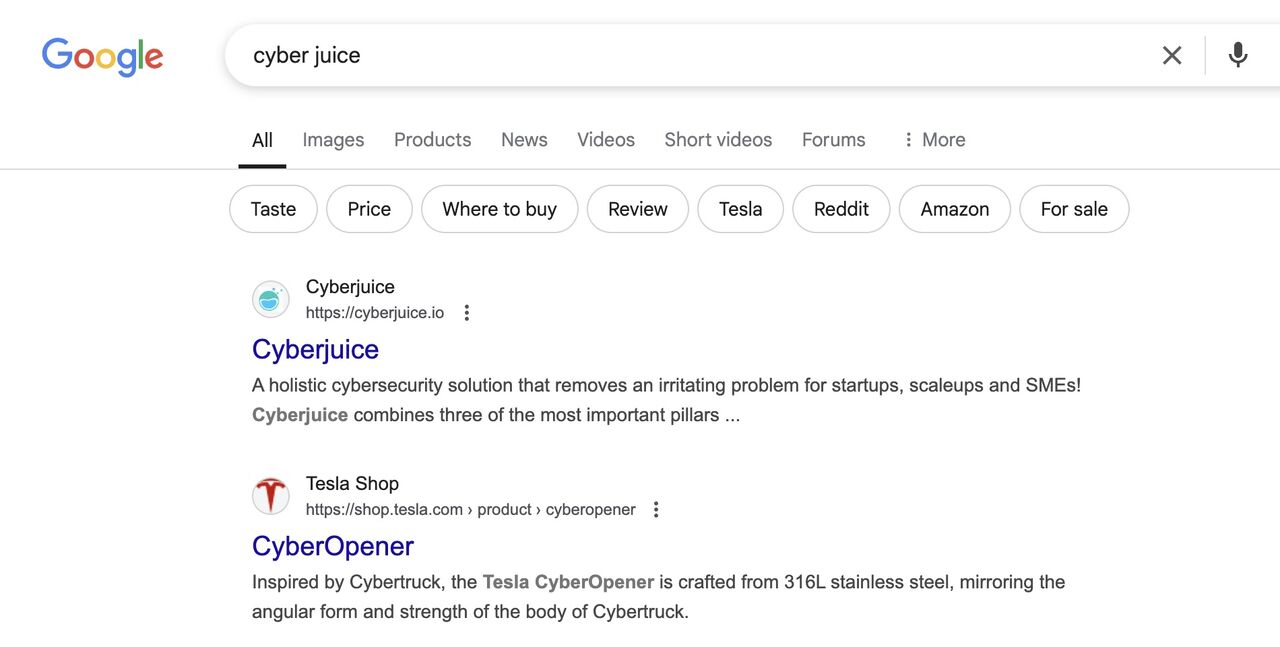
CyberJuice is trending. Not the Tesla beer. The ISO 27001 platform. Google agrees. So does your future CISO 😉 #Startups #Cybersecurity #ISO27001 #TechHumor Cyberjuice
- DataDomeSince 28 Jul 2026
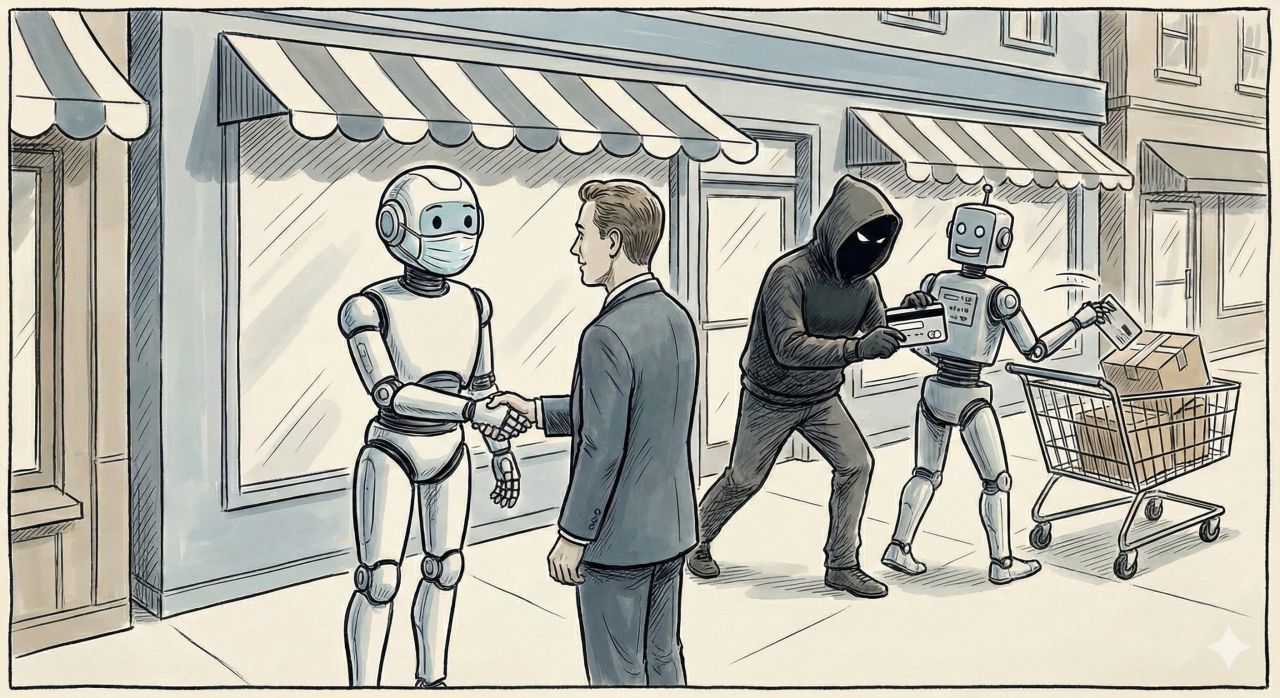
💭 I'm sure most would agree that fraud in ecommerce is something we have generally mastered over the past 2 decades, and managed to keep mostly under control. ⚠️ Agentic AI is mixing up the cards, and creating massive new opportunities, all with significant new risks. 🚀 With Google rolling out agentic checkout, a Paypal/Google agentic commerce solution, Amazon piloting "Buy for me", Perplexity announcing agentic shopping and Visa/Mastercard developing their agent trust protocols, it is undeniable agentic commerce will represent an important portion of revenue for merchants. Even just this year, the % of bot traffic has quadrupled, reaching 10% of bot traffic in Q3. Agentic AI supercharges existing fraud threats, but also brings new risks we must prepare for: 🟣 Highly scalable automated ATOs and credential stuffing attacks 🟣 Fully orchestrated fraudulent account creation (including deepfaked IDs) 🟣 New ATOs, targeting agent takeover rather than account 🟣 MCP server attacks With this transformation of how customers interact with our platforms comes many questions: ❓ Who, in the organization, is responsible for the management of agents, and the defense against fraudulent ones? ❓ Who is liable for the losses if an agent is hijacked or taken over? Fraud teams should start checking a few crucial elements to assess their readiness: ✅ Regarding Agentic AI and agent management, are the roles well defined between fraud, cybersecurity, compliance and other teams? Do we have a documented AI policy? ✅ Can we identify the agents visiting our site? Once that's done, can we understand those agents' intent and detect malicious behaviors? ✅ Do we have the right skillsets in the fraud team to build to antifraud rules and investigate agent-related fraud cases? ✅ Do we have the right technology in place to detect agent takeover and block unwanted or untrusted AI agents? 👂 I'm curious to hear where you feel agentic AI is going in 2026. Do you think it will keep growing? Is the threat real? Do you see those new types of attacks today? 📖 Also, if you want to do a full assessment of your organization's readiness, I will leave a link to DataDome's latest "Guide to Readying Your Business for Agentic Commerce" in the comments below. Go have a look. It is a great introduction to Agentic AI's potential, and the necessary steps to be ready for it. 👇 #fraud #fraudprevention #agenticai
- Daylight SecuritySince 24 Jul 2026
The sequel has arrived. 🎬 Episode 2 is below. As you've probably figured out by now, we at Daylight Security have a Genie who grants wishes. So if you've got one, tag CISO Genie, send it my way, or just drop it in the comments. You never know... I might be able to make it happen. Think of it like forwarding a résumé... except with wishes. After all, we work in the same open space, and maybe your wish will be granted. ✨ Hagai Shapira Eldad Rudich Eric Byrd Maya Rotenberg Lior Liberman Amnon Kushnir Eli Kugel Sarah Himmel Noam Zada
- CymphonyRecorded 15 Sept 2026
Every so often, a cybersecurity category has to be rebuilt because the thing it protects changed shape. It's happening again, and faster this time. AI agents are being added to the workforce before security teams have a clear view of what's happening. The critical unanswered question is what agents, and on whose behalf, have access to what data and systems. The legacy identity and data security tooling was built for a static, siloed world where you could put human employees in RBAC boxes. But AI agents shape-shift all the time; they download new skills, gain access to new systems etc. The previously siloed disciplines of identity and data security now need to become one. Shy Dekel, Idan Berkovits, and Erez (Edi) Gotlieb, saw that shift early and built for it. Every security leader we spoke with recognized the problem in the first two minutes. We at Sequoia Capital are excited to co-lead Cymphony's $30M round. The best signal during diligence is what customers say. Congratulations Shy Dekel, Idan Berkovits, Erez (Edi) Gotlieb, and team!
- CymphonyRecorded 15 Sept 2026
Tools suck. Buy the wrong tool and you make whatever problem you have a lot worse. “Data” or “Identity” have been nagging problems, and my tools create more findings and alerts, putting more pressure on my team AI broke the dam and I needed to start solving. I wanted to map my organization, understand the risk, and focus on reducing risk and doing work rather than generating more findings. What Cymphony changed for us is the starting point: one connected view of who and what has access, what they're doing with it, and what deserves attention first. This is what allows us to drive action, FAST. Congratulations to Shy Dekel Elinor Sadka, Idan Berkovits Erez (Edi) Gotlieb and the team, we want to see much more of these guys.
- CYREBROSince 10 Apr 2025
𝗔𝘂𝘁𝗼𝗺𝗮𝘁𝗶𝗼𝗻 𝗶𝘀 𝘀𝗲𝗱𝘂𝗰𝘁𝗶𝘃𝗲. The promise of a hands-off SOC, where AI effortlessly sniffs out threats, is intoxicating. But relying solely on AI for detection and response? That's less "cybersecurity utopia" and more "digital disaster waiting to happen." Here's the harsh truth: AI's brilliance is tethered to its training data. Novel attacks often slip through its grasp. It's like expecting a history textbook to predict tomorrow's news. And let's not forget the deluge of false positives – AI mistaking perfectly normal activity for a full-blown breach. Beyond just identifying anomalies, true security understanding often requires context and nuance that AI struggles to grasp. Developers deploying a new application or pushing a large code update might trigger unusual network patterns and resource consumption. AI can flag these anomalies, but it lacks the insight into planned development cycles and authorized system changes to determine their legitimacy. Over-reliance on its alerts without human validation can lead to wasted resources chasing shadows or, worse, ignoring subtle indicators that a human analyst would recognize as malicious. And then there's the human element: intuition. AI can process data, but it can't think like an adversary. That's where human threat hunters come in, spotting the subtle anomalies that AI, in its data-driven arrogance, overlooks. So, while AI offers undeniable benefits, it's not a substitute for human expertise. It's a tool, a powerful one, but still just a tool. And tools, as we all know, can malfunction, misinterpret, and occasionally decide to stage a digital rebellion. #AISecurity #CyberSecurity
- CYREBROSince 6 May 2025
𝗖𝗵𝗲𝗰𝗸𝗶𝗻𝗴 𝗕𝗼𝘅𝗲𝘀 𝗪𝗼𝗻'𝘁 𝗦𝗮𝘃𝗲 𝗬𝗼𝘂. Let's be honest, how many breaches have you seen where the victim proudly proclaimed, "But we were SOC 2 compliant!"? Crickets, right? The uncomfortable truth is that compliance, while often necessary, is rarely sufficient for actual security. It's like the Titanic having more lifeboats than legally required. Great on paper, but when you hit the real iceberg, those boxes ticked don't magically make the problem disappear. Compliance frameworks provide a baseline, a checklist of things you should do. But security is about understanding your specific risks and proactively defending against them. Just because you've ticked all the boxes doesn't mean a determined attacker won't find a way around your perfectly compliant setup. Think of it this way: compliance is like knowing the syntax of a programming language. It's important, but it doesn't teach you how to write secure code or prevent buffer overflows. Security is about the actual code, the dynamic defense against real exploits. So, while you might need to be compliant, don't mistake it for being secure. One is a regulatory hurdle; the other is an ongoing battle. Focus on the battle, and let compliance be a byproduct, not the ultimate goal. #Compliance #Cybersecurity
- CypagoRecorded 15 Sept 2026
When “audit season” feels like Groundhog Day 🐼 Recently, a CISO at a leading tech company shared with me her latest #FedRAMP authorization story: “By the time we found all the evidence, formatted the spreadsheets, and wrestled with PDF templates, the audit window was nearly closed. We were firefighting instead of building.” Sounds familiar? 🤔 Here’s what turning that narrative around can look like 😎 👉 https://lnkd.in/d6QHQrS5 #fedramp #compliance #automation #ccm #ConMon








Other LinkedIn formats
Watch the companies you care about.
Filter every ad by industry, country, format and network, and get alerts when a company you watch starts running new ads.