LinkedIn thought leader ad examples
109 thought leader ads are live on LinkedIn right now, from 93 companies. Browse real ones, filtered by industry.
- BRASAS English CourseRecorded 11 Sept 2026
Tenho percebido algo recorrente nas conversas com profissionais de RH e gestores de pessoas: a escolha de um programa de inglês muitas vezes começa pela comparação de propostas que, à primeira vista, parecem praticamente iguais. Todos falam em fluência, metodologia, flexibilidade e resultados. Quando os diferenciais não ficam claros, é natural que o menor preço acabe se tornando o principal critério de decisão. E é aí que o programa começa perdendo valor antes mesmo de começar. Porque o sucesso de uma iniciativa de idiomas não depende apenas do valor investido, mas da capacidade do parceiro de conectar o aprendizado aos objetivos da empresa e às necessidades reais das pessoas. Isso envolve gerar engajamento ao longo de toda a jornada, acompanhar a evolução dos participantes, agir quando alguém perde o ritmo e criar oportunidades para que o inglês seja aplicado no dia a dia de trabalho. Minha atuação no B2B me ensinou que os programas mais consistentes começam antes da primeira aula. Eles começam com uma análise cuidadosa de pontos como: ➡️ A forma como a evolução será acompanhada e demonstrada. ➡️ As estratégias utilizadas para recuperar o engajamento. ➡️ A conexão entre o conteúdo e a rotina profissional. ➡️ O suporte oferecido à empresa durante todo o programa. No fim, escolher um parceiro de idiomas não é apenas comparar quanto cada proposta custa. É entender qual delas tem estrutura para transformar investimento em desenvolvimento real, adesão e impacto para o negócio. Porque um programa de inglês só começa gerando valor quando a estratégia vem antes do preço.
- BRASAS English CourseRecorded 11 Sept 2026
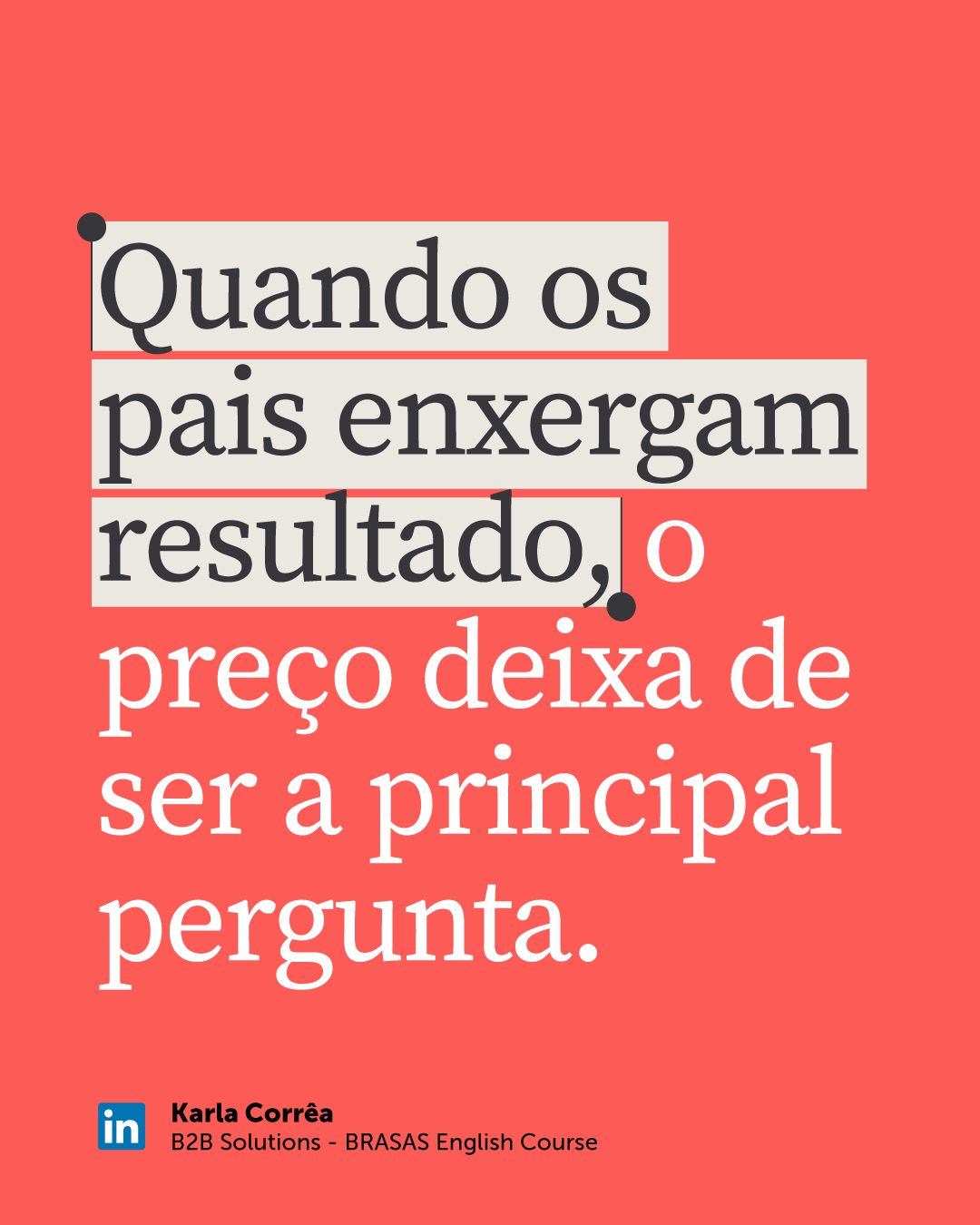
Quando a conversa sobre o programa de inglês de uma escola gira apenas em torno de preço, carga horária ou material, a comparação por custos se torna inevitável. Mas existe uma mudança simples de perspectiva que muda totalmente o jogo no período de matrículas. Quando a instituição consegue apresentar evidências concretas de evolução, com alunos se comunicando com segurança, participando de experiências internacionais e atingindo alto nível de proficiência, o inglês deixa de ser visto como um custo extra. Ele se transforma em um diferencial de valor percebido de forma clara pelas famílias. Pais e mães não buscam apenas uma grade curricular mais cheia. Eles buscam a garantia de um impacto real e duradouro no futuro dos filhos. As instituições que mudam essa dinâmica e transformam promessas em provas concretas constroem mais do que matrículas: constroem autoridade e confiança. A decisão das famílias deixa de ser sobre valor monetário e passa a ser sobre o valor da transformação. É essa clareza que define as escolas que lideram o mercado. E, na sua percepção, o que mais convence os pais hoje: a promessa de um bom programa ou a prova de que ele entrega resultados?
- BeUpNextSince 14 Dec 2025
The Day My Mentor Saved Me From Giving Up on My Dreams Sometimes the difference between a breakthrough and a breakdown is one conversation. Sometimes, the person who changes your life forever is someone you meet on an ordinary Wednesday. I was drowning in my own success. There I was with my hard-earned degree, working in QA, earning decent money and feeling like I was suffocating. I was good at testing software, but every day felt like testing my patience with a life that didn’t fit. That’s when I met Garnet Masenda while we both worked for FNB South Africa. “What are your career aspirations?,” he asked one day. Such a simple question. Such a complicated answer. Instead of advice, he gave me something more valuable: his time. We worked on my business analysis, agile and scrum skills, We practised interview questions until my answers felt natural. We role-played salary negotiations until I could confidently advocate for my worth. By the time I stepped into my next role, I wasn’t just prepared, I was empowered. The salary matched my skills, and more importantly, the version of myself we’d worked so hard to build. But Garnet’s mentorship didn’t end there. Years later, when life got overwhelming, I quietly deregistered from my master’s program at the University of Pretoria During a check-in, he asked, “How’s the master’s going?” I told him the truth. His reply changed everything: “Don’t be the person who starts things and never finishes them. That habit will follow you for the rest of your life.” I re-registered. I finished that degree. Because that’s what mentorship does It sees beyond your excuses, beyond your burnout, into your potential. That’s why I created BeUpNext. For the person who’s stuck in a “good job” that doesn’t fit. For the person quietly giving up on a dream because no one is checking in. For the next Garnet. And for the next me. Your breakthrough is one conversation away. Your mentor is one connection away. You don’t have to figure it all out alone. BeUpNext exists so no one has to climb alone. #MentorshipMatters #MentorshipChangesLives #CareerTransformation #BusinessAnalyst #ManualTestAnalyst #ProfessionalGrowth #DontGiveUp #Accountability #MastersDegree #FinishWhatYouStart #BeUpNext #CareerAdvice #ProfessionalDevelopment #Mentoring #Leadership #SuccessStory #CareerJourney #Breakthrough #Inspiration #Motivation #GrowthMindset #MentorshipMatters #BeUpNext #CareerBreakthrough #FromGoodToGreat #PurposeDriven #AfricanExcellence #WednesdayWisdom #LinkedInStorytelling #LeadershipJourney #UniversityOfPretoria #FNB
- BeUpNextSince 14 Dec 2025
In entrepreneurship, the real question isn't "Do you have a vision?" It's "What is the term of your vision?" Because your answer will shape every decision you make. In my journey of entrepreneurship, I've learned this the hard way. Many step into entrepreneurship hoping to make quick money. But if you want to build something with a solid foundation, you need patience. What we don't often talk about is how expensive it is to start a business. How difficult it is to find the right people. And in Africa, this is compounded by affordability challenges: Customers want your product for free or at a discount. Yet you must still pay your team fairly. Then there's partnerships. When your vision is long-term, but you're partnered with someone who only thinks short-term, misalignment creeps in. They want immediate results. You're trying to build structures that will last. And in the quiet moments when your savings are draining, when there's no income, when you're choosing between chasing your dream and paying for a roof over your head, your long-term vision can feel like a luxury. That's when the temptation of a quick win becomes hardest to resist. Here's what I've learned about surviving this journey: 👉 Funding: We need better access to early-stage capital that doesn't punish entrepreneurs for being small but sees potential in their vision. 👉 Partnerships: Choose partners who share your horizon. If your vision is long-term, align with those who are willing to build patiently. 👉 Personal survival: Don't romanticise the struggle. It's okay to take a job, consult, or create a side stream of income while your business grows. Survival is not failure. It's strategy. But here's the transformation I want you to understand: Stop asking, "How can I win today?" Start asking, "What will still matter 10 years from now?" That one shift changes how you handle money, partnerships, and even failure. Because when long-term builders partner with short-term thinkers, the result is always misalignment. One is sowing seeds, the other is chasing harvest. It's easy to say "start a business." The truth? Most people cannot afford to. But for those who do, and for those who hold onto the long vision, understand this: Patience is not a weakness. It's the price of building something that lasts. The short-term might keep the lights on. But only the long-term will keep the legacy alive. So ask yourself: Are you building for applause or for impact? Are you chasing quick wins or lasting change? Because the world doesn't need another business that disappears in two years. It needs entrepreneurs who are brave enough to build for decades. Your vision's timeline will determine your business's lifeline. Choose wisely. #Entrepreneurship #StartupLife #BusinessStrategy #LongTermVision #EntrepreneurMindset #BusinessGrowth #Leadership #Innovation #AfricanEntrepreneurs #BuildingLegacy #BeUpNext
- Big Think+Recorded 10 Sept 2026
Completion rates don’t equal impact. They only tell you who finished the program, not who changed because of it. Every week, I talk with L&D leaders across industries. Some have large, mature programs. Others are just getting started. Almost all ask the same question: “How can I prove the value of learning to the business?” It’s the right question. But to answer it, you have to separate three kinds of value: Engagement → Are people participating and finding value? Impact → Are they applying what they learned and performing differently? ROI → Is that change driving measurable business results? At Big Think+, we see the L&D functions that stand out don’t just track completion. They connect participation, impact, and ROI to build a clear story of how learning moves the business forward. I recently shared a few thoughts on how L&D teams can start connecting these dots in my latest article. You can read it here: https://hubs.li/Q03V3mVD0
- Algorithmics GlobalSince 3 Jul 2026
Two educational center owners told me the same thing: "The business works. So why am I scared?" One owns a language school. For years it worked with full classes and families who stayed. Then English stopped being something only he could offer. And someone is always cheaper. His summers got thinner each year, tutoring centers and subscription based apps entered the market. Then one family - one he'd taught for six years - left for a newer-looking online school. That was the decisive moment: he wasn't losing clients on price. He was losing them on feeling old. And he had no idea how to fix that without rebuilding everything from scratch. He didn't rebuild, but just started teaching kids to code in the weekend hours - through Algorithmics platform, so he didn't have to become a tech person himself. It wasn't a grand plan. He tried it with one group. Then parents started asking to add the second hour. He's not safe forever. But he's not scared of August anymore. The other entrepreneur owns a robotics club. Her money kept leaking out. Kits cost a fortune, and small parts vanished every week. The worst part wasn't the cost for her - it was watching her best kids turn twelve and quit. They'd outgrown what she could offer them. They wanted to go further, and her setup couldn't take them there. One month four of her oldest students left together. She sat with that for a while, then stopped buying her way out. She moved the older kids into Python, and game design - through our platform, using the computers already sitting in the room. The twelve-year-olds who used to walk out stayed. Yes, not all of them.But enough that she wasn't starting over every year. Neither of these two business owners had some big transformation. They just stopped patching the same hole over and over and tried something different. If one of them is you, I've watched a few owners find a way out of exactly that. Happy to tell you how #EducationBusiness #SchoolOwners #EdTech #KidsCoding #SmallBusinessGrowth
- Algorithmics GlobalSince 3 Jul 2026
Owners of education businesses - this one's for you. I asked 5 marketers across our schools what they stopped running this year and what they focused on. They spend real ad budgets every day, in different countries. From everything they told me, here are the insights that will actually be useful to you: 1. Leads will never cost what they did 10 years ago. We stopped waiting for cheap traffic and started growing the landing pages instead - new offers, new quizzes, better conversion. Not just new creatives. 2. A free trial lesson used to be enough to fill a group. Now it takes "4 free weeks." 3. Facebook lead forms stopped working. We moved to hand-written sites, and we don't run many - sometimes one page holds for months, because it converts better and cheaper than anything new we test. 4. We built our own tool to make quizzes. Traffic goes to a quiz now, not a form. 5. What buys the traffic changes on its own - video for a stretch, static right now. It's the Facebook auction, not our taste. So we don't cling to last month's winner. We track what's working now, scale it, and spend on analytics to catch the shift early. 6. Retargeting didn't work. Ads to people who'd visited the site or left a request but never came to the intro lesson - nothing. Might be the market. We stopped. 7. Webinars in kids' edtech don't work. Not for anyone. 8. A product that sells well isn't always one that makes money. We pulled ads off one that sold great - the lifetime value cost too much, and another course had a far better margin. We watch every cost, not just cost per lead. 9. A smaller budget doesn't make your leads worse. You just get fewer. The one real limit is the market: full in season, thin off-season, and the media plan has to account for that. 10. We don't always advertise what we sell. Run the AI course ad, and plenty sign up for Python once they're talking to us. So we find the cheapest way in, then sell from there. 11. Speaking only to a pain point isn't always the strongest play. A broader offer often pulls more. 12. AI writes our ad visuals now, alongside the designers. Still 90/10 in the designers' favor. Probably only for now. They landed on the same last point: a creative that works in one of our markets almost always works in the next. Proven across countries. So Algorithmics partners don't start from zero - they run what already worked somewhere else. --- This is part of the list. Want the other half? Drop a comment and I'll share #EdTech #EducationBusiness #SchoolOwners #FranchiseOpportunity
- Academia CEORecorded 31 Aug 2026
Existem dois problemas recorrentes que têm aparecido nas minhas conversas com os CEOs, que eu entrevisto aqui na Academia CEO, nas minhas mentorias em grupo em diversas empresas e até nos Conselhos em que eu participo: turnover alto e apagão de talentos. São dois fantasmas interligados, com custos invisíveis, de alto valor. Os nossos estudos mostram que esses fenômenos estão acontecendo no mundo todo e a discussão das causas desses problemas mostra fatos concretos e, também, muitos mitos. Já colecionei diversos exemplos inovadores e muito positivos de empresas que estão enfrentando essa situação de forma muito competente e eu gostaria de pedir para vocês relatos de casos práticos nessa direção. Vocês irão colaborar muito comigo, respondendo às seguintes perguntas: - Quais iniciativas vocês viram funcionar para reduzir o turnover? - Quais práticas têm ajudado a atrair e reter talentos? Nós acabamos de criar uma comunidade da Academia CEO, no WhatsApp, para trocarmos ideias sobre esses dois assuntos. Se você tem respostas para uma ou para as duas perguntas acima, ou se você se interessa por esses temas, mande uma mensagem no número do WhatsApp da Academia CEO, abaixo, ou no e-mail da Vanuza A., que trabalha aqui comigo na Academia CEO, informado na arte abaixo. Nós incluiremos você nessa comunidade. Em breve, eu postarei na comunidade as conclusões que temos até agora, além de uma série interessante de informações, artigos e opiniões sobre esses dois temas: TURNOVER ALTO e APAGÃO DE TALENTOS. Já adianto que o papel do líder é fundamental, afinal, na maioria dos casos, a pessoa pede demissão do chefe e não da empresa. Conto com a sua participação.
- 365 Akademie GmbHSince 17 Jul 2026
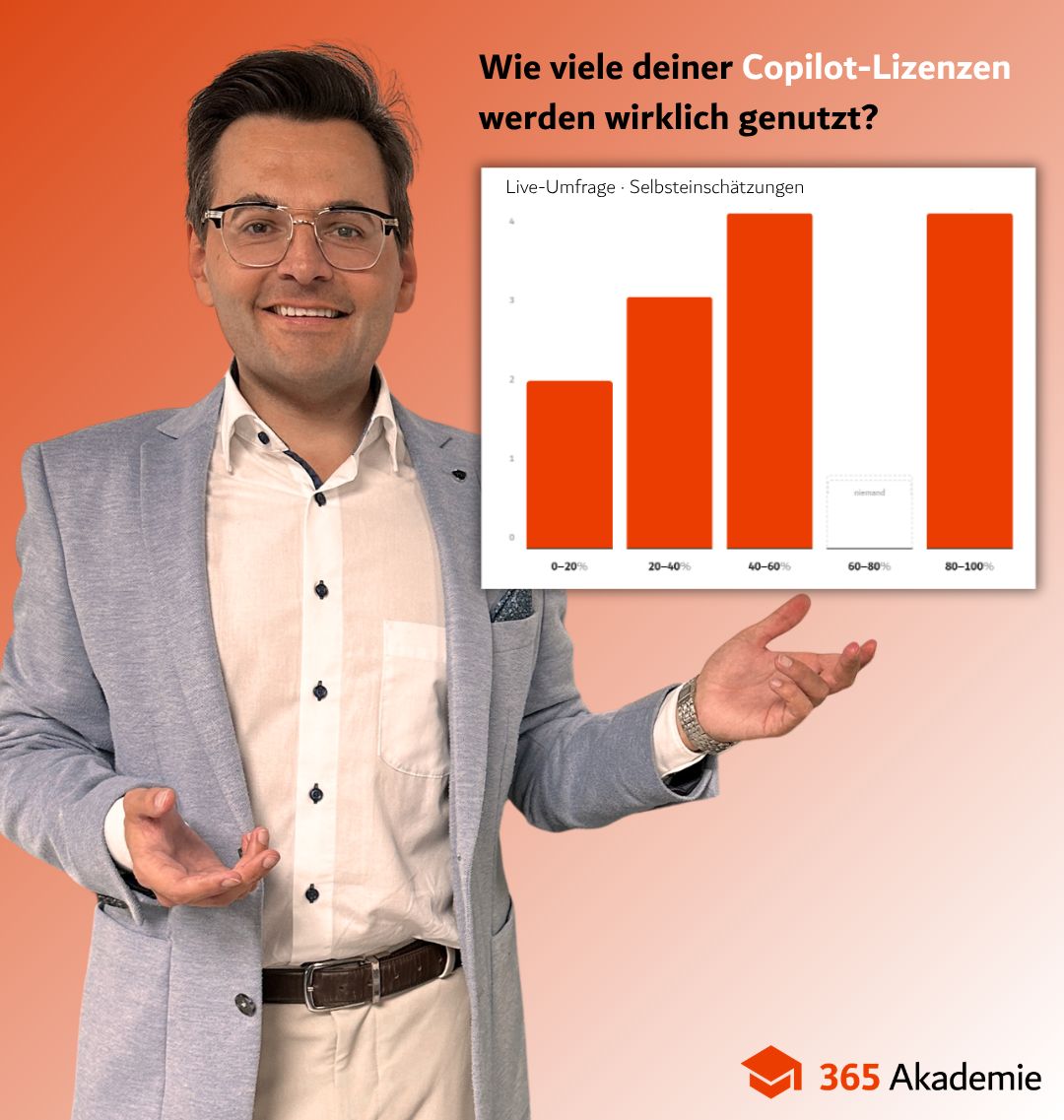
„Wie viele eurer Copilot-Lizenzen werden eigentlich wirklich genutzt?" https://m365akademie.de/ Letzte Woche haben wir in einem Webinar die Frage gestellt.Die Schätzungen reichten von unter 10% bis 90%. Durchschnitt rund 45%. Schon das ist eine Ansage: Selbst wenn man die Antworten für bare Münze nimmt, arbeitet im Schnitt nur die Hälfte der bezahlten Lizenzen. Aber der spannende Teil ist nicht der Durchschnitt, es war die Form der Verteilung. Die Antworten sammeln sich an zwei Polen. - Eine Gruppe ganz unten, im einstelligen bis 20er-Bereich. - Eine Gruppe ganz oben, bei 80 bis 90%. - Dazwischen eine Mittelgruppe um die 40. Und genau da liegt die eigentliche Erkenntnis: Die Teilnehmenden messen gar nicht dasselbe. Wer „80-90%" sagte, bezieht sich auf den Adoption Score im Admin Center – Lizenz wurde mindestens einmal aktiv angefasst. Das ist Breite. Wer „5-10 %" sagt, meint systematische, wertstiftende Nutzung und Copilot verändert tatsächlich die Arbeit. Das ist Tiefe. Zwei völlig verschiedene Fragen, beantwortet unter einer Überschrift. Und auffällig: Fast alle hohen Werte kamen mit Einschränkung. „…aber nicht in der vollen Ausprägung." „…noch im Pilot." „…nicht granular geprüft." Dazu kam: Fast alles war Bauchgefühl. „Vielleicht 40 %." „Nach Gefühl." „Müsste man mal im Admin Center schauen." im Konjunktiv, also noch nicht geschaut. Drei Dinge sagen diese Schätzungen damit in Summe: Es gibt keine gemeinsame Realität, denn die Antworten sind nicht nur unsicher, sie beantworten unterschiedliche Fragen. „Nutzung" ist nicht definiert, denn Breite und Tiefe werden vermischt, und sobald man auf Tiefe schaut, fallen die Zahlen drastisch. Kaum jemand misst belastbar, denn die meisten raten, die wenigen Messenden messen nur Aktivität. Das ist die Lücke, um die es eigentlich geht. Nicht zwischen den gekauften und genutzten Lizenzen. Sondern zwischen „eingeloggt" und „bringt Wert". Solange das nicht sauber definiert ist, diskutiert man über ein Ergebnis, das man gar nicht gemeinsam meint und bezahlt weiter für eine Wirkung, die niemand belegen kann. Was zählt bei euch als „Copilot wird genutzt"? Einmal eingeloggt oder echter Use Case im Alltag?
- 365 Akademie GmbHSince 17 Jul 2026
Jeder spricht über Copilot-Agenten. Fast niemand über die Frage, die über Erfolg oder Chaos entscheidet: https://m365akademie.de/ Wer darf eigentlich welche bauen? Gerade teilt sich die Welt in zwei Lager. Die einen feiern Agenten als größten Produktivitätssprung seit der E-Mail. Die anderen winken ab: alles Hype, in zwei Jahren redet keiner mehr davon. Beide diskutieren die falsche Frage. Ob Agenten Hype oder Produktivitätsgewinn werden, entscheidet nicht die Technologie. Das entscheidet sich daran, ob ein Unternehmen zwei Dinge gleichzeitig hinbekommt: Fachbereiche befähigen UND Leitplanken setzen. Warum die Fachbereiche? Weil die wertvollsten Agenten nicht in der IT entstehen können. Die Kollegin im Einkauf kennt den Freigabeprozess, der sie jede Woche Stunden kostet. Der Kollege im Vertrieb weiß, welche Informationen er vor jedem Kundentermin zusammensucht. Eine IT-Abteilung kann nicht 200 Prozesse kennen und 200 Agenten bauen. Die Menschen, die die Prozesse leben, können es, wenn man sie befähigt. Aber genau da liegt das Risiko: Wenn hunderte Mitarbeitende Agenten bauen, ohne dass jemand Regeln definiert hat, entsteht kein Produktivitätsgewinn, sondern die nächste Schatten-IT. Nur diesmal mit Werkzeugen, die selbstständig handeln. Deshalb arbeite ich mit einem Zonenmodell: 🟢 Grüne Zone: Agenten, die Fachbereiche eigenständig bauen dürfen. Persönliche Assistenten, Wissens-Agenten auf freigegebenen Quellen. Geringes Risiko, keine Freigabe nötig – hier soll Geschwindigkeit entstehen. 🟡 Gelbe Zone: Agenten mit Zugriff auf Geschäftsdaten oder für ganze Teams. Bauen ja, aber mit Review und definierten Verantwortlichen, bevor sie live gehen. 🔴 Rote Zone: Agenten, die autonom handeln, in andere Systeme schreiben oder nach außen kommunizieren. Hier gehören Entwicklung und Betrieb in professionelle Hände, mit Monitoring. Der Punkt dabei: Das Zonenmodell ist keine Bremse. Es ist die Voraussetzung dafür, dass die grüne Zone überhaupt geöffnet werden kann. Ohne Zonen bleibt aus Angst alles verboten oder aus Naivität alles erlaubt. Beides kostet am Ende mehr als jede Lizenz. Meine These: In zwei Jahren unterscheidet man Organisationen nicht danach, ob sie Agenten einsetzen. Sondern danach, ob ihre Fachbereiche welche bauen können, ohne dass ihre IT nachts schlecht schläft. Dürfen bei euch Fachbereiche schon Agenten bauen und gibt es Regeln dafür? 👇








Other LinkedIn formats
Watch the companies you care about.
Filter every ad by industry, country, format and network, and get alerts when a company you watch starts running new ads.