Not on air · 2 of 3 networks checked

Zahaf & Partners Law Firm ads
- zahaflaw.com
- Legal Services
- LY
- 13 employees
Zahaf & Partners Law Firm’s ads on LinkedIn, Meta and Google, recorded by adsrunning. Browse the latest here for free. Sign up free to see all 25. Watch Zahaf & Partners Law Firm on any plan to get each new one in your feed.
Watchlist included in every plan
What Zahaf & Partners Law Firm runs
- Single image · LinkedIn
- 6
| Network | Status | Live ads | Nov 2025LinkedIn activity · 52 weeksNov 2026 | Checked | Next step |
|---|---|---|---|---|---|
| None recorded | 0 | Checked 3 Nov 2026 | See all 25 ads → | ||
| Meta | Not checked | — | |||
| None recorded | 0 | No ads found on the Google Ads Transparency Center | Checked 15 Oct 2026 | Collect them with the API → |
Zahaf & Partners Law Firm has no live LinkedIn ads. We recorded no Google ads on 15 Oct 2026.
Latest ads
- LINKEDIN · IMAGESince 26 Oct 2026
Libya has taken a further step towards developing its commercial framework through the Prime Minister’s Decision No. 410 of 2026, which established a committee tasked with preparing the legal and regulatory framework for an international arbitration center in Libya. The committee held its first meeting on 19 October 2026 at the headquarters of the National Oil Corporation in Tripoli. Its work includes examining the legal and procedural requirements for establishing the center, as well as preparing its organisational structure and regulatory framework. The committee includes representatives from several key public institutions, including the National Oil Corporation, the Ministries of Justice, Finance, and Economy and Trade, the National Investment Corporation, and the Litigation Department. The initiative aims to establish a framework for resolving commercial disputes that is consistent with Libyan legislation while drawing on internationally recognized approaches to commercial arbitration. For any inquiries, please feel free to reach out to our team at [email protected] or visit www.zahaflaw.com.
- LINKEDIN · IMAGESince 13 Oct 2026
Libya’s Ministry of Labour and Rehabilitation issued Resolution No. 589, adopting two manuals on work regulation and disciplinary measures for employment relations within the scope of Chapter Three of Labor Relations Law No. 12 of 2010. The Resolution provides an important reference for employers reviewing their internal workplace regulations and disciplinary procedures. The two manuals address several key aspects of employment, including: - Working conditions: Daily and weekly working hours, overtime compensation, annual leave, and employment contracts. - Performance evaluation: Annual employee assessments and the right to challenge evaluation results. - Disciplinary measures: Permitted penalties, limits on wage deductions, and the progressive application of disciplinary measures. - Due process: Written investigations, employees’ right to present a defense, and the time limits governing disciplinary proceedings. - Approved penalty schedules: Employers may not impose penalties for violations that are not included in their approved disciplinary regulations in accordance with Art.115 of the labor Law. Disciplinary decisions must also state the reasons for the penalty, as failure to comply with this requirement may render the decision void. The manuals are not legally binding. They provide guidance for employers in preparing their internal regulations, allowing companies to tailor these rules to their operational needs while respecting the rights guaranteed under applicable labor legislation. For any inquiries, please feel free to reach out to our team at [email protected] or visit www.zahaflaw.com.
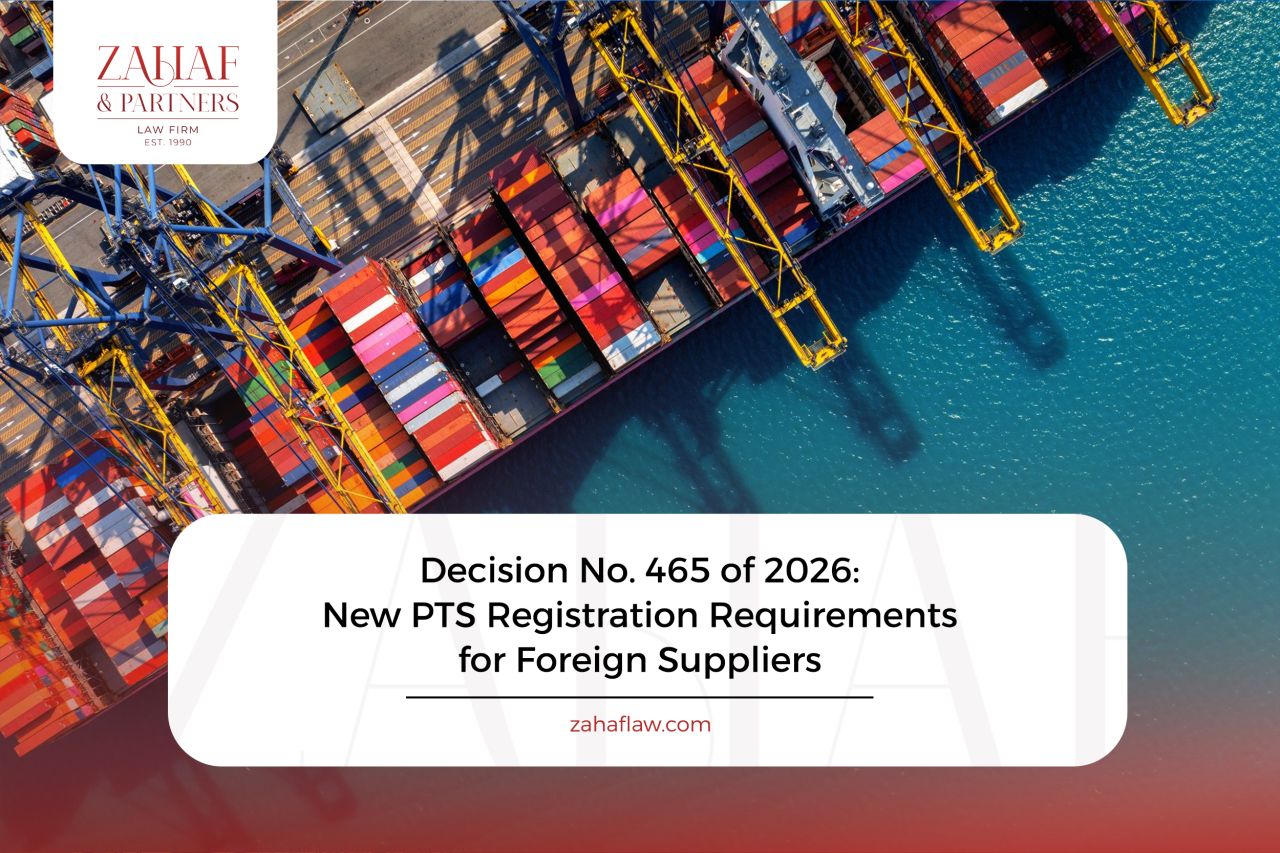
- LINKEDIN · IMAGESince 17 Sept 2026
On 15 September 2026, the Libyan Minister of Economy and Trade issued Decision No. 465 of 2026, introducing new registration requirements for suppliers and exporters under the Unified Digital Trade System (PTS) operated by the Libya Trade Network, as part of the ongoing regulation and digitalisation of Libya’s foreign trade framework. Under the Decision, suppliers, exporters and foreign companies supplying goods to the Libyan market through Libyan companies are required to register on the PTS platform and obtain a Certificate of Registration, which will include a unique electronic identification number (PTS Code). The Decision provides for a transitional period until 31 December 2026 to allow relevant entities to complete their registration. Mandatory implementation will then take effect in stages: • From 1 January 2027: the registration requirement will apply to foreign suppliers and exporters whose annual transactions or shipments to Libya amount to USD 1 million or more, in accordance with the cases specified under the Decision. • From 31 March 2027: the requirement will extend to foreign suppliers and exporters whose annual exports or shipments to Libya amount to USD 100,000 or more. The Decision also provides for the electronic integration of the PTS platform with relevant systems used by banks, customs authorities, ports, free zones, chambers of commerce and industry, and technical inspection authorities, including the Trade Verification and Advance Cargo Information System (TCN-ACI). This integration is intended to streamline verification procedures, facilitate the processing of foreign trade transactions and support the broader digitalisation of Libya’s import and export framework. Foreign suppliers and companies engaged in trade with Libya should therefore review the new requirements and consider the applicable registration thresholds and implementation dates in advance. For any inquiries, please feel free to reach out to our team at [email protected] or visit www.zahaflaw.com
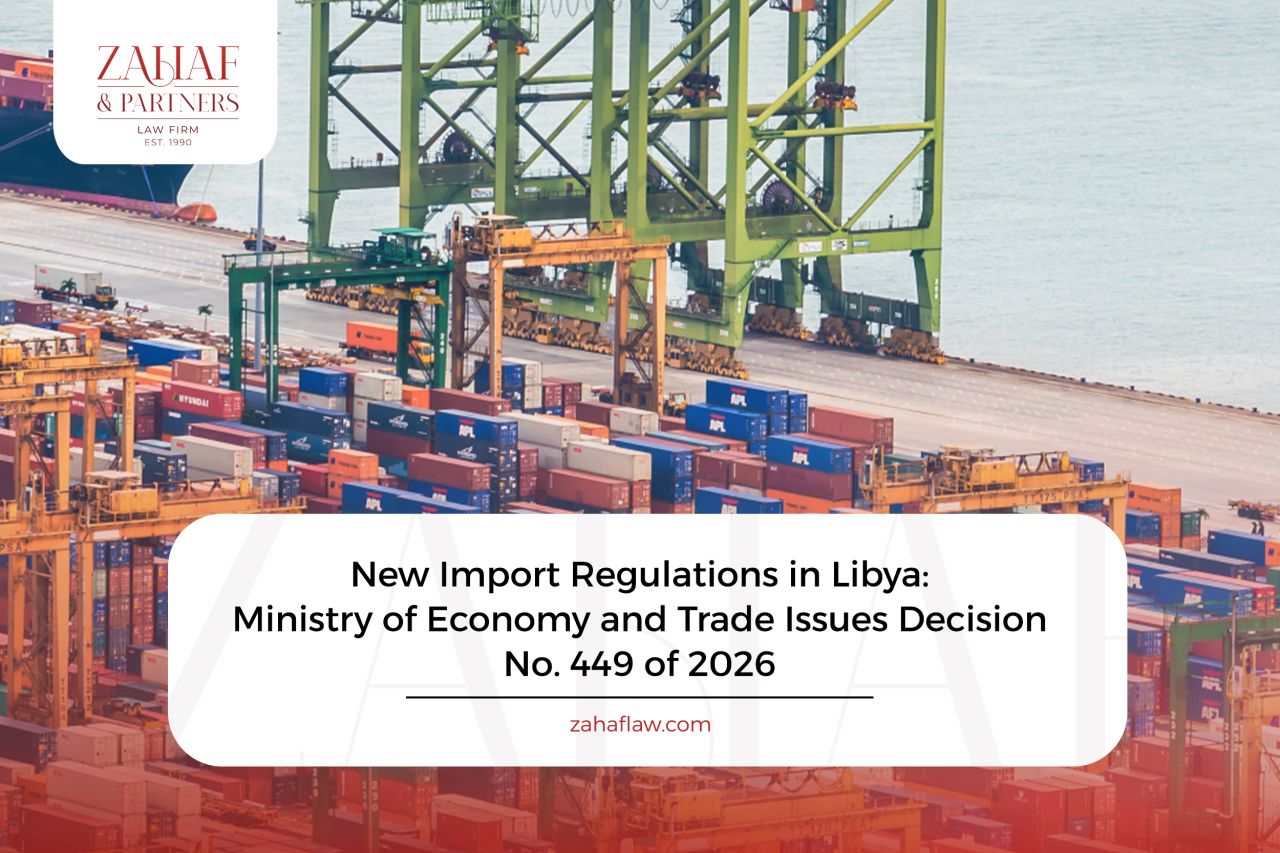
- LINKEDIN · IMAGESince 10 Sept 2026
The Libyan Minister of Economy and Trade has issued Decision No. 449 of 2026 concerning the Regulation of the Importation of Goods and Commodities for Commercial Purposes, introducing new requirements for the importation and customs clearance of commercial goods in Libya. The Decision will take effect on 30 September 2026. Key provisions include: • Mandatory use of banking channels: From 30 September 2026, goods and commodities imported into Libya for commercial purposes may no longer be imported outside the approved banking channels and procedures, in accordance with the mechanisms and controls established by the Central Bank of Libya and other competent authorities. • Customs clearance requirements: Commercial shipments may not be released by customs unless all applicable banking, commercial and customs requirements have been satisfied and the relevant documentation is capable of verification and matching under the approved unified mechanism. • Exception for individual business activities: As an exception to the general requirement that commercial imports be conducted through approved banking channels, holders of individual activity licences may import goods and commodities for commercial purposes up to an aggregate annual limit of USD 100,000, or its equivalent in other currencies, subject to the conditions set out in the Decision. The limit is calculated cumulatively across all shipments during the calendar year and may not be circumvented by splitting or multiplying shipments or by using more than one individual activity licence. • Conditions for benefiting from the exception: Among other requirements, the individual activity licence must be valid, the activity must be duly registered and operational, the licence holder must be registered in the Ministry of Labour and Rehabilitation's system and linked to their national number, and the imported goods must correspond with the scope of the licensed activity. • Transitional treatment of existing shipments: Shipments already in transit to Libya or which have arrived at a Libyan port before the effective date may be exempt, provided that the customs declaration and release request were submitted before 30 September 2026 and the applicable procedures and documentation requirements have been satisfied. Importantly, shipments for which the customs declaration and release request have not been submitted before the effective date will be subject to the new rules, irrespective of the date of the underlying contract, invoice or shipment. Businesses engaged in the importation of goods into Libya should therefore review their existing import arrangements, banking procedures and pending shipments ahead of the 30 September 2026 implementation date. For any inquiries, please feel free to reach out to our team at [email protected] or visit www.zahaflaw.com
- LINKEDIN · IMAGESince 31 Aug 2026
Last week, the Ministry of Economy and Trade issued Decision No. 428 of 2026, introducing a new framework for determining the annual ceiling on foreign trade transactions available to private-sector companies. The Decision, is intended to regulate foreign trade, rationalize the use of foreign currency, and ensure that the volume of a company’s external transactions is aligned with its actual economic activity and its financial and operational capacity. Under this framework, the foreign trade transaction ceiling represents the maximum annual amount that a company may utilize through letters of credit, documents against collection, and other external commercial payment methods. For companies subject to general income tax, the ceiling will be calculated by reference to their tax payments over the preceding three tax years, based on the following formula: 30 × the average general income tax paid over the last three tax years + 20 × the average salaries and wages tax paid over the same period. To benefit from this ceiling, companies must be actively engaged in import or overseas supply activities, must have conducted such activities regularly during the preceding three years, and must be compliant with their tax filing obligations. The Libyan Tax Authority will issue an annual certificate specifying each company’s approved foreign trade ceiling the certificate will serve as the principal reference for commercial banks when granting letters of credit or processing foreign trade transactions. The Decision also introduces specific treatment for certain categories of companies. Companies undertaking import and overseas supply activities for the first time will be subject to an annual ceiling of USD 250,000, subject to meeting the applicable requirements. Companies benefiting from income tax exemptions under Investment Law will have their ceilings determined by the Minister of Economy and Trade based on factors including the scale of their activities, existing investments, operational capacity, and market position. Importantly, the Decision establishes an overall annual ceiling of USD 50 million per company, which may only be exceeded with the prior approval of the Minister of Economy and Trade. Commercial banks may also approve a lower amount based on their own assessment of the company’s risk, solvency, and compliance. Commercial banks will not be permitted to accept applications for letters of credit or external transfers for commercial purposes unless accompanied by the required certificate confirming the applicable ceiling. The ceilings and classifications issued under the Decision will remain applicable until 1 May 2027, while the Decision itself is intended to operate as an interim framework pending the introduction of a permanent classification system based on financial solvency, operational capacity and tax compliance. For any inquiries, please feel free to reach out to our team at [email protected] or visit www.zahaflaw.com
- LINKEDIN · IMAGESince 11 Aug 2026
Libya’s oil sector is entering a new phase of investment and production expansion, supported by renewed funding and ambitious medium- and long-term targets. According to recent statements by the Chairman of the National Oil Corporation (NOC), the unified spending plan has allocated more than LYD 13 billion to the Corporation’s operating budget, providing important financial support following the absence of budget allocations during 2025. The NOC has also secured a USD 1 billion financing arrangement with the Libyan Foreign Bank to support projects aimed at increasing national oil production beyond 1.5 million barrels per day by mid-2027. A further USD 1 billion is expected to become available once this production milestone is achieved. Looking further ahead, the NOC estimates that approximately USD 36 billion in investment will be required to achieve its target of 2 million barrels per day by early 2031. The proposed funding structure would see approximately USD 20 billion invested by the NOC, alongside USD 16 billion sought from international partners. The Corporation is also working to restore production from currently inactive wells across a number of operating companies, while preparing to launch a bidding round for the development of the North Jalo field. The project is expected to require approximately USD 5 billion in financing and is targeting production of around 100,000 barrels per day. At the same time, financial pressures remain significant, with the NOC continuing to manage approximately LYD 25 billion in rescheduled obligations relating to 2024 and 2025, alongside monthly operating requirements estimated at around USD 300 million. Taken together, these developments point to a significant investment cycle for Libya’s oil sector, with access to financing, increased production capacity and greater participation by international partners likely to play an important role in the sector’s next stage of development. For any inquiries, please feel free to reach out to our team at [email protected] or visit www.zahaflaw.com #Libya #Oil&Gas #Energy #Investment #NOC #LibyanEconomy




6 of 25 adsSign up to see every Zahaf & Partners Law Firm ad, filter by format and date, and get alerts on new ones.
See all 25 adsQuestions about Zahaf & Partners Law Firm’s ads
Is Zahaf & Partners Law Firm running LinkedIn ads?
We recorded no live LinkedIn ads for Zahaf & Partners Law Firm on 8 Nov 2026.
How many LinkedIn ads has Zahaf & Partners Law Firm run?
LinkedIn’s ad library lists 23 ads for Zahaf & Partners Law Firm. We recorded 25 LinkedIn ads for Zahaf & Partners Law Firm, first recorded on 3 Oct 2026 and last recorded on 28 Oct 2026.
Does Zahaf & Partners Law Firm run Google ads?
We recorded no Google ads for the domain zahaflaw.com on 15 Oct 2026.
Which ad formats does Zahaf & Partners Law Firm use?
The 6 LinkedIn ads on this page include 6 image ads.
Watch the companies you care about.
Filter every ad by industry, country, format and network, and get alerts when a company you watch starts running new ads.