2 new LinkedIn ads in 30 days · 2 of 3 networks checked

WUK ads
- wuk.app
- Digital Accessibility Services
- BE
- 11 employees
WUK’s ads on LinkedIn, Meta and Google, recorded by adsrunning. Browse the latest here for free. Sign up free to browse our full recording. Watch WUK on any plan to get each new one in your feed.
Watchlist included in every plan
What WUK runs
- Single image · LinkedIn
- 6
| Network | Status | Last 30 days | Total ads found | Ad activity | Checked | Next step |
|---|---|---|---|---|---|---|
| Ads recorded | 2 | 37+ | Checked 8 Nov 2026 | View ads → | ||
| Meta | Not checked | — | — | View ads → | ||
| None recorded | — | 0 | Checked 15 Oct 2026 | View ads → |
WUK has 2 new LinkedIn ads in the last 30 days. We recorded no Google ads on 15 Oct 2026.
Latest ads
- LINKEDIN · IMAGESince 23 Oct 2026
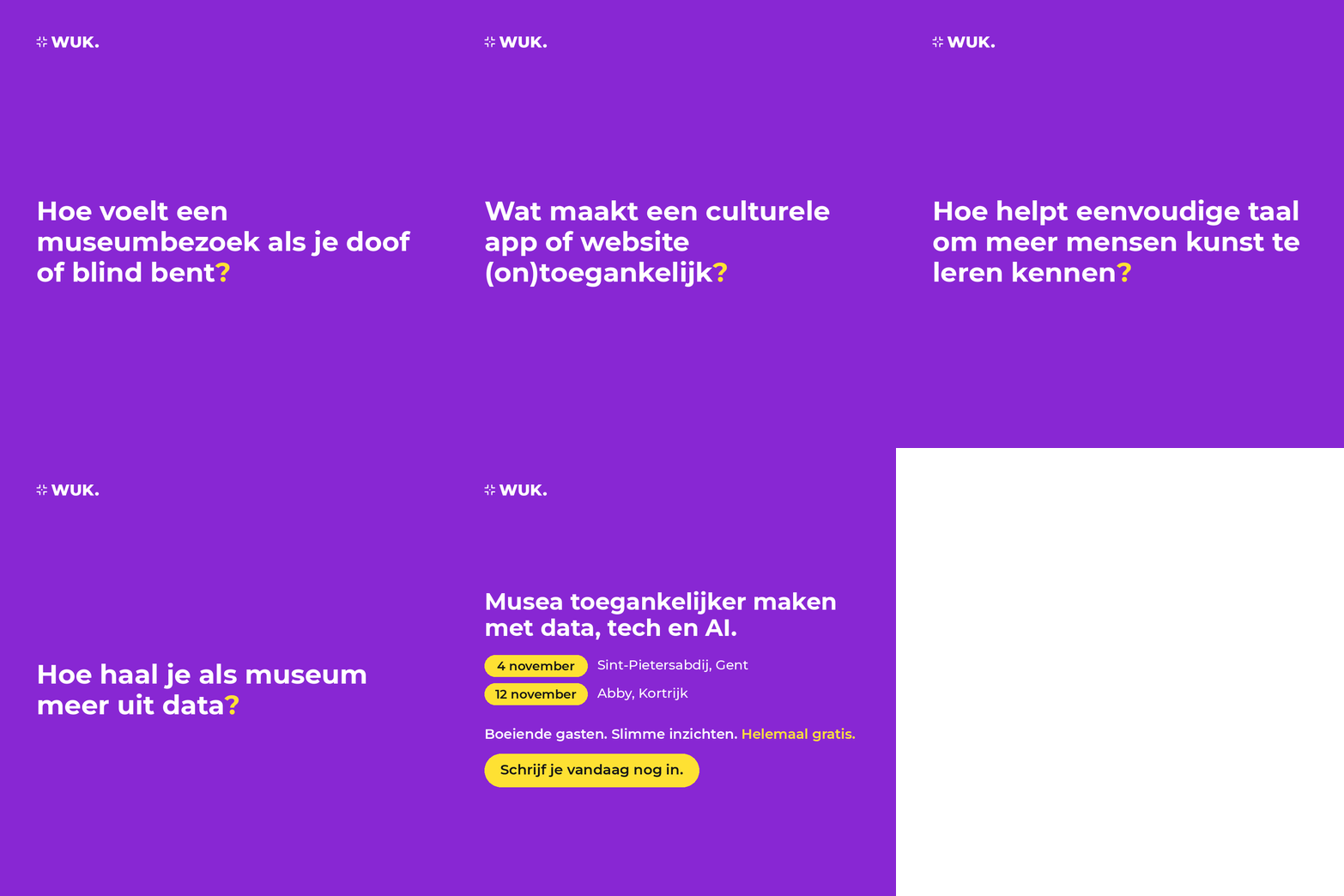
“Kan technologie ons museum écht toegankelijker maken?” “Welk probleem lost dat op?” “Moeten wij daar dan een app voor hebben?” “Is dat niet enorm duur, zoiets?” “Hebben wij daar iemand technisch voor nodig?” Dat soort vragen krijg ik vaak van museummedewerkers, zodra ik vertel dat we bij WUK nogal geloven in inclusieve technologie voor musea en cultuur. Logische vragen. Er lopen nu eenmaal niet veel toegankelijkheidsexperts rond in musea. En we bekijken de wereld allemaal vooral door onze eigen bril. Dat die wereld niet voor iedereen even toegankelijk is, merk je pas als iemand het je vertelt. Daar willen we meer bewustzijn rond creëren. Daarom brengen we vijf gasten samen rond concrete vragen: → Hoe voelt een museumbezoek als je doof of blind bent? → Wat maakt een culturele app of website écht toegankelijk, en waar gaat het mis? → Hoe helpt eenvoudige taal om meer mensen kunst te laten ontdekken? → En hoe haal je als museum meer uit je bezoekersdata? Met Doof Vlaanderen, Eleven Ways en WUK. Plus demo’s en voorbeelden uit binnen- en buitenland. Een halve dag (10u tot 14u), op maat van de museum- en erfgoedsector. Lunch inbegrepen, deelname gratis. 📍 4 november, Sint-Pietersabdij Gent – https://lnkd.in/esxQAfVS 📍 12 november, Abby Kortrijk – https://lnkd.in/ekbgwJrg
- LINKEDIN · IMAGESince 21 Oct 2026
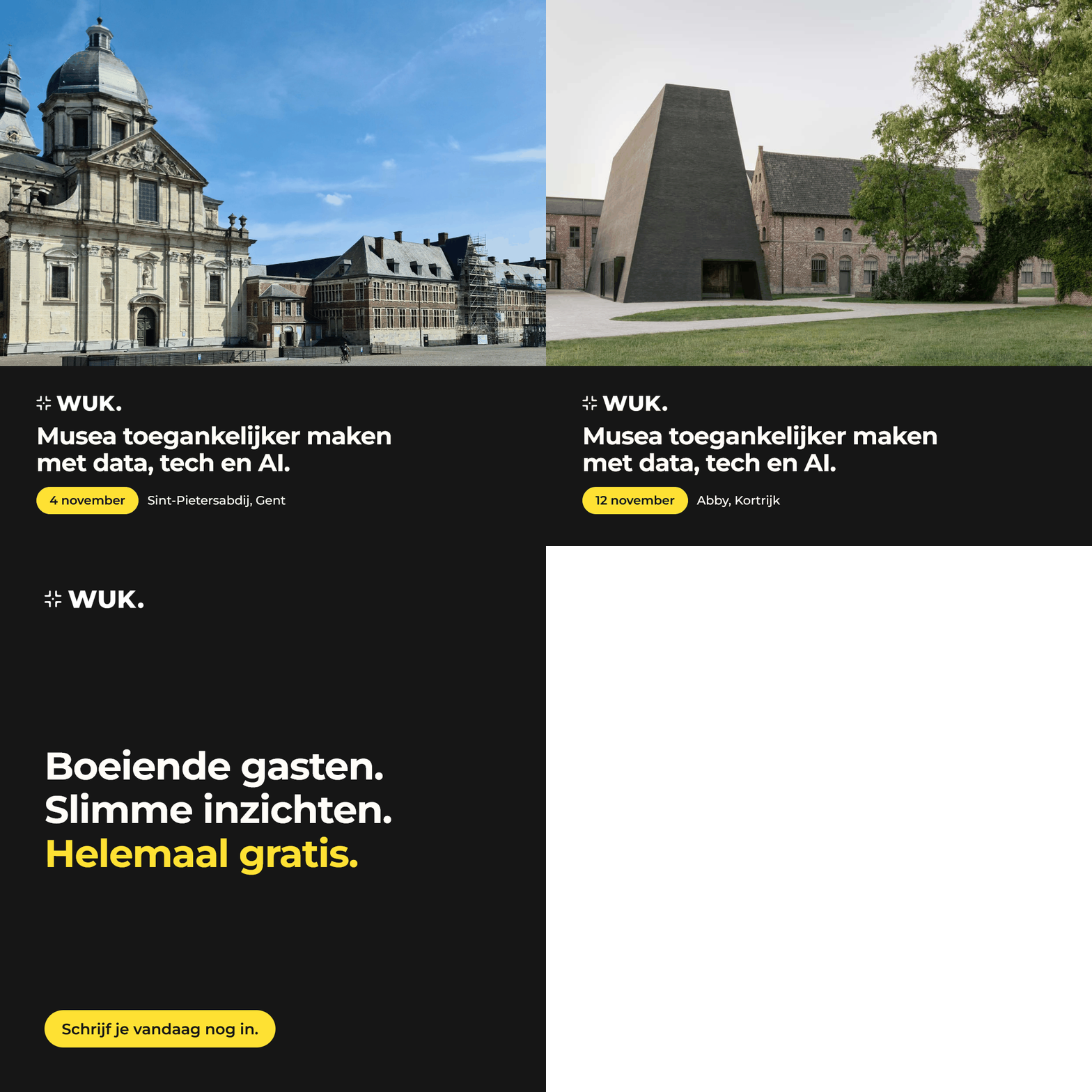
In de meeste musea krijgt iedereen exact dezelfde ervaring. Of je nu blind bent of doof. Of je nu 12 bent of 80. Of je nu kunsthistoricus bent of weinig hebt met kunst. Of je nu één van de landstalen spreekt of niet. Hoe het anders en beter kan, dat leer je binnenkort in Gent en Kortrijk. We geven een podium aan de mensen voor wie musea niet ontworpen zijn, samen met experts die de situatie op verschillende manieren proberen te verbeteren. 'Musea toegankelijker maken met data, tech en AI' 📍4 november in de Sint-Pietersabdij, Gent 📍12 november in Abby Kortrijk Een halve dag met getuigenissen, praktijkvoorbeelden, (inter)nationale cases en demo's. Daarna is er een netwerklunch, helemaal gratis. Inschrijven via deze links: 👉 Gent - https://lnkd.in/esxQAfVS 👉 Kortrijk - https://lnkd.in/ekbgwJrg
- LINKEDIN · IMAGESince 13 Sept 2026
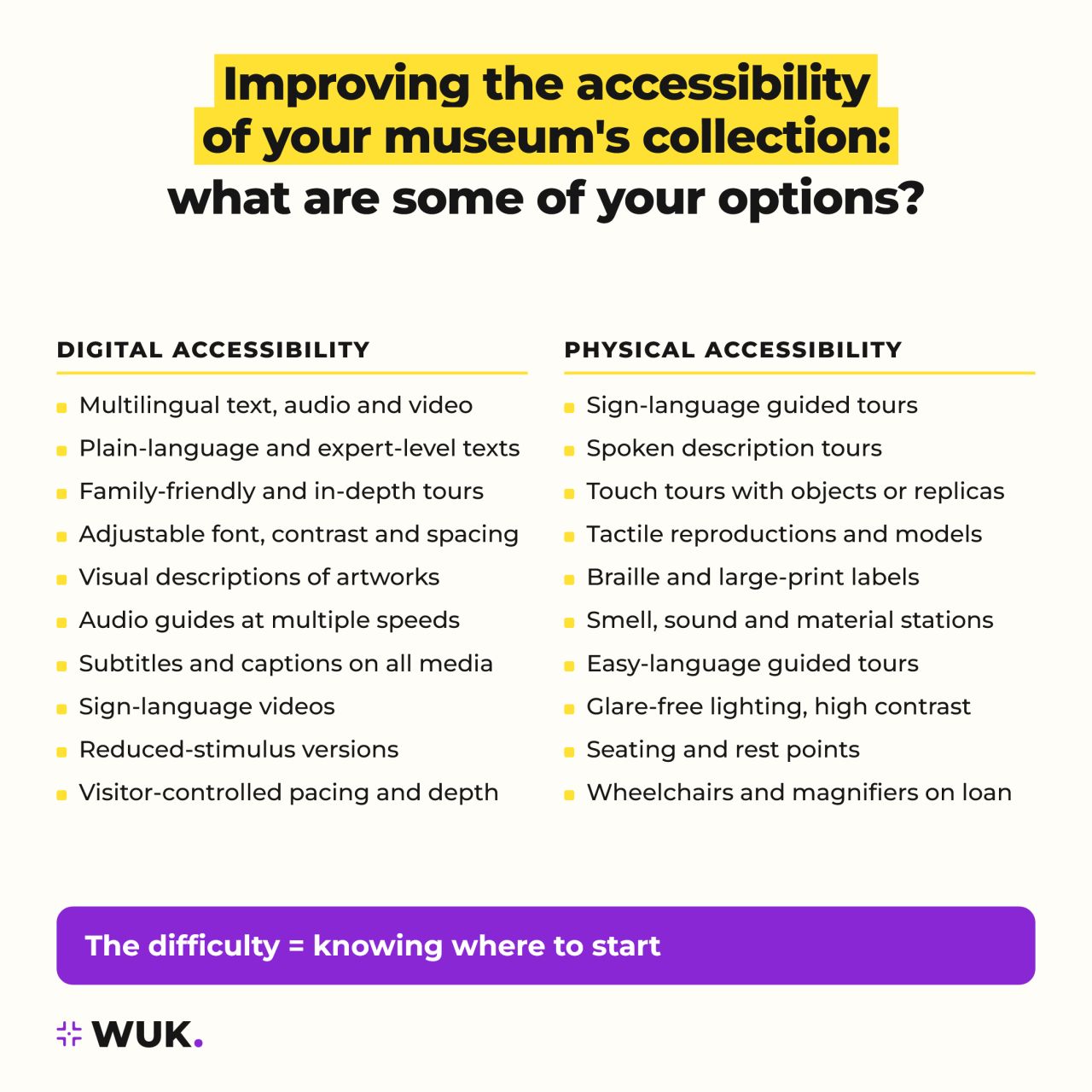
“We want to make our museum more accessible but don’t know where to start.” I hear this often when talking to museum people about accessibility. Indifference is certainly not the issue: most museums want their collection to be enjoyed by as many people as possible. Sometimes it’s a lack of time and money, but not always. So if the will and the resources are there, what’s the real stopper? It’s the lack of a plan. Psychologists call it task ambiguity: if you’re unsure of what to do first, you likely won’t do it all. Look at the image accompanying this post. It's based on a slide I show during WUK talks. I made it text-heavy and overwhelming – on purpose. I made it to prove a point: the perfectly accessible museum does not exist. There is simply too much to do, too many people and needs to consider. But at the same time: better really is good. Because the traditional museum experience offers very little of this. Anything you add that’s done well is a marked improvement. Our advice for museums who want to be more inclusive? ✔️ Start small, with one type of visitor in mind: a relaxed opening for neurodivergent visitors or one exhibit optimized for the hard-of-hearing. ✔️ Involve those visitors in planning, not just at the end. They will catch what your team cannot see. ✔️ Think about the whole visit . A blind person who can’t book a ticket online or reach your door safely will never become a visitor at all. ❌ Don’t try to do everything for everyone at once. You’ll make mistakes. Accessibility done badly helps no one. At WUK, we have an Accessibility Maturity Scan. It helps museum teams understand how accessible their experience is today and how they can improve it step by step, in a practical and realistic way. Request a scan today, obligation-free 👉 https://lnkd.in/ea6Hdnth
- LINKEDIN · IMAGESince 13 Sept 2026
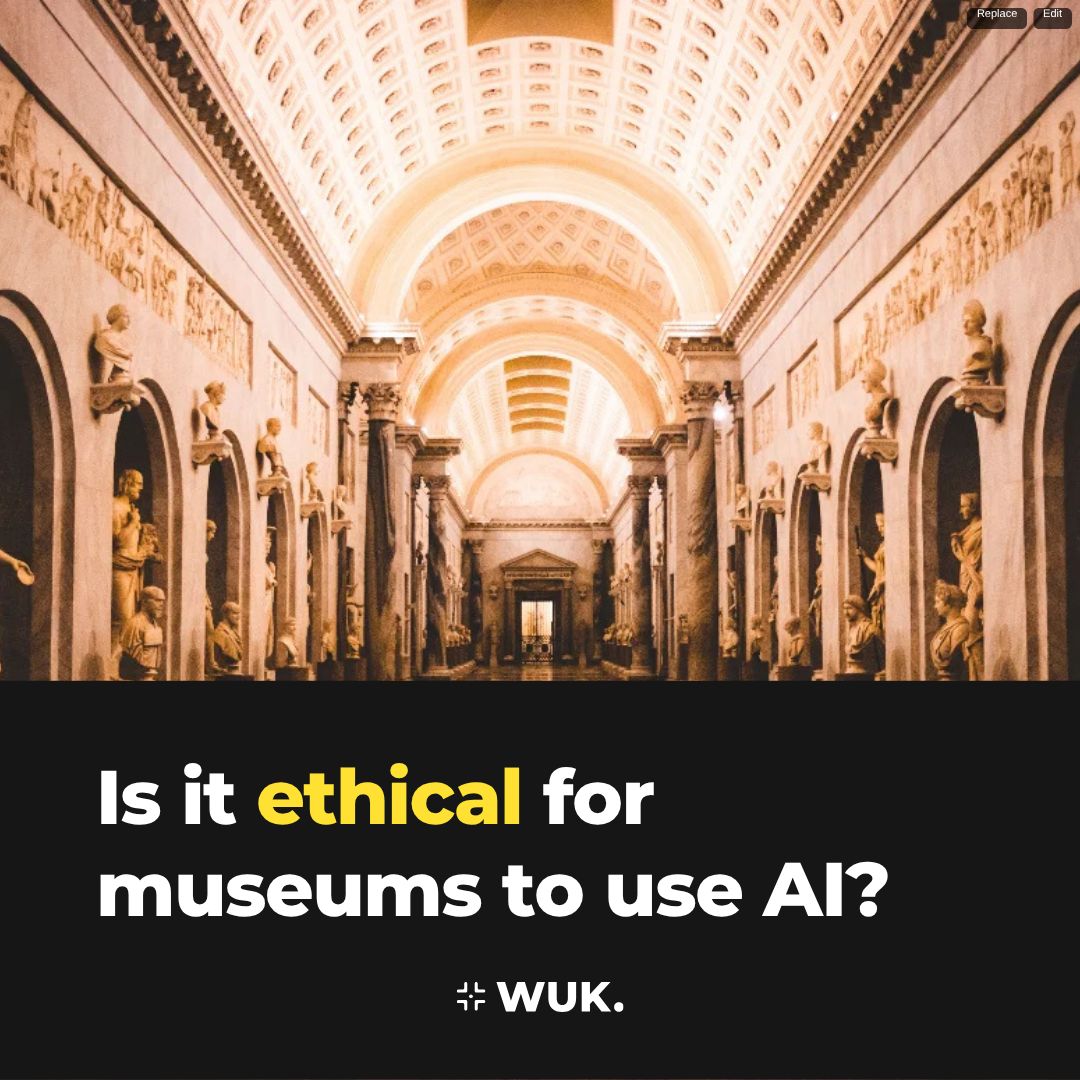
Is it ethical for museums to use AI? Fair question. Training data and energy cost are real problems. But AI is also a strong accessibility tool: fast translation into rarely served languages, text-to-speech for blind and low-vision visitors… It can also assist with collection management or save staff hours on cataloguing. Here are 7 rules we give museums considering AI: 1. Pick ethical suppliers. How were the models trained? Is your content used for training, and can you switch that off? Consider EU-hosted providers like Mistral who publish their footprint, or have a look at Fairly Trained. 2. Complement the human experience, don't replace it. Human guides and AI-assisted visits can coexist. AI covers the gaps a guide can't: the visitor who arrives when no tour is running, the one who needs Mandarin, the one who can't read wall labels. 3. Skip AI "art" unless it has a purpose. In 2021 the Rijksmuseum reconstructed the edges of Rembrandt's 'Night Watch', trimmed off in 1715: that’s evidence-based AI use, with a research goal. 4. Be clear about what's real and what's digital. Hang an AI version of 'Girl with a Pearl Earring' like the Maritshuis did in 2023 and expect the same backlash. 5. Keep humans in the loop. Trained on your own catalogue, a model could reproduce a century of colonial language, or invent dates. AI drafts, a curator signs off, and it's logged. 6. Mind the energy cost. Prompt well before you generate. Text is cheap, images are not. 7. Tell visitors how and why you use AI, and what happens to their data. Label a chatbot on the first screen, not in the privacy policy. And you don't need AI to be inclusive. Human-made content works just as well, as long as it reaches your audience in a usable format, on a platform that meets WCAG 2.1. WUK does both: your own copy on an accessible platform, converted to audio when needed. If you want to learn how to do this for your museum, book a call 👉 https://lnkd.in/eFy2Siwxhttps://lnkd.in/eFy2Siwx
- LINKEDIN · IMAGESince 13 Sept 2026
Exhibit labels and panels are how a museum communicates with visitors. But who reads them? 🖼️ Labels started small. For most of museum history, they were basically inventory tags: artist, title, catalogue number, and not much more. 19th-century critics thought text distracted from the object. After 1968, changing education policy pushed a sharp increase in exhibition text. In the late 1970s and 80s, the label became the museum's voice. Beverly Serrell's Exhibit Labels (1996) gave the field its standards. Today there are style guides, interpretive writing frameworks and courses to learn the craft. Enormous care goes into these panels. Unfortunately, they also present multiple issues: Most visitors don't finish them. Long, dense panels get skipped by everyone except the deeply interested. Studies find reading drops as word count rises. An estimated one third to half of visitors read exactly zero labels. Then there are the visitors who love deep reading. The specialist, the returning member, the student… they hit the end of your 75 words and want 500 more. And a real share of your audience can't read labels at all: Blind and low-vision visitors. Deaf visitors whose first language is sign language.. Visitors with low literacy. Visitors who don't speak your language. One physical panel cannot serve all four… but a visitor guide app can. So if you want your museum to be more inclusive: digitize your existing label texts, and feed them into a guide app of your choosing. They can then be turned into audio, translated, and offered in short, long, simple or specialist versions – all from the same source. And it doesn’t impact your physical museum at all. 👉 I help museums and cultural spaces be more inclusive. What started as a mission for my own museum is now the mission of WUK, the multilingual and inclusive visitor guide app. 💜 Curious about inclusive visitor experiences? Let's chat.
- LINKEDIN · IMAGESince 13 Sept 2026
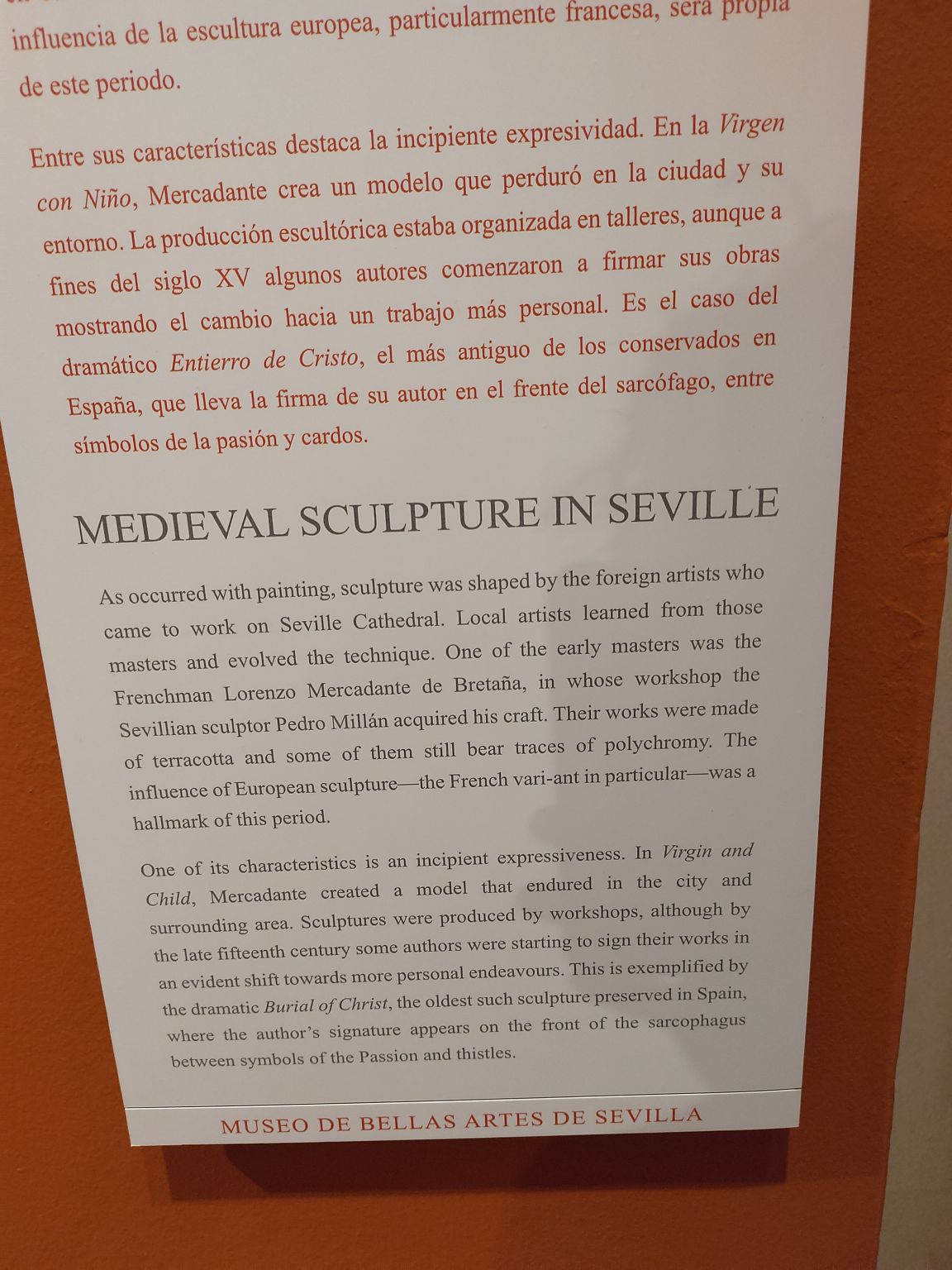
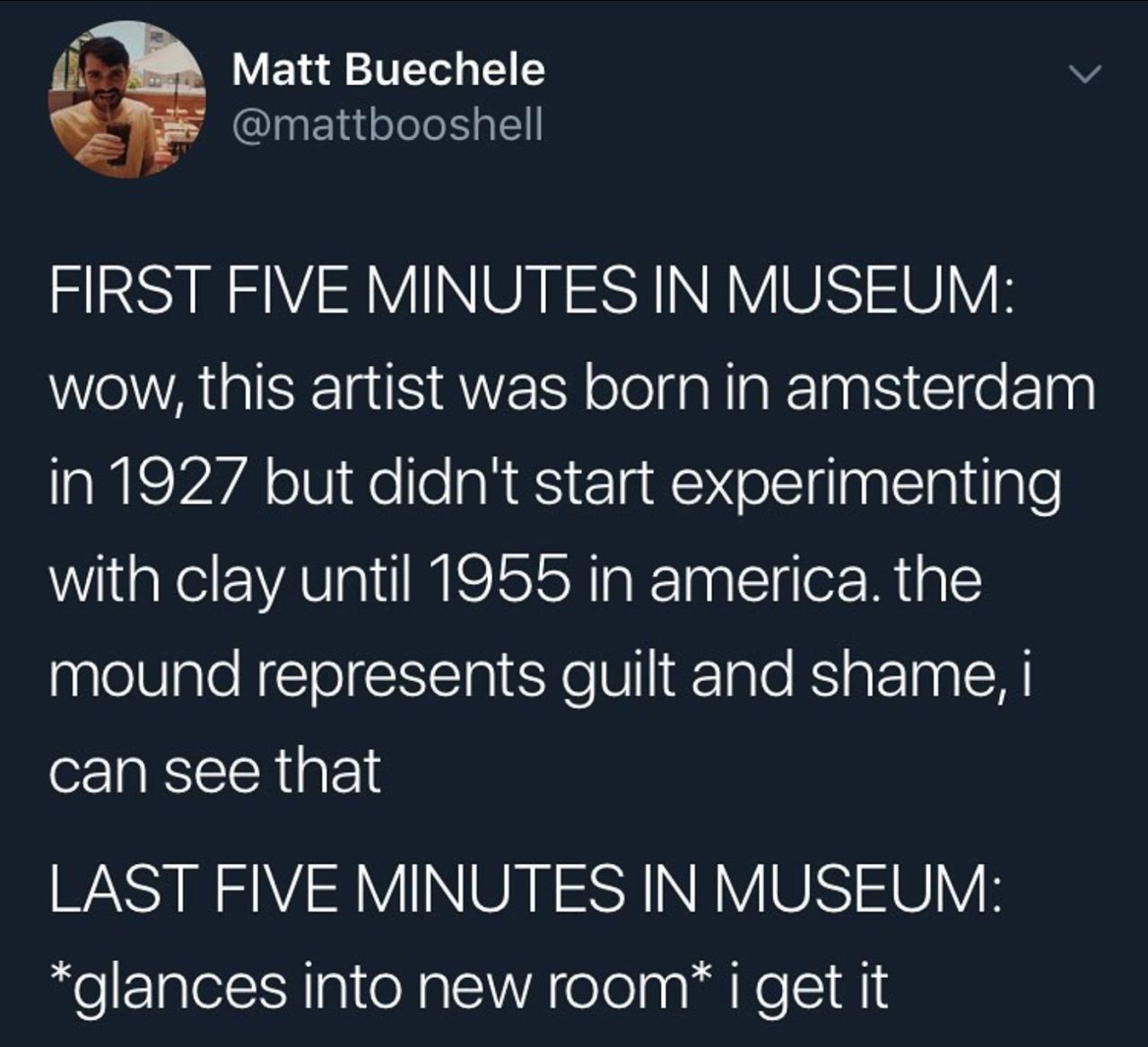
Museum fatigue is real, and it applies to every type of visitor. Museum fatigue is the well-documented drop in visitor attention, interest and retention that sets in as a visit goes on. It happens to anyone asked to concentrate on dozens of unfamiliar objects in a row, while navigating an often new space. Benjamin Ives Gilman named it in 1916, after photographing visitors contorting themselves to read badly placed labels. Later researchers made it measurable: Falk and colleagues found interest holds for roughly the first 30 minutes and then declines; Serrell put the drop-off closer to 20. Melton observed the related "exit gradient”: the further in you get, the more the exit pulls. Everyone knows the symptoms, and the funny tweet puts it perfectly: you read every word in room one. By room six you're glancing in from the doorway. Now hold that next to an accessible tour, and realize how universal the phenomenon really is: - A blind visitor listening to a visual description is processing more per object, not less. - A deaf visitor watching a sign language video can't skim ahead the way a hearing visitor skims a wall text. - A neurodivergent visitor may have spent half their mental focus processing the noise, light and crowds before reaching the first artefact. - A family often runs on the stamina and attention span of its youngest member. Everyone fatigues. The audiences we want to optimize the museum visit for often fatigue sooner, because they have more to carry, not less. So when you have 100+ artefacts and you're designing an accessible tour: the accessible route is usually the shorter one. 👉 I help museums and cultural spaces be more inclusive. What started as a mission for my own museum is now the mission of WUK, the multilingual and inclusive visitor guide app. Curious about inclusive visitor experiences? Let's chat.
6 of 37+ adsSign up to see every WUK ad, filter by format and date, and get alerts on new ones.
See all 37+ adsQuestions about WUK’s ads
Does WUK have new LinkedIn ads?
Yes. We found 2 new LinkedIn ads for WUK in the 30 days to 11 Nov 2026.
How many LinkedIn ads has WUK run?
LinkedIn’s ad library lists 32 ads for WUK. We recorded 37 LinkedIn ads for WUK, first recorded on 3 Oct 2026 and last recorded on 28 Oct 2026.
Does WUK run Google ads?
We recorded no Google ads for the domain wuk.app on 15 Oct 2026.
Which ad formats does WUK use?
The 6 LinkedIn ads on this page include 6 image ads.
Watch the companies you care about.
Filter every ad by industry, country, format and network, and get alerts when a company you watch starts running new ads.