Not on air · 2 of 3 networks checked

Wombex ads
- web.wombex.com
- IT System Custom Software Development
- GB
- 8 employees
Wombex’s ads on LinkedIn, Meta and Google, recorded by adsrunning. Browse the latest here for free. Sign up free to see all 23. Watch Wombex on any plan to get each new one in your feed.
Watchlist included in every plan
What Wombex runs
- Single image · LinkedIn
- 6
| Network | Status | Live ads | Nov 2025LinkedIn activity · 52 weeksNov 2026 | Checked | Next step |
|---|---|---|---|---|---|
| None recorded | 0 | Checked 3 Nov 2026 | See all 23 ads → | ||
| Meta | Not checked | — | |||
| None recorded | 0 | No ads found on the Google Ads Transparency Center | Checked 19 Oct 2026 | Collect them with the API → |
Wombex has no live LinkedIn ads. We recorded no Google ads on 19 Oct 2026.
Latest ads
- LINKEDIN · IMAGERecorded 3 Oct 2026
Infinite number of methods. That’s the smell test. If your “service” can be changed in a hundred different places… it’s not flexible. It’s unpredictable. One endpoint becomes five. A flag becomes “the way.” A payload grows a new field because it was faster than thinking. Then a new feature lands. And it isn’t hard. It’s scary. Because one service does everything. So every change touches something you can’t see. You start shipping with your memory, not your tests. “That one customer flow.” “That weird edge case.” “That report that only runs on Tuesdays.” Here’s the pattern we keep seeing across mature teams: When a service gets big, names drift. Payloads drift. Ownership blurs. And change turns into a guessing game. In our reviews, the biggest risk is rarely “bad engineers.” It’s unclear contracts. Once contracts get fuzzy, teams stop trusting the system. Speed drops. Stress goes up. The fix is not a heroic refactor sprint. It’s a reset of structure. Take the oversized service and split it into clear modules. Give each module one job. Use consistent naming. Keep payloads stable. That’s the whole point of Wombex: turn a too-big service into a set of understandable pieces, so adding features feels routine again. Proof looks boring, which is the best kind. Fewer surprise breakages. Faster reviews. Easier onboarding. Teams often see feature confusion drop by about 50% once modules and contracts stop shifting. When you get this right, releases stop feeling like a dare. You can change one thing without waking up ten others. Roadmaps get quieter. So do nights before launch. If you’re in the “info gathering” phase, start simple. Click Learn more and see what modularizing looks like in a real codebase. Or contact Wombex to talk through your service, pressure-free, with a team that’s done this for 15+ years. Get the checklist https://web.wombex.com
- LINKEDIN · IMAGERecorded 3 Oct 2026
Rug pulled again? One day the tool “just works.” Next day it’s a new tier, a missing feature, or a roadmap you don’t control. And your team is the one eating the weekend to patch the gap. This is the quiet trap of modern ops. You buy software to move faster. But over time, the business starts depending on it in ways the vendor never promised to protect. Here’s the tell: once a system becomes “can’t fail,” buying stops being convenience and starts being a business risk. I’ve seen it over and over. The critical workflow lives in a SaaS product… but the knowledge lives in one admin’s head… and the backup plan is “hope.” Then it’s: • price hike you can’t negotiate • integrations that break with no warning • “we’re sunsetting that feature” • support tickets stuck in a queue • leadership asking for answers you don’t have Most teams miss the tipping point until the first real incident. And the incident never lands on a calm Tuesday morning. The fix is not “build everything.” And it’s not forcing the whole company into yet another system. The move is to get clear on what you can safely keep buying… and what you can’t afford to rent. Wombex helps teams do that with a simple path: 1) Map the workflows that keep revenue, compliance, or delivery alive 2) Score vendor risk and lock in what’s truly core 3) Build only the internal pieces that need to be owned 4) Make adoption easy by fitting how people already work (Excel hooks, file share monitoring, minimal new logins) That last part matters. Great internal tools fail when they ignore real habits. With 15+ years in custom software, the goal is boring reliability: fewer fire drills, fewer hostage moments, and a plan that makes sense to both ops and IT. What changes when you get this right? You stop treating vendor updates like weather. You can switch tools without panic. You can grow without betting the company on someone else’s pricing page. If you want, share one “can’t fail” workflow you’re currently renting. I’ll tell you what I’d classify as safe-to-buy vs must-own, and what the first step looks like. Or message me to schedule a consult. Get a build-vs-buy assessment
- LINKEDIN · IMAGERecorded 3 Oct 2026
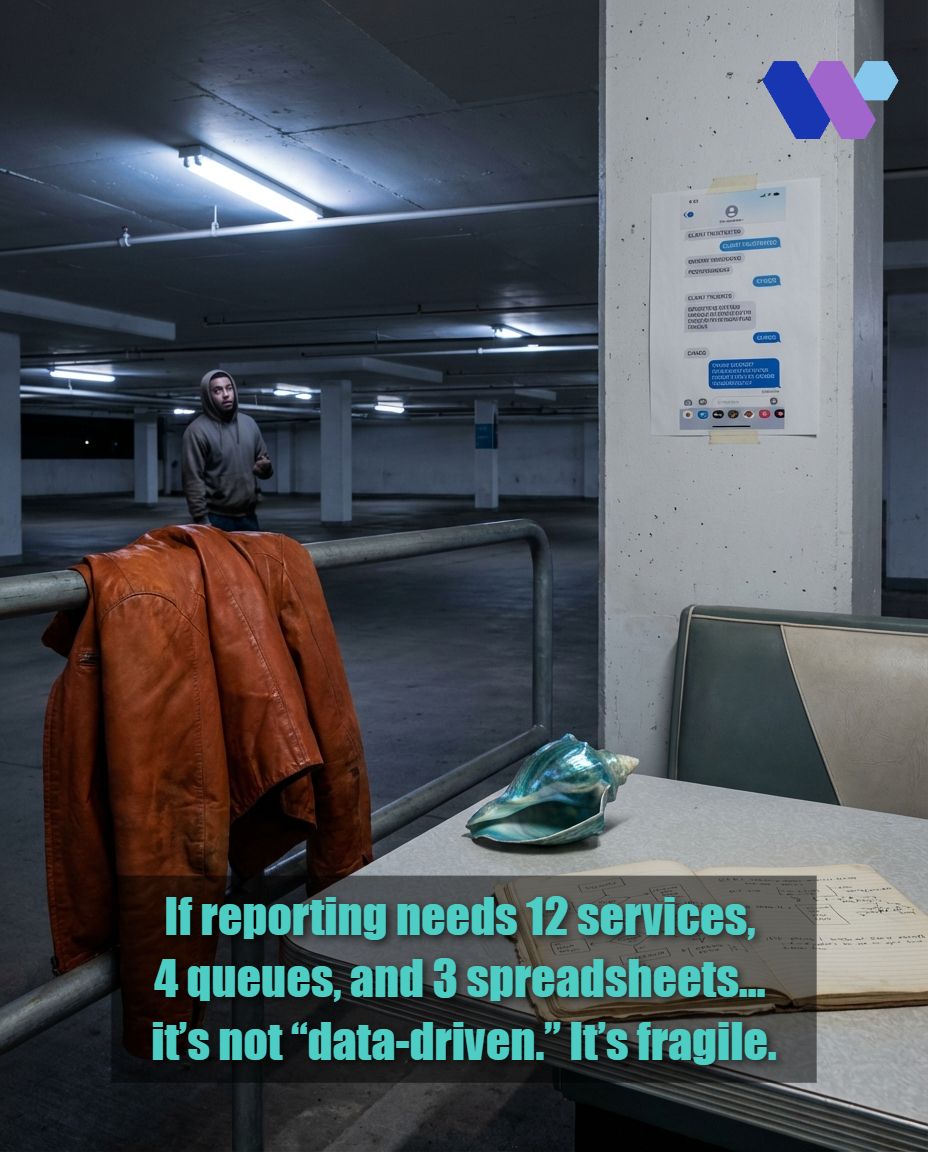
Reports with microservices suck. Not because microservices are “bad.” Because reporting turns into a scavenger hunt. If your monthly report needs 12 services, 4 queues, and 3 spreadsheets… it’s not “data-driven.” It’s fragile. Teams add services over time. That part is normal. What’s not normal is the cost. Data lives in five places. Field names drift. Payloads change. One service ships “customerId,” another ships “client_id.” Then a dashboard breaks and nobody knows where. So people export. Merge. Re-check. Every month. One quick reality check: most reporting bugs aren’t math. They’re mismatched data definitions and missing events. The same metric can come out three different ways, depending on which service you ask. The fix is not “one more ETL job.” It’s one clear data path. A simple approach works well: Pick the key business events. Collect them into a single, consistent store. Then have reports pull from one place. Often that store is a unified search layer like Elasticsearch. Fast queries. One schema. One source for reporting. Less glue code. Fewer brittle joins across services. Wombex helps you design that flow end to end. Not a rip-and-replace. A clean path that scales with your system. Built to stay maintainable as teams and services change. Backed by 15+ years building enterprise-grade software where reporting has to be trusted. When this is done right, a “simple” report stays simple. New services don’t break old metrics. Finance and product stop arguing about numbers. You get answers in minutes, not meetings. If you want a quick sanity check on your reporting architecture, contact Wombex to schedule a consultation. Explore the blueprint https://web.wombex.com
- LINKEDIN · IMAGERecorded 3 Oct 2026
They lied. Again. Not with malice. With a deck. With a timeline. With “we’ve done this before.” Then you’re 10 weeks in and the story changes. You didn’t buy software. You bought a promise. It usually looks like this: • “That’s out of scope.” • “Our platform can’t do that.” • “We’ll add it to the roadmap.” • “It’s blocked until the next sprint.” And somehow you’re the one explaining delays to your team. Here’s the part most vendors skip: the risk isn’t the code. It’s the guessing. A recent industry survey found most software projects miss at least one major target, like timeline, budget, or expected value. Not because people are lazy. Because the work gets scoped like a contract, not like a real workflow. If your ops are complex, “deliverables” are not safety. They’re a loophole. The fix isn’t more meetings. It’s changing how the work gets scoped, proven, and handed over. That’s the approach behind Wombex. Start with outcomes, not features. Turn your real process into testable scenarios. Prototype the risky parts early, before they become expensive. Build clean, then hand it over like an adult, with clarity, docs, and ownership. No mystery box. No “trust us.” Just proof, early. This is what good looks like: You can see what’s real in week 2, not month 4. You stop paying for confidence and start paying for results. Your team gets software that fits the way you actually work, and you’re not trapped when the build is done. If you’ve been burned by “deliverables” that turned into excuses, send a message with the word SCOPE. You’ll get a short consult to map the workflows, name the risks, and see what it would take to validate the right build before you commit. Talk to Wombex https://web.wombex.com
- LINKEDIN · IMAGERecorded 3 Oct 2026
Another login? Nope. That tiny pause when a new tool invite hits. Hover over “set password.” Sigh. Close tab. Because it’s never just a login. It’s a new place to check. A new way to do the same work. And under pressure, people go back to what’s fast. Excel. Email. File shares. Then the “official” system becomes optional. So the real work lives in side spreadsheets and folders with weird names. Now you have two truths. And you feel it. Meetings get longer. Numbers don’t match. Everyone asks, “Which version is right?” Here’s the part most teams miss: the shiniest system fails if users hate it. In review after review, adoption drops when a tool becomes “one more place.” Not when it lacks features. So the fix usually isn’t “pick a better platform.” It’s remove the extra place. The win is building around what people already use, then adding just enough structure to stop the chaos. Think: keep the spreadsheet, but add guardrails. Simple intake so data lands in the right columns. Checks that flag missing fields. A change log so “who edited this?” stops being a mystery. Alerts so handoffs don’t rely on memory. Same with file shares. Keep the folder habit. Add visibility, triggers, and a clear “ready” signal so work moves without chasing. That approach tends to land because it respects reality. It meets users where they already work. And it gives ops control without forcing a big bang switch. The proof shows up fast. Fewer pings. Fewer “can you resend that.” Cleaner inputs. Shorter cycles. Less double entry. More trust in the numbers. When the workflow stops fighting people, adoption stops being a campaign. It becomes the default. If you’re problem-aware and tired of rolling out “the system” only to watch it fade, it might be time to stop replacing habits and start designing around them. Tap “Learn More” if you want examples of the small shifts that create the biggest lift. Explore an adoption-first build https://web.wombex.com
- LINKEDIN · IMAGERecorded 3 Oct 2026
Immediate, massive debt. Not the kind you see on a balance sheet. The kind that looks “stable” for years… right up until it isn’t. A 17-year-old system can run quiet. No big fires. Then the one engineer who knows the real flow leaves. Now every change is a gamble. A “small” tweak takes weeks. Not because the team is slow. Because the map is missing. Docs are old. Parts of the code are “don’t touch.” Infra is held together by habits and hope. And each release feels like you’re pulling a thread. Here’s the hard part: most legacy risk is hidden. Teams often spend 20–40% of their time just figuring out what the system does before they can safely change it. So you’re paying for the past every sprint. And the debt keeps compounding. The goal isn’t a big rewrite. That’s how good systems get broken. The safer path is small, low-risk steps. Modernize without stopping the business that depends on it. That’s where Wombex helps as a guide. First, the system gets mapped. What calls what. What breaks what. Where the real bottlenecks live. Then the safest first cuts get picked. The parts that reduce risk fast, with the least blast radius. Then changes ship in steps, with checks in place, so you can learn as you go. Teams that do this right don’t just “clean up code.” They get time back. Changes stop dragging. Onboarding gets easier. Releases get calmer. And scaling starts to feel normal again. If you’re 15+ years into a system and it’s starting to feel fragile, you’re not alone. You can fix it without a ground-up rebuild. Want a quick gut-check on where the risk is hiding? Contact Wombex and share what you’re running. We’ll help you find the safest first step. Read the approach https://web.wombex.com




6 of 23 adsSign up to see every Wombex ad, filter by format and date, and get alerts on new ones.
See all 23 adsQuestions about Wombex’s ads
Is Wombex running LinkedIn ads?
We recorded no live LinkedIn ads for Wombex on 8 Nov 2026.
How many LinkedIn ads has Wombex run?
LinkedIn’s ad library lists 23 ads for Wombex. We recorded 23 LinkedIn ads for Wombex, first recorded on 3 Oct 2026 and last recorded on 3 Oct 2026.
Does Wombex run Google ads?
We recorded no Google ads for the domain wombex.com on 19 Oct 2026.
Which ad formats does Wombex use?
The 6 LinkedIn ads on this page include 6 image ads.
Watch the companies you care about.
Filter every ad by industry, country, format and network, and get alerts when a company you watch starts running new ads.