Not on air · 2 of 3 networks checked
WillingnessToPay.com
- willingnesstopay.com
- Business Consulting
- DK
- 11 employees
WillingnessToPay.com’s ads on LinkedIn, Meta and Google, recorded by adsrunning. Browse the latest here for free. Sign up free to see all 250. Watch WillingnessToPay.com on any plan to get each new one in your feed.
Watchlist included in every plan
| Network | Status | Live ads | Nov 2025LinkedIn activity · 52 weeksNov 2026 | Checked | Next step |
|---|---|---|---|---|---|
| None recorded | 0 | Checked 1 Nov 2026 | See all 250 ads → | ||
| Meta | Not checked | — | |||
| Recently | 5 | Ads on the Google Ads Transparency Center | Checked 15 Oct 2026 | Collect them with the API → |
WillingnessToPay.com has no live LinkedIn ads. We recorded 5 Google ads on 15 Oct 2026.
Latest ads
- LINKEDIN · IMAGESince 31 Oct 2026
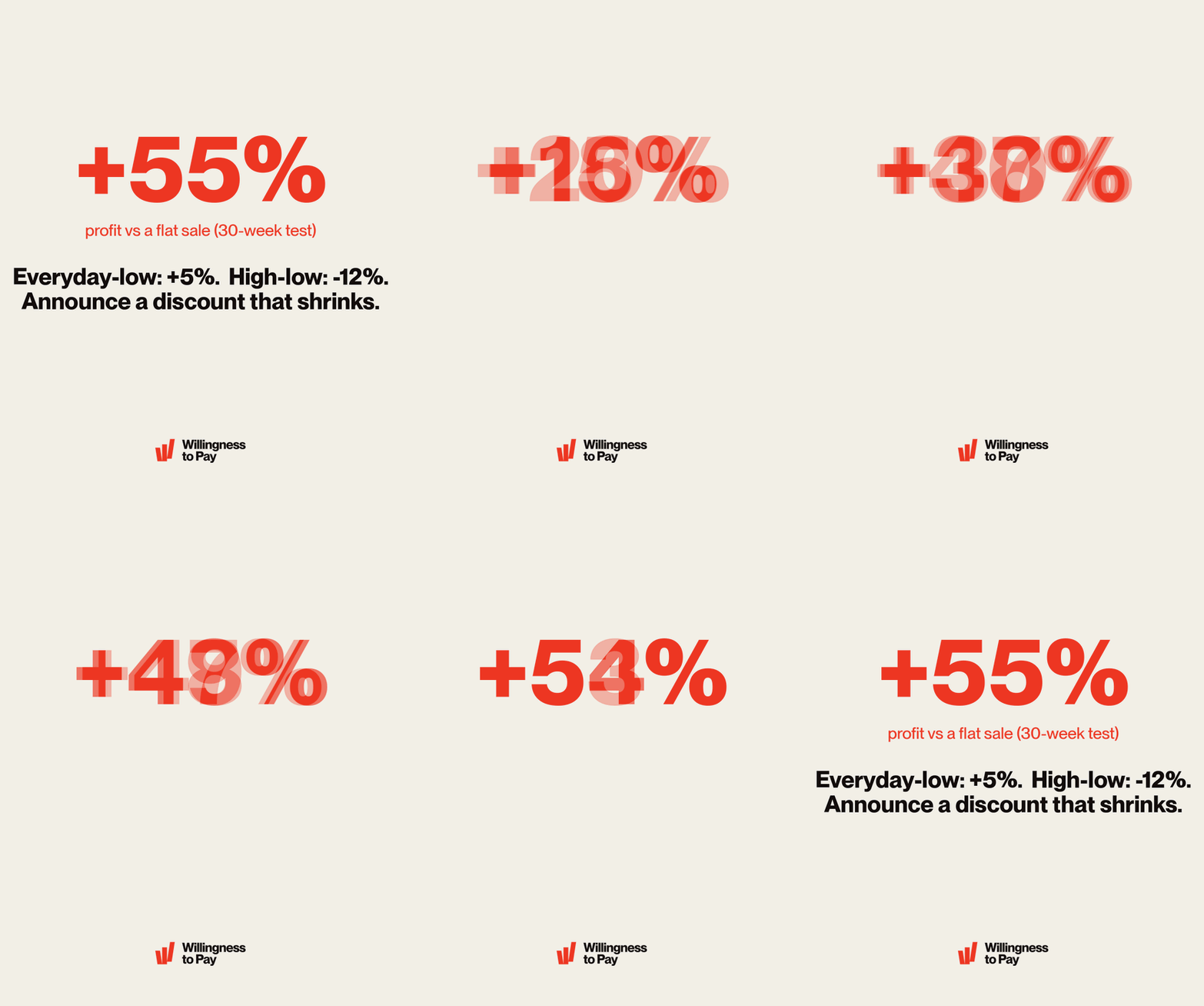
Everyone runs one of two sales: high-low (slash it, then snap it back) or everyday-low (keep it a bit cheap all the time). A team at the University of Miami tested a third kind almost nobody uses, and it beat both by a mile. They ran a 30-week experiment in a kitchenware store on a designer wine stopper, regular price $24.95. The twist in the third model: start the discount deep, then raise the price toward list day by day, and tell customers in advance that it is climbing. The results, after costs: - Declining discount: +55% profit. - Everyday-low price: +5%. - Classic high-low: minus 12%, worse than running no promo at all. The mechanism is anticipated regret. When the buyer can see the price only goes up from here, waiting has a cost, so they act now. A static sale says "come back whenever." A rising one says "this is as cheap as it will ever be." You do not need the full ramp to get the effect. The researchers found even one extra step beats one jump: $79 to $89 to $99 outperforms going straight from $79 to $99. Announce a discount that shrinks. It is the one sale that sells urgency instead of training people to wait.
- LINKEDIN · IMAGESince 24 Oct 2026
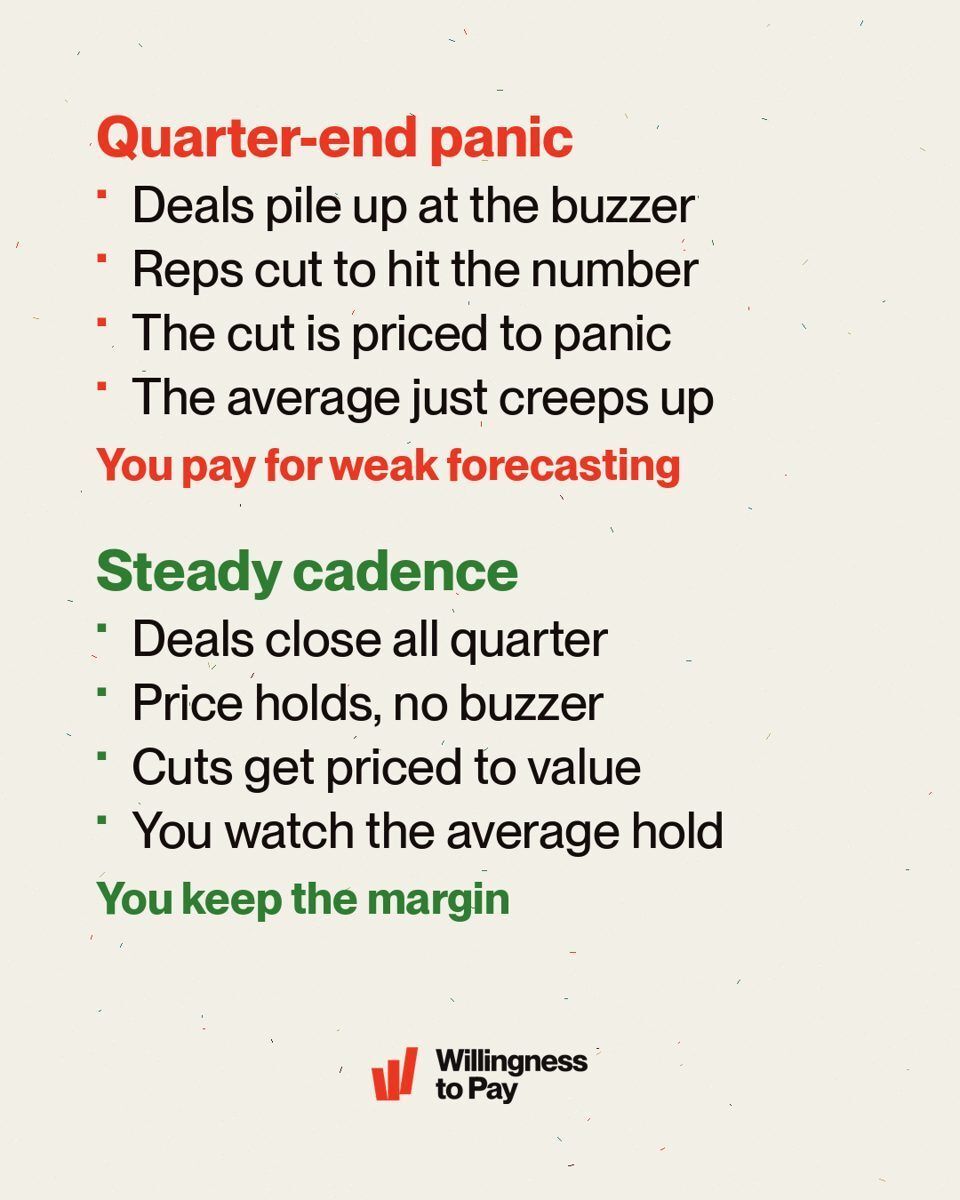
Your end-of-quarter discounts aren't a pricing problem. They're a forecasting problem. ❌ Wrong way: deals pile up in the last three days, so you buy them down to hit the number. ✅ Right way: fix the pipeline cadence so deals close across the quarter, not at the buzzer. Why: a discount granted against a deadline isn't priced to the customer's value, it's priced to your panic. The calendar sets the number, not the deal. The discount you give at the buzzer is the most expensive one of the whole quarter. When did your last quarter really close: steadily across twelve weeks, or in the final seventy-two hours?
- LINKEDIN · IMAGESince 23 Oct 2026
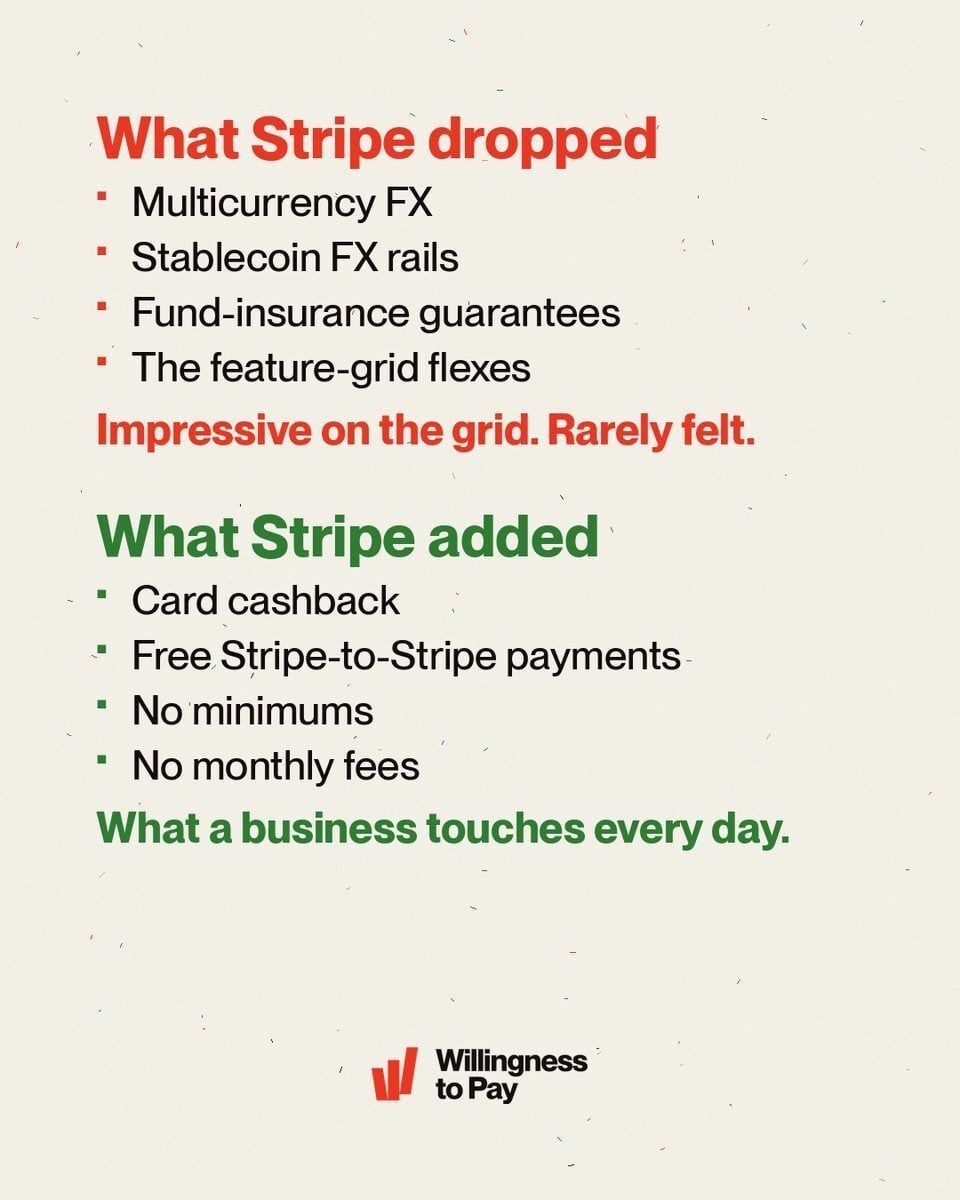
🔥 Stripe just rewrote its Treasury card, and it's a small masterclass in charging for what customers actually value. Out go the headline flexes: multicurrency and stablecoin FX, the fund-insurance bullets. In come the things a business touches every single day: card cashback, free Stripe-to-Stripe payments, no minimums, no monthly fees. Then, almost as a footnote, a new $329 Terminal reader (the T600) lands alongside the S710 and S700. Here's the commercial read 👇 1️⃣ They repriced around the value metric that actually gets used. FX and stablecoin rails look impressive on a feature grid. Daily cashflow perks are what a business feels. Stripe traded shelf-appeal for everyday value. 2️⃣ They widened the entry rung. A cheaper reader isn't a discount, it's a new doorway. Lower the cost to say yes, then land and expand once the volume shows up. 3️⃣ They turned a product page into a funnel. Everyday perks pull smaller businesses in at the bottom. The enterprise FX muscle still exists, it's just not the hook anymore. The lesson isn't "cut your prices." It's "charge for the thing your customer actually uses, and build a rung they can step onto." So, honest question: would you rather lead with the feature that wins the demo, or the one that wins the renewal? (Public info only, from Stripe's own pricing pages.)
- LINKEDIN · IMAGESince 22 Oct 2026
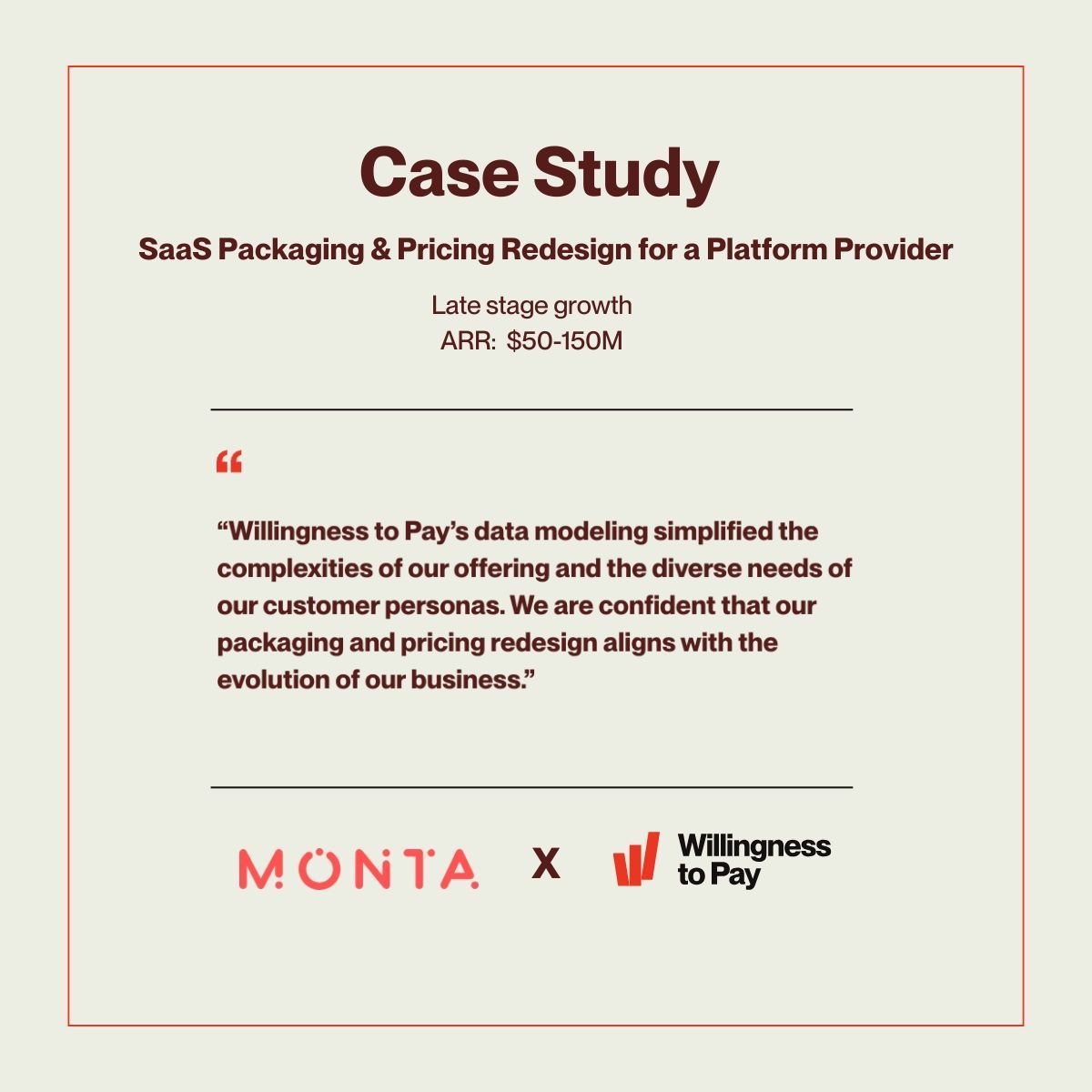
As Monta’s Director of Strategy, Mike Hawkes, said: "Our business is constantly evolving, and our packaging and pricing need to flex with it." Accelerating Monta’s Global Growth with Pricing Transformation As Monta scaled into 12+ markets, their pricing couldn’t keep up with diverse customers - from EV operators to enterprise clients. 💡 In 6 months, we: - Built a scalable packaging & pricing framework - Aligned teams across the company - Validated with customers pre-launch The result? A fair, value-driven model that fuels growth and helps sales close bigger deals without custom pricing. 📖 Full case study: https://lnkd.in/ewPaEifb #SaaS #PricingStrategy #GoToMarket #Growth #EVCharging #ProductStrategy #InternationalExpansion
- LINKEDIN · IMAGESince 22 Oct 2026
Many B2B companies have added AI but haven’t updated how they price it. Costs are rising. Usage is unpredictable. Margins are quietly getting squeezed. The problem isn’t just price levels, it’s how value is structured and monetized. See how to structure pricing for AI-driven products
- LINKEDIN · IMAGESince 22 Oct 2026
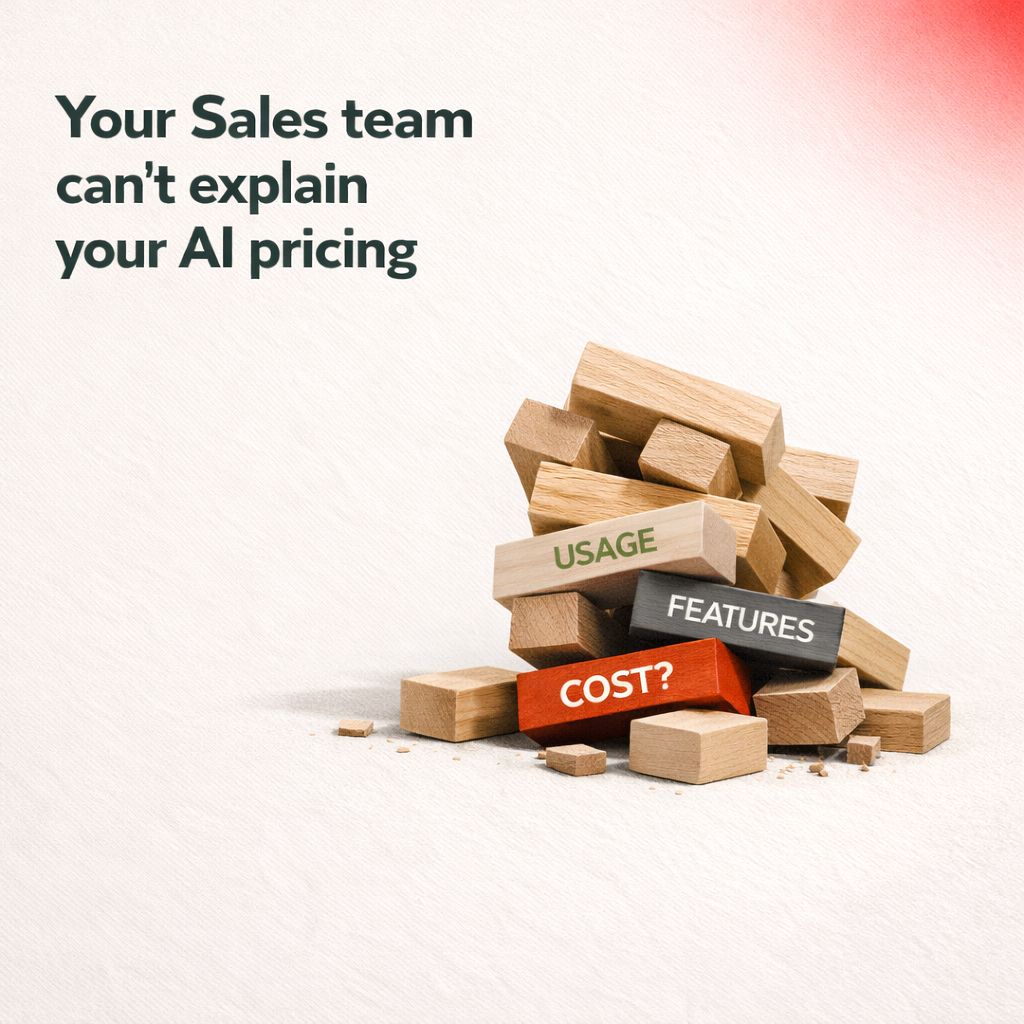
AI adds complexity — to your product and your pricing. If Sales can’t clearly explain: ✅ what customers pay for ✅ how usage works ✅ why it’s worth it Deals slow down. Or get discounted. That’s not a pricing problem. It’s a structure problem. Call to Action:

6 of 250 adsSign up to see every WillingnessToPay.com ad, filter by format and date, and get alerts on new ones.
See all 250 adsWatch the companies you care about.
Filter every ad by industry, country, format and network, and get alerts when a company you watch starts running new ads.