Not on air · 2 of 3 networks checked

Voyantis ads
- voyantis.ai
- Technology, Information and Internet
- US
- 121 employees
Voyantis’s ads on LinkedIn, Meta and Google, recorded by adsrunning. Browse the latest here for free. Sign up free to see all 176. Watch Voyantis on any plan to get each new one in your feed.
Watchlist included in every plan
What Voyantis runs
- Single image · LinkedIn
- 5
- Video · LinkedIn
- 1
| Network | Status | Live ads | Nov 2025LinkedIn activity · 52 weeksNov 2026 | Checked | Next step |
|---|---|---|---|---|---|
| None recorded | 0 | Checked 3 Nov 2026 | See all 176 ads → | ||
| Meta | Not checked | — | |||
| None recorded | 0 | No ads found on the Google Ads Transparency Center | Checked 15 Oct 2026 | Collect them with the API → |
Voyantis has no live LinkedIn ads. We recorded no Google ads on 15 Oct 2026.
Latest ads
- LINKEDIN · VIDEOSince 20 Oct 2026
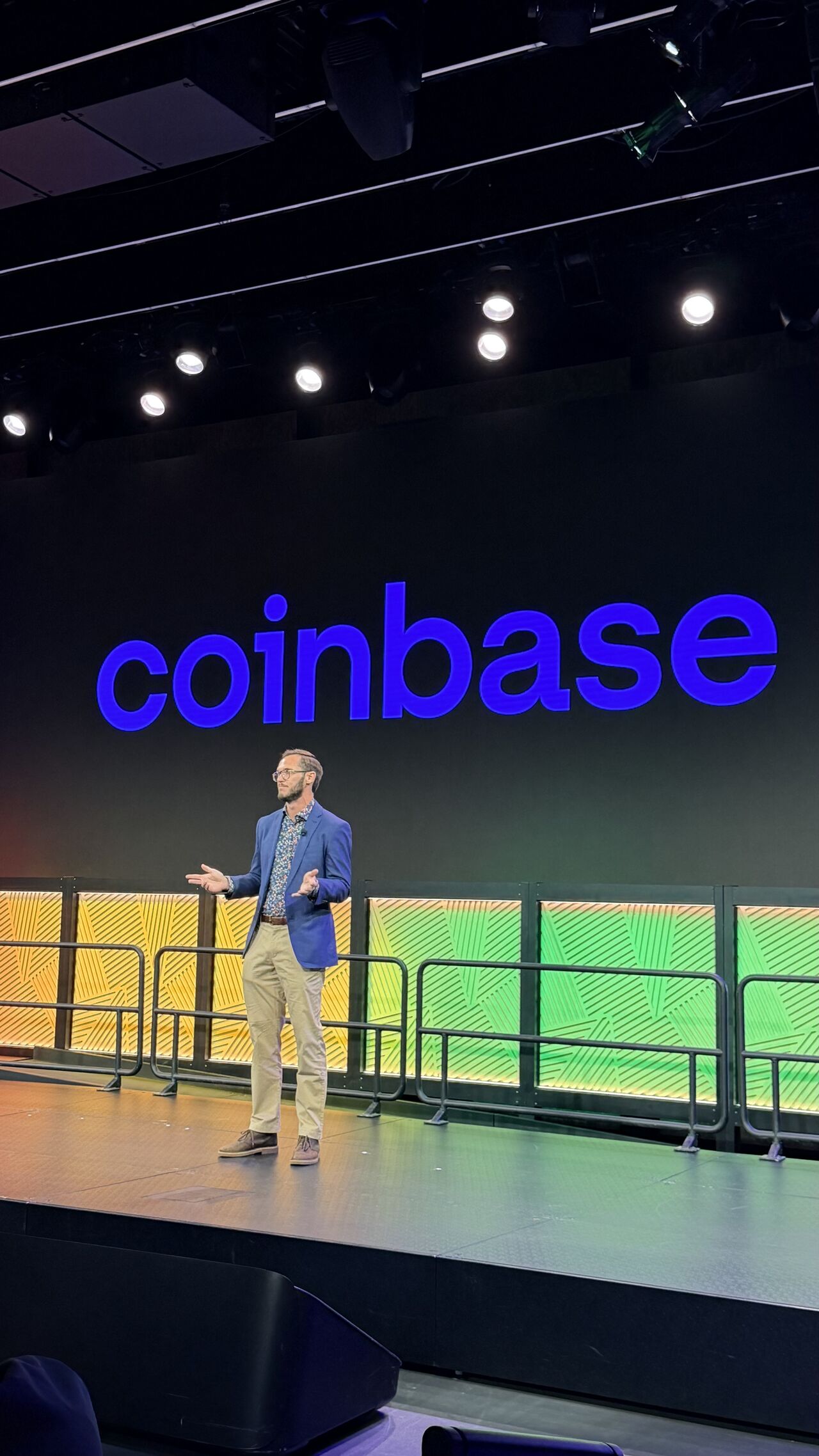
“If your feedback loop is longer than your optimization cycle, you're not doing performance marketing. You're doing archaeology." – Coinbase's Scott Ridout on stage at Google Rethink Apps last week. Hands down the best comparison I’ve heard for the biggest challenge in paid media right now, and it comes from six years of his team working out what a new Coinbase user is worth. Coinbase has a two-year payback period, and a lot happens in crypto in two years. Someone who signs up during a bull run and someone who signs up a few weeks into a drawdown can make the same first trade and go in completely different directions. Scott's team kept raising the bar on measurement. By 2023 they had a gradient boosting LTV model with macro conditions and market scenarios built in. It also needed months of data to make a prediction, and as Scott put it, "in crypto, two months is an era." So they made a call. They threw out the long-horizon target and built a 30-day metric they call payback ratio, predicted for every user at sign-up. Four things that changed how they bid: 1/ User value now arrives at sign-up instead of months later. 2/ Every user gets their own predicted value instead of their campaign's average. 3/ Predictions are measured against payback ratio, so they track how Coinbase makes money in the first 30 days instead of a two-year projection. 4/ A signal engineering layer shapes each prediction into a signal Google's bidding can act on, and updates it as the user mix, the product, and the market evolve. When Scott's team tested tROAS against tCPA on Android, cost per first trade dropped 20% and day-30 ROAS rose 114%. They're now rolling it out across every Android app campaign globally. Link to the full talk in the comments. If your payback window is measured in years, start there.
- LINKEDIN · IMAGESince 12 Oct 2026
Last week, I had the opportunity to take the stage at Google’s ReThink Apps conference and share how Coinbase is approaching value-based bidding in one of the most unpredictable categories in consumer marketing. For years, we tried to predict longterm customer lifetime value. The breakthrough came when we shifted the question from “What will this user be worth over two years?” to “How much revenue does this user need to generate by day 30 to stay on track with our ROI goals?” That more timely, granular signal helped us move from Target CPA to Target ROAS on Google App Campaigns (and with the help of Voyantis). In our initial tests, we saw improvements in first trades, cost per first trade, day-30 ARPU, and Day-30 ROAS. The broader lesson: value-based bidding only works when the signal is connected to the economics of the business, granular enough to distinguish users, and fast enough to influence optimizations while it still matters. A huge thank you to David Hautefeuille, Elizabeth Devcich, Leslie Smith, Megan Decker Mansoori for the invitation, the collaboration, and the opportunity to share this work with such a thoughtful group of marketers and app leaders. I’m grateful for the conversation and excited to keep pushing the feedback loop between early user behavior, predicted value, and realized payback. #ReThinkApps #PerformanceMarketing #GrowthMarketing #AppMarketing #GoogleAds
- LINKEDIN · IMAGESince 16 Sept 2026
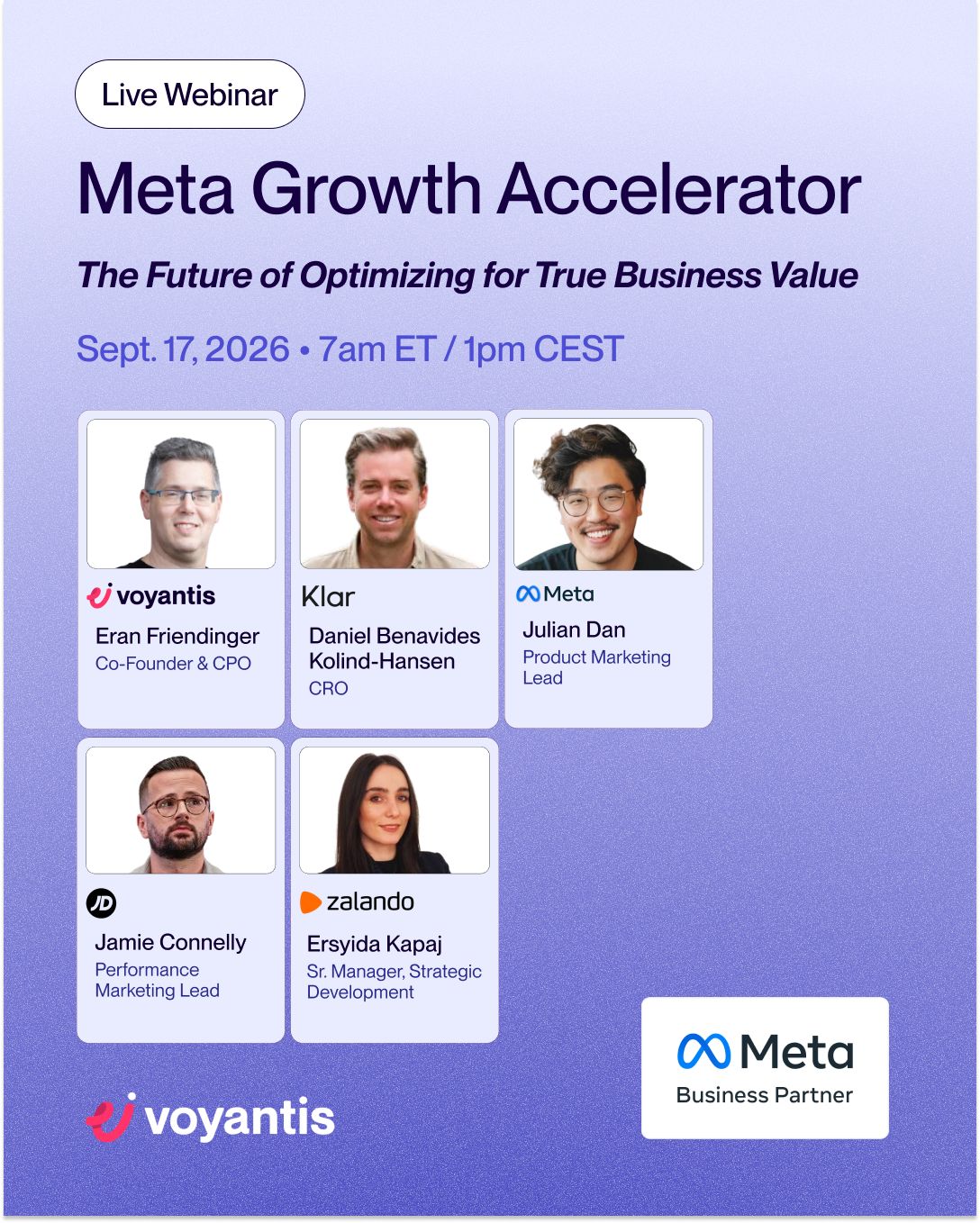
When Klar pointed its Meta campaigns at predicted customer value instead of approval counts, the same spend returned 22% more revenue. Results like that are the subject of next week’s Meta Growth Accelerator. Voyantis co-founder & CPO Eran Friendinger and Klar CRO Daniel Benavides Kolind-Hansen will be taking the virtual stage to chat about the shift to pLTV bidding and the impact it has had on Klar’s business. They’ll be speaking alongside Ersyida Kapaj of Zalando and Jamie Connolly of JD Sports Fashion – bringing their own real-world examples of success. It'll be a jam-packed hour of insights this Thursday, Sept. 17 at 7am ET / 1pm CEST. Virtual on Zoom. Register here: https://lnkd.in/deRKT_hu
- LINKEDIN · IMAGESince 15 Sept 2026
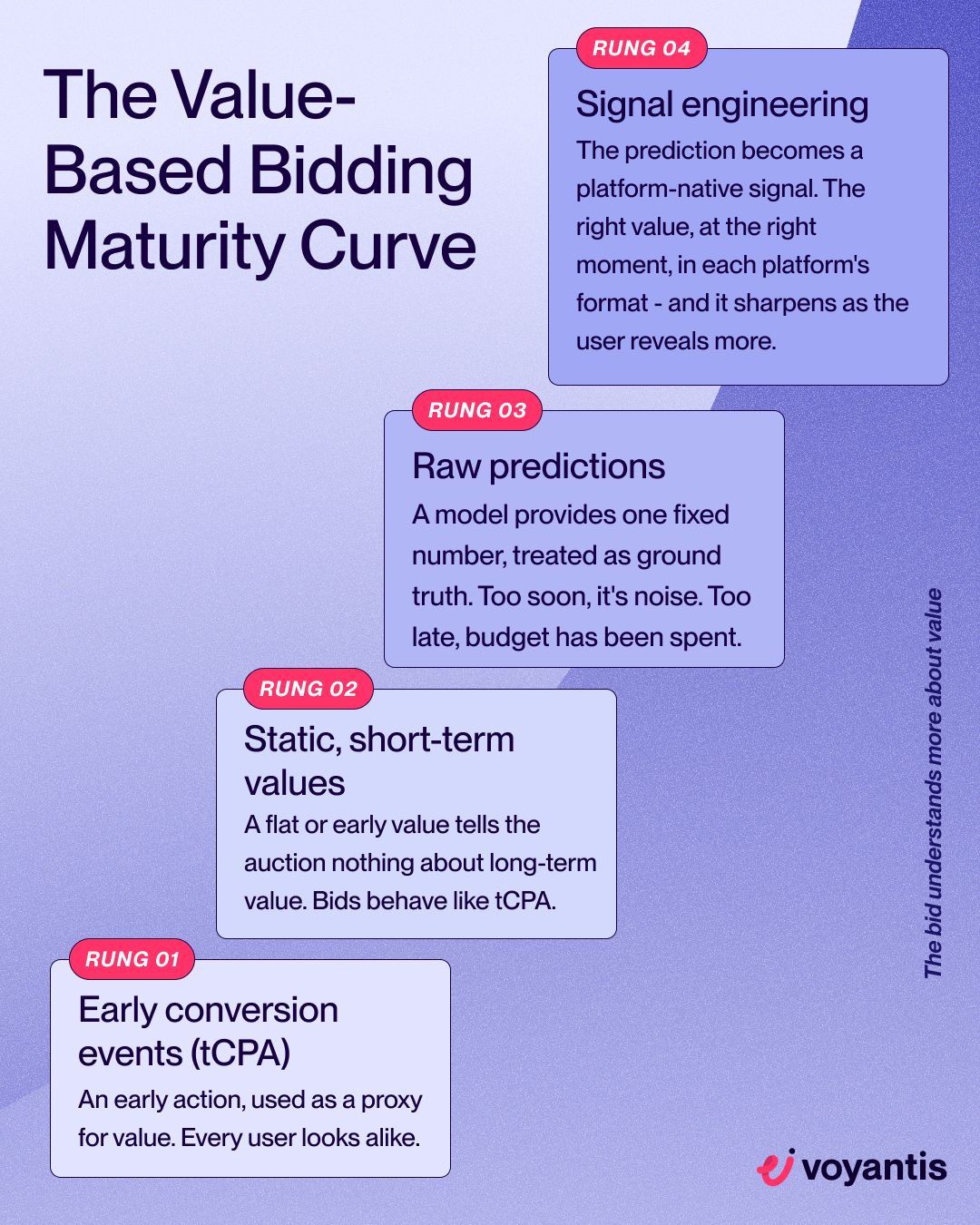
After speaking with 100+ growth leads a year, here's the #1 thing I hear. Almost all of them know their budget would work harder aligned to LTV. Almost none of them have been handed a way to make it happen. It's never for lack of trying. Sending a value – any value – takes an afternoon. Bidding on a customer's true worth takes expertise and infrastructure the ad platforms don't hand you. Here's the value-based bidding maturity curve I've outlined from these chats. Four rungs with real examples, and where each level caps out. 1. You optimize on early conversion events. This is where most teams start. Klar was optimizing for credit approval, Lennar for form completions, Upside for app installs. It’s not value-based bidding in the traditional sense, but a stand-in for it, using an early action as a proxy for intent. The challenge is that an action says nothing about long-term worth. Every conversion looks identical. 2. You send values, but short-term ones. Semrush was sending a flat value by funnel stage. It was value-based bidding that behaved like tCPA, because a static number tells Google nothing about who the user becomes. Real-but-early values, like D7 revenue, fall short in the same way. 3. You feed a raw LTV model into the auction. ZipRecruiter had a model, built by a sophisticated data science team, that they fed directly into Google, but didn’t see performance move in the way they expected. While a prediction keeps evolving, ad platforms want one number, early, and treat it as ground truth. Send it too soon, it's noise. Too late, the auction's already spent. 4. You use signal engineering to turn a prediction into a platform-native signal. All of those teams now operate at this level of maturity. They translate the prediction into a signal for the auction, one that carries the right value, at the right moment, in the format and cadence each platform can act on – and keeps sharpening as the user reveals more. The bid reflects what a customer will become, not just what they did in week one. ___________ Many capable teams stall at rung 2 or 3 because nothing tells them their signal isn't right at the moment. The dashboard, built on the numbers you sent it, looks perfectly healthy. So they stop climbing. The teams I mentioned – those leading their categories – started somewhere around there, but they didn’t settle. They pushed further and further until they reached the top. Which rung are you on right now? What would it take to push further? ____ P.S. We built Voyantis to help teams climb the ladder from the bottom to the top. Let’s chat about what that looks like for you: https://lnkd.in/d2XCPjnr
- LINKEDIN · IMAGESince 17 Aug 2026
When you're engineering signals for Google, more value is not always better. The instinct is to shout about your best customers. Tell the platform exactly how valuable they are. Loudly. Then let the algorithm go and find you more of them. The problem with that is your best customers are usually outliers. Send Google their raw values and you have just told it those users are the target, so it goes looking for more of them. But there are not more of them. That's what made them outliers. So the budget goes on chasing exceptions. And the customers you actually wanted, the reliably good ones sitting just behind the top, get passed over. The model identified a rare, extremely valuable user. The fix is deciding how far the top of your distribution is allowed to stretch before Google ever sees it. For every one decision, there are dozens more like it. 1. What are you predicting, and over what horizon? 2. How early can you call it? 3. How wide should the gap be between your best and worst users? 4. Who gets filtered out before the signal is ever sent? 5. How often do you revise a user's value as they change? 6. Who watches all of this after launch, when signals drift and products move? Shippo is a good example of what that looks like in practice. They power shipping for more than 100,000 e-commerce businesses. They had already built custom proxy events and their own predictive models in-house. Strong team. Real infrastructure. What they could not do was identify future power shippers early enough to bid on them. So we rebuilt value measurement around a 90-day LTV horizon, predicted it from day-one behavior, then engineered that output into something Google's auction could actually learn from. The model now predicts 90-day LTV at 91% accuracy. → Cost to acquire a high-volume shipper fell 47%. → Cost per label fell 22%. → ROAS rose 11%. Then they pushed spend 16% higher, and cost per new active shipper still fell 10%. Scale almost always costs you efficiency. Here it did not. Here is how Matthias Groo, their Marketing Director, put it: "With Voyantis, we've seen better merchants at lower cost across every campaign, improving both scale and customer quality. Their platform and expertise complement what we've built in-house and deliver results we couldn't get to on our own, turning our first-party data into signals Google can actually learn from." A model predicts who your best customers will be. Signal engineering determines what Google learns from that prediction. Most teams get the first part right and never touch the second. Then they wonder why a good model never moved the numbers. If you are sending values to Google today, here is the question I would ask. Do you know what happens to your outliers before Google ever sees them? Full case study: https://lnkd.in/dE9PY7SP.
- LINKEDIN · IMAGESince 13 Aug 2026
A casual browser and a future enterprise deal look identical to Google Ads. So you bid the same for both. Everyone comes in through the same door. The free trial. Same signup. Same form. Same event fired to your Google Ads. One of them is just kicking the tires. One of them will roll it out across their whole company. Google is told they are worth the same. So it goes and buys more of whoever was cheapest to sign up. Which is almost never the enterprise account. Cheap signups are cheap for a reason. Miro knows this better than most. More than 80 million people use their whiteboard product. Their product-led motion is one of the most sophisticated in SaaS. And every paid dollar still landed on the same undifferentiated signup. So we built something that could tell them apart. Here is what we did together: 1. Trained a bespoke model on Miro's anonymized first-party data. 2. Had it predict, at signup, how likely a trial was to become a paying corporate account. 3. Engineered that prediction into a signal Google could actually act on. Right timing, right format, right value distribution. 4. Delivered it in real time through the Server API, so bidding could react the same day. 5. Let value-based bidding do the rest, chasing accounts instead of signups. 6. Proved it in a controlled A/B test across five non-branded US Search campaigns. 7. Kept validating the model against reality, so accuracy holds as the product moves. The model now predicts at 90% accuracy. Corporate trials went up 55%. Corporate customers went up 30%. Annual plans went up 35%. pROAS went up 33%. And the accounts that landed came in bigger. Average seat count at renewal rose 14%. All of it on the same media budget. That last part is the one I would underline. We did not find Miro more traffic. We changed which traffic was worth winning. Same spend. Different users. Better business. Most teams try to solve this downstream. Better nurture. Better lead scoring. Better sales routing. All of that happens after you have already paid to acquire the wrong person. At that point you are not fixing acquisition. You are cleaning up after it. The cheapest place to fix it is the moment you tell Google who is worth pursuing. Miro has been a partner for years now, and watching what we built together keep compounding is the part of this job I like most. So here is my real question for anyone running a free trial motion. What are you sending Google at signup? Not what you wish you were sending. What actually fires today. Checkout the full breakdown of the Miro build: https://lnkd.in/eE-vbZjH


6 of 176 adsSign up to see every Voyantis ad, filter by format and date, and get alerts on new ones.
See all 176 adsQuestions about Voyantis’s ads
Is Voyantis running LinkedIn ads?
We recorded no live LinkedIn ads for Voyantis on 7 Nov 2026.
How many LinkedIn ads has Voyantis run?
LinkedIn’s ad library lists 185 ads for Voyantis. We recorded 176 LinkedIn ads for Voyantis, first recorded on 2 Oct 2026 and last recorded on 3 Nov 2026.
Does Voyantis run Google ads?
We recorded no Google ads for the domain voyantis.ai on 15 Oct 2026.
Which ad formats does Voyantis use?
The 6 LinkedIn ads on this page include 5 image ads and 1 video ad.
Watch the companies you care about.
Filter every ad by industry, country, format and network, and get alerts when a company you watch starts running new ads.