Not on air · 2 of 3 networks checked

vaibe ads
- vaibe.com
- Software Development
- PT
- 22 employees
vaibe’s ads on LinkedIn, Meta and Google, recorded by adsrunning. Browse the latest here for free. Sign up free to see all 149. Watch vaibe on any plan to get each new one in your feed.
Watchlist included in every plan
What vaibe runs
- Single image · LinkedIn
- 5
- Video · LinkedIn
- 1
- Google ads on 14 Oct 2026
- 7
| Network | Status | Live ads | Nov 2025LinkedIn activity · 52 weeksNov 2026 | Checked | Next step |
|---|---|---|---|---|---|
| None recorded | 0 | Checked 8 Nov 2026 | See all 149 ads → | ||
| Meta | Not checked | — | |||
| Recently | 7 | Ads on the Google Ads Transparency Center | Checked 14 Oct 2026 | Collect them with the API → |
vaibe has no live LinkedIn ads. We recorded 7 Google ads on 14 Oct 2026.
Latest ads
- LINKEDIN · IMAGESince 2 Jul 2026
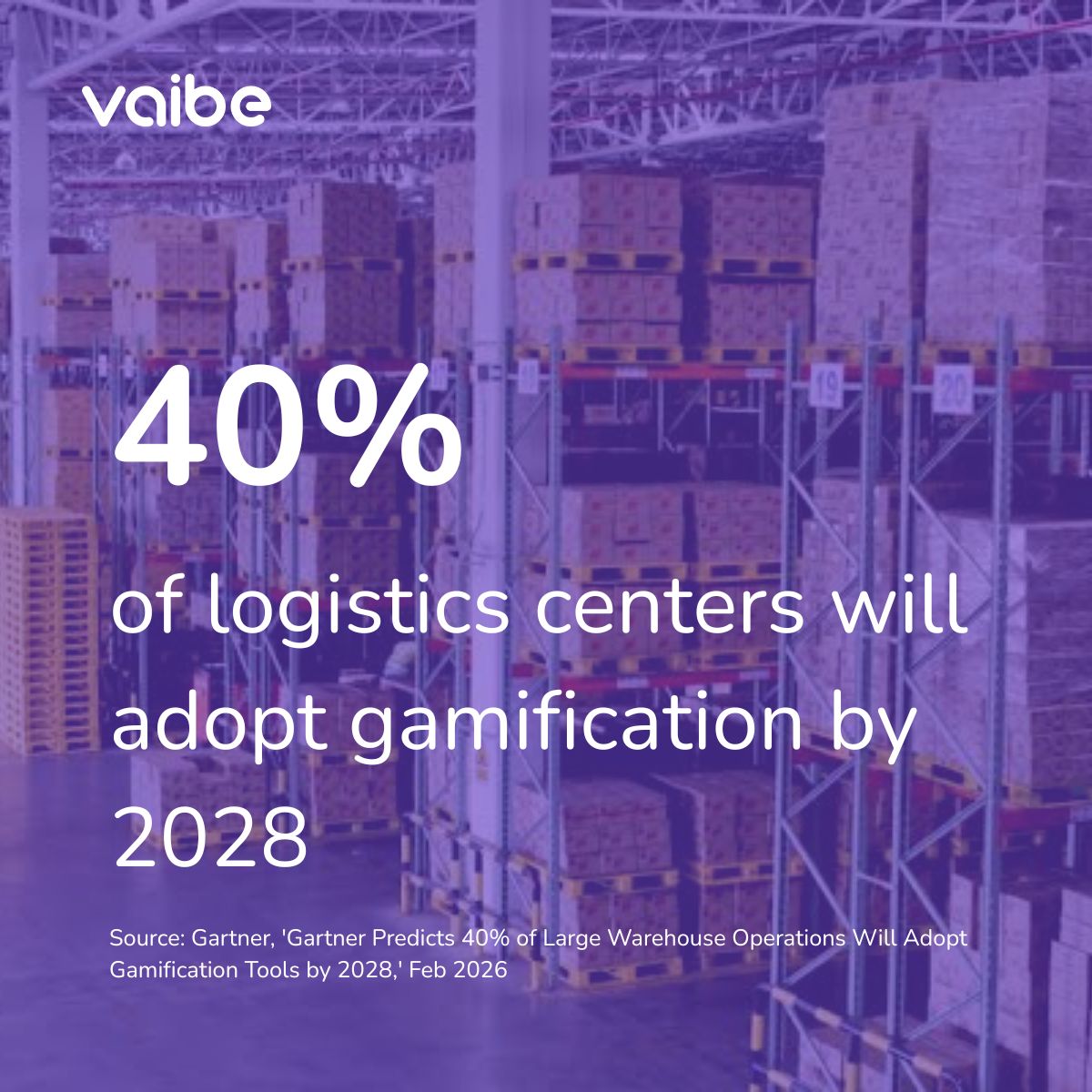
By 2028, Gartner predicts 40% of large warehouse operations will deploy gamification tools to fight labor shortages and turnover. This number shows we're on the right path. As Federica Stufano, Senior Principal Analyst in Gartner's Supply Chain practice, put it: "Employee retention is becoming increasingly crucial in the current climate, where labor shortages are one of the toughest challenges companies face." She points to why: today's workforce, especially younger employees, wants meaningful work and real opportunities to grow, not just a paycheck. Gamification works when it delivers that through engagement, skill-building, and recognition together. That's exactly how vaibe is built. We turn the data your team already has into clear daily actions, so the right behaviors happen consistently, every shift, every site. That's the real win for supply chain leaders: gamification that actually works, driving engaged employees and performance you can count on, site after site. Full Gartner article in the comments. #gamification #operationalPerformance #vaibe
- LINKEDIN · IMAGESince 2 Jul 2026
I've stopped explaining what vaibe does. I started asking questions instead. Things like: -> Your operation runs three shifts. Is productivity consistent across all of them, or does performance drop when certain people aren't in the building? -> You invested in a WMS that tracks everything happening on your floor. Does that data ever reach the person who can actually change it in real time? -> You rolled out a new system six months ago. Has throughput moved since go-live? The silence after those questions is the loudest radio silence I've ever heard. And the looks I get are usually in between embarrassment for not knowing what to say and a "was this guy hired by my boss to do my performance assessment?" kind of look. I speak to DC managers running multi-site distribution operations, VP of Operations overseeing hundreds of frontline workers, and logistics managers who have some of the most sophisticated supply chain technology available. They can tell me what their throughput was last week, where their error rates sit, and which site is underperforming. What they struggle to answer is why performance varies between shifts and what it would take to consistently close that gap. My answer revolves around visibility. When workers can see how they're performing in real time and understand what's expected of them, still on that shift, behavior changes and productivity improves. CIN, an automated warehouse, saw a 13% increase in workforce productivity after implementing vaibe. The data existed; the difference was making it visible and actionable for those on the floor. Your systems track everything. The question: does the right data reach those who can act?
- LINKEDIN · IMAGESince 2 Jul 2026
My son will probably never Google anything. When I was a kid I was obsessed with birds. My parents had a library full of encyclopedias and I had this gigantic birds encyclopedia that I loved. The process of identifying a bird was LONG. I had to stay completely still, memorize every marking and detail, walk upstairs to the library, find the book, flick through the pages, and by the time I had found something close enough to confirm, the bird had flown away.[sw1] [MM2] [sw3] Then came a CD encyclopedia. The world was my oyster. Then came Google. Suddenly, everything was...Googleable. You had to know how to ask the right question and sort through the results yourself. Now I take a photo and ask Claude. My son is three. By the time he needs to find something, the idea of typing a search query into a bar and scrolling through ten blue links will probably feel strange to him. He will just ask. Out loud or in writing. And something will answer. I find that fascinating and slightly unsettling at the same time. Because I keep coming back to how much I learned from the act of searching. Following one link to another, going down rabbit holes, finding things I wasn't looking for. Piecing together my own understanding from incomplete information. I wonder what that process looks like when the answer arrives before the question has formed. I don't have a conclusion here. My son is three, and his biggest question right now is why the sky is blue and why he cannot have ice cream for dinner. What’s your version of the bird encyclopedia?
- LINKEDIN · IMAGESince 25 Jun 2026
A $100 bill can create a recognition moment, but it can't create a recognition culture. Last month, a prospect told me that during peak time, if a manager spots someone going above and beyond, they pull out a $100 bill and hand it to them on the spot. Without any approval process or system. Just a decision made in the moment by someone who happened to be watching. I loved that story. And of course, it says a lot about how much they care about their people. BUT here's the wrinkle: • What about the person who went above and beyond on a shift when nobody was watching? • What about the worker who consistently performs at a high level but never happens to be in the right place at the right time? A moment depends on visibility. Culture creates it. I've seen this pattern across a lot of operations. The intention and care is real. But recognition that relies on someone being in the right place at the right time will always miss more people than it reaches. The companies I admire most make recognition part of the system. When good performance is consistently visible, it stops being a moment and starts becoming culture. And that's what this prospect saw the potential for in their first conversation with vaibe. By the way, we are about to close a contract with them. Watch this space to learn more about our first client in the automotive industry!
- LINKEDIN · VIDEOSince 25 Jun 2026
Recap: from the floor at Shoptalk Europe in Barcelona. Rafael and Margaux spent last week meeting with retailers and partners, and one message came through consistently: while technology continues to evolve at a pace, executing it into measurable outcomes still remains the real challenge. Turns out, "just add AI" isn't much of a strategy. Here are a few highlights from the floor. #vaibe #operationalPerformance #retailOperations
- LINKEDIN · IMAGESince 24 Jun 2026
Everyone tells you to think big. I'll tell you to think small. Most operations I speak to want to solve everything at once. New system, full integration, company-wide rollout, results by end of quarter. And then six months later the project is stalled, the team is exhausted, and nobody can remember what problem they were originally trying to solve. This month a prospect came to me with a familiar objection. "This will require significant effort on our side to integrate and manage." They were right. A full rollout would. So, I suggested something different. I asked them to forget the full integration for now. Let’s pick five people and run a short proof of value. See what the behavior looks like when it changes. AND what the numbers look like when it does. Because here is the thing about committing to something that changes how your frontline team works: you shouldn't have to take it on faith. You should be able to see it first. Even if it is small enough to be low risk, but specific enough to be real. We started small. That's usually how the best operational changes begin. Thinking big is fine. Starting small is how you actually get there. When was the last time you started something small that turned into something significant?



6 of 149 adsSign up to see every vaibe ad, filter by format and date, and get alerts on new ones.
See all 149 adsQuestions about vaibe’s ads
Is vaibe running LinkedIn ads?
We recorded no live LinkedIn ads for vaibe on 8 Nov 2026.
How many LinkedIn ads has vaibe run?
LinkedIn’s ad library lists 151 ads for vaibe. We recorded 149 LinkedIn ads for vaibe, first recorded on 2 Oct 2026 and last recorded on 2 Oct 2026.
Does vaibe run Google ads?
Yes. We recorded 7 Google ads for the domain vaibe.com on 14 Oct 2026.
Which ad formats does vaibe use?
The 6 LinkedIn ads on this page include 5 image ads and 1 video ad.
Watch the companies you care about.
Filter every ad by industry, country, format and network, and get alerts when a company you watch starts running new ads.