Not on air · 2 of 3 networks checked

Transak ads
- transak.com
- Financial Services
- US
- 128 employees
Transak’s ads on LinkedIn, Meta and Google, recorded by adsrunning. Browse the latest here for free. Sign up free to see all 137. Watch Transak on any plan to get each new one in your feed.
Watchlist included in every plan
What Transak runs
- Single image · LinkedIn
- 5
- Video · LinkedIn
- 1
| Network | Status | Live ads | Nov 2025LinkedIn activity · 52 weeksNov 2026 | Checked | Next step |
|---|---|---|---|---|---|
| None recorded | 0 | Checked 8 Nov 2026 | See all 137 ads → | ||
| Meta | Not checked | — | |||
| None recorded | 0 | No ads found on the Google Ads Transparency Center | Checked 13 Oct 2026 | Collect them with the API → |
Transak has no live LinkedIn ads. We recorded no Google ads on 13 Oct 2026.
Latest ads
- LINKEDIN · IMAGESince 27 Apr 2026
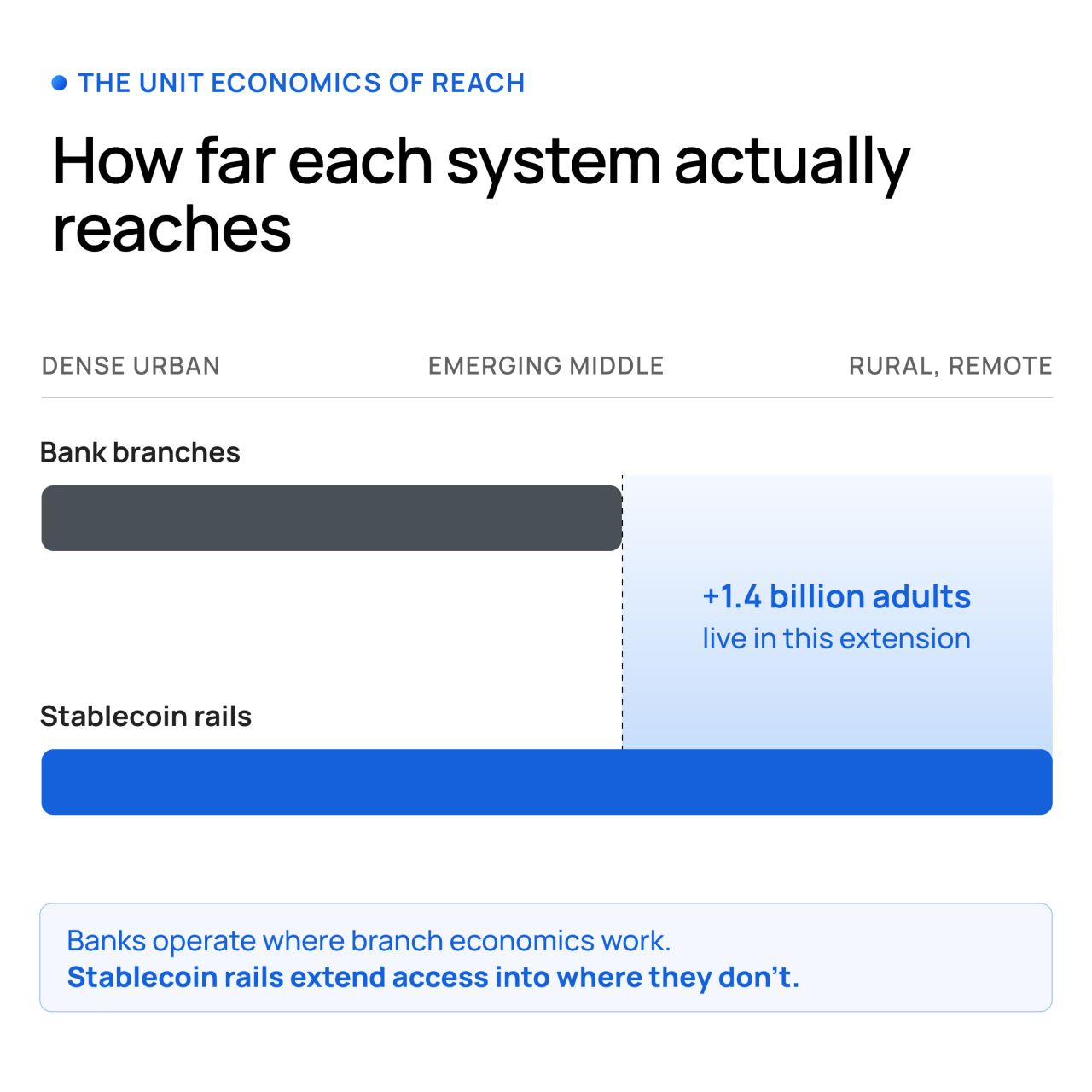
Banks aren't going anywhere. But they were never built to reach everyone. 1.4 billion adults don't have a bank account because the economics simply don't work. A branch in rural Kenya costs roughly the same to run as a branch in London. But the customer revenue for the bank doesn't. Naturally, banks being businesses, gravitate towards operating only in markets that drive the most revenue. That is how traditional banking stops being accessible in certain income levels and corridors. Stablecoin payment rails change the unit economics of reach. The cost to move a digital dollar to Nairobi is close to the cost of moving one to New York. The infrastructure is the phone. This isn't a replacement story. Banks like Chase and HSBC aren't becoming obsolete because of stablecoins. They continue operating where banking economics work while stablecoin rails extend financial access into the markets where they don't.
- LINKEDIN · IMAGESince 10 Apr 2026
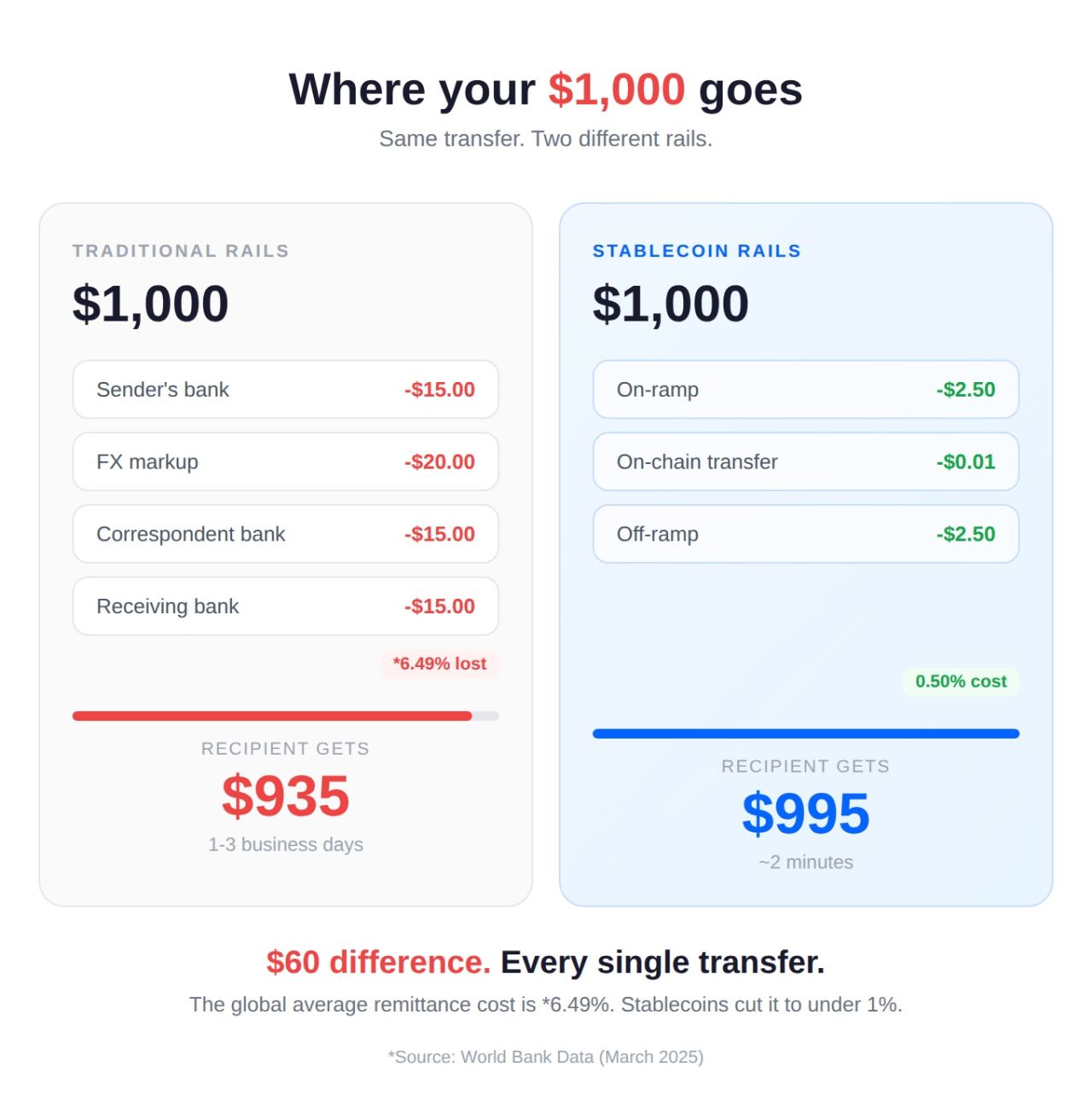
On average $65 out of every $1000 sent through a bank never reaches the recipient. And it takes a few days to get there. That is not outdated data. This is still how the system works today. The global average across all providers for cross-border remittances stands at 6.49%. Now look at the same transfer on stablecoin rails. You send $1000. The recipient gets around $995. Settlement happens in minutes. What changed is not just cost or speed. It is the architecture. Cost: <1% Speed: Minutes Availability: 24/7 Architecture: Fiat → Stablecoin → Fiat Both sides stay in local currency. No correspondent banks. No pre-funded accounts. No 3-day settlement windows. This is where I think many people misread what is happening. This is not really about adopting crypto. It is about fixing the unit economics of moving money. Your settlement layer is your margin. And for the first time, there is a model that is faster, cheaper, and global by default. The infrastructure to do this at scale already exists. Compliance, licensing, local payment methods. All handled in the background. The real question is not whether this works. It is whether you are ready to plug into it. If you are exploring stablecoin settlement for your remittance corridors, worth a conversation: https://lnkd.in/g6Hf3RBB
- LINKEDIN · IMAGESince 9 Apr 2026
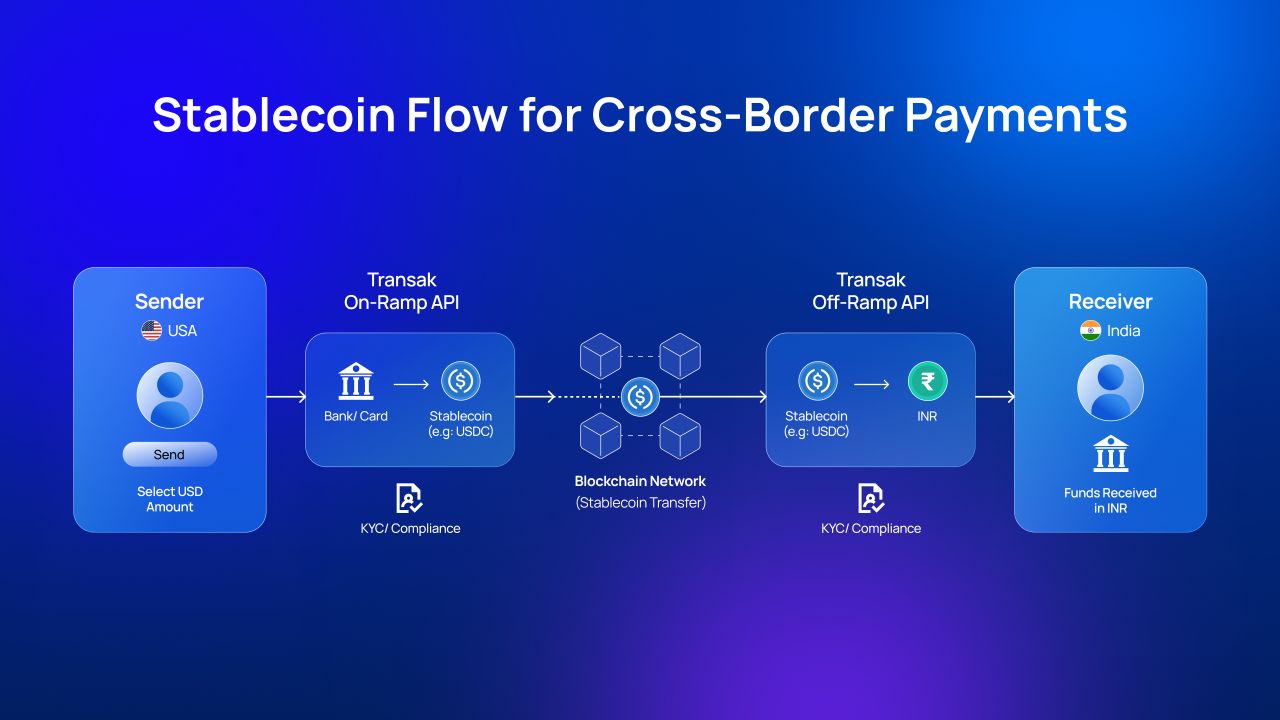
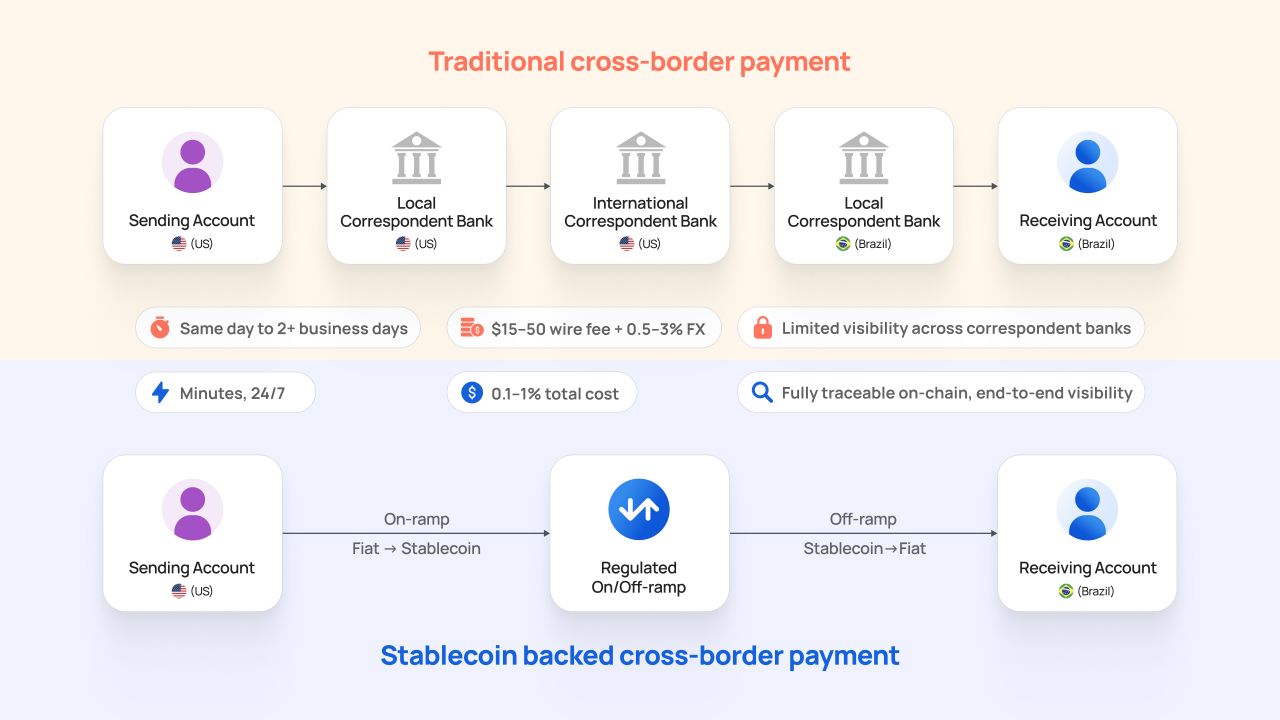
Cross-border payments are evolving with stablecoins. Payments no longer hop through multiple intermediaries when they move on stablecoin rails and that helps businesses better serve their customers. Here's what that flow looks like 👇🏻
- LINKEDIN · IMAGESince 6 Apr 2026
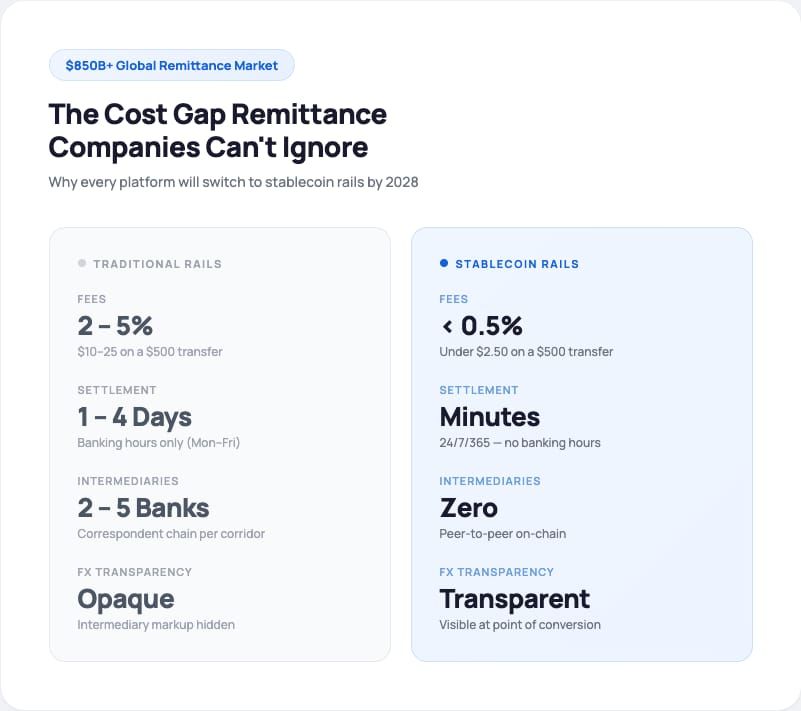
Most remittance platforms will be using stablecoin rails within the next few years. It sounds bold, but the numbers make it quite straightforward. Today, cross-border transfers still cost 2 to 5 percent and take a few days to settle. With stablecoins, that drops to under 0.5 percent and happens in minutes. At an $850B plus market size, that gap is too large to ignore. What we are seeing is a gradual shift. Teams start by testing in high-volume corridors, such as the US to Mexico or the US to the Philippines. Then, regulation starts to catch up, with markets like Singapore and Europe leading. And over time, payout coverage extends beyond crypto-native regions. What surprised me is who is moving fastest. Not just crypto companies, but traditional remittance businesses with deep compliance and banking relationships. They see the cost structure changing underneath them. The reason everyone has not switched yet is simple. Building this infrastructure is complex and not their core business. Most just want better rails, without the complexity of managing the underlying systems. So they are choosing to plug into stablecoin infrastructure. Stablecoins are upgrading the rails beneath incumbent remittance companies. And they are allowing innovators and start-ups to leverage stablecoin infrastructure to build new services that compete with the incumbents. And once that shift starts, it compounds quickly. This is what we are building at Transak. If you are exploring this, you can learn more here: https://lnkd.in/evvq4aDF
- LINKEDIN · VIDEOSince 31 Mar 2026
While B2B stablecoin companies are hitting billion-dollar valuations and handling massive volume through bank transfers, the infrastructure for retail onboarding is still nascent and stunted. The industry lacks seamless card-based rails, compliant KYC, and easy APIs that fintechs and wallets can actually integrate. Our CEO, Sami Start hit the nail on the head on this in a recent interview with The Rollup. Transak is the simple, compliant, global infrastructure that finally makes fiat↔stablecoin rails work at scale for everyone. Onward to better on-chain payments 💙 Talk to us today to learn more: https://lnkd.in/gHjkHkAt
- LINKEDIN · IMAGESince 27 Mar 2026
Your cross-border payout infrastructure is costing you more than you think. Every $10,000 transaction carries ~3% in fees, 2+ day settlement windows, and zero real-time visibility for your ops team. That's not just a cost problem. It's a customer experience problem. It's a reconciliation problem. It's a working capital problem. The stablecoin sandwich architecture changes the unit economics entirely: Fiat → Stablecoin → Fiat 🥪 In Minutes Under 1% total cost 🔍 Fully traceable For platforms operating across corridors key payment corridors, the stablecoin sandwich model upgrades the settlement layer your business already depends on. Your end users never see a wallet or a token. They see faster payouts and lower fees while your finance team sees cleaner reconciliation and predictable costs. ➡️ The platforms that rewire their payout rails now will unlock corridors that were previously uneconomical to serve.
6 of 137 adsSign up to see every Transak ad, filter by format and date, and get alerts on new ones.
See all 137 adsQuestions about Transak’s ads
Is Transak running LinkedIn ads?
We recorded no live LinkedIn ads for Transak on 8 Nov 2026.
How many LinkedIn ads has Transak run?
LinkedIn’s ad library lists 136 ads for Transak. We recorded 137 LinkedIn ads for Transak, first recorded on 2 Oct 2026 and last recorded on 3 Nov 2026.
Does Transak run Google ads?
We recorded no Google ads for the domain transak.com on 13 Oct 2026.
Which ad formats does Transak use?
The 6 LinkedIn ads on this page include 5 image ads and 1 video ad.
Watch the companies you care about.
Filter every ad by industry, country, format and network, and get alerts when a company you watch starts running new ads.