Not on air · 2 of 3 networks checked

Thinkmill ads
- thinkmill.com.au
- IT Services and IT Consulting
- AU
- 31 employees
Thinkmill’s ads on LinkedIn, Meta and Google, recorded by adsrunning. Browse the latest here for free. Sign up free to see all 27. Watch Thinkmill on any plan to get each new one in your feed.
Watchlist included in every plan
What Thinkmill runs
- Single image · LinkedIn
- 5
- Video · LinkedIn
- 1
| Network | Status | Live ads | Nov 2025LinkedIn activity · 52 weeksNov 2026 | Checked | Next step |
|---|---|---|---|---|---|
| None recorded | 0 | Checked 8 Nov 2026 | See all 27 ads → | ||
| Meta | Not checked | — | |||
| None recorded | 0 | No ads found on the Google Ads Transparency Center | Checked 12 Oct 2026 | Collect them with the API → |
Thinkmill has no live LinkedIn ads. We recorded no Google ads on 12 Oct 2026.
Latest ads
- LINKEDIN · IMAGERecorded 24 Oct 2026
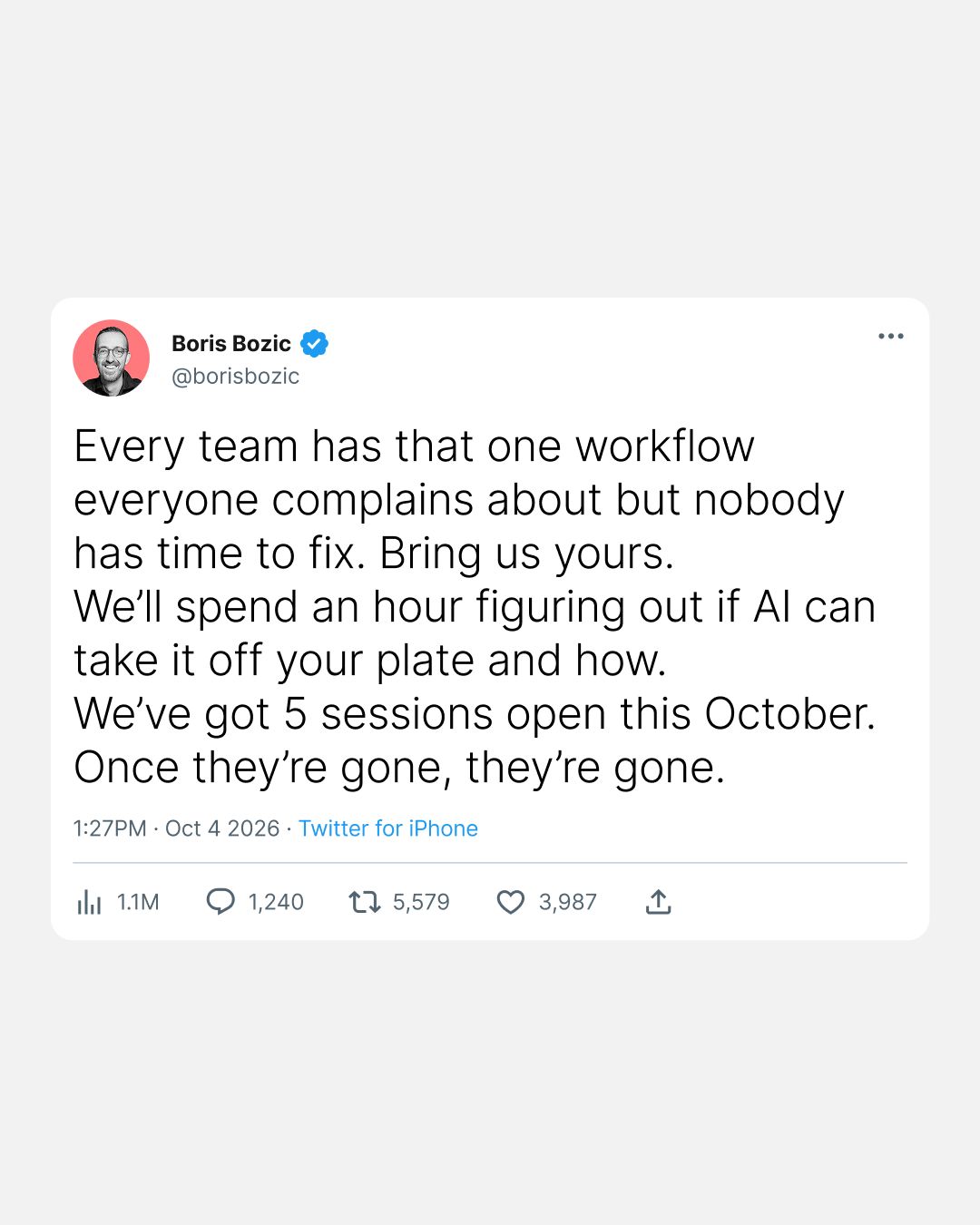
Everyone has AI now. So what’s actually changed? Some people picked their own AI tools. Others got a company licence. Either way, the best prompt lives in one person’s head, and outputs get checked by whoever has time. People get through tasks faster, but the way the business runs hasn’t changed. So where does the business see the value? When everyone can buy the same AI tools, having them isn’t an advantage. The advantage comes from where you put it: which workflow, connected to which systems, checked by whom. Spend 60 minutes with Thinkmill leaders working out whether AI could improve a workflow that’s slowing your team down. Sessions are led by: Boris Bozic, Co-CEO: workflow and interface experience Jed Watson, Co-CEO: agent systems and orchestration Mal Bozic, CFO & COO: finance and fiduciary advisory You’ll leave with: - Whether AI belongs in the workflow you bring - What we’d prioritise first, and why - Our findings in writing For over a decade, we’ve been trusted to build systems and product for Atlassian, Reckon, Breville, Westpac, Koala and many more. For businesses with AUD $5m+ in annual revenue. Five sessions remaining this October.
- LINKEDIN · IMAGERecorded 24 Oct 2026
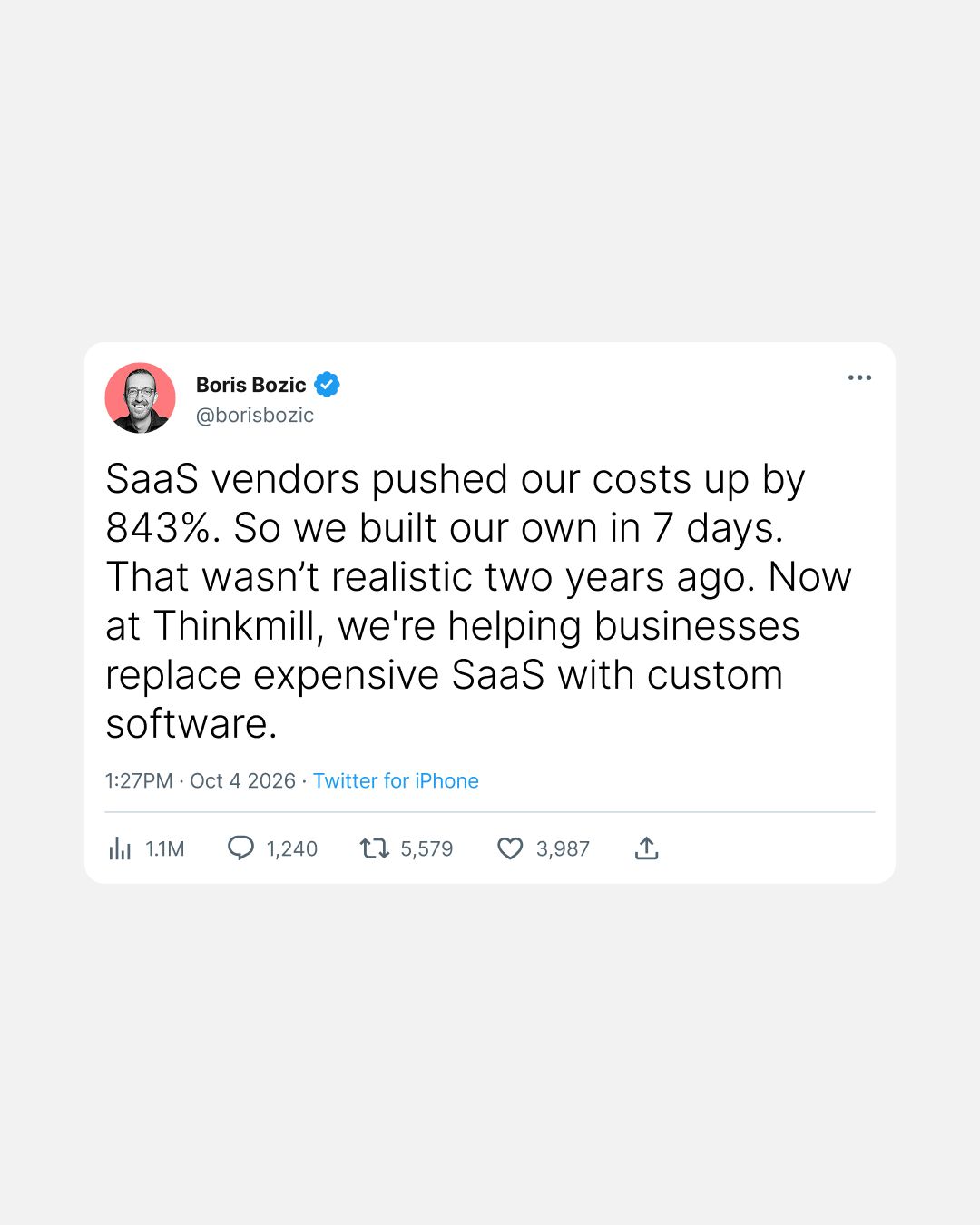
Six figures a year, and your team still works around the gaps. For years, custom software cost too much, so businesses bought SaaS and adapted to how it worked. Now the bills keep rising, the seats come in tiers, and your team still put up with tools that don’t fit right. AI-enabled engineering has changed the economics. Software that fits how you actually work, and that you own, is now within reach. Bring a SaaS tool that’s slowing your team down, and spend 60 minutes with Thinkmill leaders working out whether AI can change your buy equation. Sessions are led by: Boris Bozic, Co-CEO: workflow and interface experience Jed Watson, Co-CEO: agent systems and orchestration Mal Bozic, CFO & COO: finance and fiduciary advisory You’ll leave with: - Whether AI belongs in the tool you bring - What we’d prioritise first, and why - Our findings in writing For over a decade, we’ve been trusted to build systems and product for Atlassian, Reckon, Breville, Westpac, Koala and many more. For businesses with $5m+ in annual revenue. Five sessions remaining this October.
- LINKEDIN · IMAGERecorded 2 Oct 2026
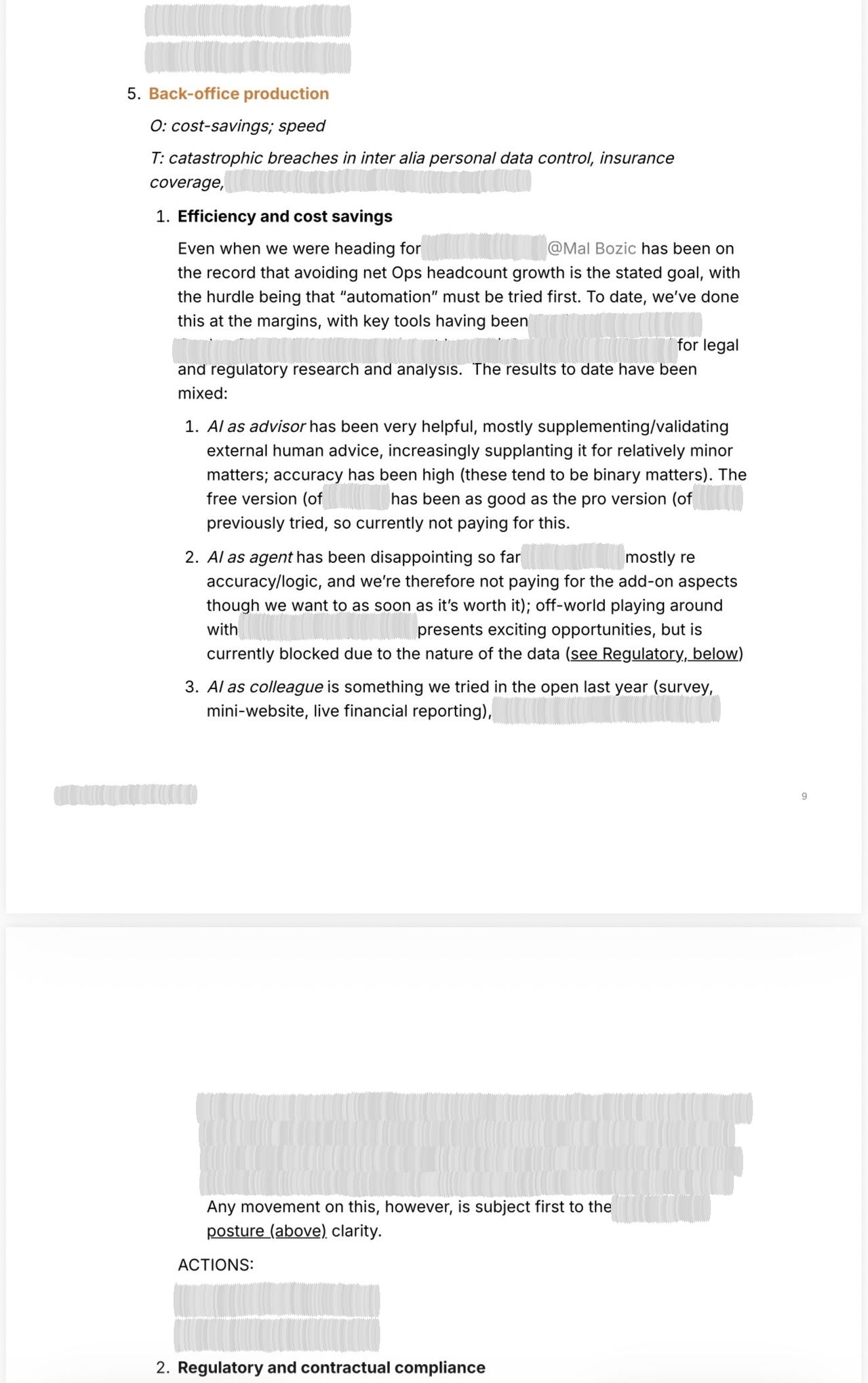
Last year, my strategy for the agentic transformation of our operations was to wait. I set that out in a board paper. Accountability made me too cautious. For the most part, I was wrong. My assumption was that trusted SaaS vendors would introduce impressive and safe agents into their ecosystems. We would use them, reap the efficiency gains, and avoid unnecessary transition costs and data security risks. I genuinely believed this. It was also convenient. I was hoping gains would be handed to us on a platter. Over time, I became increasingly disillusioned by our vendors’ AI offerings. The capability was arriving more slowly than I expected, and some tools created more work than they eliminated. My first pivot was simple: our finance and operations teams know their domains; coding agents are improving; surely such subject-matter experts could talk in human language with coding agents and build what we needed? It was worth testing, but it didn’t clear our quality or efficiency hurdles. To make tools as functional and safe as needed, I ended up where I least expected: partnering with human software engineers to build the tools in-house. At Thinkmill, I’m fortunate to have top engineering talent outside my proverbial office. This way we pair workflow domain experts with engineers who build safe agents. As for me? Someone still has to remain accountable for the consequences and risk, ensuring we do what makes sense for our business without becoming a prop in someone else’s pre-IPO hype story. I think of agentic transformation with a fiduciary lens as aggressively pursuing efficiency gains while being fully awake to the costs and risks they carry. Specifically, it means knowing where our data goes, what dependencies we create, if the economics stack up over the medium-term and where risk lines are red rather than amber. The conclusion, in the end, was apparent: one cannot simply sit on the sidelines. Any meaningful change carries risk. The task is to thread the needle: access genuine agentic gains while remaining sufficiently sovereign and risk-aware. We are building and deploying internal tools while anchoring security, data sovereignty, optionality, governance and economic rationale at the design stage. I’m now comfortable sharing this journey here: what we build, why, the trade-offs we consider, enough technical detail, all while owning the outcomes as they emerge. The redacted board paper extract captures where my thinking started. My current position may prove to be as wrong as my original statement. That’s OK. I can’t wait for certainty that may never arrive. In subsequent posts, I plan to document where our thinking and development stand, and where they go from here. All with a view to creating space for genuine enthusiasm about agentic transformation alongside sober, sometimes anxious, reservations.
- LINKEDIN · VIDEORecorded 2 Oct 2026
My goal was to reduce monthly SaaS spend. Yet the bigger benefit I got could be a 50% time saving on a recurring process. Last month I wrote about partnering with in-house software engineers to build bespoke agentic tools. Later, I complained about vendor price rises prompting us to prioritise replacing external tools. The resultant first internal product is called Hopper. (The demo reel uses sample data, with sensitive items redacted.) Over a few years, two utilities became load-bearing for us: a SaaS time-tracker, and a Google Sheet creaking as our production scheduler, staff allocator and revenue projector. Hopper is a web app hosted on Cloudflare that replaces both with an integrated tool that has live internal feedback loops. Project managers can track live progress against budget instead of waiting for a monthly update. Logging time is being reimagined: voice-activated "start my timer" and remote start from Slack. And as it learns the cadence of each project and team member, it is built to flag exceptions to the human in the loop before time is processed toward an invoice or a remaining-budget figure is relied on. Soon it will extend further into revenue recognition, invoicing and budgeting. And it's coded to reflect the unique specs of our client contracts, be it how we define a billable day or what triggers value recognition. My fiduciary lens influenced every stage. At kick-off, we fitted scope to practitioner requirements and company risk appetite rather than to sheer technological possibility. At the midpoint, a daily user checked that outputs match or exceed those of the tool being replaced. And live deployment waited for risk, finance and engineering to conduct a joint exceptions review and final calibration. To drive speed: “before sign-off on any feature set, take one thing off”. Minimalism also informed how much client-project economics to reveal internally and what staff details were essential to feature without adding an exposure vector for sensitive information. To optimise cost, we paired a senior human engineer with a stack of AI coding models: Fable for planning, Sol for implementation and Opus for iterating. The result is a five-figure reduction in annual opex and a material compression of month-end duration. Compared to a couple of years ago, it took a fraction of time to build. Early results put the time saving at between roughly 25% and 33% for the revenue part of month-end, though I'd want six cycles of data before settling on a figure. I am confident of at least a 50% reduction in time once future feature releases move Hopper further into month-end. What excites me even more than the savings is that we’re being prompted to take a fresh look at what's no longer needed. Yes, because it's now technologically and economically easier to customise and automate, but also because it’s good hygiene - questioning one material element has created a cultural moment for scanning the wider workflow ecosystem.
- LINKEDIN · IMAGERecorded 2 Oct 2026
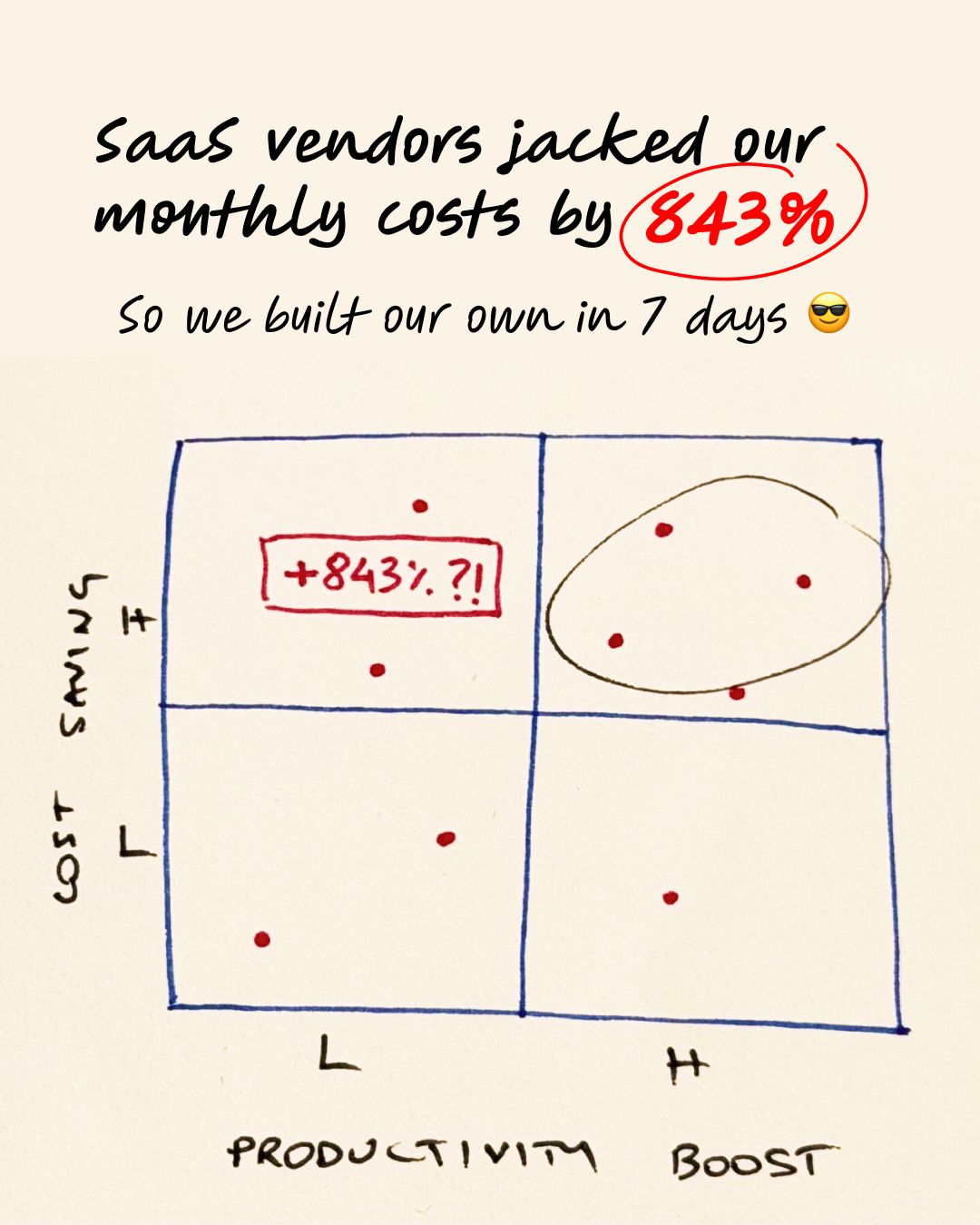
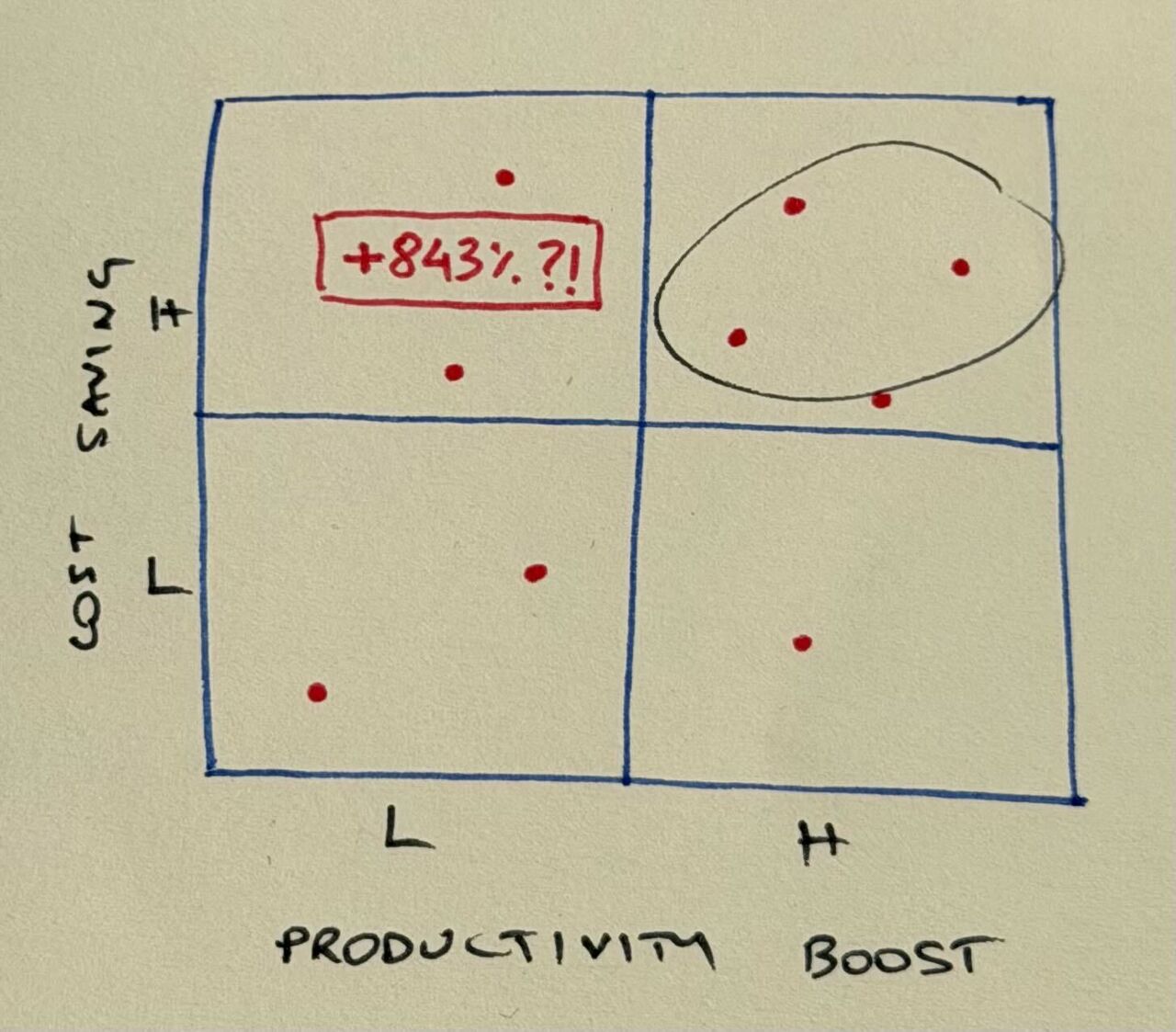
A SaaS vendor pushed our cost up by 843% and upended how we’re sequencing agentic transformation initiatives. Within a week, three unrelated vendors raised prices or forced us to pay for more seats than we needed, due to arbitrary plan-size tiers. Two of the three demanded we recommit months before expiry. I did not expect incumbent SaaS pricing to drive our decision about how to prioritise workstream automation. Yet that is what we decided to do first: build our own versions in-house with bespoke features that go beyond like-for-like functionality. We weren't looking to replace the products, at least not in the short term. We had higher priority workstreams on our radar. We would have kept paying for the SaaS products for the time being. Then the economics changed. I recognise that I am in a privileged position. Most buyers cannot push back on a vendor and then walk outside their office to a group of software engineers capable of exploring an internal replacement. I did, and the changing economics of software development mean more buyers will be able to do so. My past experience in pricing economics also kicked in and left me wondering: if you run an incumbent SaaS business and believe AI is reducing the cost for customers to substitute parts of your product, how should you treat the customers you already have? Defend the installed base? If customer demand is becoming less sticky, give them fewer reasons to leave. Keep the economics sensible. Maintain the product. Make the cost and disruption of replacing you greater than the benefit of doing so. Coming at it from first principles, this is probably where my instinct sits. But there is another argument. Harvest the installed base? If you believe many customers are likely to leave eventually anyway, perhaps the rational strategy is to maximise the revenue from those relationships while switching costs still buy you time. Historically, replacing an established SaaS product could take months. A customer might strongly dislike a price increase and still have little practical choice but to pay it while they evaluate alternatives, change processes and migrate data. If that window is shrinking, extracting margin while it still exists is not necessarily irrational. I have no way of knowing the thinking behind the commercial decisions we recently received. But I do know how it felt from our side: being harvested. I wonder if some SaaS vendors may inadvertently be accelerating the customer choices they are trying to prevent.
6 of 27 adsSign up to see every Thinkmill ad, filter by format and date, and get alerts on new ones.
See all 27 adsQuestions about Thinkmill’s ads
Is Thinkmill running LinkedIn ads?
We recorded no live LinkedIn ads for Thinkmill on 9 Nov 2026.
How many LinkedIn ads has Thinkmill run?
LinkedIn’s ad library lists 27 ads for Thinkmill. We recorded 27 LinkedIn ads for Thinkmill, first recorded on 2 Oct 2026 and last recorded on 24 Oct 2026.
Does Thinkmill run Google ads?
We recorded no Google ads for the domain thinkmill.com.au on 12 Oct 2026.
Which ad formats does Thinkmill use?
The 6 LinkedIn ads on this page include 5 image ads and 1 video ad.
Watch the companies you care about.
Filter every ad by industry, country, format and network, and get alerts when a company you watch starts running new ads.