Not on air · 2 of 3 networks checked

The Object Relations Institute for Psychotherapy and Psychoanalysis ads
- orinyc.org
- Education
- US
- 4 employees
The Object Relations Institute for Psychotherapy and Psychoanalysis’s ads on LinkedIn, Meta and Google, recorded by adsrunning. Browse the latest here for free. Sign up free to see all 28. Watch The Object Relations Institute for Psychotherapy and Psychoanalysis on any plan to get each new one in your feed.
Watchlist included in every plan
What The Object Relations Institute for Psychotherapy and Psychoanalysis runs
- Single image · LinkedIn
- 1
- Carousel · LinkedIn
- 5
| Network | Status | Live ads | Nov 2025LinkedIn activity · 52 weeksNov 2026 | Checked | Next step |
|---|---|---|---|---|---|
| None recorded | 0 | Checked 7 Nov 2026 | See all 28 ads → | ||
| Meta | Not checked | — | |||
| None recorded | 0 | No ads found on the Google Ads Transparency Center | Checked 19 Oct 2026 | Collect them with the API → |
The Object Relations Institute for Psychotherapy and Psychoanalysis has no live LinkedIn ads. We recorded no Google ads on 19 Oct 2026.
Latest ads
- LINKEDIN · CAROUSELRecorded 16 Oct 2026
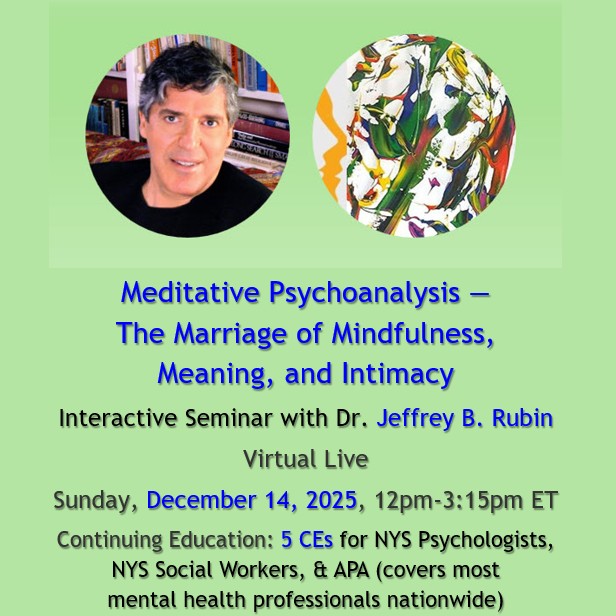
For many years, I have been exploring how Western psychoanalysis and Eastern meditative traditions can speak to — and transform — one another. Each offers something essential. Meditation cultivates presence, steadiness, and the capacity to witness experience without judgment. Psychoanalysis illuminates the symbolic, unconscious, and relational dimensions that shape our inner lives. When these approaches meet, a fuller picture of the human condition emerges. In this seminar, I will introduce what I call meditative psychoanalysis: a practice that quiets and focuses the mind, listens deeply to the meanings that arise, and engages a therapeutic relationship capable of illuminating and transforming one’s history. We will explore meditative and somatic exercises, discuss clinical applications, and consider how this integration can enrich both our personal lives and our work with patients. My hope is that you will leave with tools that deepen your meditation, expand your analytic listening, and help you cultivate more meaningful and liberating forms of connection — with yourself and with those you serve. For more information and to register, visit: https://lnkd.in/dG2WPMd7 All registered will receive the recording of the event. — Jeffrey B. Rubin, PhD
- LINKEDIN · CAROUSELRecorded 16 Oct 2026
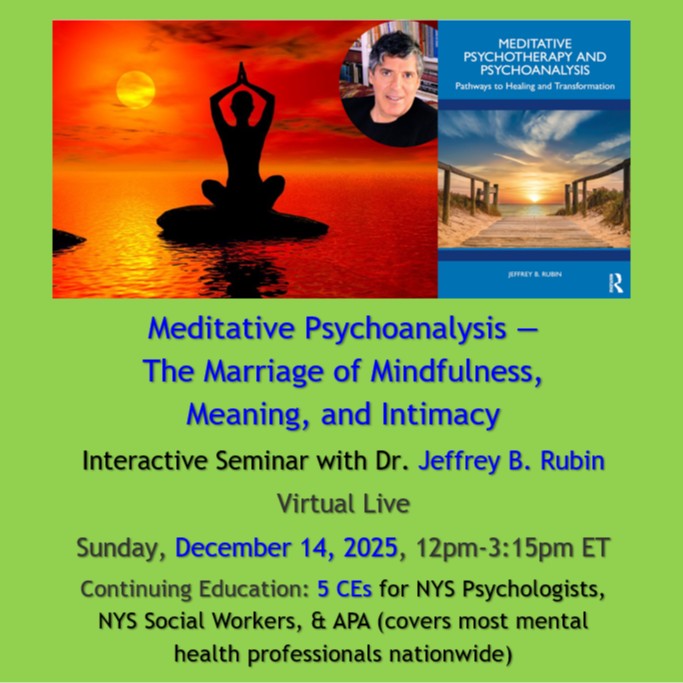
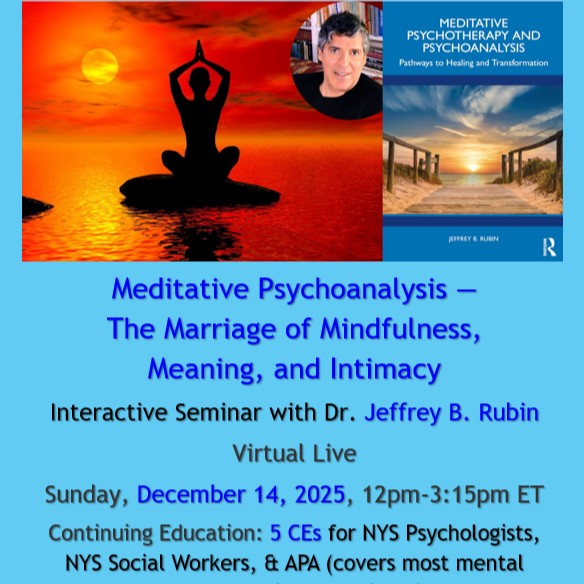
Live Virtual Seminar — December 14, 2025 | 12–3:15 PM ET “Meditative Psychoanalysis: The Marriage of Mindfulness, Meaning, and Intimacy” with Dr. Jeffrey B. Rubin 5 CE hours Meditation helps us quiet and focus the mind. Psychoanalysis helps us understand it. Dr. Jeffrey Rubin’s work brings these traditions together in a transformative way. Join us for a rare interactive seminar exploring meditative psychoanalysis — an approach that uses meditation and yogic breathing to deepen focus, then brings psychoanalytic insight to illuminate unconscious meaning, and finally harnesses the therapeutic relationship as a space for real transformation. The seminar blends: • Lecture + guided meditations • Yogic breathing, qigong, and somatic practices • Clinical applications and discussion • A practical framework for integrating meditation and psychoanalysis in life and practice This training is ideal for clinicians, therapists, analytic candidates, and anyone exploring how Eastern and Western traditions can enrich each other. Participants will learn to: • Use meditation to enhance psychoanalytic listening • Explore symbolic and unconscious meanings that emerge in meditative states • Integrate contemplative and relational practices in therapy • Deepen their own meditation practice with psychoanalytic insight 5 CEs for psychologists, social workers, NYS psychotherapists, and related professionals. Register via web portal: https://lnkd.in/dG2WPMd7
- LINKEDIN · IMAGERecorded 16 Oct 2026
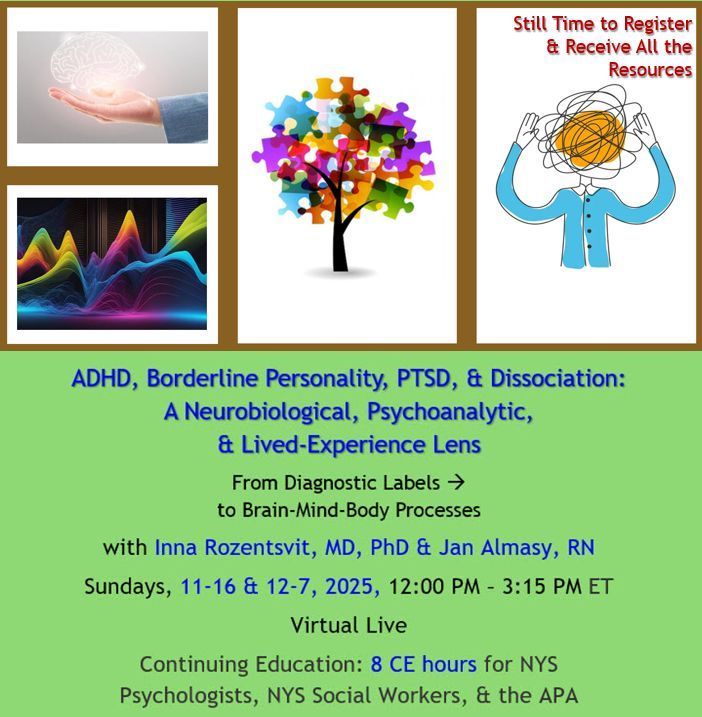
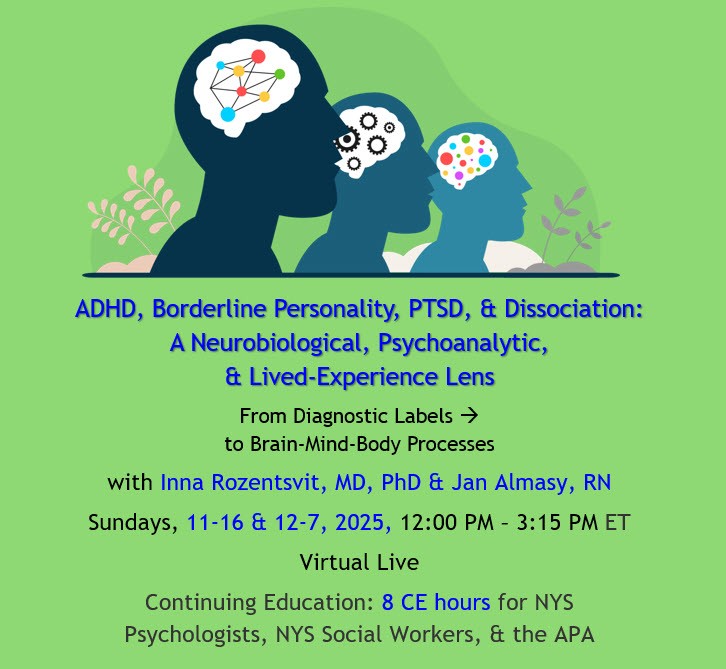
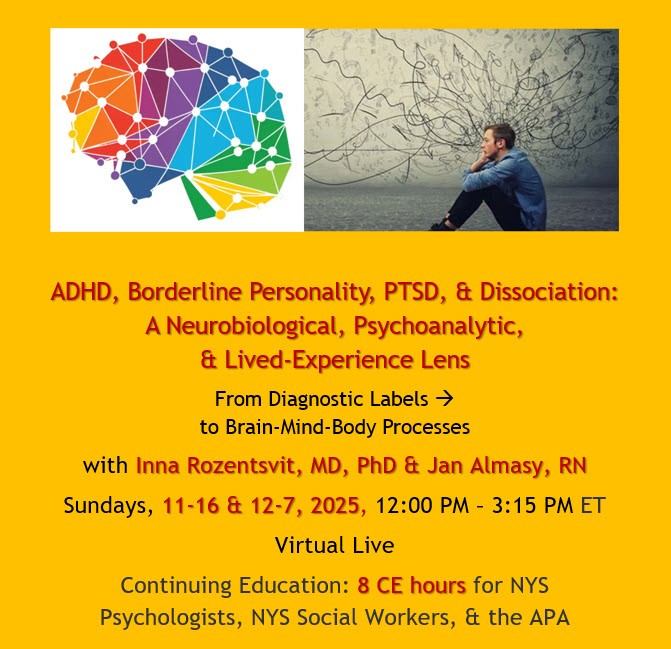
There is still time to join our two-part workshop on ADHD, Borderline Personality, PTSD, & Dissociation: A Neurobiological, Psychoanalytic, & Lived-Experience Lens before Part 2 on December 7, 2025 (12–3:15 PM ET). This series is designed for practitioners who want to move beyond diagnostic labels and work at the level of psychoneurobiological processes that drive what we see in the room. - Why this workshop may be valuable for you 1. From labels to processes. We look at ADHD, trauma, and borderline patterns not as separate “boxes,” but as different expressions of shared brain–mind–body processes: attention and arousal shifts, affect regulation, relational safety, shame, and guilt. The focus is on how these systems function, interact, and dysregulate—so that treatment can be process-based rather than label-driven. 2. Using the resources of the self. We explore non-pharmacological, neurobiologically informed ways to navigate these processes: • working with the body (interoception, sensory load, movement), • emotional regulation and co-regulation, and • executive functions and meaning-making (planning, reflection, narrative). The goal is to help clinicians support patients in building internal and relational resources, whether or not medication is part of the picture. If you register now, you will receive all Part 1 materials: For late registrants, we are making the full Part 1 package available so you can comfortably join us for Part 2: • 🎥 Full Part 1 recording (time-stamped) • 📑 Slide deck from Part 1 • 📂 Resources and literature folder (articles, handouts, clinician tools) • 🧊 Personal Iceberg building instructions • 🧠 Triune Brain Check-In exercise • 🧘 Recommended meditations list • 💬 Access to the private discussion forum for questions, reflections, and integration between sessions You can review these at your own pace before or after December 7 and still fully participate in the live workshop discussion. Live Session Details (Part 2) ADHD, Borderline Personality, PTSD, & Dissociation: A Neurobiological, Psychoanalytic, & Lived-Experience Lens • Part 2 Date: Sunday, December 7, 2025 • Time: 12:00 PM – 3:15 PM ET (Virtual live) • Continuing Education: 8 CE hours total for NYS Psychologists, NYS Social Workers, & APA (covers most mental health professionals outside NYS) 🔗 More information and registration: https://lnkd.in/eSxWwiKc Share this invitation with your colleagues who might benefit from this continuing educational activity.
- LINKEDIN · CAROUSELRecorded 16 Oct 2026
Interest in blending Eastern meditative and Western psychotherapeutic traditions is burgeoning, yet we have only begun to realize what these rich traditions can teach each other. In this seminar — a combination of lecture, meditation practice, and dialogue with the participants — Dr. Rubin will explore what he calls meditative psychoanalysis, which blends the best aspects of Western psychoanalysis and Eastern meditative traditions into a more encompassing synthesis. In meditative analysis, we first use meditation and yogic breathing to quiet and focus the mind, and we then explore and translate the meaning of what we have discovered using psychoanalytic understandings of symbolic and unconscious communication. Psychoanalytic attention to unconscious communication and meaning — the second facet of meditative psychoanalysis — expands the focus and equanimity that meditation fosters. The third and final aspect of meditative psychoanalysis is a special relationship (and environment) designed to illuminate and transform one’s history. Psychoanalysis not only elucidates the interpersonal roots of adult afflictions, it offers a relationship and experience that is a vehicle for transformation in the present. In tandem with meditation, the therapeutic relationship — seen in a freer and more empathic light as the vehicle for both validating a person’s experience and providing opportunities for new forms of relatedness and self-transformation — becomes a crucible in which old patterns of restrictively seeing and organizing one’s life can be witnessed and ultimately transformed, so that new and liberating kinds of human connections can occur. This seminar will offer a focused presentation by Dr. Rubin, discussion of the concepts presented, and meditative and somatic practices ranging from Buddhist meditation and yogic breathing to qigong and practices derived from Chinese internal martials and Russian “Systema,” a holistic system of self-transformation. Learn More and Register Here: https://lnkd.in/dG2WPMd7
- LINKEDIN · CAROUSELRecorded 16 Oct 2026
From Diagnostic Labels to Brain-Mind-Body Processes | An 8 CE Two-Part Workshop Series Our brains share the same neural highways, but the routes we take — shaped by experience, attachment, and meaning — make all the difference. Join us for a two-part experiential workshop that reconnects brain, mind, and body through Functional PsychoNeuroBiology® — transforming diagnostic confusion into clarity, connection, and integrative healing. Workshop Overview Many clients arrive with multiple diagnostic labels — ADHD, Borderline Personality, PTSD, or dissociation — yet their lived experiences reveal shared symptoms and processes: impulsivity, affective storms, attention “blackouts,” shame cycles, and relational volatility. This workshop reframes those overlaps through a unified brain–mind–body lens that integrates neurobiology, psychoanalysis, and trauma studies — offering clinicians a common language for complex presentations. Using Freud’s Iceberg Model as a guiding metaphor, we explore how the unconscious, both psychic and neurobiological — governs conscious life, so that what lies below the surface becomes open to reflection. Making the unconscious conscious means helping patients understand why they feel better, not just that they do — bridging verbal and somatic awareness for lasting change. We’ll also introduce the Functional PsychoNeuroBiology® (FPNB®) Toolbox, which maps how the same brain–mind architecture processes experience through unique personal meaning — A phenomenon called the Beholder’s Share. Understanding this variability allows clinicians to intervene not at the symptom level, but at the level of perception, regulation, and Meaning-making. Finally, the workshop emphasizes self-regulation and co-regulation, capacities disrupted across all three conditions. Participants will learn how to use relational and neurobiological tools to restore these processes and foster integration rather than fragmentation, expanding one’s windows of tolerance. The Workshop will Cover the Following Central Ideas and Takeaways: - From Comorbidity to Process - The Iceberg Model - The Beholder’s Share - Regulation and Co-Regulation - Functional PsychoNeuroBiology® Tools Learning Objectives: - Analyze overlapping features of ADHD, Borderline Personality, and PTSD through developmental, relational, and neurobiological lenses to inform process-based treatment. - Integrate psychoanalytic and somatic approaches to make unconscious neuro-affective patterns conscious and workable. - Apply Functional PsychoNeuroBiology® principles (neuroplasticity, Triune Brain Plus®, connectome/cognitome) to enhance self-regulation and co-regulation in complex clinical cases. For more information and to register, visit https://lnkd.in/daaswVmU
- LINKEDIN · CAROUSELRecorded 16 Oct 2026
ADHD, Borderline Personality, PTSD, and Dissociation: A Neurobiological, Psychoanalytic, and Lived-Experience Lens | 8 CE From Diagnostic Labels to Brain-Mind-Body Processes Join us for a two-part experiential workshop that reconnects brain, mind, and body through Functional PsychoNeuroBiology® — transforming diagnostic confusion into clarity, connection, and integrative healing. Many clients arrive with multiple diagnostic labels — ADHD, Borderline Personality, PTSD, or dissociation — yet their lived experiences reveal shared symptoms and processes: impulsivity, affective storms, attention “blackouts,” shame cycles, and relational volatility. This workshop reframes those overlaps through a unified brain–mind–body lens that integrates neurobiology, psychoanalysis, and trauma studies — offering clinicians a common language for complex presentations. Using Freud’s Iceberg Model as a guiding metaphor, we explore how the unconscious, both psychic and neurobiological — governs conscious life, so that what lies below the surface becomes open to reflection. Making the unconscious conscious means helping patients understand why they feel better, not just that they do — bridging verbal and somatic awareness for lasting change. We’ll also introduce the Functional PsychoNeuroBiology® (FPNB®) Toolbox, which maps how the same brain–mind architecture processes experience through unique personal meaning — A phenomenon called the Beholder’s Share. Understanding this variability allows clinicians to intervene not at the symptom level, but at the level of perception, regulation, and Meaning-making. Finally, the workshop emphasizes self-regulation and co-regulation, capacities disrupted across all three conditions. Participants will learn how to use relational and neurobiological tools to restore these processes and foster integration rather than fragmentation, expanding one’s windows of tolerance. The Workshop will Cover the Following Central Ideas and Takeaways: - From Comorbidity to Process: ADHD, borderline, and post-traumatic patterns share underlying mechanisms in attention, affect regulation, and relational safety. - The Iceberg Model: Symptoms above the surface are rooted in submerged biological and psychological processes. - The Beholder’s Share: Brains function similarly, but minds assign different meanings based on personal history and context — understanding this variability frees patients from pathology narratives. - Regulation and Co-Regulation: Core capacities that buffer stress and support connection — and that can be restored through relational, somatic, and reflective work. - Functional PsychoNeuroBiology® Tools: Triune Brain Plus®, connectome/cognitome models, neuroplasticity, mirror neurons, and self-directed neurointegration as practical maps for therapy and education. For more information and to register, visit https://lnkd.in/dETe7CSm
6 of 28 adsSign up to see every The Object Relations Institute for Psychotherapy and Psychoanalysis ad, filter by format and date, and get alerts on new ones.
See all 28 adsQuestions about The Object Relations Institute for Psychotherapy and Psychoanalysis’s ads
Is The Object Relations Institute for Psychotherapy and Psychoanalysis running LinkedIn ads?
We recorded no live LinkedIn ads for The Object Relations Institute for Psychotherapy and Psychoanalysis on 7 Nov 2026.
How many LinkedIn ads has The Object Relations Institute for Psychotherapy and Psychoanalysis run?
LinkedIn’s ad library lists 22 ads for The Object Relations Institute for Psychotherapy and Psychoanalysis. We recorded 28 LinkedIn ads for The Object Relations Institute for Psychotherapy and Psychoanalysis, first recorded on 16 Oct 2026 and last recorded on 16 Oct 2026.
Does The Object Relations Institute for Psychotherapy and Psychoanalysis run Google ads?
We recorded no Google ads for the domain orinyc.org on 19 Oct 2026.
Which ad formats does The Object Relations Institute for Psychotherapy and Psychoanalysis use?
The 6 LinkedIn ads on this page include 1 image ad and 5 carousel ads.
Watch the companies you care about.
Filter every ad by industry, country, format and network, and get alerts when a company you watch starts running new ads.