Not on air · 2 of 3 networks checked
Strategyn
- strategyn.com
- Business Consulting
- US
- 22 employees
Strategyn’s ads on LinkedIn, Meta and Google, recorded by adsrunning. Browse the latest here for free. Sign up free to see all 294. Watch Strategyn on any plan to get each new one in your feed.
Watchlist included in every plan
| Network | Status | Live ads | Nov 2025LinkedIn activity · 52 weeksNov 2026 | Checked | Next step |
|---|---|---|---|---|---|
| None recorded | 0 | Checked 3 Nov 2026 | See all 294 ads → | ||
| Meta | Not checked | — | |||
| None recorded | 0 | No ads found on the Google Ads Transparency Center | Checked 10 Oct 2026 | Collect them with the API → |
Strategyn has no live LinkedIn ads. We recorded no Google ads on 10 Oct 2026.
Latest ads
- LINKEDIN · VIDEORecorded 1 Oct 2026
I want to share with you the top source of team misalignment. Here's what is happening: - Sales is pitching what's closing deals. - Marketing is targeting segments based on market research. - Product is building features the data says customers want. - R&D is investing in where the technology trends are heading. Every decision makes sense. Every team is being logical. Yet because each team is using different (and often conflicting) sources of customer insights, they are not fully aligned. The organization lacks a reliable, universal source of customer truth. The result? Even your most capable teams work in different directions, because each team is working from a different definition of "the customer and their needs." And that's when you start seeing the symptoms: Missed targets. Delayed launches. Strategies that need to be restarted midstream. The frustrating part? Each decision is completely rational when you're sitting in that department's chair. The breakdown happens at the organizational level. Ask yourself: How many phantom targets is your organization chasing right now?
- LINKEDIN · VIDEORecorded 1 Oct 2026
Sales, marketing, product and R&D all believe they understand the customer. And here's the thing—they probably do, from their vantage point. But different views take teams in different directions. - Sales is responding to what they hear in the field. - Marketing is building campaigns based on market research. - Product is prioritizing features from their usage analytics. - R&D is following where the technology is headed. The research tells us this misalignment can cost companies 10% or more of their revenue. For a $100M business, that's $10M+ walking out the door each year. So here's the question worth asking yourself: Do your teams share a common understanding of who your customer is and their underserved needs? Or is everyone working from their own version of the truth? Let me know if you see this in your team in the comments.
- LINKEDIN · VIDEORecorded 1 Oct 2026
I was in a strategy meeting not long ago that really stuck with me. Each department presented their customer targets for the year. - Marketing: "We're targeting millennials interested in sustainability." - Product: "We're building features that increase engagement." - Sales: "We're pitching solutions to business problems." - R&D: "We're investing in emerging technologies with market potential." All reasonable answers. All thoughtful teams. But here's what hit me: These targets didn't reflect how actual customers make decisions or what they're really trying to accomplish. Now, imagine a different meeting: - Marketing targets customers struggling with specific outcomes they're trying to achieve. - Product builds features that measurably improve how well customers reach those outcomes. - Sales positions solutions based on quantified improvement to customer outcomes. Every strategic decision gets filtered through one question: "Does this help our customers get their job done better?" That's when phantom targets disappear. That's when you finally have what every organization needs. A reliable source of customer truth that everyone works from. So here's what I'm curious about: Which scenario sounds more like your organization today?
- LINKEDIN · VIDEORecorded 1 Oct 2026
So you've identified your organization needs a single, reliable source of customer truth. The question is: How do you create it? Outcome-Driven Innovation provides the proven methodology. Unlike traditional market research that fragments organizations with demographic segments and feature preferences, ODI aligns organizations around what customers are actually trying to accomplish. The approach centers on Jobs-to-be-Done theory. Customers don't buy products. They "hire" them to get jobs done. This insight leads to desired outcome statements - precise instructions of what customers want to achieve when getting a job done. These statements become the universal language that all departments use for strategic decision-making. The result? Organizations achieve an 86 percent innovation success rate compared to the 17 percent industry average. More importantly? All teams work from the same customer playbook, eliminating the coordination failures that create misalignment. Ready to explore how this applies to your organization, schedule time with me by clicking the meeting link in the comments.
- LINKEDIN · VIDEORecorded 1 Oct 2026
There is a better way to prioritize your product feature backlog. Product teams often struggle with backlog prioritization: - making decisions based on gut feeling - internal politics, - or the loudest voice in the room. But there's a more strategic approach: Reverse-engineer features into outcomes. Instead of debating the merits of features themselves, convert each potential feature into the customer outcomes it would satisfy: 1. For each feature in your backlog (let's say 10-15 items), identify which customer outcomes it would address 2. Map these connections - each feature might satisfy 2-3 outcomes, and multiple features might address the same outcome 3. Once you've compiled your list of 20-30 outcome statements, survey your customers 4. Measure which outcomes are both important AND currently unsatisfied - these represent your true opportunities This approach reveals insights that typical prioritization methods miss. You'll discover which features address genuinely underserved needs and which would simply over-serve outcomes that customers already consider well-satisfied. Why waste resources developing features that don't create meaningful value? By focusing on outcomes rather than features, you ensure your development efforts target what truly matters to customers.
- LINKEDIN · IMAGERecorded 1 Oct 2026
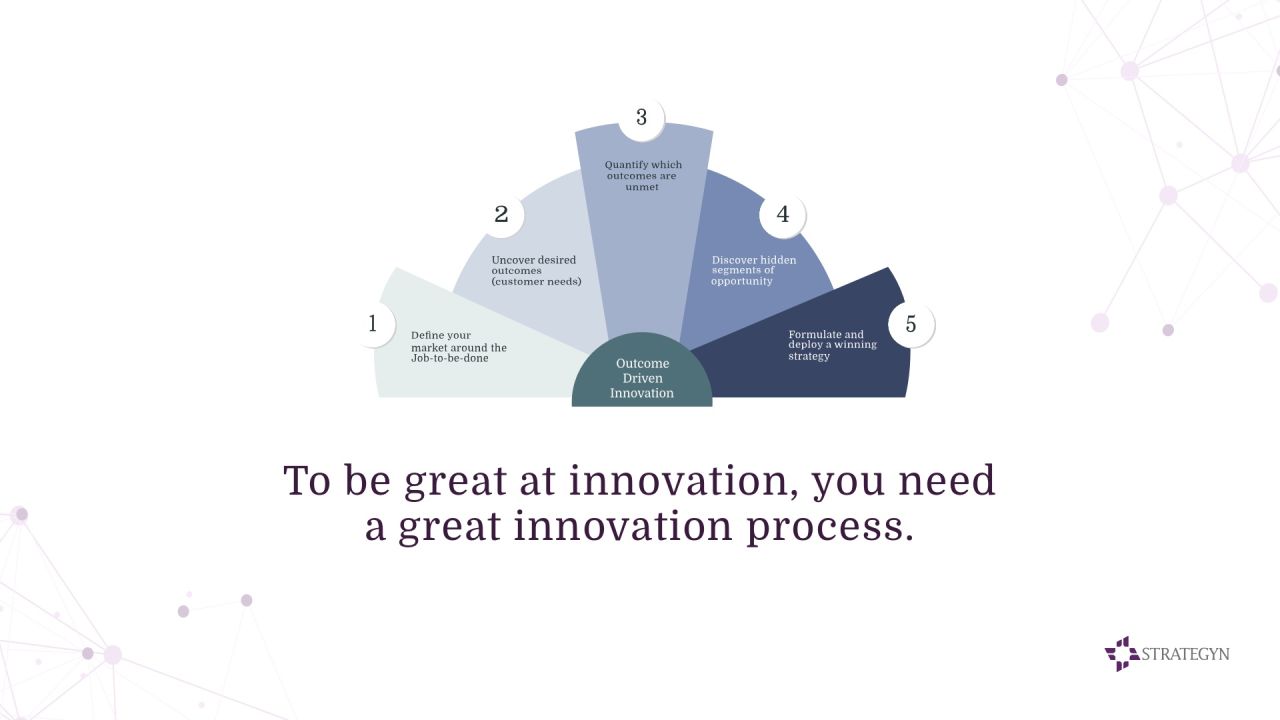
We recently surveyed 300 innovators and found that: - 66% of product teams don't agree on what a "market" is. - 70% don't agree on what a "need" is. - 89% don't agree on the best way to prioritize unmet needs. - 74% don't agree on the best way to segment a market. No surprise success is rare. To be great at innovation, you need: - a great process - a shared understanding - a shared language' You can overcome these challenges and align your organization around value creation by doing the following: - Define a market as "a group of people and their job-to-be-done." - Define a need as "a statement that instructs how to help people get a job done better." - Prioritize unmet needs based on their importance and level of satisfaction. - Segment markets around the unmet needs, not a proxy. These are the first four steps of Outcome-Driven Innovation. You are 5X more likely to succeed when you have these insights. #innovation #markets #language #productmanagement #productteams #innovationmanagement
6 of 294 adsSign up to see every Strategyn ad, filter by format and date, and get alerts on new ones.
See all 294 adsWatch the companies you care about.
Filter every ad by industry, country, format and network, and get alerts when a company you watch starts running new ads.