1 new LinkedIn ad in 30 days · 3 of 3 networks checked

Sierra Club Canada Foundation ads
- sierraclub.ca
- Non-profit Organizations
- CA
- 34 employees
Sierra Club Canada Foundation’s ads on LinkedIn, Meta and Google, recorded by adsrunning. Browse the latest here for free. Sign up free to browse our full recording. Watch Sierra Club Canada Foundation on any plan to get each new one in your feed.
Watchlist included in every plan
What Sierra Club Canada Foundation runs
- Single image · LinkedIn
- 2
- Video · LinkedIn
- 4
- Google ads on 8 Nov 2026
- 21
- active Meta ads on 8 Nov 2026
- 2
- Meta placements
- 2
| Network | Status | Last 30 days | Total ads found | Ad activity | Checked | Next step |
|---|---|---|---|---|---|---|
| Ads recorded | 1 | 61+ | 11/11/2026 | View ads → | ||
| Meta | Ads recorded | 2 | 3 | 11/08/2026 | View ads → | |
| Ads recorded | — | — | 11/08/2026 | View ads → |
Sierra Club Canada Foundation has 1 new LinkedIn ad in the last 30 days. Its Facebook page had 2 active ads on 8 Nov 2026, and we recorded 21 Google ads on 8 Nov 2026.
Latest ads
- LINKEDIN · VIDEORecorded 30 Sept 2026
We answer your questions about Sierra Club Canada and take a look behind the scenes of the work that goes into fundraising with Development Manager Taylor Farrugia for the giving season - as well as share advice for young people interested in getting into the fields of fundraising or communications. Don't forget to spread the word to others! Sierra Club Canada has chapters working in ONTARIO, the PRAIRIES, QUÉBEC, and ATLANTIC CANADA as well as a NATION-WIDE Youth Chapter that are fighting to protect our climate, biodiversity, and nature. We also have many supporters of our national work in British Columbia and the North. Listen to the Full Podcast here: https://lnkd.in/eNJpFvWq Our Wild Child programs get kids outside into nature in Edmonton Alberta, Nova Scotia, and Prince Edward Island. Learn more about us at: https://www.sierraclub.ca/ Learn more about our staff at: https://lnkd.in/ghKsBZiW And Board at: https://lnkd.in/gXe2TdaH Sign up for email updates from us here: https://lnkd.in/e3gw_XfY Consider giving a gift at: https://lnkd.in/eGhJ2eb5 And help spread the word to others ahead of this giving season about Sierra Club Canada! Thank you for your continuing support!
- LINKEDIN · VIDEORecorded 30 Sept 2026
Having grown up in northern Newfoundland, Gretchen witnessed the impacts of the collapse of the cod fishery on her community and was drawn to marine biology and conservation ecology as a student at Dalhousie University. Sierra Club Canada has chapters working in ONTARIO, the PRAIRIES, QUÉBEC, and ATLANTIC CANADA as well as a NATION-WIDE Youth Chapter that are fighting to protect our climate, biodiversity, and nature. We also have many supporters of our national work in British Columbia and the North. Our Wild Child programs get kids outside into nature in Edmonton Alberta, Nova Scotia, and Prince Edward Island. Learn more about us at: https://www.sierraclub.ca/ Learn more about our staff at: https://lnkd.in/ghKsBZiW And Board at: https://lnkd.in/gXe2TdaH Sign up for email updates from us here: https://lnkd.in/e3gw_XfY Consider giving a gift at: https://lnkd.in/eGhJ2eb5 And help spread the word to others ahead of this giving season about Sierra Club Canada! Thank you for your continuing support!
- LINKEDIN · VIDEORecorded 30 Sept 2026
Talk with others about renewable ways forward: Backing American-owned, U.S. Administration-linked, oil & gas projects is NOT ‘economic necessity.’ It’s economic naivety. As is cutting funding that protects Canadians from wildfires and floods. We have renewable solutions & we need safe and healthy communities. More (with sources): https://lnkd.in/gmQs__e2 Other countries are acting, the United Kingdom has just announced an ambitious clean energy plan (£40 billion in clean investment annually). But Canada is spending three times more backing oil and gas than renewables, even though renewables are a better investment, especially as a November 2025 report shows a stark picture of the revenue losses provincial governments will face in the next decade as “oil and gas demand dries up: By 85% in Alberta, from $153 billion to $23 billion; By 72% in British Columbia, from $47 billion to $13 billion; By 78% in Saskatchewan, from $16 billion to $3.5 billion; By nearly 100% in Newfoundland and Labrador, from $4.4 billion to $300 million.” Fossil fuel interests now rely heavily on maintaining the false appearance that there will be continued oil and gas expansion – an appearance propped up by Canadian taxpayer support. Because if people see the evidence beyond the spin investors will quickly realize reserves of oil and gas are overvalued. As a key energy journalist wrote recently: “Every fossil company everywhere wants investors, governments, and citizens to think, even against the thinnest of evidence, it will be the last one standing as its business steadily crashes... The problem is that citizens, rather than fossil companies and their shareholders, might be stuck picking up the tab.” As covered by DeSmog: “new LNG ventures in British Columbia saddle Indigenous communities with debt, opaque ownership structures, and financial risk that could leave them owing billions.” Of every additional dollar of inflation in Canada [from 2023 back], 25 cents of that has gone to oil and gas and mining extraction profits. The majority of those profits go to the richest 1% and very little of those profits end up in things like pension funds. There are rumours that an insular culture within the Federal Government has led to anyone who questions oil and gas’ economics being labeled a heretic and silenced, and Natural Resources Canada (NRCan) just made cuts that will hurt our ability to protect Canadians from climate impacts like wildfires and floods. Meanwhile calls from journalists to NRCan about whether or not sustainable jobs are even a priority go unanswered. We cannot simply ‘trust the market,’ businesses, or government alone to act wisely. The renewable energy transition is happening but as a recent report shows: “At present, [the transition] is occurring in an unplanned, unsupported & chaotic way, with key disemployment decisions made unilaterally by fossil fuel employers in the interests of maximizing their own profits.”
- LINKEDIN · IMAGERecorded 30 Sept 2026
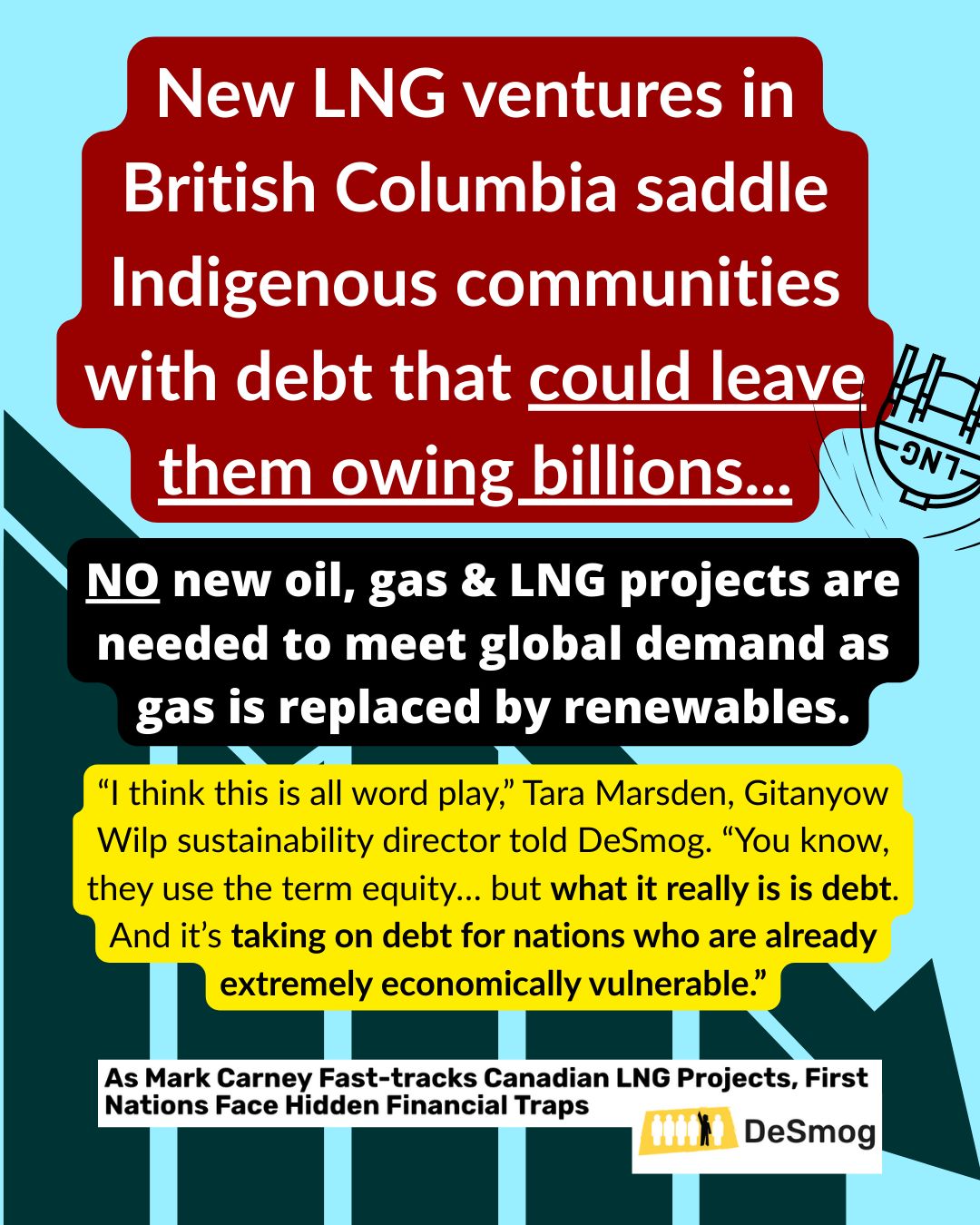
LNG companies want Indigenous communities and taxpayers to pick up the bill when their projects inevitably fail. The International Energy Agency (IEA) estimates that the sponsors of around 70% of LNG export projects currently under construction would struggle to recover their invested capital. A November 2025 report shows a stark picture of the revenue losses provincial governments will face in the next decade (2030s) as global oil and gas demand dries up: - By 85% in Alberta, from $153 billion to $23 billion; - By 72% in British Columbia, from $47 billion to $13 billion; - By 78% in Saskatchewan, from $16 billion to $3.5 billion; - By nearly 100% in Newfoundland and Labrador, from $4.4 billion to $300 million.” As a key energy journalist wrote recently: “Every fossil company everywhere wants investors, governments, and citizens to think, even against the thinnest of evidence, it will be the last one standing as its business steadily crashes. But times are already tough, and the tell comes from two of the industry’s biggest voices…. The problem is that citizens, rather than fossil companies and their shareholders, might be stuck picking up the tab.” If we do not go renewable soon we risk being left behind to carry the weight of a lot of very unpopular and uneconomical gas projects. Because renewable energy create more jobs, and localize jobs, while helping protect the climate, it’s also best to power any data centres with renewables not gas. We already have renewable solutions for when the sun does not shine or the wind does not blow like interconnected grids, energy efficiency, and energy storage, but LNG prices are inherently volatile due to international factors beyond our control. Learn more with sources: https://lnkd.in/gcaDwnxE
- LINKEDIN · VIDEORecorded 30 Sept 2026
We answer your questions about Sierra Club Canada and take a look behind the scenes of the work that goes into fundraising with Development Manager Taylor Farrugia for Giving Tuesday - as well as share advice for young people interested in getting into the fields of fundraising or communications. Don't forget to spread the word to others! Sierra Club Canada has chapters working in ONTARIO, the PRAIRIES, QUÉBEC, and ATLANTIC CANADA as well as a NATION-WIDE Youth Chapter that are fighting to protect our climate, biodiversity, and nature. We also have many supporters of our national work in British Columbia and the North. Listen to the Full Podcast here: Our Wild Child programs get kids outside into nature in Edmonton Alberta, Nova Scotia, and Prince Edward Island. Learn more about us at: https://www.sierraclub.ca/ Learn more about our staff at: https://lnkd.in/ghKsBZiW And Board at: https://lnkd.in/gXe2TdaH Sign up for email updates from us here: https://lnkd.in/e3gw_XfY Consider giving a gift at: https://lnkd.in/eGhJ2eb5 And help spread the word to others ahead of this Giving Tuesday and the giving season about Sierra Club Canada! Thank you for your continuing support! Note: this is a special early release - only on our website for now - ahead of Giving Tuesday.
- LINKEDIN · IMAGERecorded 30 Sept 2026
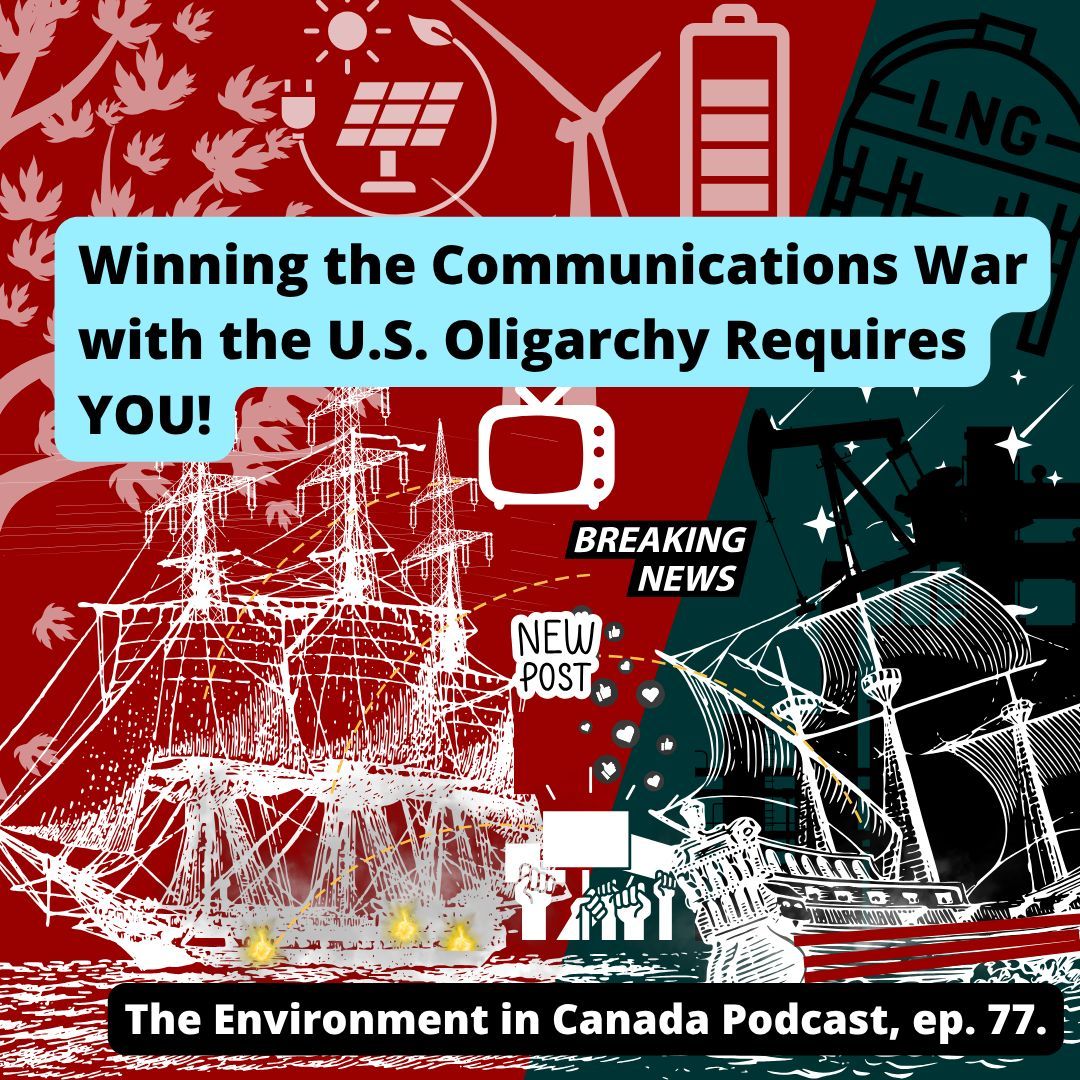
If Canada is to defeat the aggression of the U.S. oligarchy it will require all of us learning how to communicate more effectively, strategically, and rapidly to counter disinformation. Listen to this episode of The Environment in Canada Podcast on IHeart Radio, Apple Podcasts, Spotify, YouTube, or on our website. Full podcast with (resources and sources): https://lnkd.in/eEir63sV We discuss how to be more effective in your personal role in defending energy democracy and our environment, briefly look at the strategic anatomy of that Ontario ad campaign (this was recorded a few hours before the U.S. called off talks with Canada), and discuss why 'the perfect communications plan' isn't everything. Fixing this problem will also require dealing with the extreme inequality that led us to this point, as we covered in last week’s episode.
6 of 61+ adsSign up to see every Sierra Club Canada Foundation ad, filter by format and date, and get alerts on new ones.
See all 61+ adsOn Facebook and Instagram
Facebook page Sierra Club Canada Foundation · 2 active ads, checked 8 Nov 2026 · 3 recorded
- All 3
- Image 3
 META · IMAGESince 7 Nov 2026
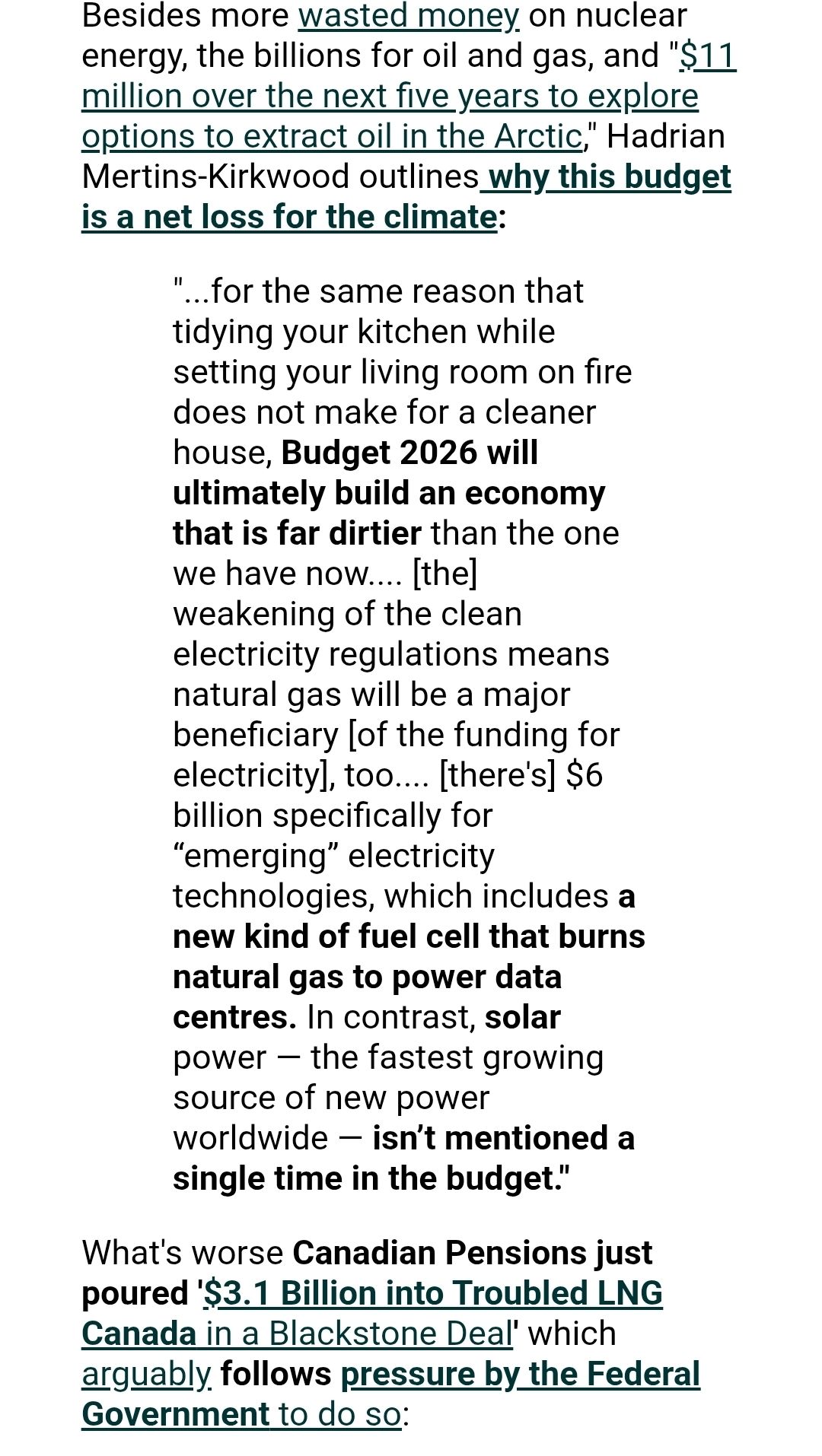
Active on Facebook, Instagram. The biggest budget winners are wealthy oil and gas corporations, it's not a budget for Canadians, nor the climate, nor affordability. The Federal Government is betting our economy on oil and gas in Budget 2026 and is desperate for AI to fuel oil and gas demand. Even though the sector directly and indirectly accounts for only 7.8% of Canada’s GDP, has terrible forward looking economics (thus AI), and employs less and less Canadians even when production increases. The largest budget item is the corporate mega-deduction, at $`36 billion, and "the biggest beneficiary — the oil and gas industry — which is expected to capture a full third of the value of the program." There were a lot of better options for the economy than this mega deduction. As CBC reports "If the investments don't pay off, Canada's debt load leaves it exposed" AND we know that the investments in oil, gas, & AI on which this whole budget hinges will NOT pay off. Because, despite the fact that oil and gas corporations are making tons of profit, they would not event pay for their new pipeline and they hire less and less people (they made the public pay for the pipeline because oil and gas expansion makes no economic sense). AI, likewise, is a bubble. In short, our economy is now tied to economic bubbles waiting to burst. As the CCPA notes: "While federal policy-makers are presenting this budget with a lot of fanfare around relatively limited affordability measures, the actual numbers show something different... the actual spending shows a government prioritizing [already high] corporate profits over all else.... [and regarding homelessness] this government has a poor track record on hitting social targets like this. It will miss the poverty reduction goal of 50 per cent by 2030, for example by a country mile." The Budget must be assessed as much by what's not in it as what is: for instance, there's no serious plan to reduce reliance on U.S. tech corporations for key government functions. We need to address inequality to fix anything. But as Rachel Gilmore notes of the gender-based budget analysis "some of [the] biggest ticket economic measures are expected to have the biggest benefit for high-income men." National pharmacare is not in the budget. The "budget gives no boost in health-care funding to provinces warning of 'fiscal cliff'" yet, as reported earlier, "Planned changes to Ottawa’s Canada Health Transfer in the 2028-2029 fiscal year will likely result [in] cuts of more than `$50 billion for health care [over a decade]". Further, "U.S.-style health care has come to Canada, but the federal government is [still] not enforcing the Canada Health Act." Likewise, the Pharmaceutical Sciences Sector Task Force mentioned in the budget is: "an industry-dominated task force.... [that] wants the CDA to stop the practice of publicly publishing its price reduction recommendations, leaving the public in the dark about the true value of new drugs." Besides more wasted money on nuclear energy, the billions for oil and gas, and "$`11 million over the next five years to explore options to extract oil in the Arctic," Hadrian Mertins-Kirkwood outlines why this budget is a net loss for the climate: "...for the same reason that tidying your kitchen while setting your living room on fire does not make for a cleaner house, Budget 2026 will ultimately build an economy that is far dirtier than the one we have now.... [the] weakening of the clean electricity regulations means natural gas will be a major beneficiary [of the funding for electricity], too.... [there's] `$6 billion specifically for “emerging” electricity technologies, which includes a new kind of fuel cell that burns natural gas to power data centres. In contrast, solar power — the fastest growing source of new power worldwide — isn’t mentioned a single time in the budget." What's worse Canadian Pensions just poured '$`3.1 Billion into Troubled LNG Canada in a Blackstone Deal' which arguably follows pressure by the Federal Government to do so: "[A] risky investment facilitated by Trump-donor taken ahead of global gas supply glut... 'another backroom deal is signed to enrich Trump-backing foreign investors while Canadian workers pay the bill and take on the risk.'" The (actually very small in the big budget picture) tax benefit for artists rings a little hollow, given the billions in support for AI that steals artists' work, and there are many other weird failings in a Budget that: - Has a not-a-sovereign wealth fund to transfer the risk of major projects (i.e. oil / gas) - and now potentially AI (see Cohere reference in Budget 2026 p.169) - off of corporations and onto the public. - Signals that privatization may extend beyond airports (the math on privatizing the key aspects of airports simply doesn't make sense as pointed out even before the budget dropped). - Has strange declining climate disaster funding plans "as if the federal government expects climate change to get less expensive over time." - Prioritizes defence spending that tend to finds its way to U.S. corporations (see below). Federal officials are also poised to hand over 'the mastery of our destiny' to AI. Prime Minister Mark Carney states his vision for an AI-integrated Federal Government on video and how he 'uses GPTs to inquire about issues.' It's a vision of a Canadian Government that wealthy U.S.-aligned interests also want to see. As Paris Marx notes: "Mark Carney says he doesn’t use generative AI as much as he’d like [feeling limited in his use only by privacy concerns], but that he’s brought in a [U.S. tech giant] Google executive to “transform government” and enable more AI use. Basically, the answer of someone completely bought in on the fantasy of AI who refuses to recognize that isn’t reflected in reality." "Meanwhile, [in addition to billions in direct funding] the government is offering billions in corporate subsidies allowing tech companies to deduct costs for equipment in data centres as well as lucrative tax breaks for tech entrepreneurs and investors." - see: Federal Budget Announces Billions to Boost AI and Build Data Centres as AI Industry Faces Growing Public Backlash in The Watchdog. Read the Full Newsletter (WITH SOURCES) here: https://secure.sierraclub.ca/en/civicrm/mailing/view?id=4051
 META · IMAGESince 6 Nov 2026
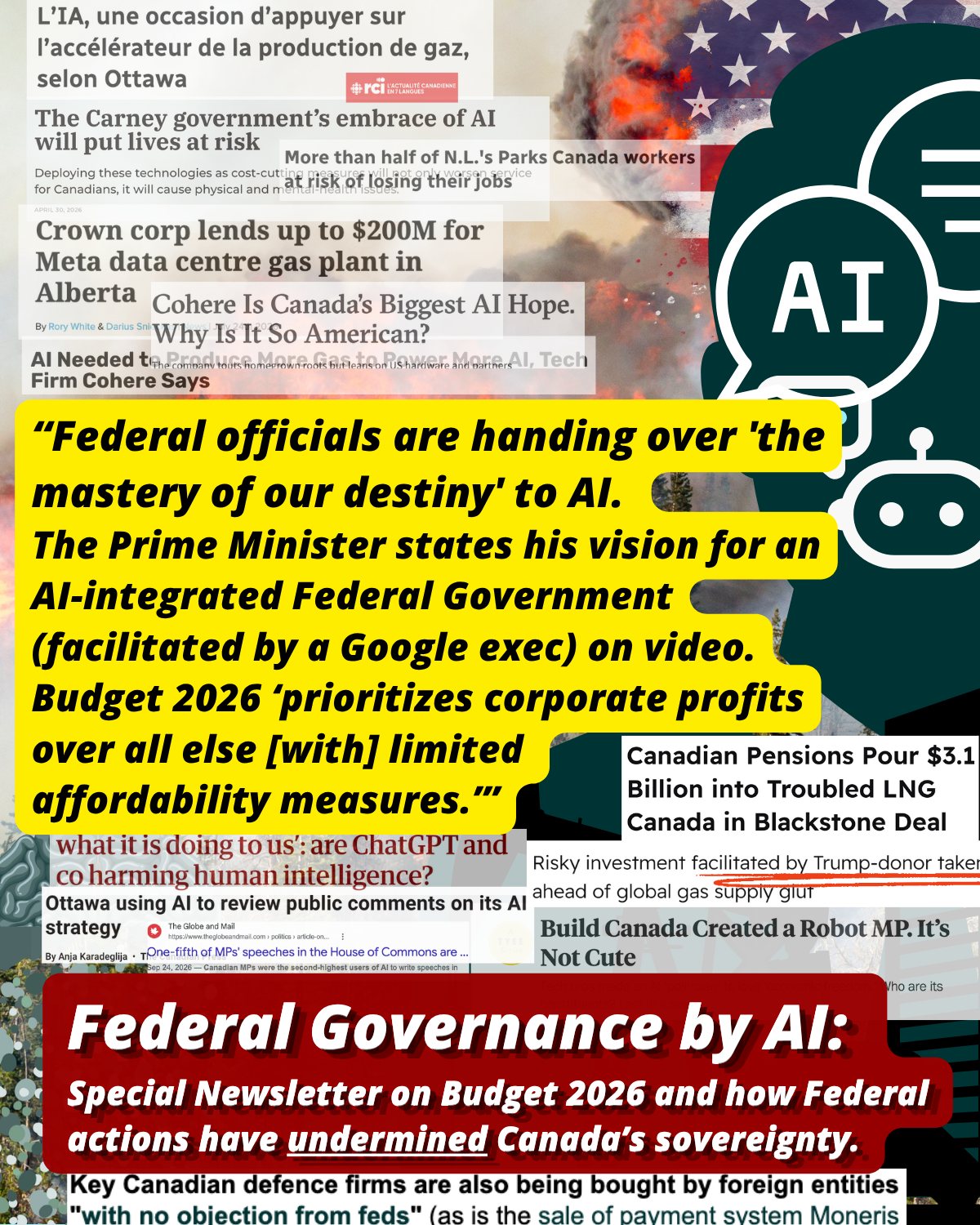
Active on Facebook, Instagram. Federal officials are poised to hand over 'the mastery of our destiny' to AI. Prime Minister Mark Carney states his vision for an AI-integrated Federal Government on video and how he 'uses GPTs to inquire about issues.' It's a vision of a Canadian Government that wealthy U.S.-aligned interests also want to see. As Paris Marx notes: "Mark Carney says he doesn’t use generative AI as much as he’d like [feeling limited in his use only by privacy concerns], but that he’s brought in a [U.S. tech giant] Google executive to “transform government” and enable more AI use. Basically, the answer of someone completely bought in on the fantasy of AI who refuses to recognize that isn’t reflected in reality." The Federal Government is desperate for AI to fuel oil and gas demand, since they seem to be betting our economy on oil and gas in Budget 2026. Even though the sector directly and indirectly accounts for only 7.8% of Canada’s GDP, has terrible forward looking economics (thus AI), and employs less and less Canadians even when production increases. The largest budget item is the corporate mega-deduction, at $36 billion, and "the biggest beneficiary — the oil and gas industry — which is expected to capture a full third of the value of the program." There were a lot of better options for the economy than this mega deduction. As the CCPA notes this is not a budget for Canadians: "While federal policy-makers are presenting this budget with a lot of fanfare around relatively limited affordability measures, the actual numbers show something different... the actual spending shows a government prioritizing [already high] corporate profits over all else.... [and regarding homelessness] this government has a poor track record on hitting social targets like this. It will miss the poverty reduction goal of 50 per cent by 2030, for example by a country mile." The Budget must be assessed as much by what's not in it as what is: for instance, there's no serious plan to reduce reliance on U.S. tech corporations for key government functions. We need to address inequality to fix anything. But as Rachel Gilmore notes of the gender-based budget analysis "some of [the] biggest ticket economic measures are expected to have the biggest benefit for high-income men." National pharmacare is not in the budget. The "budget gives no boost in health-care funding to provinces warning of 'fiscal cliff'" yet, as reported earlier, "Planned changes to Ottawa’s Canada Health Transfer in the 2028-2029 fiscal year will likely result [in] cuts of more than $50 billion for health care [over a decade]". Further, "U.S.-style health care has come to Canada, but the federal government is [still] not enforcing the Canada Health Act." Likewise, the Pharmaceutical Sciences Sector Task Force mentioned in the budget is: "an industry-dominated task force.... [that] wants the CDA to stop the practice of publicly publishing its price reduction recommendations, leaving the public in the dark about the true value of new drugs." Besides more wasted money on nuclear energy, the billions for oil and gas, and "$11 million over the next five years to explore options to extract oil in the Arctic," Hadrian Mertins-Kirkwood outlines why this budget is a net loss for the climate: "...for the same reason that tidying your kitchen while setting your living room on fire does not make for a cleaner house, Budget 2026 will ultimately build an economy that is far dirtier than the one we have now.... [the] weakening of the clean electricity regulations means natural gas will be a major beneficiary [of the funding for electricity], too.... [there's] $6 billion specifically for “emerging” electricity technologies, which includes a new kind of fuel cell that burns natural gas to power data centres. In contrast, solar power — the fastest growing source of new power worldwide — isn’t mentioned a single time in the budget." What's worse Canadian Pensions just poured '$3.1 Billion into Troubled LNG Canada in a Blackstone Deal' which arguably follows pressure by the Federal Government to do so: "[A] risky investment facilitated by Trump-donor taken ahead of global gas supply glut... 'another backroom deal is signed to enrich Trump-backing foreign investors while Canadian workers pay the bill and take on the risk.'" The tax benefit for artists rings a little hollow, given the support for AI that steals artists' work, and there are many other weird failings in a Budget that: - Has a not-a-sovereign wealth fund to transfer the risk of major projects (i.e. oil / gas) - and now potentially AI (see Cohere reference in Budget 2026 p.169) - off of corporations and onto the public. - Signals that privatization may extend beyond airports (the math on privatizing the key aspects of airports simply doesn't make sense as pointed out even before the budget dropped). - Has strange declining climate disaster funding plans "as if the federal government expects climate change to get less expensive over time." - Prioritizes defence spending that tend to finds its way to U.S. corporations (see below). GOVERNANCE BY AI Previous cuts of billions in foreign aid (cuts Budget 2026 leaves in place, barely mentioning aid at all) have undermined our ability to address pandemic and global health risks like Ebola. But the Federal Government is wasting 1.6 billion on a (not very sovereign) AI company, Cohere - just as the AI bubble starts to look very unstable. Cohere is eager to fulfill a Federal oil and gas vision that will pollute Canadian's air and water (data centres can also release "the equivalent of several atomic bombs of heat waste every day as CBC reports"): 'Backed by a $1.6 billion investment from Mark Carney’s government, Cohere is pitching its services to the oil and gas sector.... [with Cohere arguing that] oil and gas companies need to integrate AI into their operations so that they can extract more fossil fuels—which can then be used to power more AI.... Cohere’s products will specifically create “greater profitability” for [Canada's often U.S.-owned] oil and gas industry—at least according to the AI company’s promotional materials [as if big oil weren't already profiting enough].' Our Federal Government likes to fall back on the excuse of comparative U.S. deregulation as a reason to justify bad policy - like letting big U.S. AI companies self-regulate in Canada (via non-binding rules they are possibly already violating in Canada). So allow me to quote the Governor Elect of - *checks notes* - Texas on AI to illustrate just how far Canadian policy has slipped under that excuse: "... we cannot trust the billionaires profiting off of AI to self-regulate... it’s critical that we put the needs of Texans before corporate profits.” Indeed as Canadians publicly finance gas plants for U.S. corporate data centres to the tune of up to $200 million: "Hinojosa, Texas' first Latina governor, has pledged to impose a moratorium on data centre construction in Texas." Meanwhile Google, which is now being entrusted with even more sensitive defence matters by the Canadian Government, 'announced It’s shutting off search engine access for schools that ban AI.' The same Google, who had no issue changing Lake Ontario's name to Lake America on its maps system, is inside our Federal Government. As noted in Trump Has His Finger on Canada’s Kill Switch: "Patriotic defiance means little if Washington can shut off the systems we need.... JPMorgan, Blackstone, BlackRock, and KKR were among the American giants at [Carney's] vaunted investment summit in September. These are the US companies answering Canada’s call to build a more independent country—and for whom Carney is rewriting Canada’s environment and labour regulations." REGULATING CANADIANS, DE-REGULATING BIG U.S. TECH Big tech might not be regulated but individual Canadians are finding themselves increasingly under the microscope: from attacks on workers' rights to Bill C-22 which goes after Canadians' digital privacy and "risks binding Canada even more tightly to Trump’s surveillance state" - potentially exposing Canadians to external hacking risks. "The [U.S.] AI job boom favors men," Mary Whitfill Roeloffs notes, while "AI employment screening tools have been found to penalize female applicants." The impact of AI integration into Ontario prisons offers yet another warning as to what we can expect from an AI-Federal Government, as The Breach reports: "Black prisoners in Ontario’s jails are being assigned to harsher living conditions than other prisoners, through the use of an artificial intelligence (AI) tool that claims to predict their behaviour." Integrating AI into defence is also a terrible idea for reasons covered in our last newsletter here. AI chatbots are harming teens’ learning but Canada has done little to address the issue. One thus wonders about the effect of AI on Federal leaders' learning since we know it already can lead to disastrous defence decisions. Even before the integration of AI into Federal systems, general tech automation was already enabling Immigration, Refugees and Citizenship Canada to deny the legitimate study permits of Afghan women and girls. Automation doesn't operate in a vacuum and it can magnify existing problems. Stories like this are reflective of a manufactured fear of immigration and migration that is being used to distract Canadians from the real reasons for our economic difficulties, as The Breach points out in a comprehensive fact check: "Migrants are being blamed for everything from the housing crisis to hospital wait times to joblessness —and it couldn’t be further from the truth.... They are underwriting the entire [social services] system.... It’s speculators who are leaving tens of thousands of rental units empty in order to manufacture scarcity.... If you follow immigration levels and housing prices over the last forty years, you see that there is no correlation between the two..." AI-automation introduces additional problems for anyone trying to access government services. We are arguably seeing similar impacts on policy creation. Per the last newsletter: "'Plausible looking [but not actually pragmatic] output' full of errors [with a bias towards wealthy interests] and hollow in terms of implementation might well describe Federal policy at large, so much so that one wonders if government decisions are being generated by ChatGPT [which turns out to be ever closer to reality]." All this is made worse by a flawed parallel neoliberal agenda in decision making (with the caveat that public spending is okay when it's on oil and gas or AI). THERE IS HOPE: THE FEDERAL GOVERNMENT IS DEEPLY SCARED OF BEING CALLED OUT, BY YOU! I want to talk for a second about the positive value of de-flooding the zone (see our guide on how you can participate: PART 1 and PART 2). Wading through and highlighting the hypocrisy of Federal actions leaves them with less room to carry out even worse actions. Take defence spending for example. Despite using U.S. threats as an excuse for environmental deregulation, the Federal Government does not actually take risks of U.S. aggression seriously (drone policy is no exception). A $182 million dollar announcement on using Canadian steel in icebreakers sounds big, but is little more than a distraction from the BILLIONS in Federal contracts going to the U.S., up from 1/5 to 1/3 already due to Federal decisions. We're spending $4 billion on American F-35 “capabilities” alone, and 'National Defence has doubled new contracts with U.S. tech giants'). As recently reported in an article entitled David McGuinty Claims Canada Can Work With U.A.E. And Oppose War Crimes: "The Maple asked McGuinty which country he sees as currently posing the greatest military threat.... He made no mention of U.S. President Donald Trump’s repeated threats against Canadian sovereignty". Key Canadian defence firms are also being bought by foreign entities "with no objection from feds" (there's no objection to the sale of payment system Moneris to U.S. interests either): "U.S. defence giant Lockheed Martin purchased Ultra Maritime, the Dartmouth, N.S. company founded in 1947.... The deal follows the purchase of a Canadian underwater drone manufacturer by an Israel firm.... A newly released report by the Center for American Progress noted that [Lockheed Martin] and its subsidiaries have provided more than $16 million to Trump-related causes." But Federal attempts to further Americanize Canadian systems have been slowed by the fear of Canadian public backlash: "What is changing is not so much the strategy as the political discomfort of publicly announcing purchases of American military equipment." said Massie, a political science professor at Université du Québec à Montréal." The Federal Government is operating in Canada's interest only when scared of what people will think otherwise. Because at the end of the day AI might be useful at producing distractions from the issues at hand, but it is no match for an informed populace who can think without AI. The very Federal need to constantly flood the zone is a sign of desperation and fear of you calling out policies and speaking to others. Every piece of cumulatively-presented evidence matters. The Federal Government is also under significant pressure concerning other issues like Bill C-39 (the Business Council of Canada's "long-standing" wish list), with Althia Raj documenting scale of concern in letters written in by the public: "The Carney government clearly sought to curtail debate and study on C-39 to limit knowledge about the bill, and public outcry. But shortcuts have consequences." Further, as The National Observer reports in Reconciliation or runaround? Skepticism abounds around push to revisit Indian Act: "Carney declared his interest in abolishing the 150-year-old act as part of a larger effort to “modernize” the relationship between Canada’s federal government and First Nations.... Raising the prospect of abolishing the Indian Act, [Starblanket] says, is 'a transparent attempt to deflect attention away from Bill C-39 and sow division among Indigenous Peoples at a time when unity is desperately needed'.... 'It had nothing to do with why we were there,' Na’Moks said. 'I don’t know if you’ve ever watched a magician, but I’ve seen a bait-and-switch before.'" This is by no means an easy topic to discuss, but Federal comments are specifically being called into question. Indeed according to CTV News: "The national chief of the Assembly of First Nations says the only leaders to discuss abolishing the Indian Act during a landmark meeting last week were Manitoba Premier Wab Kinew and Prime Minister Mark Carney. Carney [had] said after the meeting that the idea was raised by chiefs in the room." ACCOUNTABILITY MUST INTENSIFY In a general sense across many issues public accountability must intensify, because Federal strategy is fundamentally flawed: on climate inaction and oil and gas promotion, on workers rights and Indigenous rights, on austerity, on tech and on defence. This is all the more important as we possibly enter a new round of negotiations with the U.S. over a trade deal. The last round saw the Federal Government almost agree to a deal that would have been bad for Canada (even before the U.S. arguably 'pushed things too far'). Accountability is also all the more important right now if we truly want to build a Canada less reliant on the U.S. Weakening the industrial carbon price, for example, made no sense if the Federal Government was serious about a truly closer relationship with the EU. As the Energy Mix reports: "European Union politicians could not legally offer Canada an exemption from the continent’s powerful Carbon Border Adjustment Mechanism, even if they wanted to..." Polling showed weakening the industrial carbon price was not necessary for national unity and, as the Pembina Institute noted in May: "The agreement to delay a meaningful price on Alberta’s industrial carbon emissions until 2040 will hurt Canadian jobs, undermine clean energy investment." Other lacking climate regulation has harmed the economy in terms of the types of foreign investment that would actually be useful right now (see "climate disclosure pause costs Canada $44B in sustainable foreign investment"). The Federal desire for a closer relationship with the EU seems driven by a desire to sell Europe LNG that ultimately benefits U.S. Government-aligned interests, and to weaken EU sovereignty. This as Canadians are unnecessarily paying into the profits of big oil and gas because of a policy choice. With "Cenovus reporting [a] 1,400 litre synthetic drilling mud spill from west White Rose platform" it's clearer than ever that fossil fuels are the way of the past. We need stronger climate policies and targets - at all levels - now more than ever, as we told Radio-Canada in a recent interview - T.-N.-L. en voie de rater ses cibles climatiques : Patrick Butler - that you can listen to here or read here: « Ce discours sur la raisonnabilité des cibles est dangereux, [Sierra Club Canada]. L’objectif, en se donnant une cible ambitieuse, est de se donner des ambitions et de s’assurer qu’on ne soit pas en train de reculer si la cible n’est pas atteinte. » Read the Full Newsletter (WITH SOURCES) here: https://secure.sierraclub.ca/en/civicrm/mailing/view?id=4051 Get these newsletters by email every week here: https://www.sierraclub.ca/subscribe-for-updates/ Read our Strategic Plan for Nature Justice and Democracy here: https://www.sierraclub.ca/sierra-club-canada-strategic-plan-2025-2029/
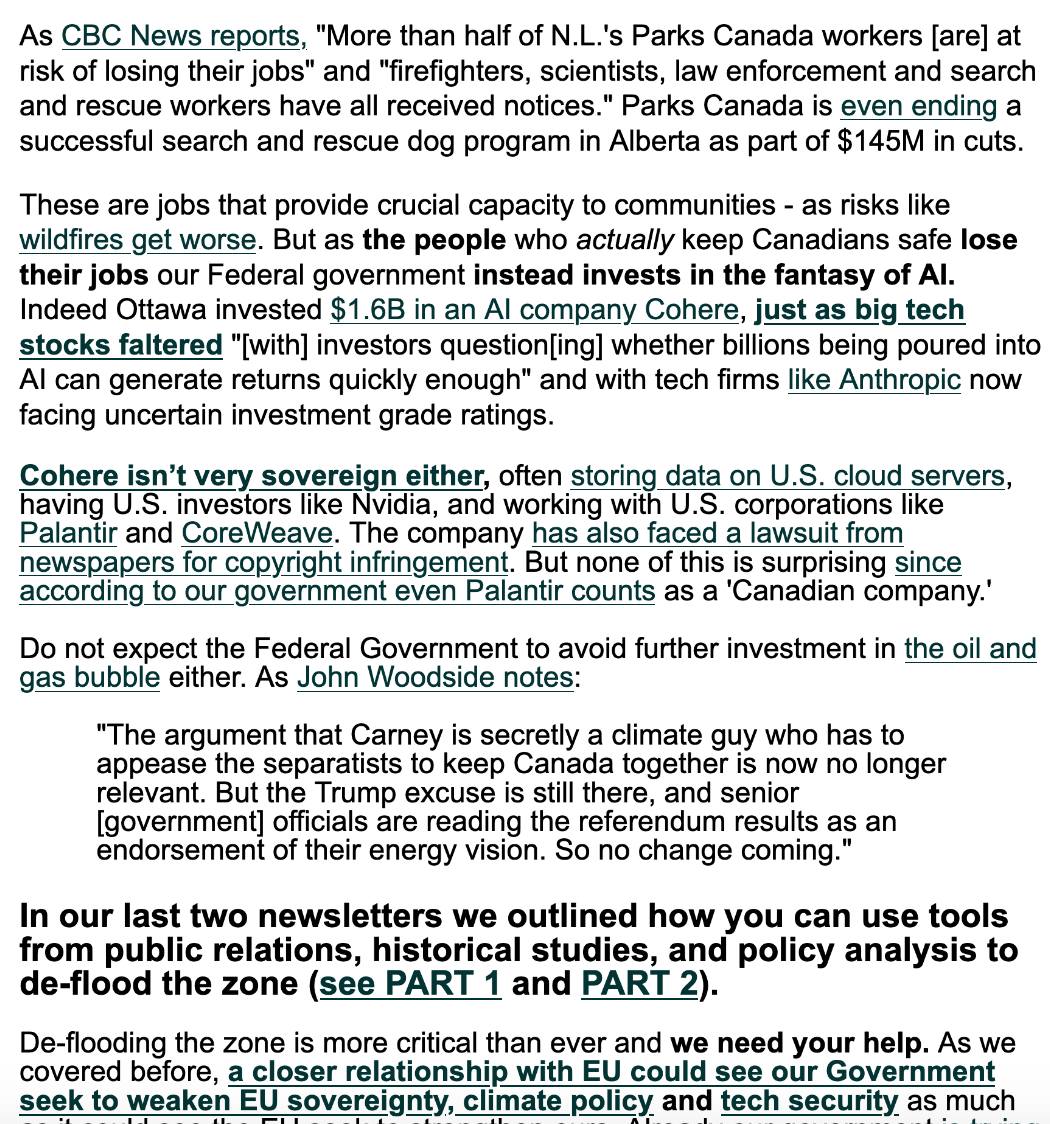 META · IMAGESince 31 Oct 2026
Active on Facebook, Instagram. Federal Government's HOLLOW NATIONAL SECURITY STRATEGY and faulty bet on the AI and oil and gas economic bubbles, while cutting Canadian jobs and undermining our existing strengths - a Newsletter: As CBC News reports, "More than half of N.L.'s Parks Canada workers [are] at risk of losing their jobs" and "firefighters, scientists, law enforcement and search and rescue workers have all received notices." Parks Canada is even ending a successful search and rescue dog program in Alberta as part of $145M in cuts. These are jobs that provide crucial capacity to communities - as risks like wildfires get worse. But as the people who actually keep Canadians safe lose their jobs our Federal government instead invests in the fantasy of AI. Indeed Ottawa invested $1.6B in an AI company Cohere, just as big tech stocks faltered "[with] investors question[ing] whether billions being poured into AI can generate returns quickly enough" and with tech firms like Anthropic now facing uncertain investment grade ratings. Cohere isn’t very sovereign either, often storing data on U.S. cloud servers, having U.S. investors like Nvidia, and working with U.S. corporations like Palantir and CoreWeave. The company has also faced a lawsuit from newspapers for copyright infringement. But none of this is surprising since according to our government even Palantir counts as a 'Canadian company.' Do not expect the Federal Government to avoid further investment in the oil and gas bubble either. As John Woodside notes: "The argument that Carney is secretly a climate guy who has to appease the separatists to keep Canada together is now no longer relevant. But the Trump excuse is still there, and senior [government] officials are reading the referendum results as an endorsement of their energy vision. So no change coming." IN OUR LAST TWO NEWSLETTERS WE OUTLINED HOW YOU CAN USE TOOLS FROM PUBLIC RELATIONS, HISTORICAL STUDIES, AND POLICY ANALYSIS TO DE-FLOOD THE ZONE (SEE PART 1 AND PART 2). De-flooding the zone is more critical than ever and we need your help. As we covered before, a closer relationship with EU could see our Government seek to weaken EU sovereignty, climate policy and tech security as much as it could see the EU seek to strengthen ours. Already our government is trying to get the EU to recognize our severely weakened industrial carbon pricing system as legitimate, even though our rollbacks of the industrial carbon price and climate policy will "slow low-carbon investment and job creation" hurting Canada's "long-term competitiveness in an increasingly low-carbon global economy." Amid a flurry of confusing statements about EU associate membership the Federal Government on Friday, so as to avoid press coverage, listed the Roberts Bank Terminal 2 port expansion for fast-tracking. As The National Observer reports: "Listing Roberts Bank Terminal 2 before Fisheries and Oceans Canada completes and publishes its analysis on the impact on Southern Resident killer whales “creates a reasonable assumption that the Building Canada Act is being used to avoid that determination,” Raincoast said." The Federal government is also set to dismantle mandatory pesticide safety reviews (again, neatly timed with big, EU-friendly, news stories even though pesticide deregulation is anything but EU-friendly): "...proposed changes bundled in Bill C-31 mean Canadians won't be able to scrutinize federal pesticide approvals, question the science underlying those decisions, or force the regulator to reassess health and environmental risks in light of new scientific findings" Our Government's pro-oil corporation approach to inflation is making life harder for Canadians when solutions like price caps exist. Our Government's answer to climate change is likewise to let AI find a solution to the problem (somehow, someday), while financing gas plants for slop-generating U.S. data centres and wasting tens of billions on marketless pipelines (making climate change worse). As a Radio-Canada report highlights, the Federal Government sees AI data centres as a way to burn more gas (environmental protection rules for AI are non-binding, after all): « Le gouvernement canadien de Mark Carney voit un potentiel de symbiose économique entre le gaz naturel, qui répond à l'immense besoin d’énergie de l’intelligence artificielle (IA), et l’IA, qui stimulera, à son tour, la production de gaz naturel, surtout en Alberta. C’est ce que montrent des documents rendus publics grâce à la Loi sur l’accès à l’information. » All this, even as our government looks to eliminate actual human fire-fighting capacity and community safety programs with proven results. All this, even as corporations are realizing AI adoption has led to outcomes full of mistakes and errors without generating promised increases in productivity: "...the technology’s tendency to produce “plausible-looking output” with weaknesses or mistakes that are not immediately apparent... “This makes it more likely that an error propagates through a workflow instead of being immediately corrected,” which can cause problems to snowball, said Reif." 'Plausible looking output' full of errors and hollow in terms of implementation might well describe Federal policy at large, so much so that one wonders if government decisions are being generated by ChatGPT. The integration of AI into defence might well have more risks than benefits. As Robert Evans points out, mistakes by AI systems have already brought countries close to conflict and AI hallucinations could even one day become the spark of a Nuclear conflict. Add to this that generative AI tends to use cult-like tactics to keep its users engaged - reinforcing their existing beliefs. Generative AI might be better compared to an addictive substance than to a source of national security or climate insights (internal defence AI tools are mostly just 'copies of the commercial stuff' subject to the same problems). The solutions to climate change and the means to reinforce sovereignty at the same time exist. They do not require a generative AI to imagine. They require implementation by human beings with their critical thinking skills intact. Which leads us to today's analysis of Canada's new National Security Strategy. A HOLLOW NATIONAL SECURITY STRATEGY THAT LEAVES CANADIANS AT RISK Environmental policy rollbacks and the adoption of AI are often justified as necessary given the threats Canada now faces. Yet the opposite is true: we need stronger policies and jobs filled by the most complex intelligence system in existence (human minds). Reading through the Federal Government's new National Security Strategy one finds it light on any details about Canadian sovereignty in relation to the U.S., absent any in depth discussion of the definitions of tech sovereignty and absent a direct discussion of U.S. government-aligned corporate influence (corporate influence which the U.S.'s own National Security Strategy specifically highlights as a tool the U.S. Government intends to use). Indeed, ultra-wealthy /corporate influence is one of the greatest U.S. threats we face, as recent Stelco CEO statements should make clear, which makes the issue's practical absence in the document all the more glaring. Not all foreign investment is a good thing, in fact it comes with major risks and opens the door to domestic policy leverage, yet there is no critical assessment of these risks. The references to tech sovereignty and human rights that are in the document are also completely contradicted by actual Federal actions, as we noted in a recent newsletter Canada has doubled new defence contracts with U.S. tech giants, increased the share of Federal contract money going to U.S. firms, and failed completely to get existing Federal tech off of U.S. systems despite having more than adequate time to start doing so. They are even allowing the sale of Canadian payment processing to U.S. interests. Despite a mention of 'withstanding shocks,' there's no reference to the need to control the damage of oil and gas price volatility (via price caps, excess profits taxes, renewable energy growth etc.) which is currently playing a major role in undermining our economy. Despite referencing democratic principles and human rights in the document, Canada seems set to create an extradition treaty with the U.A.E., even though the country has a horrid human rights record. The Federal Government is also talking with the U.A.E, Israel, and Saudi Arabia about the utilization of AI while "[all three] states have all weaponized AI to commit war crimes and/or other alleged abuses [as well as facilitate democratic repression]." Our government, while leaving AI corporations unregulated, has expressed a profound interest in using AI in the policing of Canadian citizens. Our Federal Government has made cuts to Global Affairs undermining our ability to influence global events and relationships, contrary to the assertions in the strategy. "Our security and prosperity also depend on strong domestic institutions" the document states. Yet our Government has eroded public sector capacity and accountability - no doubt in part under the false belief that AI will magically fill the gaps. "Planned changes to Ottawa’s Canada Health Transfer could slash more than $50B from public health care over a decade," as Rabble notes, which also undercuts planning to counter future pandemics. Claims in the document about food sovereignty are also contradicted by inaction on that file. Claims the government will work with labour unions and Indigenous communities are likewise deeply contradicted by attacks on workers rights and Indigenous rights by the Federal Government, as well. While countering U.S. corporate influence isn't a core part of the document, our Federal Government will be protecting the safety of projects like pipelines, critical minerals, and LNG that often ultimately benefit U.S. corporate interests. The national security strategy promises to: "Strengthen Canada’s resilience with a comprehensive, all-threats approach to securing critical infrastructure, including government-supported major projects." After all, our government has offered to help the U.S. achieve energy dominance through fossil fuels and the U.S. identifies climate action as a threat. Indeed, it just came out that the Federal Government quietly scrapped a ban on thermal coal exports even though, as Le Devoir reports an increasing majority the coal comes from the U.S.: « En 2025, environ 61 % du charbon thermique expédié depuis le Canada provenait des États-Unis. » The implementation section of the new security strategy (the make or break part of any policy) is just one giant TBD, which ignores the fact that on the factors under Federal control we have seen our government undermine, not strengthen, Canadian sovereignty. For all the above reasons I invite you to help us de-flood the zone. Read the FULL NEWSLETTER (WITH SOURCES) here: https://secure.sierraclub.ca/civicrm/mailing/view?id=4046&reset=1 Also in today's newsletter: a Halloween bat-focussed podcast and new polling shows strong support for offshore wind power in NL. Get these Newsletters by email each week here: https://www.sierraclub.ca/subscribe-for-updates/ Read Sierra Club Canada’s new plan for Nature, Justice, and Democracy here: https://www.sierraclub.ca/sierra-club-canada-strategic-plan-2025-2029/
Questions about Sierra Club Canada Foundation’s ads
Does Sierra Club Canada Foundation have new LinkedIn ads?
Yes. We found 1 new LinkedIn ad for Sierra Club Canada Foundation in the 30 days to 12 Nov 2026.
How many LinkedIn ads has Sierra Club Canada Foundation run?
LinkedIn’s ad library lists 58 ads for Sierra Club Canada Foundation. We recorded 61 LinkedIn ads for Sierra Club Canada Foundation, first recorded on 30 Sept 2026 and last recorded on 16 Oct 2026.
Does Sierra Club Canada Foundation advertise on Facebook and Instagram?
Yes. Sierra Club Canada Foundation’s Facebook page had 2 active ads in Meta’s Ad Library, last recorded on 8 Nov 2026.
Does Sierra Club Canada Foundation run Google ads?
Yes. We recorded 21 Google ads for the domain sierraclub.ca on 8 Nov 2026.
Which ad formats does Sierra Club Canada Foundation use?
The 6 LinkedIn ads on this page include 2 image ads and 4 video ads.
Watch the companies you care about.
Filter every ad by industry, country, format and network, and get alerts when a company you watch starts running new ads.