Not on air · 2 of 3 networks checked
ScalixAI
- scalixai.com
- Marketing Services
- 14 employees
ScalixAI’s ads on LinkedIn, Meta and Google, recorded by adsrunning. Browse the latest here for free. Sign up free to see all 245. Watch ScalixAI on any plan to get each new one in your feed.
Watchlist included in every plan
| Network | Status | Live ads | Nov 2025LinkedIn activity · 52 weeksNov 2026 | Checked | Next step |
|---|---|---|---|---|---|
| None recorded | 0 | Checked 3 Nov 2026 | See all 245 ads → | ||
| Meta | Not checked | — | |||
| None recorded | 0 | No ads found on the Google Ads Transparency Center | Checked 9 Oct 2026 | Collect them with the API → |
ScalixAI has no live LinkedIn ads. We recorded no Google ads on 9 Oct 2026.
Latest ads
- LINKEDIN · IMAGERecorded 30 Sept 2026
Smart Bidding only works when the account gives it the right signals and the right environment to learn. Most struggles I see aren’t caused by the algorithm. They’re caused by how it’s used. Here’s how I look at Smart Bidding when I want stable, predictable performance. First, timing matters. If you switch too early, Google starts making decisions with incomplete intent signals. When that happens, your spend goes in directions you never planned for. I wait until the account has real conversion data. Not soft events. Not low-quality actions. Actual conversions that reflect business value. Only then does Smart Bidding have context. Now the strategy has to match the stage you’re in. -> Max Conversions -> Max Conversion Value Both make sense when your goal is to squeeze more output from your existing budget. Good starting point. Good for restructuring. -> Target CPA -> Target ROAS These only work when you know your numbers and the account can support the targets you set. If the target isn’t realistic, Smart Bidding will struggle no matter how much data you have. The common mistakes keep repeating: -> Switching strategies too often -> Targets that are completely out of range -> Making changes every few days -> Restarting the learning phase over and over Smart Bidding relies on steady feedback loops. Every unnecessary tweak resets the loop. I give it 3 to 4 weeks to settle before judging the direction. A few things that always help: -> Test Smart Bidding on one campaign before scaling it -> Move targets slowly, not in big jumps -> Watch conversion quality, not CPC fluctuations -> Keep your tracking clean and consistent -> Remove signals that confuse the system CPC moving up is not the issue. CPC moving down is not the win. Smart Bidding doesn’t optimize for click prices it optimizes for outcomes. When you treat Smart Bidding like a system instead of a shortcut, everything becomes easier. Volatility drops. Reporting becomes clear. Scaling becomes controlled instead of chaotic. That’s when Smart Bidding actually works in your favor.
- LINKEDIN · IMAGERecorded 30 Sept 2026
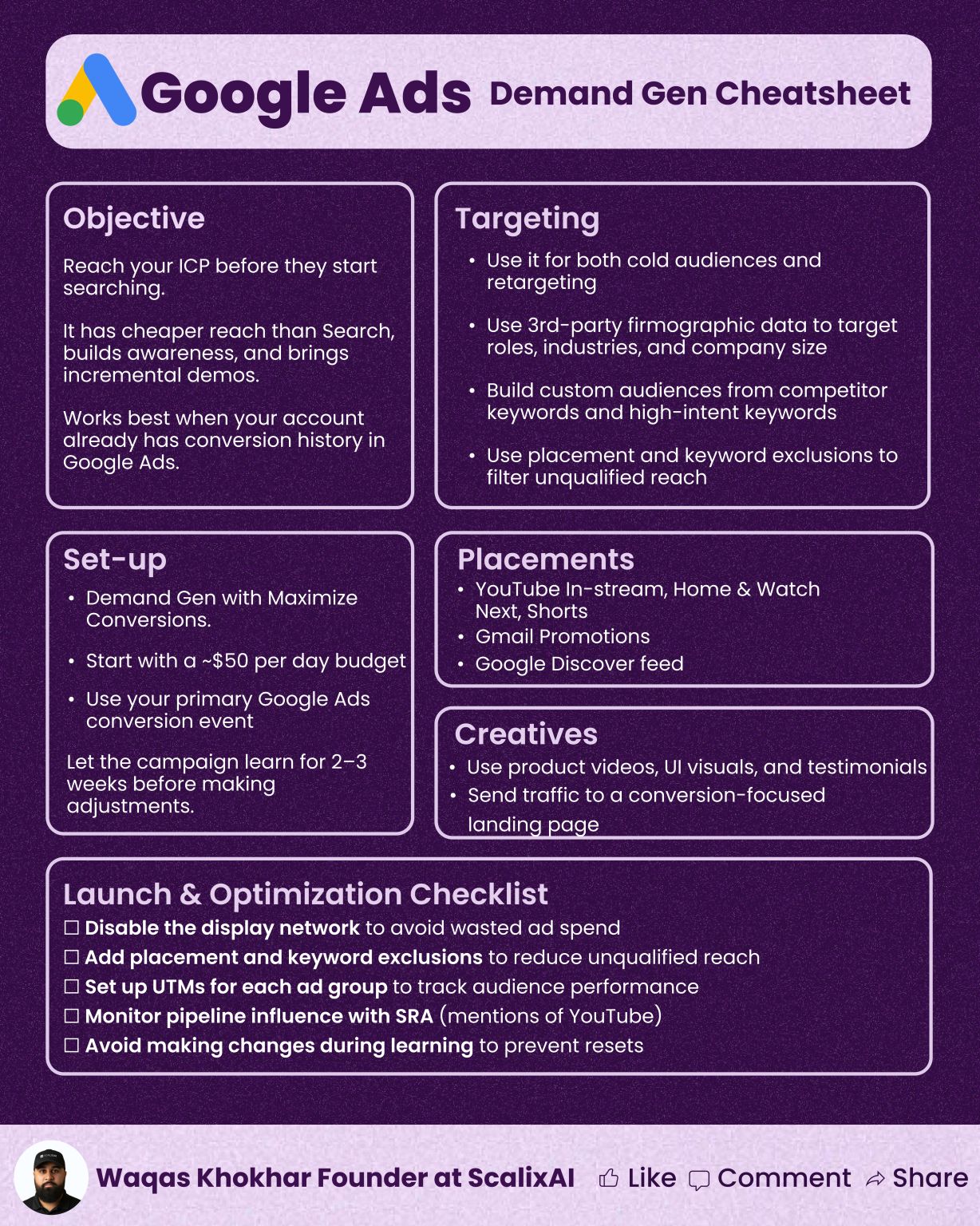
Most founders play Google Ads like a reaction game. A competitor launches something → they panic. Leads slow down → they panic. Search CPC spikes → they blame the platform. I stopped operating like that a long time ago. One of the turning points in my career was when a brand came to me saying, “Google Ads just doesn’t work for us.” They had the classic scars burned budget, messy agencies, scattered tracking, no momentum. But when I opened their account, it was obvious: They weren’t failing because Google Ads is expensive. They were failing because they were only showing up after the buyer already made up their mind. By the time someone searches, it’s too late. You’re just another tab. Another option. Another bid in the auction. So I did what I still do today: I moved them upstream into Demand Gen. That’s where everything changed. We stopped fighting for scraps in Search. We started creating demand instead of chasing it. Targeting their exact ICP before they even typed a keyword. Using YouTube placements where their attention is actually alive. Building firmographic audiences so tight it felt like cheating. Stacking exclusions so we weren’t paying for noise. And sending traffic to landing pages engineered for conversions not “awareness.” What happened next is what happens every time Demand Gen is done right: Pipeline grew before Search even kicked in. Demo requests doubled. CAC dropped. And suddenly they weren’t “unlucky with Google Ads” they were dominating it. This is the same system we run at ScalixAI now. The same checklist. The same discipline. The same upstream strategy that warms the market before you ever spend a dollar on Search. If you understand this one principle, you stop bleeding money: Hold attention early, and every other channel becomes cheaper. Show up late, and every click becomes a fight. If you want me to review your Google Ads setup or build your Demand Gen engine from scratch my calendar is open. Book your slot.
- LINKEDIN · IMAGERecorded 30 Sept 2026
Scaling ads isn’t about copying what worked. It’s about understanding why it worked. When an ad performs well, most teams’ first instinct is to duplicate it and pour in more budget. Fast. Easy. Obvious. The problem? That’s often the fastest way to break performance. Costs rise. Learning resets. Results drop. The algorithm gets confused. High-spend accounts don’t reward repetition. They reward clarity, consistency, and stability. Every signal matters. Every change impacts outcomes. The smarter approach is evolution, not duplication. → Increase budgets gradually. Respect the learning the algorithm has already done. → Test new ideas in fresh campaigns. Keep your top performers intact. → Consolidate data to strengthen your learning signals. → Watch for audience overlap and fatigue before making big changes. Scaling is not about cloning success. It’s about making your winners stronger without breaking the system. I’ve seen this pattern over and over. Teams chasing the “copy and scale” shortcut often waste months and thousands of dollars before realizing it. The ones who win don’t panic when a top ad performs well. They think: how do we preserve what works and amplify it wisely? Every tweak, every budget change, every new variation has a consequence. Understanding those consequences is what separates good operators from average ones. The lesson is simple: speed doesn’t beat strategy. Activity doesn’t beat thoughtfulness. When you scale with intention, every dollar works harder. Every test teaches something. Every campaign moves the needle. Scaling ads isn’t magic. It’s discipline, strategy, and respect for the system you’re working in. If you’re curious about how to scale without breaking your account, feel free to reach out happy to share what’s working in high-spend campaigns right now.
- LINKEDIN · IMAGERecorded 30 Sept 2026
I’ve reviewed 200+ Google Ads accounts in the past year. Want to know the most common founder complaint? “My agency keeps me in the dark.” Different industries. Different budgets. Same exact complaint from founders No clarity. No context. Just reports that explain nothing and results that make even less sense. So we rebuilt the entire model from scratch. Here’s 7 ways we fixed it: 1) Direct access, always. No account managers. No delays. 2) Daily signal tracking. We spot intent shifts before they become performance drops. 3) Real intent-layer optimization. Every query is mapped, nothing runs blind. 4) Founder-friendly reporting. No jargon. No fluff. Just truth. 5) Weekly pattern analysis. We find trends most teams never see. 6) Creative + search alignment. Your message and your intent finally move together. 7) AI monitoring 24/7. Issues get flagged instantly before money is wasted. The outcome? Founders who finally understand what’s happening inside their accounts. Founders who no longer guess, panic, or wait for answers. Founders who feel in control because the system is built to keep them in control. That’s why our accounts grow the way they do. Not because of magic. But because nothing slips through the cracks. If you want the same clarity, DM “AUDIT”.
- LINKEDIN · IMAGERecorded 30 Sept 2026
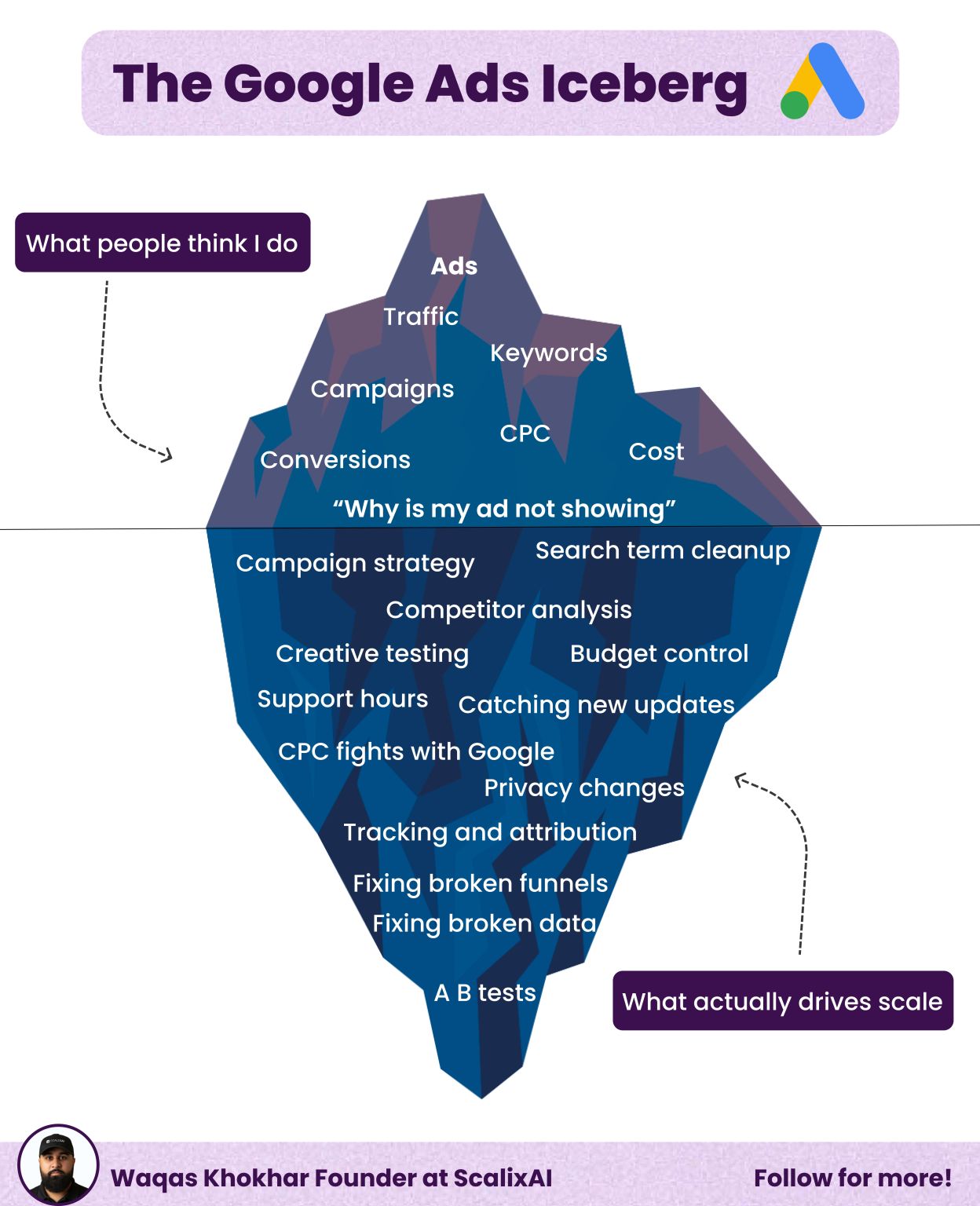
Google Ads is deeper than you realize. (Scaling lives under water) When I open a new account, the surface usually looks fine. The clicks are stable. The charts look normal. Nothing seems broken. But the performance always tells a different story and that story starts below the surface. Most founders think the problem is the ad or the keyword. In reality, Google Ads rarely fails at the top. It fails in the deeper layers most teams never check. 1) A small shift in search intent. 2) A landing page that slows down. 3) A new competitor entering the auction. 4) A tracking issue hiding real results. 5) A policy check pausing spend. 6) An attribution update moving numbers around. None of these look big on their own. Together, they decide whether you grow or stall. After nine years at Google and reviewing more than a thousand accounts, the pattern is always the same: the surface feels safe, but the layers under the waterline control everything cost, margin, speed, and scale. The brands that grow are the ones that fix those layers early. Clean signals. Strong funnels. Aligned creative. Stable auctions. When the foundation is solid, the entire system becomes easier to scale. This is the part of Google Ads most people never see. But it’s the part that moves revenue. If your account feels slow and the surface looks fine, the real issue is deeper. Send me a message I’ll show you exactly where the drop began.
- LINKEDIN · IMAGERecorded 30 Sept 2026
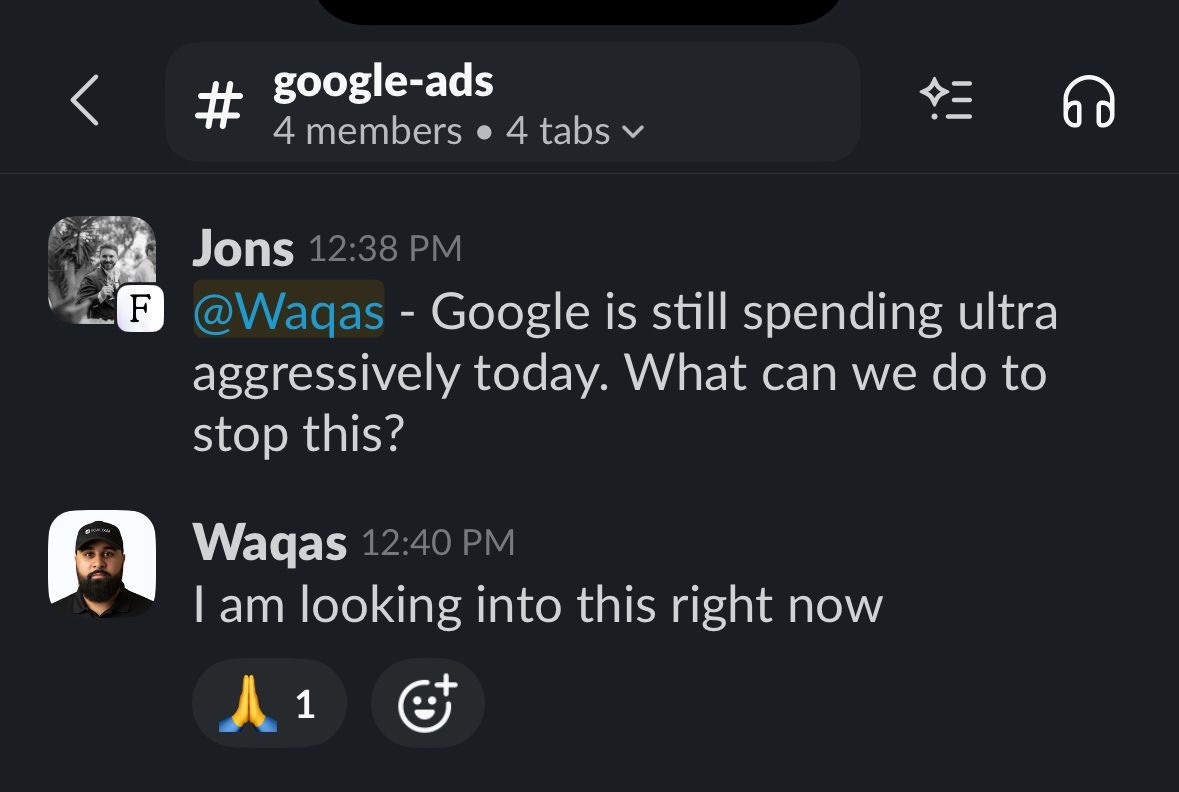
At ScalixAI, we believe one thing above everything else: Communication is the core of great service. Startups move fast and founders move even faster. Your partners need to match that pace. Our average response time on Slack is under four minutes, and that level of speed and accountability is one of the biggest reasons our clients trust us. When the communication loop is tight, execution becomes effortless. Meet customers where they are, move at their speed, and you win.
6 of 245 adsSign up to see every ScalixAI ad, filter by format and date, and get alerts on new ones.
See all 245 adsWatch the companies you care about.
Filter every ad by industry, country, format and network, and get alerts when a company you watch starts running new ads.