Not on air · 2 of 3 networks checked
Rock The Rankings - The B2B SaaS SEO & GEO Agency
- rocktherankings.com
- Technology, Information and Internet
- US
- 8 employees
Rock The Rankings - The B2B SaaS SEO & GEO Agency’s ads on LinkedIn, Meta and Google, recorded by adsrunning. Browse the latest here for free. Sign up free to see all 257. Watch Rock The Rankings - The B2B SaaS SEO & GEO Agency on any plan to get each new one in your feed.
Watchlist included in every plan
| Network | Status | Live ads | Nov 2025LinkedIn activity · 52 weeksNov 2026 | Checked | Next step |
|---|---|---|---|---|---|
| None recorded | 0 | Checked 3 Nov 2026 | See all 257 ads → | ||
| Meta | Not checked | — | |||
| Recently | 1 | Ads on the Google Ads Transparency Center | Checked 8 Oct 2026 | Collect them with the API → |
Rock The Rankings - The B2B SaaS SEO & GEO Agency has no live LinkedIn ads. We recorded 1 Google ad on 8 Oct 2026.
Latest ads
- LINKEDIN · IMAGESince 17 Jul 2026
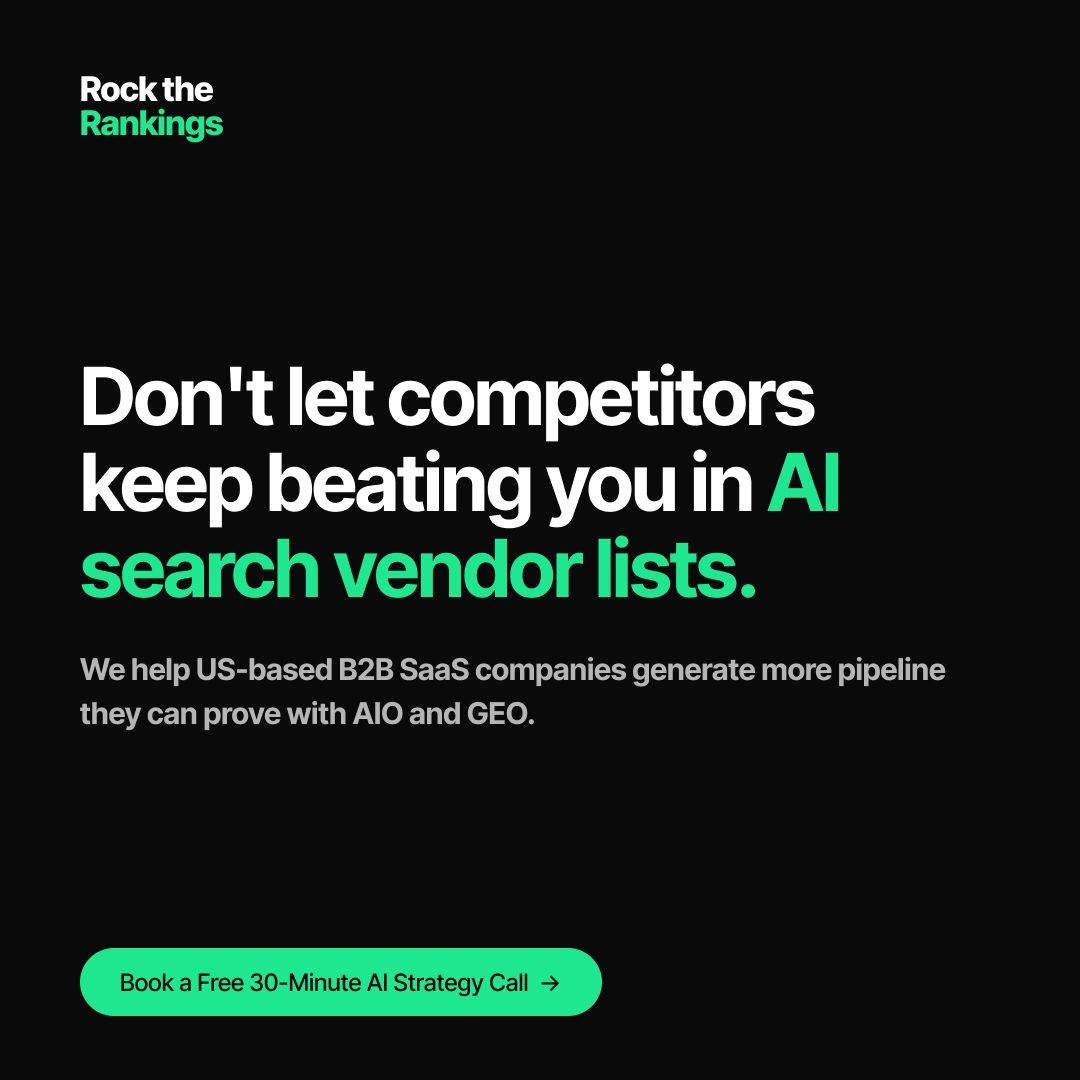
Most B2B SaaS CMOs we talk to are tired of seeing competitors on AI search vendor lists when they're not. They've been sold a lie that the old SEO playbook should solve the problem, but it's just not working. The solution? Building the right pages, and completing the right actions, in the right order. We call it the three layer system. It leads to rapid results like going from 0% to 37% AI visibility for core prompts in as little as 90 days. Book a free AI strategy call to see how we'd apply it to your B2B SaaS so you can finally start outranking competitors.
- LINKEDIN · IMAGESince 17 Jul 2026
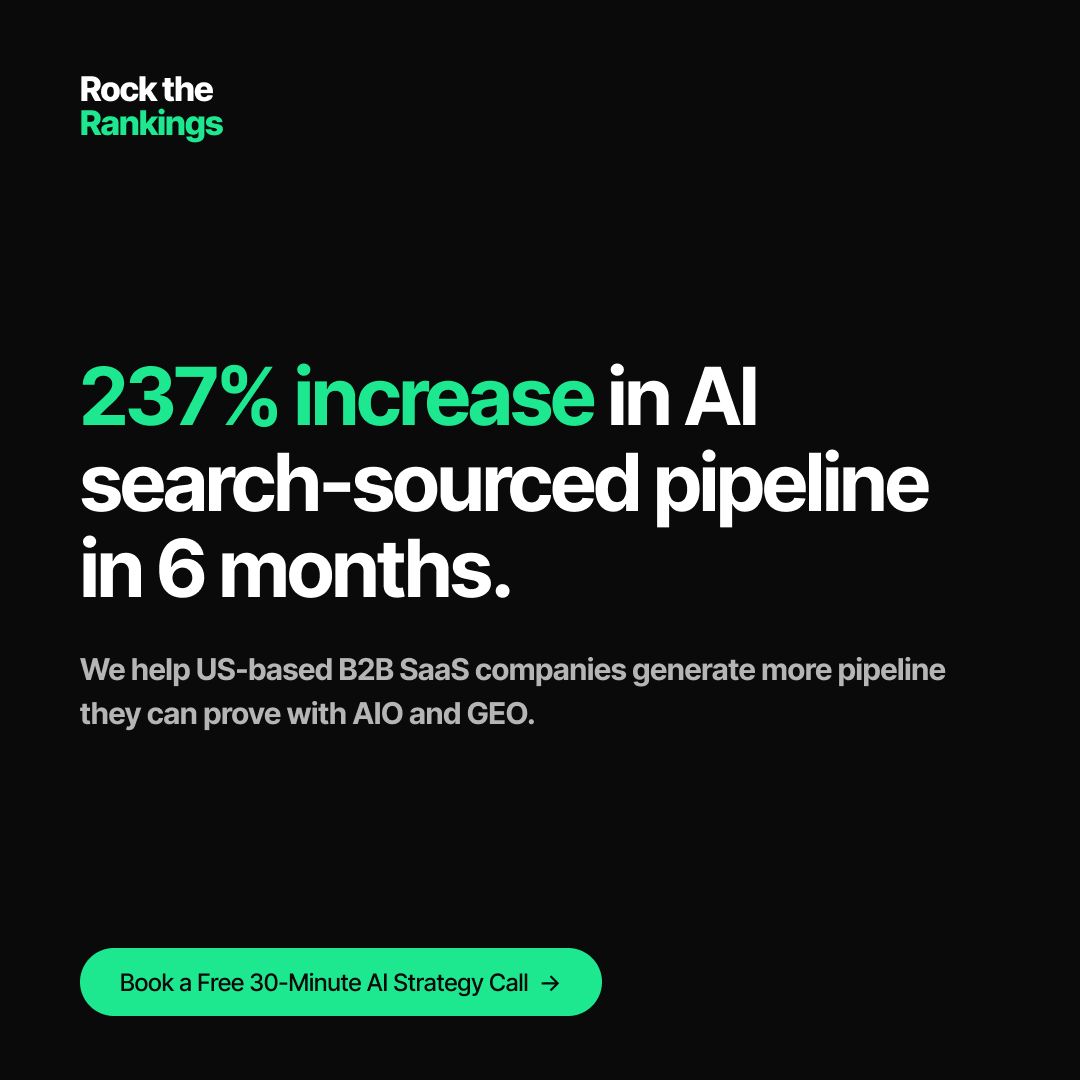
B2B SaaS CMOs we talk to are struggling to generate pipeline from AI search. They're reading posts and newsletters that make it seem like everybody else has it figured out, meanwhile they're feeling behind. The solution? Building the right pages, and completing the right actions, in the right order. We call it the three layer system. It leads to rapid results like going from 0% to 37% AI visibility for core prompts in as little as 90 days. The pipeline quickly follows. Book a free AI strategy call to see how we'd apply it to your B2B SaaS so you can finally start generating AI search pipeline.
- LINKEDIN · IMAGESince 17 Jul 2026
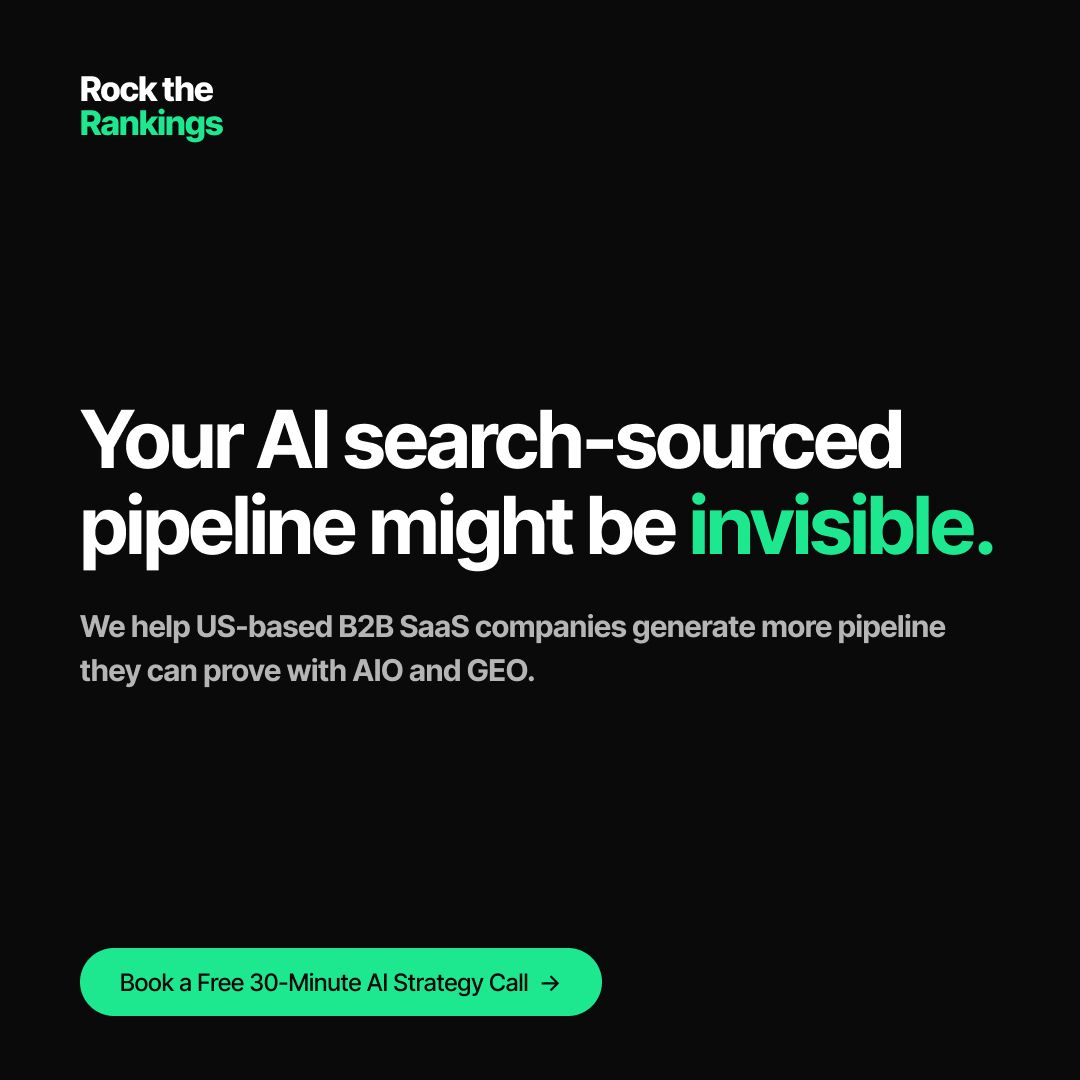
B2B SaaS CMOs we talk to are struggling to prove AI Search is generating pipeline. CEOs and CFOs aren't seeing it in the HubSpot original source field so they're questioning if it's worth the investment. This happens because most AI platforms strip the referrer before they land on the website. So it gets recorded as "direct" traffic. Using our AI search measurement triangulation process, we've helped B2B SaaS companies uncover 54x more AI-sourced pipeline. Book a free AI strategy call to see how we'd apply it to your B2B SaaS so you can finally prove your AI search budget is worth the investment.
- LINKEDIN · IMAGERecorded 30 Sept 2026
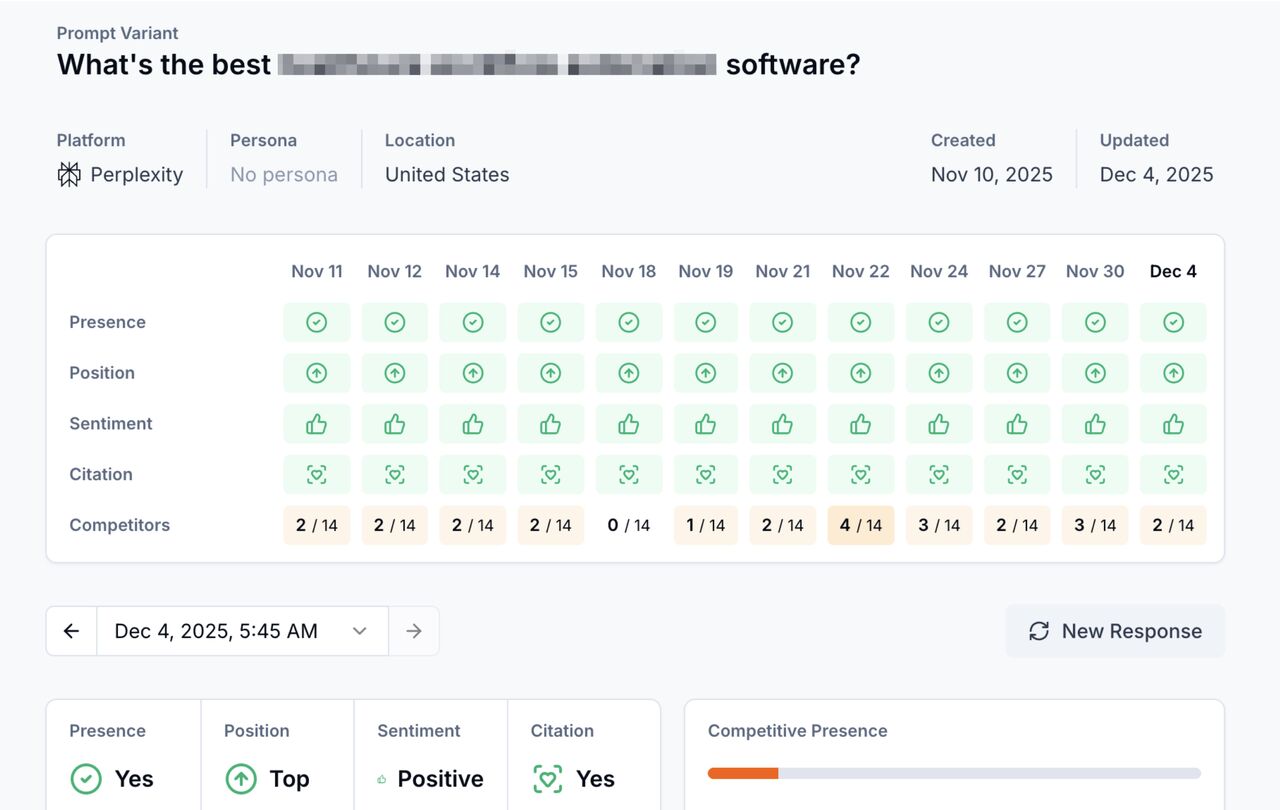
Most SaaS teams are trying to crack LLM visibility, but the reality is simpler than most people think. Two actions consistently determine whether a brand shows up in ChatGPT, Claude, Gemini, Perplexity, and other AI search engines. Let’s break them down. 1. Listicles: The Most Reliable Lever for LLM Visibility and BOFU Conversions Listicles are one of the strongest LLM visibility drivers we’ve tested across SaaS. Here’s why: - LLMs love structure → numbered lists are easy to parse, quote, and cite. - They convert → consistently top-performing BOFU pages. - They also rank well in Google for intent-driven queries. How to execute this well a) Pick solution-aware, list-friendly topics - Focus on the queries buyers search during discovery. - Example: “11 Best CRM Workflow Automation Tools” b) Structure for readability, LLM parsing, and conversions - Start with a tight intro - 3–4 sentences including the primary keyword - Short and direct - End with “In this article, we will…” c.) Outline evaluation criteria - Explain you evaluated tools based on features, pricing, usability, support, integrations. d.) Add a comparison and ratings chart - Ranked list of all software options - G2/Capterra ratings, pricing, and best-fit segments e.) Break down each solution - Your product in position #1 - Map pains/problems to features - Mini case study - Product demo - Integrations, support, ratings, pricing - Use: Pain or problem → Desired result → Feature - Repeat for other vendors with shorter overviews. IMPORTANT: 30–40% of the listicle should focus on YOUR solution. 2. Strengthen Brand Presence Across the Web (The Underrated 80/20) Your visibility in AI answers is shaped by how often and where your brand is mentioned across authoritative sites. Authoritative brand mentions are the top predictor of appearing in AI summaries. We see this consistently with SaaS clients. How to execute this well a) Identify citations and listicles - Find listicles already ranking and contact authors/editors for placements. Profound, Scrunch, and similar platforms show the exact sources LLMs cite. b) Outreach and build relationships - Build ongoing relationships with editors, journalists, and industry writers so your brand is naturally included in listicles, updates, and citation sources. - This strengthens both LLM visibility and Google rankings, making your content the default reference point for models and humans. A Quick Reality Check Other factors exist, but these two are the 80/20 for LLM visibility. Winning brands are not waiting for LLMs to discover them. They are creating the structured content LLMs want to cite and placing their brand everywhere buyers and models look. Execute these consistently and LLM search becomes a predictable acquisition channel, not a black box. -- Two levers. Consistent execution. Predictable AI visibility. Want help building it? https://lnkd.in/e98_Q45Z
- LINKEDIN · IMAGERecorded 30 Sept 2026
If you’re still building your content strategy around keywords, I hate to say it, but you’re already behind: LLMs pull from patterns, entities, brand associations, structured knowledge, and citations. Here’s how to make the shift: 1. Use Business Knowledge to Drive Content Decisions (NOT Keywords) Instead of asking: “What are people searching for?” And doing traditional keyword research, start asking: “What problems do buyers have, how do they evaluate solutions, and what content helps them make a decision?” Your internal insights outperform keyword tools: - Sales call recordings - Support tickets - Buying objections - Lost deal reasons - Customer interviews - ICP pain points - Category-level misconceptions - Competitive gaps buyers mention LLMs reward content that reflects real buyer questions, not artificially constructed keyword phrases. Your business knowledge = your most powerful LLM-search asset. 2. Structure Content Around How Buyers Think, Not SEO Tool Output LLMs prefer structured reasoning: - Problem → solution - Pros and cons - Step-by-step explanations - Feature comparisons - Definitions and clarifications - Alternative options - FAQs rooted in real-world context These formats outperform keyword-stuffed articles every time in AI results because they’re easier for LLMs to extract, cite, and summarize. 3. Focus on Content Types That LLMs Love to Cite Keyword volume doesn’t matter. Content format does. Create: - “Best tools” listicles - Alternatives pages - “X vs Y” competitor comparisons - Pricing explainers - Problem-solution guides These show up disproportionately often in ChatGPT, Perplexity, and Gemini answers because they map cleanly to buyer reasoning patterns and LLMs mimic those patterns. 4. Optimize for Entities, Not Keywords LLMs don’t think in keywords — they think in entities and relationships. Shift your optimization toward: - Products - Features - Workflows - Problems + Solutions - Integrations - Competitors When your site consistently clarifies these relationships, LLMs can understand your context and place your brand appropriately in answer sets. 5. Use LLM Search to Find the Real Opportunities Actual LLM answers reveal more than keyword tools ever will: - Ask ChatGPT: “What are the best tools for X?” - Ask Perplexity: “What’s the best alternative to Y?” - Ask Gemini: “How do I solve Z?” Study: - Which competitors appear? - What content formats are cited? - What structured elements are used? - Which pages get linked to or referenced? This becomes your LLM-first content roadmap. 6. Use Keyword Tools Only as a Secondary Signal Keyword tools can still help you: - Validate topic demand - Identify adjacent topics But they should never be the primary driver of decisions. Your business knowledge, buyer knowledge, and LLM observation are now the more accurate playbooks. -- Still building content around keyword tools? We'll help you make the shift: https://lnkd.in/e98_Q45Z
- LINKEDIN · IMAGERecorded 30 Sept 2026
If your competitors are dominating AI search, here's how to start closing the gap and gaining visibility share: Across nearly every SaaS category, competitors aren’t winning because their product is better. They’re winning because they dominate AI-driven search discovery. Many buyers aren’t starting with Google anymore. They’re asking ChatGPT, Claude, Gemini, and Perplexity questions like: “Best tools for ____” “Top platforms for ____” “Best software to do ____” “Alternatives to ____” And from there, evaluating in more detail product and feature specifics, competitor benchmarks, etc. If you’re not part of those answer sets, you’re not part of the buyer’s consideration set. You are missing from the modern discovery journey. The symptoms appear quickly: • Your brand rarely appears in AI-generated summaries • Competitors control the solution-aware content buyers rely on • Review sites and comparison lists barely mention you This is not only a visibility problem. It is a discovery problem. Buyers are forming their shortlists, comparing options, and shaping their preferences before ever reaching your website. When competitors control the sources LLMs cite, they win SQLs before you have a chance to enter the conversation. What is working right now: → 1. Build the content LLMs actually cite LLMs prefer structured, comparison-heavy content at the decision stage. Create competitor comparisons, alternatives pages, pricing explainers, integration guides, and most importantly, “best software” listicles. → 2. Strengthen your brand’s mentions AI models rely on authority signals across the web. Earn high-quality links and mentions through outreach, partnerships, PR, listicle inclusion, and review site coverage. A stronger citation profile increases your chances of appearing in AI output. → 3. Target the listicles LLMs pull data from Scrape and track SERPs for solution-aware queries such as “best tools for X,” “top software for Y,” and “alternatives to Z.” These pages often act as primary inputs for LLMs. Outreach, build relationships, and get included to pickup brand mentions. → 4. Structure content so LLMs can easily understand and cite Use clear headings, comparison tables, feature breakdowns, FAQs, and concise definitions. LLMs extract structured content far more reliably than dense paragraphs. → 5. Refresh content LLMs reevaluate sources. Refresh statistics, product capabilities, comparison tables, and clarity to maintain your position as the best source to cite. Final thoughts: LLM search is not a future trend. It is actively shaping how buyers discover, shortlist, and decide on software today. You can let competitors define the category for you, or you can create the content and authority signals LLMs rely on and retake control of discovery in AI search. -- Competitors showing up in AI search, and you're not? We'll find the gaps & build the content that closes them: https://lnkd.in/e98_Q45Z
6 of 257 adsSign up to see every Rock The Rankings - The B2B SaaS SEO & GEO Agency ad, filter by format and date, and get alerts on new ones.
See all 257 adsWatch the companies you care about.
Filter every ad by industry, country, format and network, and get alerts when a company you watch starts running new ads.