1 new LinkedIn ad in 30 days · 2 of 3 networks checked

Revenue Labs ads
- revenuelabs.co
- Software Development
- GB
- 7 employees
Revenue Labs’s ads on LinkedIn, Meta and Google, recorded by adsrunning. Browse the latest here for free. Sign up free to browse our full recording. Watch Revenue Labs on any plan to get each new one in your feed.
Watchlist included in every plan
What Revenue Labs runs
- Single image · LinkedIn
- 6
| Network | Status | Last 30 days | Total ads found | Ad activity | Checked | Next step |
|---|---|---|---|---|---|---|
| Ads recorded | 1 | 46+ | 11/11/2026 | View ads → | ||
| Meta | Not checked | — | — | View ads → | ||
| None recorded | — | — | 11/07/2026 | View ads → |
Revenue Labs has 1 new LinkedIn ad in the last 30 days. We recorded no Google ads on 7 Nov 2026.
Latest ads
- LINKEDIN · IMAGESince 6 Nov 2026
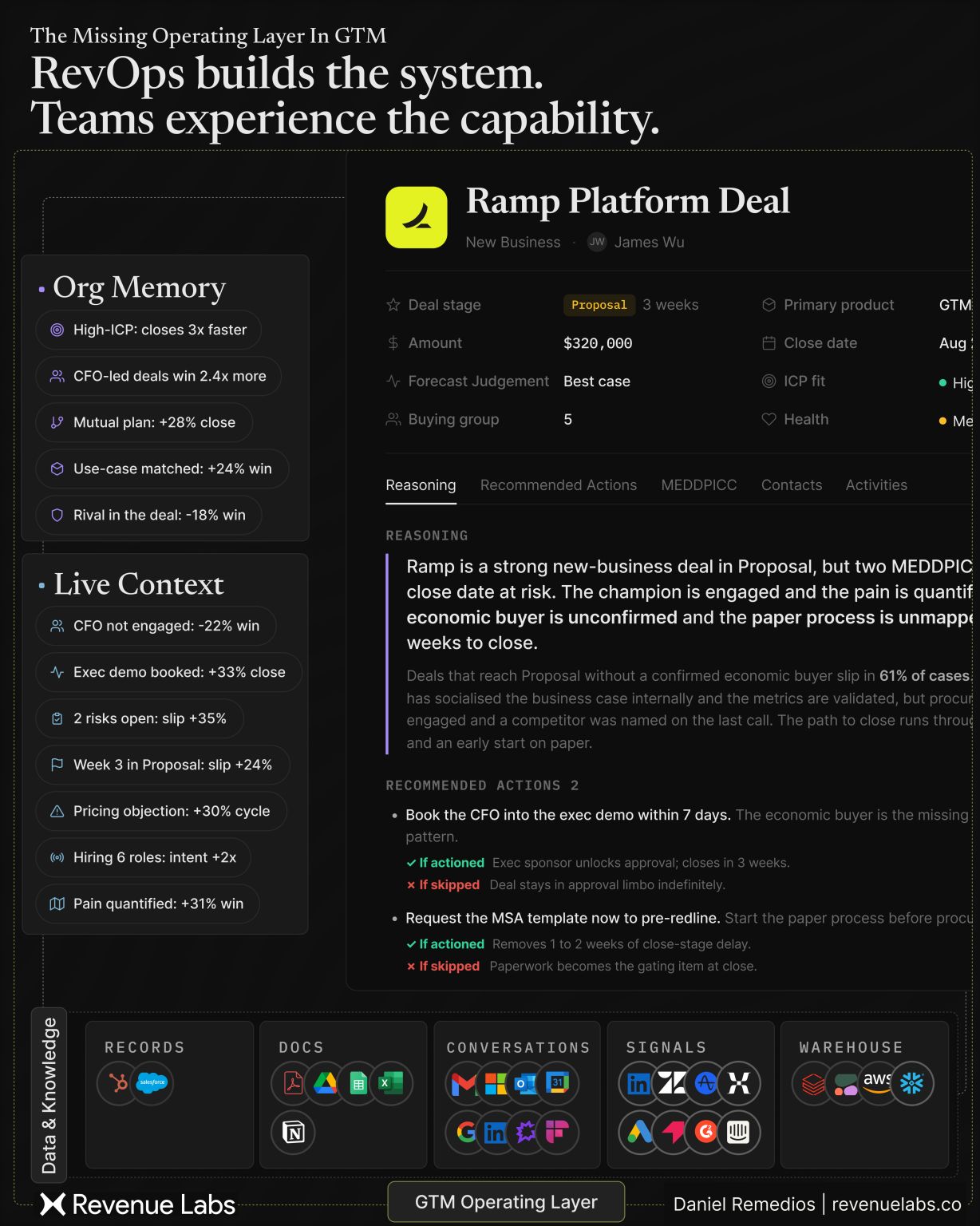
I’ve spoken with hundreds of RevOps and GTM leaders about the same tension. And the shift will transform how we operate and work 👇 Every department has more software than ever, but the organisation still struggles to maintain one shared understanding of what is actually happening. Over the last decade, GTM has been assembled department by department: → marketing bought platforms for campaigns and attribution → SDRs bought data, signals and sequencing → sales bought CRM, call intelligence and forecasting → customer success bought health scoring and renewal tools Each department bought software around its own work. Then RevOps connected the tools, reconciled the data and built workflows between them. But it created a structural limitation. Each system understands only a fragment of the customer, account or market: → marketing sees engagement → SDRs sees signals → sales sees the opportunity → customer success sees adoption and renewal risk Leadership gets another layer of dashboards trying to reconcile these different interpretations of reality. The organisation has tools for almost every task, but no shared system that understands the commercial organisation as a whole. ⚠️ AI is exposing that missing operating layer. The obvious response is to add AI to every tool and give every department more agents. But more intelligence inside fragmented systems does not create a more intelligent organisation. It can simply create more activity without the full context. 🧠 The more meaningful shift is one operating layer beneath GTM. A system that continuously monitors what is happening across accounts, conversations, relationships, product usage and market changes, then turns that live contextual understanding into different capabilities. → marketing can understand which accounts are becoming relevant and which narrative is likely to matter → SDRs can understand who to engage, why now and what action to take → sales can understand the real state of every deal, how urgency and stakeholder power are changing, and where judgement is required. → customer success can understand emerging risk and expansion potential before they appear in a health score or forecast Leadership can understand the state of the business without waiting for every function to construct a different version of reality. 💡 That changes how work happens. The system maintains the understanding, then brings the right capability into the moment of work: → a briefing before a meeting → an explanation of what changed in a deal → a recommendation on which account to prioritise → an early warning that a customer relationship is weakening The experience is different for every department, but the understanding beneath it is shared. Teams consume these capabilities through the surfaces where work already happens. RevOps builds and governs the systems beneath them. That is a much more meaningful shift than adding AI features to the existing GTM stack.
- LINKEDIN · IMAGESince 6 Nov 2026
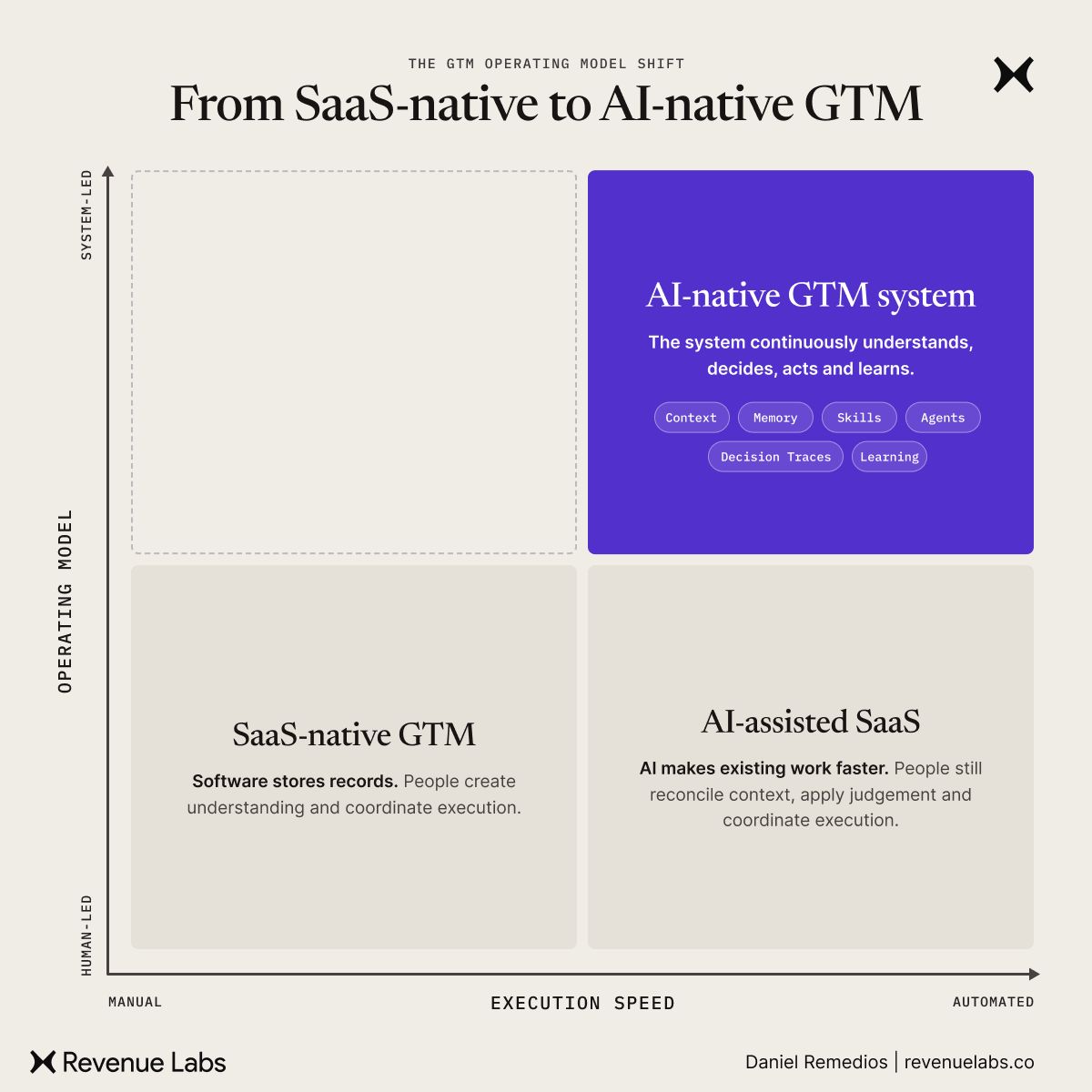
Most GTM teams think AI-native means adding AI. I think it means changing the operating model. Today, AI is making almost every GTM activity faster: → Research accounts → Summarise calls → Draft emails → Update CRM → Review pipeline → Forecast opportunities → Personalise prospecting The work gets dramatically faster. But underneath, the operating model is largely unchanged. → AE still has to understand what’s happening before deciding what to do next → Manager still has to inspect the pipeline before deciding where to coach → RevOps still has to reconcile systems, context and process before recommending action → Leadership still waits for the organisation to explain what changed Different work. The same hidden job. Continuously maintaining a shared understanding of the business. That’s the layer I think most AI discussions miss. AI accelerates execution. It doesn’t fundamentally change coordination. Every new AI creates more recommendations, more outputs and more decisions, but someone still has to connect them together, apply company judgement and decide what happens next. That’s why I think AI-native GTM starts from a different assumption. Instead of asking people to continuously reconstruct the business… …the system continuously maintains it. Live State gives every person and every agent the same understanding of prospect, opportunity and customer: → what's happening → what's changed → what needs your attention Every task changes from an isolated AI workflow to a buildable capability within a system that runs on that shared foundation: → Sourcing accounts → ICP and propensity scoring → Prospecting → Meeting prep → Deal risk → Pipeline reviews Memory captures how the company thinks. Skills capture how the company operates. Agents execute consistently from the same context and logic. The work stops depending on every individual reconstructing the business from scratch. And because every decision is observable, the system can learn. It identifies where context is missing. Where judgement should improve. Which skills should evolve. Which capabilities should exist next. The operating model continuously upgrades itself. That’s the difference I see between AI-assisted GTM and AI-native GTM. → AI-assisted achieves faster work, but exposes an operating model dependent on manual reconstruction, coordination and learning → AI-native introduces an operating layer that continuously understands, coordinates, learns and improves I think that’s the architectural shift we’re beginning to see.
- LINKEDIN · IMAGESince 6 Nov 2026
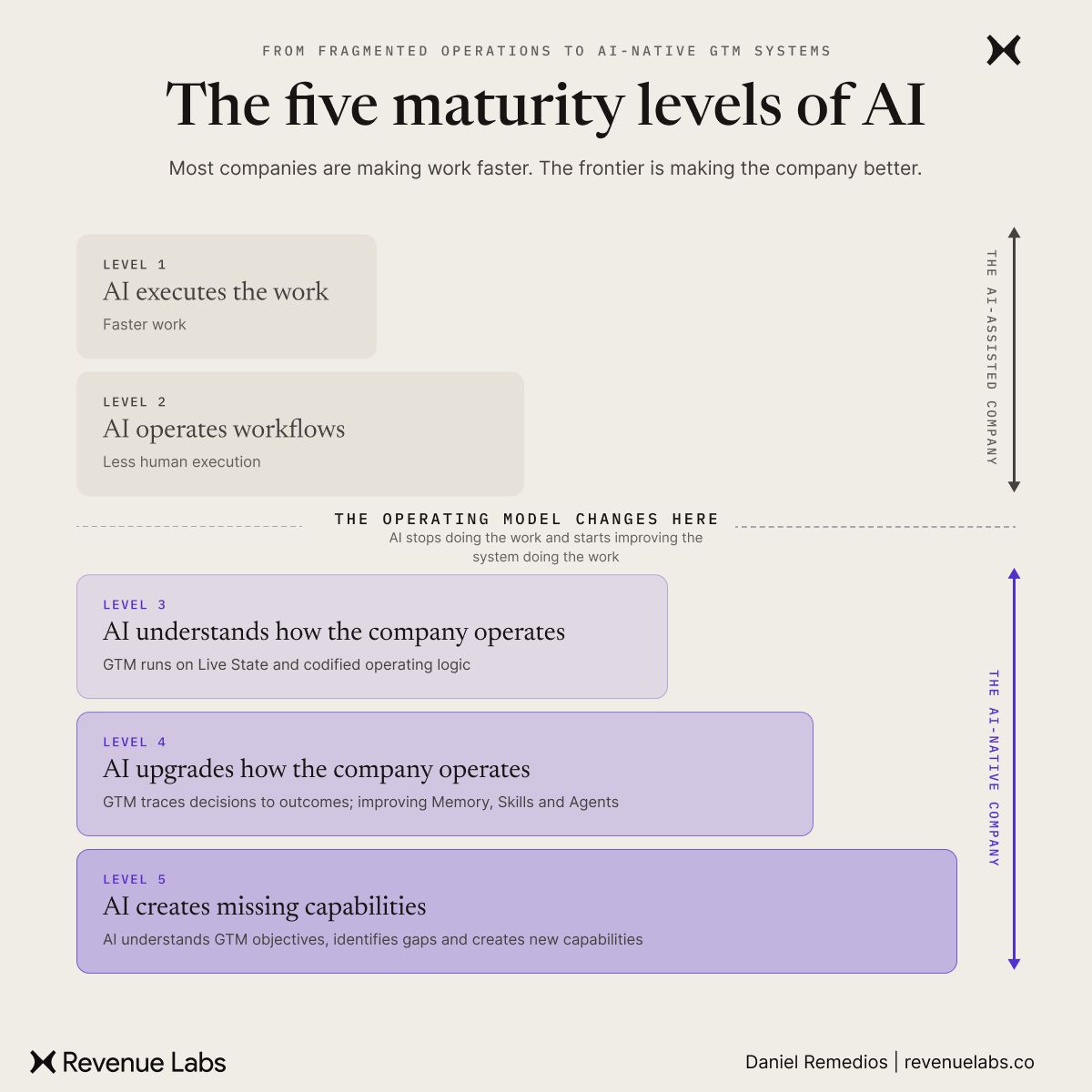
I think we're measuring AI maturity incorrectly. Most of the conversation is about how much work AI can do. → Can it draft the email? → Can it research the account? → Can it update Salesforce? → Can an agent run the entire workflow? Each step removes human execution. But it doesn't necessarily create a more intelligent company. The bigger transition is from AI doing the work to AI improving the system that does the work. For that to happen, the system needs more than Agents. It needs: → a live understanding of the business: prospects, deals, customers, activity and performance → the company's operating logic: ICP, qualification, messaging, processes, judgement and what good looks like → and traces connecting: live state → decision → action → outcome Now the loop changes. An agent executes a capability: → account sourcing → propensity scoring → prospecting → meeting prep → pipeline review → forecasts The system observes the outcome. It can identify whether the problem was missing context, weak logic, a broken Skill or a capability the company doesn't have yet. Memory evolves. Skills version up. Agents improve. Eventually, the system can identify and build entirely new capabilities from what the company is trying to achieve. That's a very different maturity curve. Levels 1-2 are AI-assisted companies. They compound output. Levels 3-5 are AI-native companies. They compound organisational capability. The companies that make the leap will overcome the break point: The shift isn't faster work. It's a new operating model. And they'll run GTM teams and agents on an Operating Layer that gets better as the company operates.
- LINKEDIN · IMAGESince 6 Nov 2026
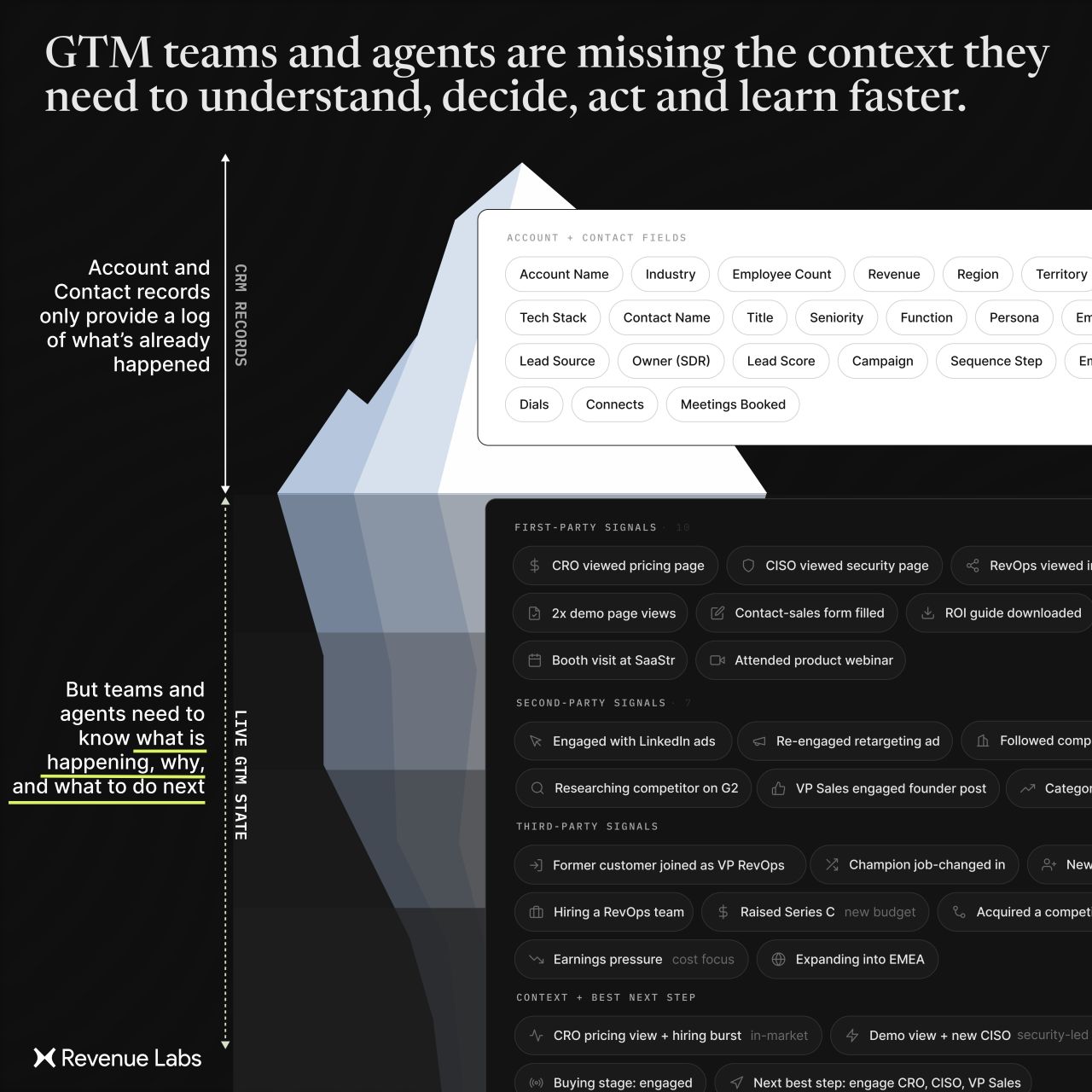
Most GTM teams are not short of data. They're short of context. Here's why that matters 👇 → CRM has the record → marketing automation has the visit → intent tools have the signal → sales engagement has the activity → call recording has the transcript → documents retain the process → SDRs, AEs, CSMs and managers have the reality Every tool has a fragment. But no system holds the live commercial situation. So individuals have to manually rebuild it. → before prospecting → before meetings → before pipeline reviews → before QBRs → before renewals → before management updates That is the hidden tax inside modern GTM. And every company is adding siloed AI and agents into the same fragmented operation. That doesn't create an intelligent GTM system. It creates faster fragmentation. → more summaries → more alerts → more tasks → more sequences → more reports → more documents → more noise And teams and agents can't operate from scattered information. They need context. Context gives teams and agents an understanding of what is really happening, why it matters and what should happen next. 1️⃣ Prospecting It knows when a high-fit account is "in market" based on learned propensity signals. Not just “pricing page viewed.” But pricing page viewed by the CRO, after a new VP RevOps joined, while the company is hiring sales ops, researching a competitor and engaging with relevant content. That changes the action: ❌ add to sequence ✅ engage the right persona with the right message at the right moment 2️⃣ Sales It understands the real state of a deal. Not just “Stage 3, next step booked.” But champion engaged, executive sponsor missing, urgency weakening, procurement not started, competitor mentioned twice and the business case still unquantified. That changes the review: ❌ rep tells the story ✅ the system highlights risk and recommends next best action This is why context is becoming the new primitive in GTM. The old stack was built around records, workflows, dashboards and human interpretation. But that's creating wasted effort, missed opportunities, delayed decision-making and inconsistent performance. AI is driving exponential execution, but the current operating model is struggling to keep up. The emerging AI-native GTM system is built around live state, codified memory, executable skills, agent orchestration and learning. That is the shift. From static records → live commercial state From disconnected tools → shared context From human reconstruction → system understanding From more activity → better judgement From one-off actions → compounding learning Because the next GTM advantage will not come from having more data. It will come from knowing what is happening, why it matters and what to do next faster than everyone else. 📩 Interested in unifying GTM data into a layer of shared context? Get in touch. 🔔 Want more insights from Revenue Labs? Follow along.
- LINKEDIN · IMAGESince 6 Nov 2026
Preparing for a sales meeting has gone from 30 minutes to 30 seconds. The interesting question is whether it’s actually become any better 👇 A few years ago, meeting preparation meant jumping between Salesforce, emails, call recordings, Slack and documents, trying to build a picture of the account before the call. Today, connect Claude (or an AI assistant built into your CRM) and that work happens almost instantly. That’s a genuine step forward. But it does raise a more important question: What is the AI actually reasoning from? Whilst it can summarise the information that’s available, it doesn't continuously understand the commercial situation. For example, it doesn’t inherently know: → what has changed across the opportunity since yesterday → whether confidence in the deal should have increased or decreased over the last week → which signals actually matter for your business → what your organisation has learned from hundreds of similar opportunities → how your best enterprise reps prepare for this type of meeting → whether the recommendation it made last week actually led to a better outcome Those aren’t limitations of Claude. They’re limitations of the operating model we’ve built around AI. We’re still asking people to coordinate everything: → people interpret the signals → people remember what worked → people connect information across systems → people improve the process afterwards That creates delays. It creates inconsistent performance. And every AI interaction becomes another isolated piece of work instead of improving the organisation itself. I think this is the next shift. Commercial organisations need an operating layer that continuously maintains a shared understanding for both teams and AI. Not just what’s stored in isolated tools, but: → what's the live state of every account, opportunity and customer → what the company has learned → how the company sells → how decisions should be made → how every interaction should improve the next one Once that foundation exists, you stop building isolated AI experiences for your sales team. → Meeting Prep → Deal Risk → Pipeline Reviews → Sales Coaching → Forecasting → Account Planning They’re no longer separate workflows. They’re all different capabilities built on the same continuously operating and improving commercial system. Adding AI to sales makes work faster. Building an AI-native Sales System makes your commercial organisation understand, decide and improve better over time. And this can be shared across Marketing, Prospecting and Customer Success. It's the most exciting opportunity in the next era: A new operating layer for AI-native GTM.
- LINKEDIN · IMAGESince 6 Nov 2026
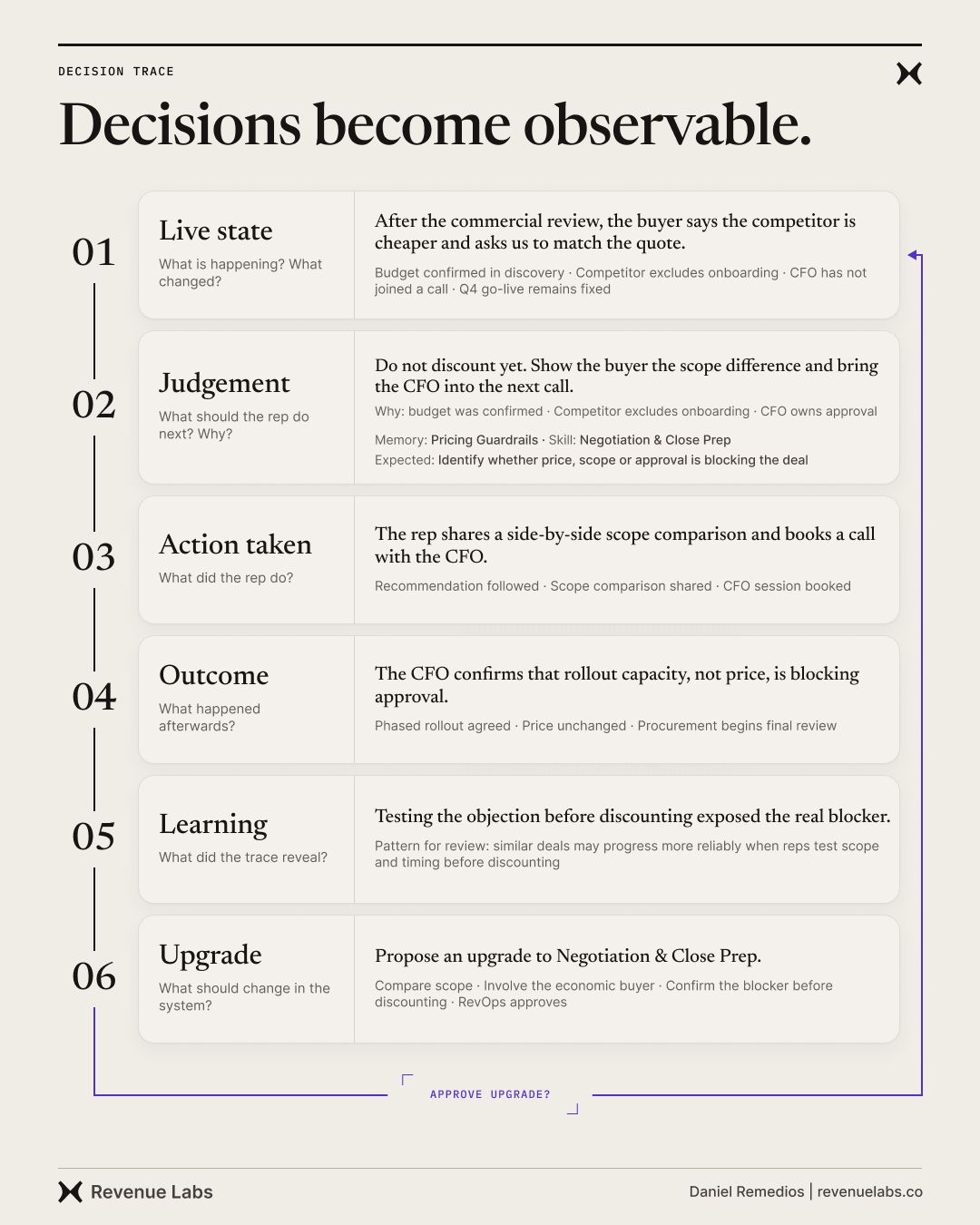
Most GTM organisations make 10,000s of consequential decisions every month. → Which accounts should we pursue? → Is this deal actually at risk? → Should we discount? → When should we intervene with a customer? The strange thing is how little of that judgement becomes an organisational asset. Take a fairly ordinary sales situation. A buyer says a competitor is cheaper and asks you to match the quote. The rep decides what to do. Perhaps they ask their manager or follow the playbook. Eventually they discount, or they don’t. A few weeks later the deal closes, slips or disappears. CRM records the outcome. But the useful part is usually lost: what did we know, why did we make that decision, what did we do, and did it work? So next time, we largely do the work again. Another rep makes another judgement. Another manager inspects another deal. This is where AI-assisted GTM stops too early. We give the rep AI research. The manager an AI deal summary. RevOps an AI dashboard. The work gets faster, but the operating model hasn’t really changed. Humans still interpret the information, decide what matters and apply the judgement. AI-native GTM should work differently. Imagine the system maintains the live State of the deal. It knows budget was confirmed, the competitor excludes onboarding and the economic buyer hasn’t been involved. Rather than immediately discounting, it recommends testing whether price is actually the blocker. The rep does. Rollout capacity turns out to be the real issue, and the deal progresses without the discount. Now the organisation has evidence about whether its judgement worked. Repeat that across thousands of GTM decisions and the system can start to learn: → Which signals identify accounts worth pursuing? → Which deal risks predict slippage? → Which interventions reduce churn? → Which actions create expansion? That learning can change how the next account, deal or customer is handled. This is why Decision Traces are much more important than an AI explainability feature. They create the connection: State → judgement → action → outcome → evaluation → learning → upgrade And that changes the economics. Today we repeatedly pay people to research, inspect, prioritise, diagnose and make many of the same classes of decision. AI-assisted makes those tasks cheaper and faster. AI-native creates the possibility of the system performing more of that work, learning from what happens and improving the next time. The value isn’t only hours removed. It’s better accounts pursued. Fewer unnecessary discounts. Earlier deal intervention. Less missed churn. Better allocation of management attention. And, over time, better judgement. The system doesn’t just help the organisation operate. It gets better because it operated. That’s a very different idea of what AI in GTM is for.

6 of 46+ adsSign up to see every Revenue Labs ad, filter by format and date, and get alerts on new ones.
See all 46+ adsQuestions about Revenue Labs’s ads
Does Revenue Labs have new LinkedIn ads?
Yes. We found 1 new LinkedIn ad for Revenue Labs in the 30 days to 12 Nov 2026.
How many LinkedIn ads has Revenue Labs run?
LinkedIn’s ad library lists 46 ads for Revenue Labs. We recorded 46 LinkedIn ads for Revenue Labs, first recorded on 29 Sept 2026 and last recorded on 11 Nov 2026.
Does Revenue Labs run Google ads?
We recorded no Google ads for the domain revenuelabs.co on 7 Nov 2026.
Which ad formats does Revenue Labs use?
The 6 LinkedIn ads on this page include 6 image ads.
Watch the companies you care about.
Filter every ad by industry, country, format and network, and get alerts when a company you watch starts running new ads.