On air · 1 of 3 networks

Rethink Priorities ads
- rethinkpriorities.org
- Research Services
- 70 employees
Rethink Priorities’s ads on LinkedIn, Meta and Google, recorded by adsrunning. Browse the latest here for free. Sign up free to see all 169. Watch Rethink Priorities on any plan to get each new one in your feed.
Watchlist included in every plan
What Rethink Priorities runs
- Single image · LinkedIn
- 6
- Google ads on 7 Nov 2026
- 10
| Network | Status | Live ads | Nov 2025LinkedIn activity · 52 weeksNov 2026 | Checked | Next step |
|---|---|---|---|---|---|
| None recorded | 0 | Checked 3 Nov 2026 | See all 169 ads → | ||
| Meta | None recorded | 0 | No active ads recorded on the Meta Ad Library | Checked 25 Oct 2026 | Collect them with the API → |
| Running | 10 | Ads on the Google Ads Transparency Center | Checked 7 Nov 2026 | Collect them with the API → |
Rethink Priorities has no live LinkedIn ads. Its Facebook page had no active ads on 25 Oct 2026, and we recorded 10 Google ads on 7 Nov 2026.
Latest ads
- LINKEDIN · IMAGESince 21 Oct 2026
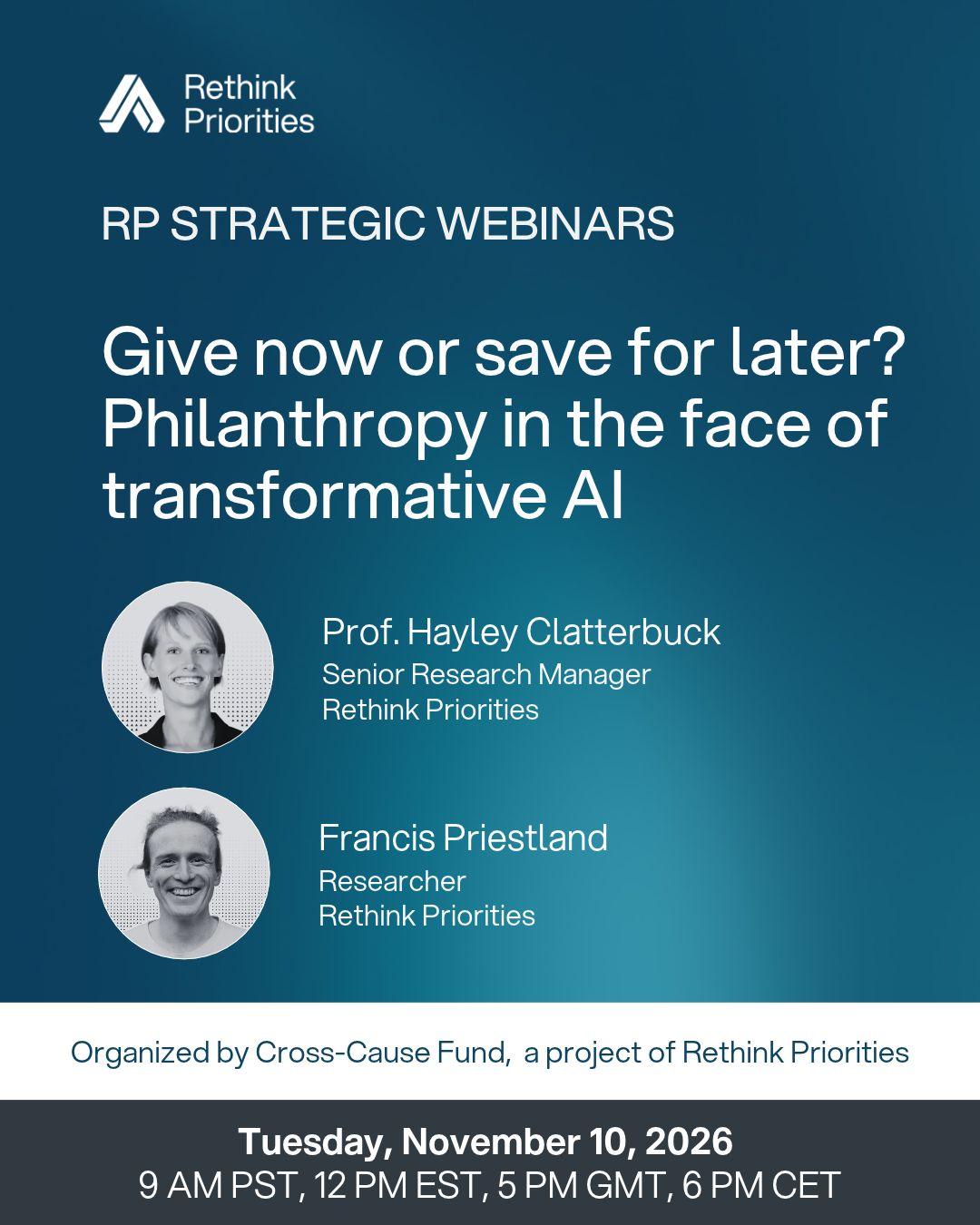
How confident should you be that giving later beats giving now? A growing number of donors, many at the frontier of AI, expect their wealth to grow sharply and have absorbed an argument that says: hold almost everything. If transformative AI arrives, capital will compound faster than problems do, and philanthropy will be far more cost-effective on the other side. When an argument points toward doing nothing for now, it deserves extra scrutiny. At RP, we’re hosting a webinar on how to time your philanthropy under deep uncertainty about how powerful AI will unfold, for donors planning their giving season, philanthropic advisors, and anyone weighing give now vs. hold off. Prof. Hayley Clatterbuck (Senior Research Manager on our Worldview Investigations team, visiting Professor of Philosophy at UCLA) and Francis Priestland (researcher, economics and computer science) will cover: - the assumptions behind the “save for later” case - the underappreciated risks of holding philanthropic wealth through a turbulent transition - whether giving opportunities get cheaper or pricier across cause areas once powerful AI arrives - how to build a giving strategy that holds up whichever way the future unfolds Format: 20–30 minute talk, then up to 30 minutes of Q&A. Bring your questions. When: November 10, 9 AM PT / 12 PM ET / 5 PM GMT Register: https://lnkd.in/g2gSxxHX
- LINKEDIN · IMAGESince 1 Apr 2026
How can frontier AI make the biggest difference in global health? It's a question funders are asking, and one we built a framework to help answer. Frontier AI has real potential to transform global health outcomes, but only if funding goes to the right places. We reviewed 258 organizations to find out where that could be. Our research indicated that genuine frontier applications (LLMs, generative AI, multimodal models) are concentrated in wealthy countries, and the areas with the strongest evidence are often the most underfunded. Based on our cost-effectiveness modelling, here's what matters most for grantmaking decisions in this area: 1️⃣ Geographic focus LMIC-focused interventions consistently outperform high-income-country deployments, driven by higher disease burdens and larger access gaps. 2️⃣ Scale Proposals that use AI to expand access or increase service volume are more promising than those focused on accuracy improvements alone. Diagnostic tools generated value by getting more people screened, not by marginally better detection. 3️⃣ System readiness Impact depends on whether downstream systems can act on what the AI detects or recommends. Better outbreak detection doesn't help if public health response capacity doesn't follow. 4️⃣ Commercial non-viability The areas with the strongest cost-effectiveness case — surveillance and frontline clinical decision support — are precisely the areas with the weakest commercial incentives. Diagnostic AI, by contrast, already attracts significant private investment. We developed these findings to help funders apply a rigorous, evidence-based lens to a space that's full of bold claims but short on frameworks for comparison. Click the link below for the full report, or to get in touch — we'd love to talk through what this means for your work.
- LINKEDIN · IMAGESince 1 Apr 2026
Not all "AI-powered" global health programs actually use frontier AI. We analyzed 258 organizations deploying AI in global health. Nearly 40% advertised AI capabilities appeared to rely on basic machine learning tools that have existed for decades. For foundations evaluating such programs, this is a genuine due diligence gap. Here are the main things our cost-effectiveness modeling suggests funders should consider: 1️⃣ LMIC deployments consistently outperform Higher disease burdens, larger access gaps, and lower treatment costs mean the same investment goes further. 2️⃣ Prioritize throughput over accuracy AI tools that expand access to screening and diagnosis drove more health impact than those marginally improving detection rates. 3️⃣ Check what's really constraining the system An AI tool that frees up clinician time only improves access if clinician time is the real bottleneck and not budgets, infrastructure, or demand. 4️⃣ Follow the funding gaps, not the hype Disease surveillance and frontline decision support have the strongest cost-effectiveness case but the weakest commercial incentives — that's where donor capital is most impactful. Click the link below for the full report. If you wish, you can also talk with our team about how it applies to your work.
- LINKEDIN · IMAGESince 5 Mar 2026
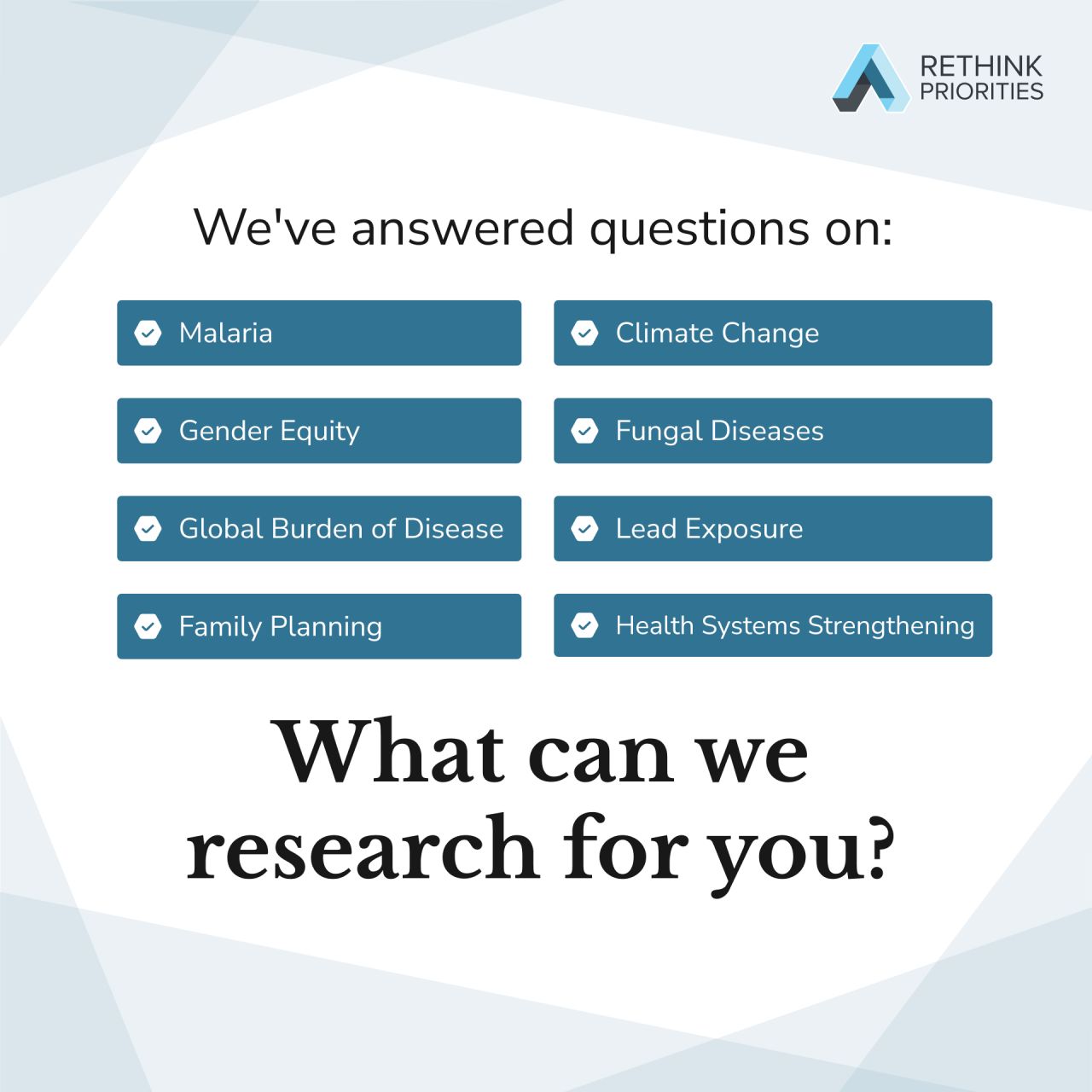
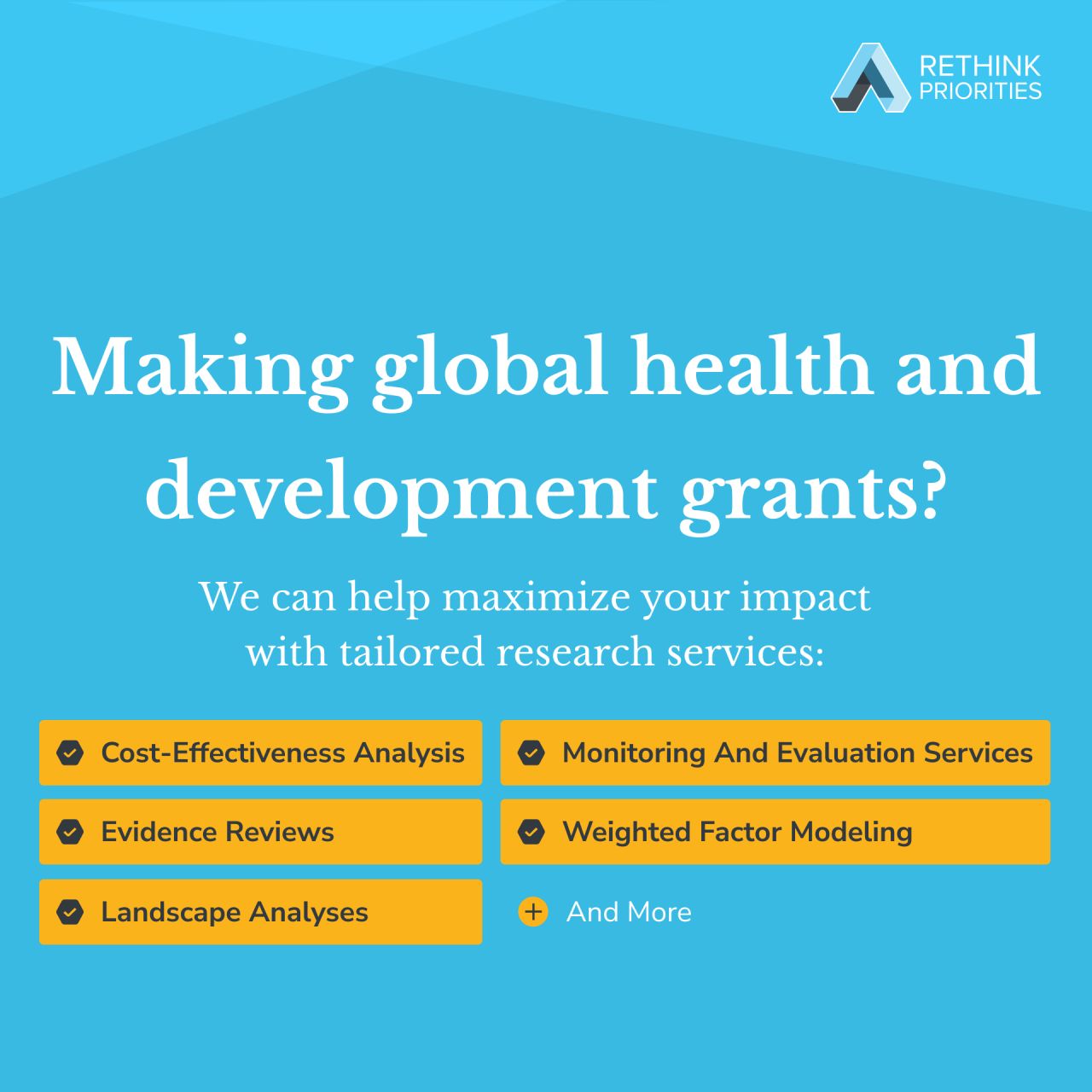
Your foundation faces complex questions about where to direct limited resources for maximum impact. The right research partner can make a difference. Rethink Priorities delivers fast, tailored research to help foundations identify cost-effective interventions, uncover emerging global health opportunities ripe for investment, and assess their grantmaking strategies. Our reports present topline recommendations, but also the underlying evidence, our analytical approach, and key uncertainties, so you can see exactly how we arrive at our conclusions. As a nonprofit, we’re simply looking to surface the highest impact opportunities, without competing motivations. Impact is our north star. Our Global Health and Development team supports a variety of global health organizations, from established foundations like the Gates Foundation and Coefficient Giving to emerging funders—always with the same goal: maximizing lives improved per dollar granted. Our services include: • Cost-effectiveness analyses • Evidence reviews and landscape analyses • Monitoring and evaluation • Weighted factor modeling Recent work: • Landscape analysis of AI opportunities to improve health outcomes • Reliability assessments of IHME Global Burden of Disease estimates • Cost-effectiveness analyses and impact modeling for family planning, education, and credit access interventions • Assessment of current and future health burdens of fungal diseases • Evaluation of health systems strengthening as a philanthropic cause area • Weighted factor modeling to create a landscape of vaccine preventable deaths Our researchers work closely with clients to ensure our analysis directly addresses your strategic questions. We customize project scopes, deliverables, and timelines to meet your needs. Want to explore how our research can advance your foundation's goals? Please inquire below and we’ll be in touch.
- LINKEDIN · IMAGESince 5 Mar 2026
How much more impactful could your next grant be? Rethink Priorities helps foundations identify highly neglected, cost-effective interventions through rigorous, tailored research. We support major global health organizations such as the Gates Foundation, Coefficient Giving, and others, exploring topics ranging from malaria and fungal diseases to health systems strengthening and economic empowerment. Our services include: • Cost-effectiveness analyses • Evidence reviews and landscape analyses • Monitoring and evaluation • Weighted factor modelings As a nonprofit, we have no competing motivations—just a focus on surfacing the highest-impact opportunities for your dollars. Wondering if this could strengthen your grantmaking? Please inquire below and we’ll be in touch.
- LINKEDIN · IMAGESince 28 Oct 2025
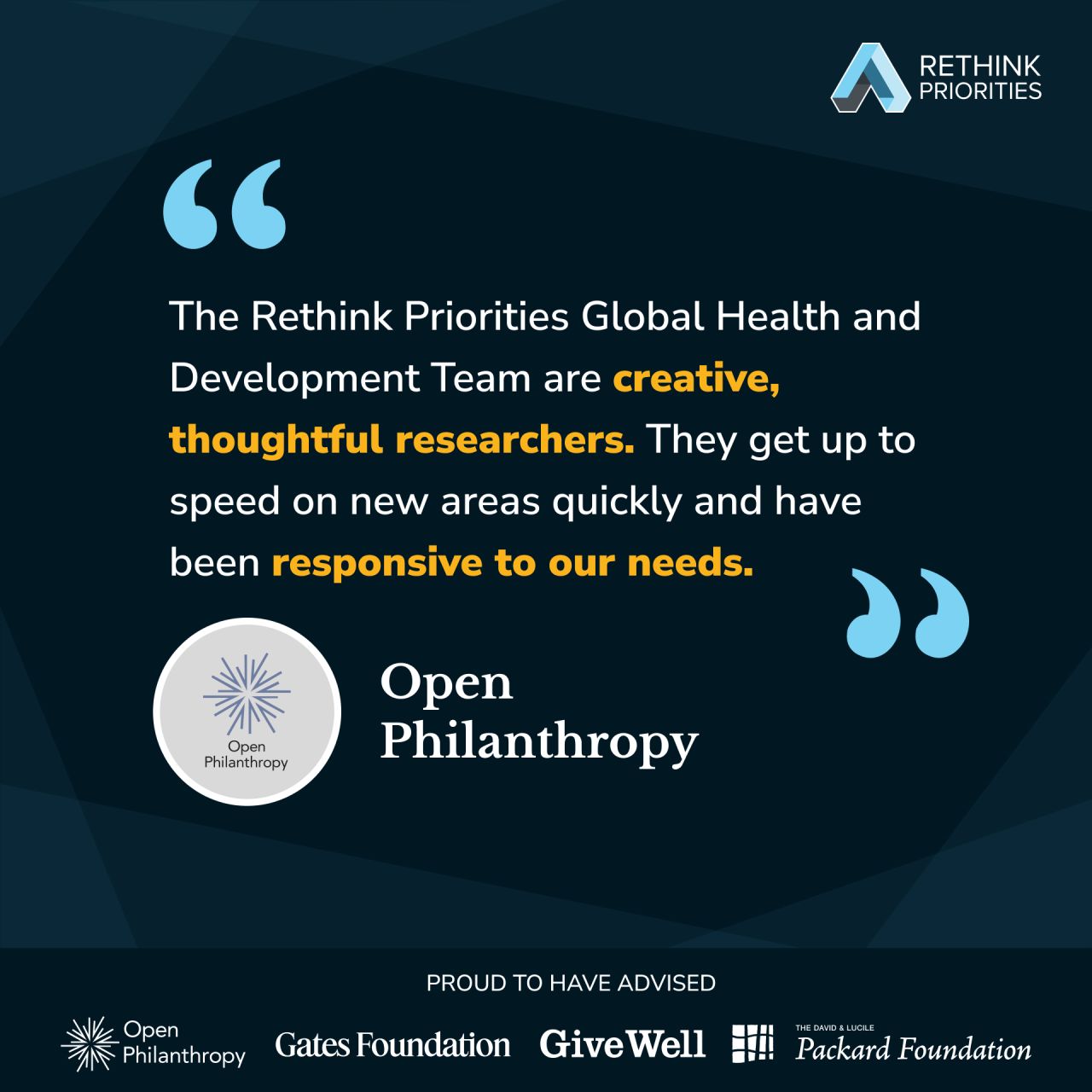
Your foundation needs answers quickly to make timely funding decisions. Waiting months for research isn't always an option. Rethink Priorities delivers rigorous research faster than traditional academic timelines, without sacrificing quality. Our Global Health and Development team conducted research for 19 clients last year, helping funders like Open Philanthropy and GiveWell identify cost-effective interventions when they need them. Our approach combines: • Rapid evidence synthesis with full reasoning transparency • Direct access to researchers throughout the process • Clear, actionable recommendations backed by data • Flexible timelines aligned with your grant cycles Book a consultation to discuss how our nimble research team can support your upcoming funding decisions.
6 of 169 adsSign up to see every Rethink Priorities ad, filter by format and date, and get alerts on new ones.
See all 169 adsQuestions about Rethink Priorities’s ads
Is Rethink Priorities running LinkedIn ads?
We recorded no live LinkedIn ads for Rethink Priorities on 8 Nov 2026.
How many LinkedIn ads has Rethink Priorities run?
LinkedIn’s ad library lists 169 ads for Rethink Priorities. We recorded 169 LinkedIn ads for Rethink Priorities, first recorded on 29 Sept 2026 and last recorded on 24 Oct 2026.
Does Rethink Priorities advertise on Facebook and Instagram?
Rethink Priorities’s Facebook page had no active ads in Meta’s Ad Library, last recorded on 25 Oct 2026.
Does Rethink Priorities run Google ads?
Yes. We recorded 10 Google ads for the domain rethinkpriorities.org on 7 Nov 2026.
Which ad formats does Rethink Priorities use?
The 6 LinkedIn ads on this page include 6 image ads.
Watch the companies you care about.
Filter every ad by industry, country, format and network, and get alerts when a company you watch starts running new ads.