0 new LinkedIn ads in 30 days · 2 of 3 networks checked

Rapt.AI ads
- rapt.ai
- Software Development
- US
- 18 employees
Rapt.AI’s ads on LinkedIn, Meta and Google, recorded by adsrunning. Browse the latest here for free. Sign up free to browse our full recording. Watch Rapt.AI on any plan to get each new one in your feed.
Watchlist included in every plan
What Rapt.AI runs
- Single image · LinkedIn
- 6
| Network | Status | Last 30 days | Total ads found | Ad activity | Checked | Next step |
|---|---|---|---|---|---|---|
| None recorded | 0 | 39+ | Checked 11 Nov 2026 | View ads → | ||
| Meta | Not checked | — | — | View ads → | ||
| None recorded | — | 0 | Checked 7 Nov 2026 | View ads → |
Rapt.AI has no new LinkedIn ads in the last 30 days. We recorded no Google ads on 7 Nov 2026.
Latest ads
- LINKEDIN · IMAGERecorded 29 Sept 2026
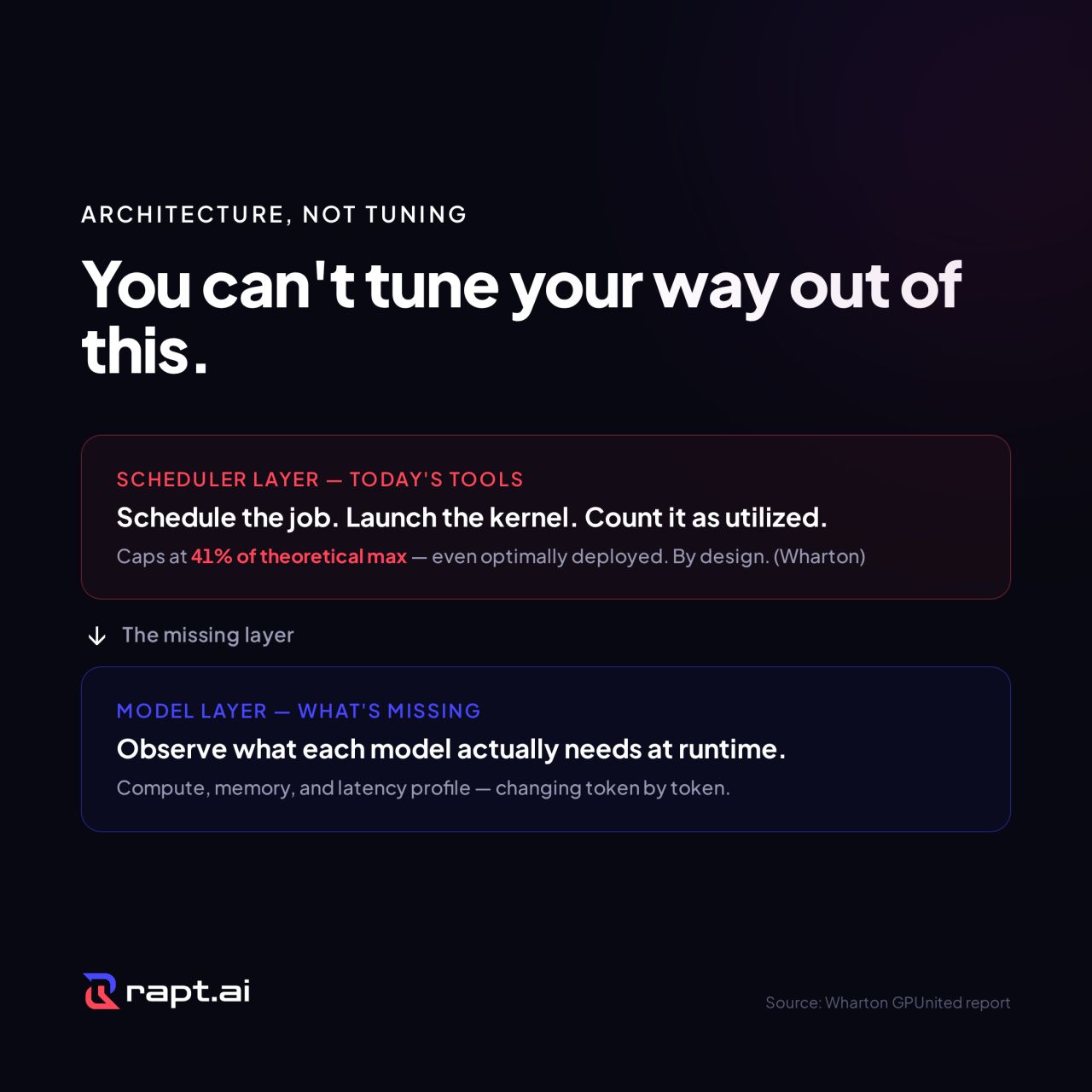
The most expensive misconception in AI infrastructure: that GPU underutilization is a tuning problem. It isn't. Wharton found that existing autoscalers — even deployed optimally — hit only 41% of theoretical maximum GPU efficiency. That means the best-case ceiling for the tools your team already has is 41%. By design, not by misconfiguration. Here's why. Every existing tool operates at the scheduler layer: → Schedule the job. → Launch the kernel. → Count it as utilized. A scheduler can place a job. It cannot observe what the model actually needs at runtime — its compute profile, memory footprint, and latency characteristics at this exact moment, changing token by token. That observation has to happen at the model layer. It's a different category of software, and it's the missing layer between the unpredictability of models and the rigidity of GPUs. You can't tune your way to good token economics with a scheduler. You need the layer that sits above it. https://lnkd.in/eAH3hBZH
- LINKEDIN · IMAGERecorded 29 Sept 2026
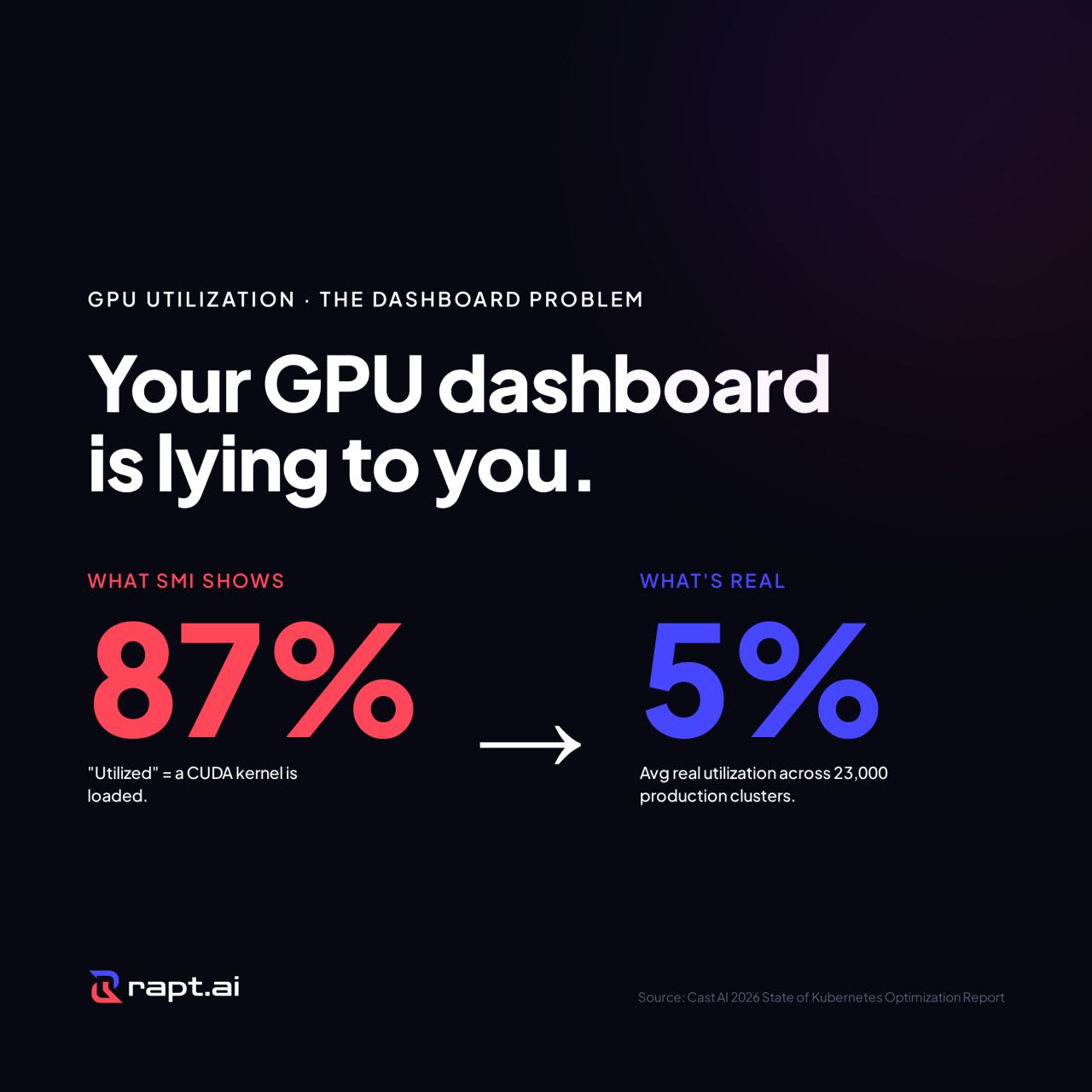
Your GPU dashboard is lying to you. Your SMI says you're at 87% utilization. The team feels good. The last hardware expansion got approved on the strength of that number. Then someone measures what's actually happening — the fraction of time the GPU is doing useful inference work versus waiting, stalling, or sitting in prefill purgatory — and the real number comes back at 18%. Sometimes 11%. This isn't a one-off. Cast AI analyzed 23,000 production Kubernetes clusters and found 5% average GPU utilization. 95% idle, billing at 100%. SMI measures whether a CUDA kernel is loaded. It does not measure whether that kernel is earning its keep. Those are very different questions — and the gap between them is where your budget goes to die. There's a better unit of measurement. Jensen Huang named it at GTC: Token Economics. Cost per token, tokens per watt, tokens per SLA. It's the first metric that tells you whether your AI infrastructure is actually producing value. Link in comments. What's your real number?
- LINKEDIN · IMAGERecorded 29 Sept 2026
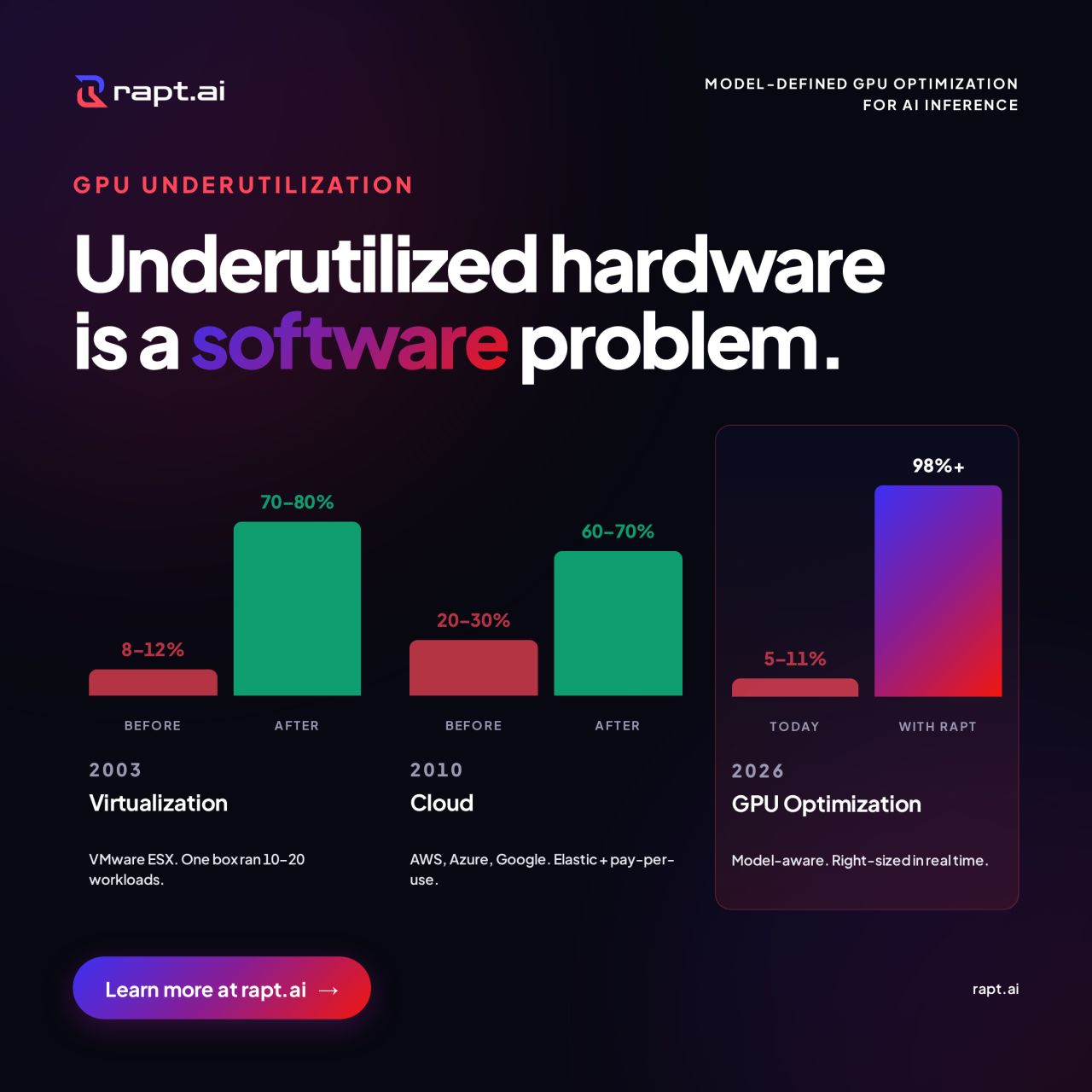
We've watched this movie twice. 2003. Enterprise servers ran at 8–12% utilization. Hardware was expensive. Teams were talented. Dashboards looked healthy. Then VMware shipped ESX. Virtualization. One physical box ran 10–20 workloads. Utilization climbed to 70–80%. The same infrastructure did 10× the work. 2010. On-premise compute ran at 20–30%. AWS, Google, and Azure added the elastic abstraction layer. Pay-per-use. Utilization climbed. The CFO approved the migration. 2026. GPU infrastructure runs at 5–11% utilization in production. Cast AI verified it across 23,000 Kubernetes clusters. xAI runs 550,000 GPUs at 11%. Wharton put $74 billion per year on the industry-wide cost. The lesson from 2003 and 2010 was never "build better servers." It was "add the software layer that understands the workload." For GPUs, that layer is model-aware. It observes what each model actually needs at runtime — compute, memory, KV cache, queue depth — and right-sizes the allocation in real time. That is what Rapt.AI does. The third act of this movie is already in production. Learn more through the link in comments. Sources: · Cast AI 2026 State of Kubernetes Optimization Report · The Information / wccftech: xAI 11% across 550,000 GPUs · Wharton GPUnited Final Report, 2025 #GPUOptimization #AIInfrastructure #TokenEconomics #Virtualization #Cloud
- LINKEDIN · IMAGERecorded 29 Sept 2026
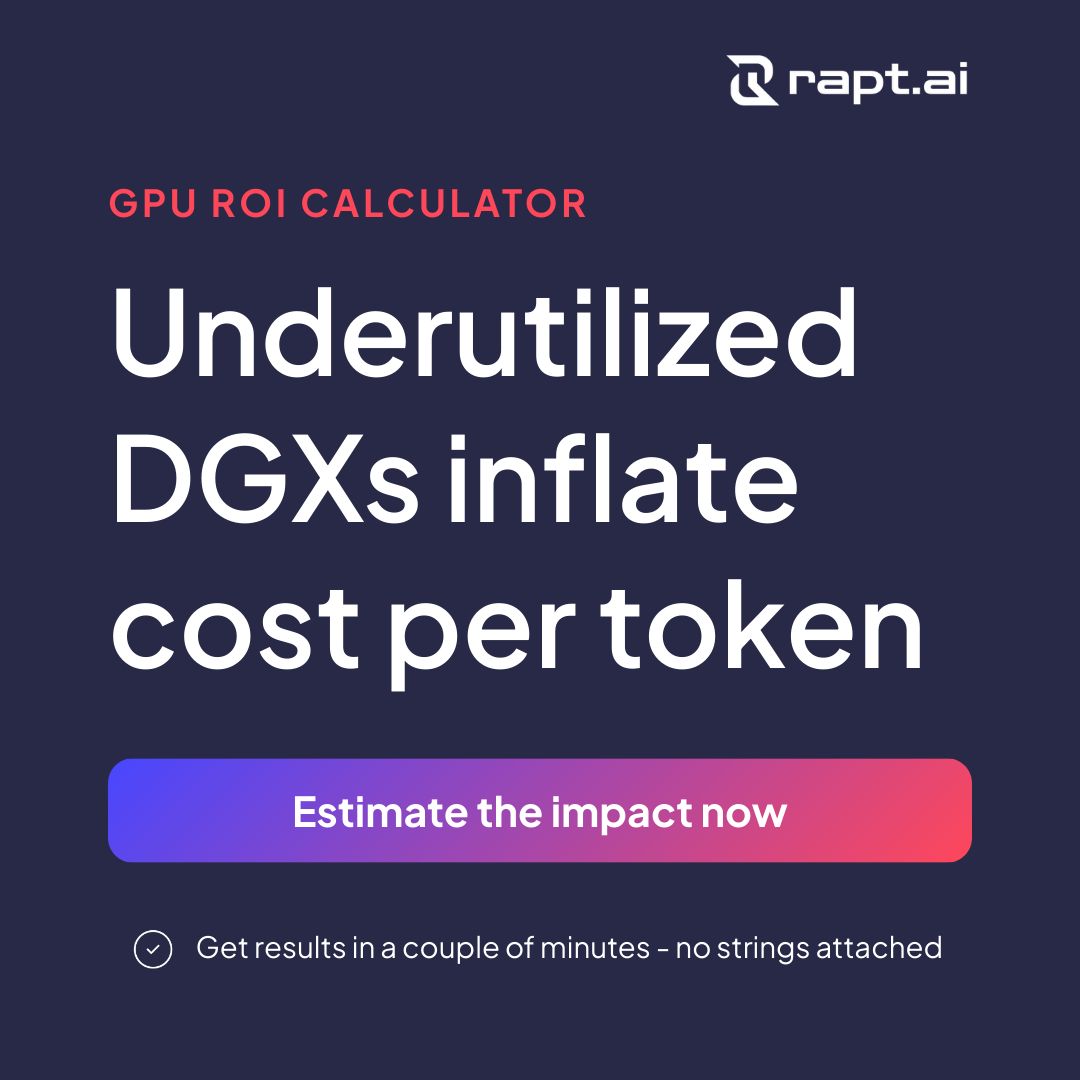
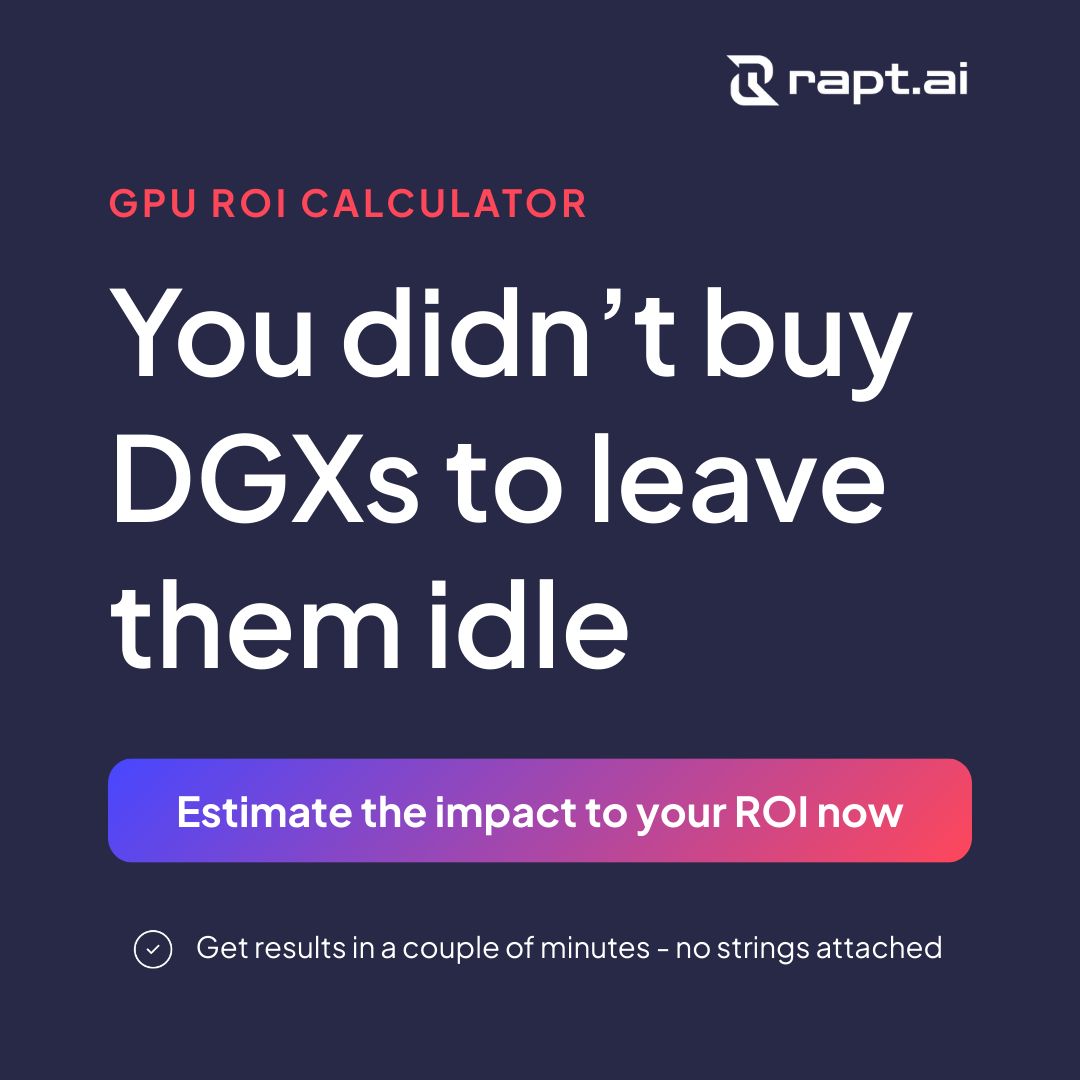
When GPUs sit idle between workloads, your cost per token quietly rises. More hardware won’t fix that. Utilization will. Model the cost of underutilized DGX capacity in minutes.
- LINKEDIN · IMAGERecorded 29 Sept 2026
DGXs are built for throughput. If they aren’t fully utilized, your AI economics won't scale the way you think they will. Pressure-test your GPU utilization assumptions in 2 minutes.
- LINKEDIN · IMAGERecorded 29 Sept 2026
AI infrastructure is under scrutiny everywhere. If someone asked today: “What’s our DGX utilization rate? And what does it mean financially?” Would you have the answer? Get it in 2 minutes.

6 of 39+ adsSign up to see every Rapt.AI ad, filter by format and date, and get alerts on new ones.
See all 39+ adsQuestions about Rapt.AI’s ads
Does Rapt.AI have new LinkedIn ads?
We found no new LinkedIn ads for Rapt.AI in the 30 days to 11 Nov 2026.
How many LinkedIn ads has Rapt.AI run?
LinkedIn’s ad library lists 39 ads for Rapt.AI. We recorded 36 LinkedIn ads for Rapt.AI, first recorded on 29 Sept 2026 and last recorded on 29 Sept 2026.
Does Rapt.AI run Google ads?
We recorded no Google ads for the domain rapt.ai on 7 Nov 2026.
Which ad formats does Rapt.AI use?
The 6 LinkedIn ads on this page include 6 image ads.
Watch the companies you care about.
Filter every ad by industry, country, format and network, and get alerts when a company you watch starts running new ads.