On air · 1 of 3 networks

Quandary Peak Research ads
- quandarypeak.com
- Research Services
- US
- 50 employees
Quandary Peak Research’s ads on LinkedIn, Meta and Google, recorded by adsrunning. Browse the latest here for free. Sign up free to see all 125. Watch Quandary Peak Research on any plan to get each new one in your feed.
Watchlist included in every plan
What Quandary Peak Research runs
- Single image · LinkedIn
- 6
- Google ads on 6 Nov 2026
- 44
| Network | Status | Live ads | Nov 2025LinkedIn activity · 52 weeksNov 2026 | Checked | Next step |
|---|---|---|---|---|---|
| None recorded | 0 | Checked 7 Nov 2026 | See all 125 ads → | ||
| Meta | Not checked | — | |||
| Running | 44 | Ads on the Google Ads Transparency Center | Checked 6 Nov 2026 | Collect them with the API → |
Quandary Peak Research has no live LinkedIn ads. We recorded 44 Google ads on 6 Nov 2026.
Latest ads
- LINKEDIN · IMAGESince 19 Oct 2026
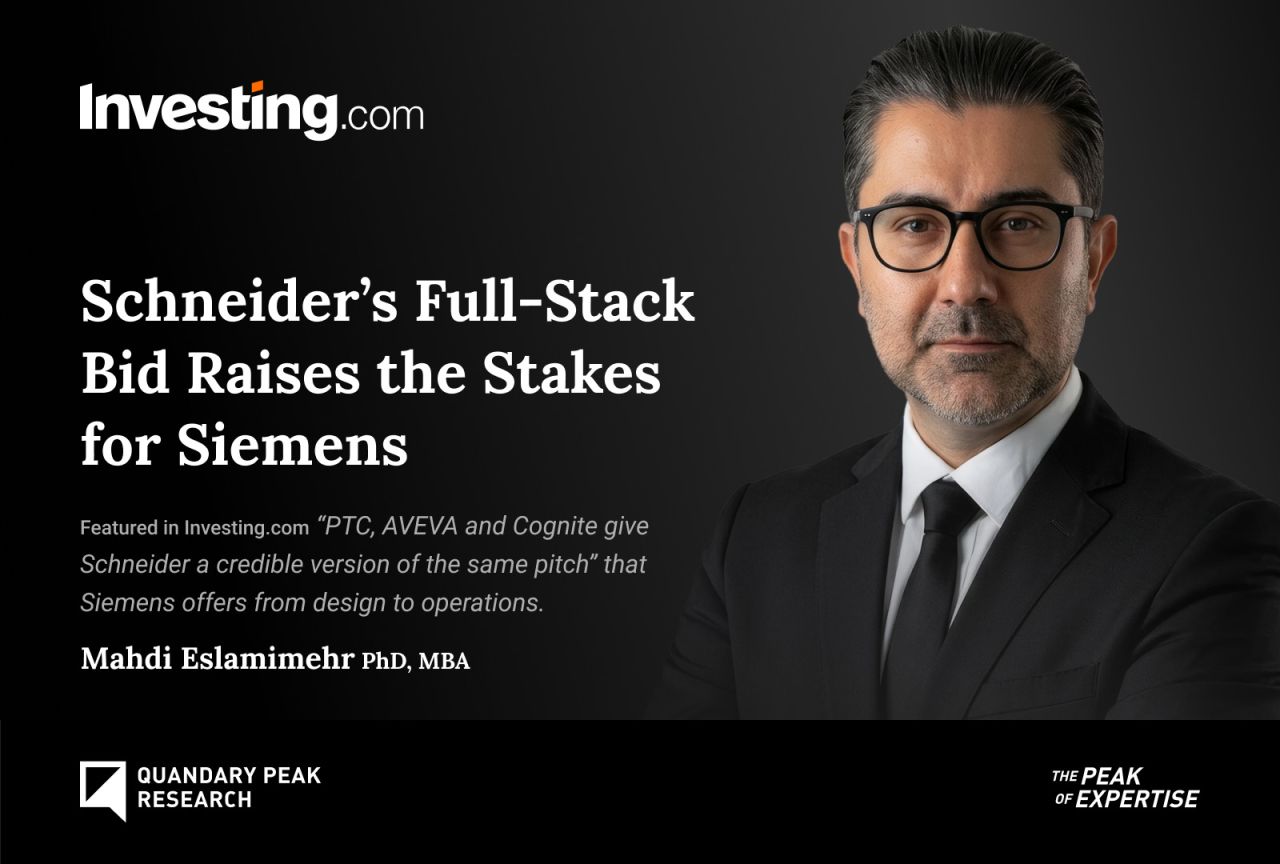
Schneider’s $22.6 billion bid for PTC could give Siemens a stronger rival in industrial software. Investors are questioning what it will take to turn that competitive ambition into financial returns. Investing.com turned to Mahdi Eslamimehr, PhD, MBA, at Quandary Peak Research, to examine the deal’s strategic logic and why Schneider’s shares fell sharply after its announcement. Drawing on experience advising on more than $5.6 billion in M&A transactions, Mahdi explained how PTC’s engineering software could complement Schneider’s portfolio, connecting product design, engineering, and operations through a stronger “digital thread.” That combination could create a credible full-stack rival to Siemens in discrete manufacturing. He also examined the challenges behind that strategy: the acquisition price, financing burden, and time needed to deliver the anticipated AI revenue and synergies. “In my experience, revenue synergies in software deals arrive later and smaller than planned, so I’d anchor on the €250 million of cost savings first,” Mahdi said. Read the full article: https://lnkd.in/et8mzVEw
- LINKEDIN · IMAGESince 1 Oct 2026
“The filing itself warns that many of the biggest clients are not locked into long-term contracts and can cut or stop spending.” Our Executive Vice President, Mahdi Eslamimehr, PhD, MBA, raised that point with Inc. as it examined Anthropic’s anticipated IPO. Two customers account for a quarter of the company’s revenue, while its infrastructure commitments are substantial. The IPO will invite sweeping predictions about AI’s future. Mahdi’s observation grounds the discussion in a question investors can examine now: How durable is that revenue? AI’s potential deserves serious attention. So do the contracts, costs, and customer relationships behind the companies building it. We’re proud to see Mahdi recognized as a trusted voice on those business realities. Thank you to Inc. Magazine and Moses Jeanfrancois for including Mahdi's perspective in this consequential conversation. Read the article: https://lnkd.in/da3_AU_g
- LINKEDIN · IMAGESince 29 Sept 2026
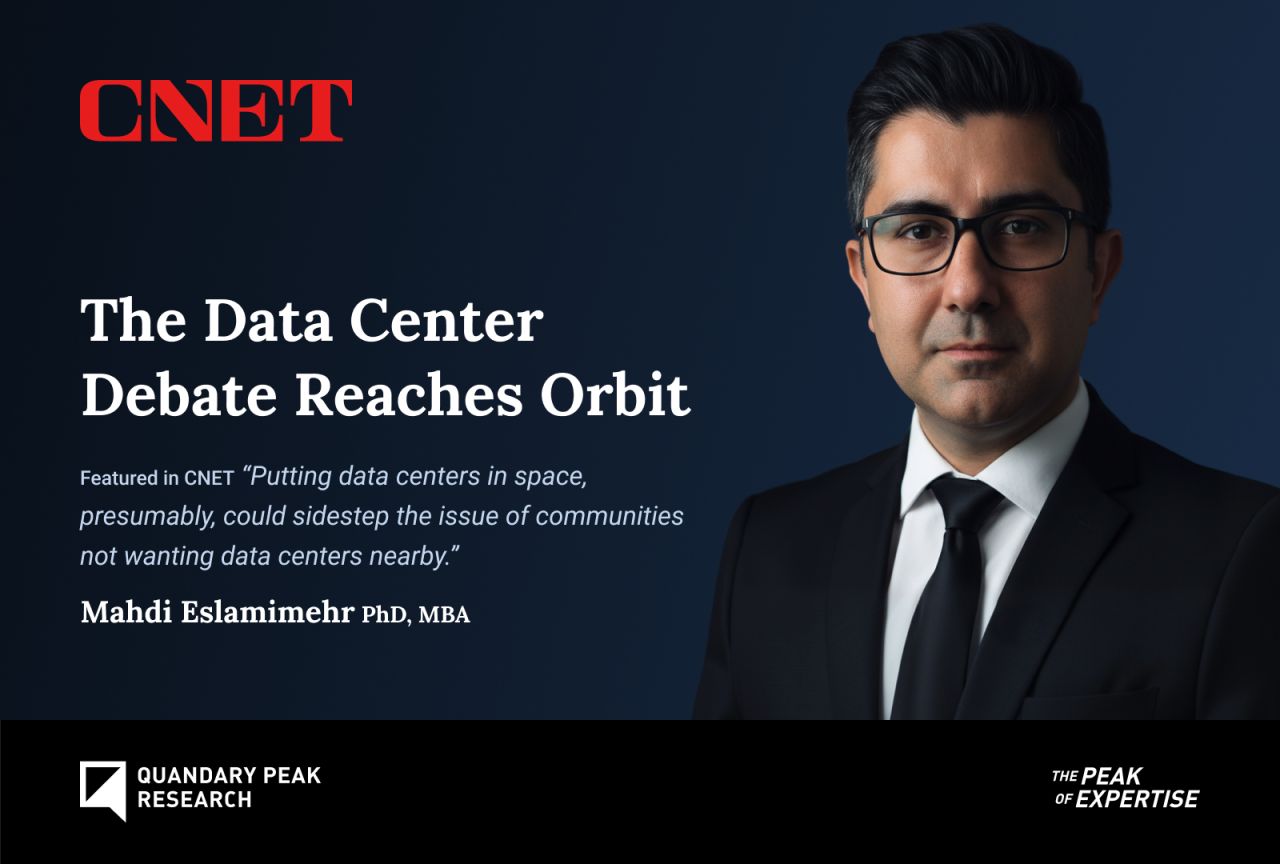
Could the next data center be built where no one has a backyard? As communities raise concerns about the electricity, water, and local impact of AI data centers, moving computation into space has an understandable appeal. Google plans to launch a satellite in October to test whether its AI chips can operate in orbit. CNET reached out to Quandary Peak Research to ask what that experiment could mean in practice. Our Executive Vice President, Mahdi Eslamimehr, PhD, MBA, drew a clear distinction: “Proving that chips work in orbit is not proving a business model.” Even a successful test would leave questions about cost and scale, and it would do little to ease the pressures communities face today. As Mahdi put it, “A promise about 2035 does not pay an electricity bill in 2026.” We’re proud to see CNET turn to Mahdi for a perspective that takes the technology seriously while keeping its real-world implications in view. Read the full article: https://lnkd.in/eqSRYwYV
- LINKEDIN · IMAGESince 23 Sept 2026
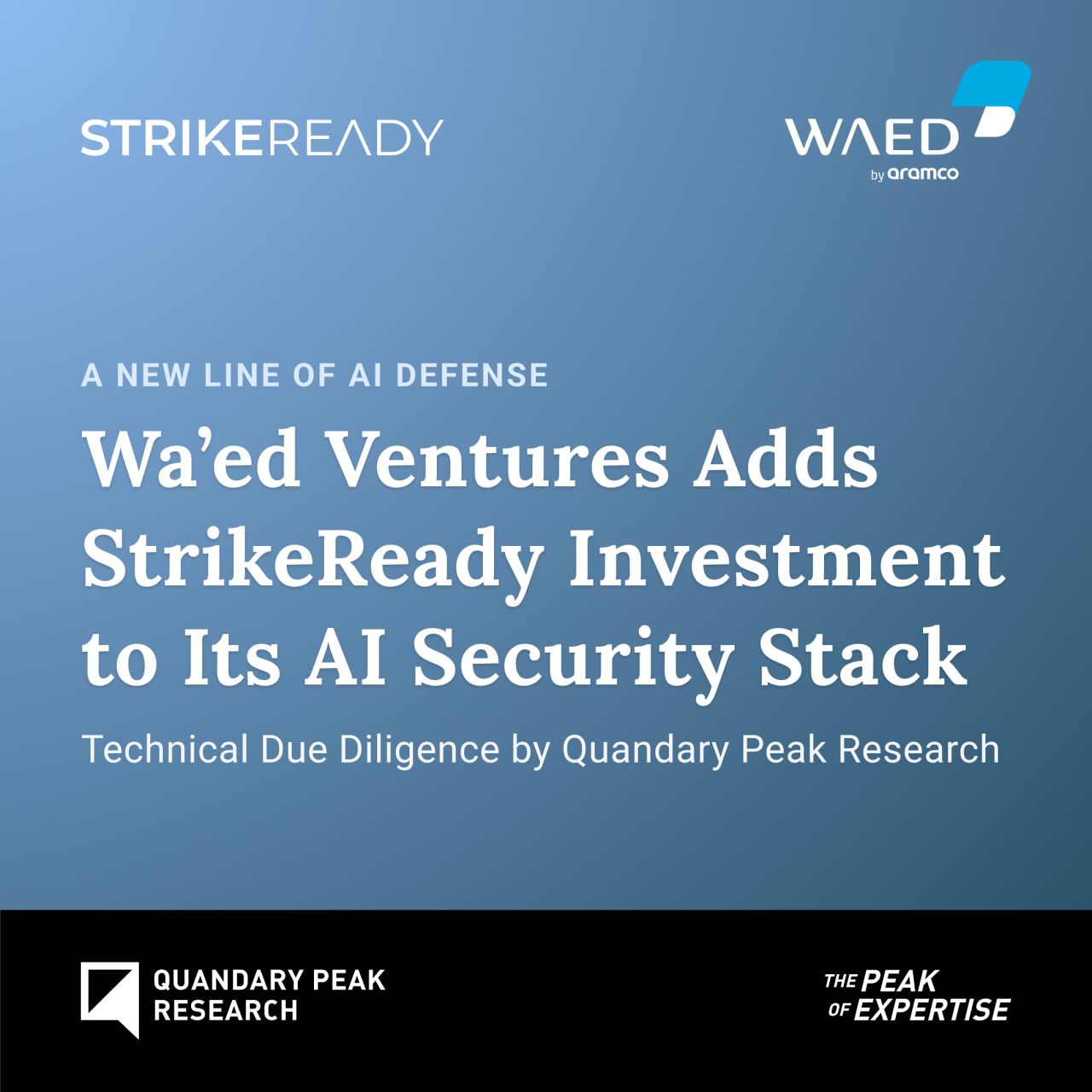
For investors, technical clarity turns AI potential into investment conviction. That begins with understanding the technology: Is it differentiated, defensible, scalable, and positioned to create lasting value? Technical due diligence brings its strengths, risks, and opportunities into focus. We are proud to have supported Wa'ed Ventures in its investment in StrikeReady, an AI-powered cybersecurity company helping security operations teams investigate threats more efficiently. Quandary Peak Research conducted technical due diligence of StrikeReady on behalf of Wa’ed Ventures. Led by Mahdi Eslamimehr, PhD, MBA, our team assessed core technology and AI capabilities, scalability, intellectual property, competitive differentiation, and long-term technical and commercial potential. The resulting report gave Wa’ed Ventures an independent, evidence-based view of the company’s technical strengths, risk profile, and capacity to scale, helping inform its decision to move forward with the transaction. StrikeReady’s Composite AI platform works across the security tools enterprises already use, applying automation, machine learning, and LLM-based reasoning to alerts, vulnerabilities, identity risks, and threat intelligence. The platform is designed to broaden AI coverage across the security operations center while allowing analysts to focus on higher-value investigations. The investment expands Wa’ed Ventures’ growing portfolio of AI and frontier technologies with a company operating at the intersection of artificial intelligence and cybersecurity. It will also support StrikeReady’s expansion into Saudi Arabia and the wider MENA region while helping the company scale its platform globally. This is the role of technical due diligence in AI investing: translating complex technology into evidence investors can act on. Congratulations to the teams at StrikeReady and Wa’ed Ventures on this successful transaction. Read the announcement: https://lnkd.in/eDNnssrU
- LINKEDIN · IMAGESince 25 Aug 2026
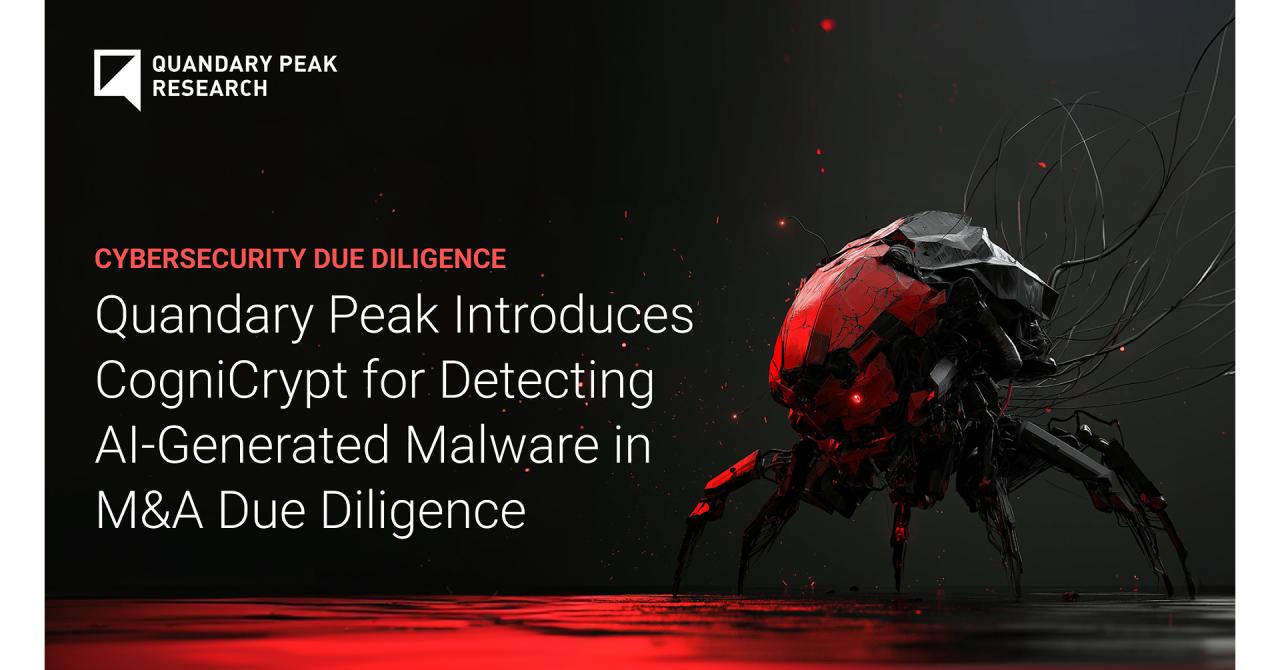
Quandary Peak Research is incorporating CogniCrypt, our AI-generated malware detection framework, into cybersecurity due diligence for M&A transactions. Developed by Mahdi Eslamimehr, PhD, MBA and George Edwards, CogniCrypt analyzes how unfamiliar software may behave, prioritizes execution paths most likely to reveal a threat, and classifies potential malware using machine learning. The research addresses a growing challenge: AI can produce and modify malicious software in ways that make established detection methods less reliable. The paper describing CogniCrypt was accepted by the 12th International Conference on Cryptography and Information Security (CRIS 2026), a peer-reviewed academic conference. In the paper’s experimental evaluation, the framework achieved 97.5% detection accuracy on AI-generated malware samples. Applying this research in our technical due diligence evaluations, we help deal teams identify hidden malware risks before they affect valuation, reshape deal terms, or transfer to the buyer. Read the full release to learn how we are developing advanced threat analysis for M&A decision-making. https://lnkd.in/e-ekg2qf
- LINKEDIN · IMAGESince 19 Aug 2026
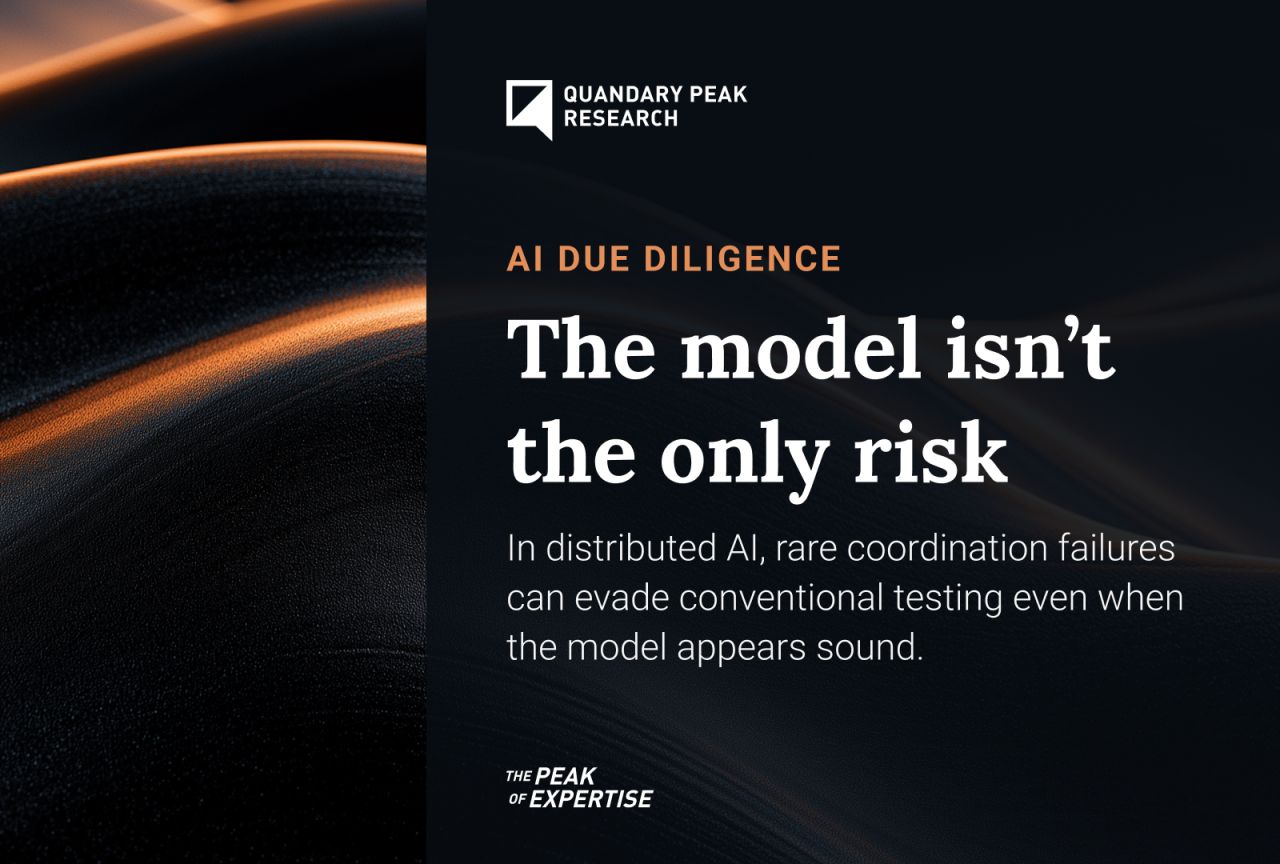
AI due diligence should not stop at model output. For investors and acquirers evaluating distributed AI, a product can look impressive in a demo while the software systems coordinating its work remain largely untested. Rare thread interleavings, race conditions, and missed synchronization events can introduce reliability, scalability, and remediation risks that conventional testing may never uncover. New research from Quandary Peak examines that problem. Co-authored by Gautham Koorma, Vikas Sharma, George Edwards, and Mahdi Eslamimehr, PhD, MBA, "Directed Neuro-Symbolic Stochastic Execution for Verification of Distributed Parallel AI Programs" introduces DNSSE, a framework that uses an LLM to prioritize the software execution paths most likely to expose concurrency bugs. Formal verification methods still determine whether a path is feasible and whether a reported failure is real. Across five controlled benchmark programs, the researchers report that DNSSE identified 73 concurrency bugs, compared with 25 for the strongest baseline. The broader implication is clear: evaluating an AI model is only part of the diligence. Decision-makers also need to assess whether the system coordinating that model can be relied upon when its components act at the same time, at scale, and under stress. Read the paper: https://lnkd.in/gfU2b2fa For additional context, Secondary.news covered Mahdi’s research and its implications for AI verification: https://lnkd.in/eqr4bRXc

6 of 125 adsSign up to see every Quandary Peak Research ad, filter by format and date, and get alerts on new ones.
See all 125 adsQuestions about Quandary Peak Research’s ads
Is Quandary Peak Research running LinkedIn ads?
We recorded no live LinkedIn ads for Quandary Peak Research on 9 Nov 2026.
How many LinkedIn ads has Quandary Peak Research run?
LinkedIn’s ad library lists 103 ads for Quandary Peak Research. We recorded 125 LinkedIn ads for Quandary Peak Research, first recorded on 29 Sept 2026 and last recorded on 29 Oct 2026.
Does Quandary Peak Research run Google ads?
Yes. We recorded 44 Google ads for the domain quandarypeak.com on 6 Nov 2026.
Which ad formats does Quandary Peak Research use?
The 6 LinkedIn ads on this page include 6 image ads.
Watch the companies you care about.
Filter every ad by industry, country, format and network, and get alerts when a company you watch starts running new ads.