On air · 1 of 3 networks

Qrvey ads
- qrvey.com
- Embedded Software Products
- US
- 58 employees
Qrvey’s ads on LinkedIn, Meta and Google, recorded by adsrunning. Browse the latest here for free. Sign up free to see all 109. Watch Qrvey on any plan to get each new one in your feed.
Watchlist included in every plan
What Qrvey runs
- Video · LinkedIn
- 6
- Google ads on 6 Nov 2026
- 19
| Network | Status | Live ads | Nov 2025Activity · 52 weeksNov 2026 | Checked | Next step |
|---|---|---|---|---|---|
| None recorded | 0 | Checked 7 Nov 2026 | See all 109 ads → | ||
| Meta | Not checked | — | |||
| Running | 19 | Checked 6 Nov 2026 | Collect them with the API → |
Qrvey has no live LinkedIn ads. We recorded 19 Google ads on 6 Nov 2026.
Latest ads
- LINKEDIN · VIDEORecorded 29 Sept 2026
If your analytics lives in an iframe, it’s not embedded. It’s borrowed. When you embed analytics into your SaaS product, it shouldn’t feel like a plug-in or a portal. It should feel like it was built by your team with the same UX, same security, same performance as the rest of your product. In this video, I break down what true embedding really means, and why it’s one of the most important factors to evaluate when choosing an analytics platform. True embedding means: • Seamless integration with your authentication and user model. No separate logins • Full control through modern web components and JavaScript APIs, not iframes • Matching UI, UX, and branding for a consistent product experience • APIs that let your team manage provisioning, deployments, and DevOps workflows • The flexibility to monetize and tier analytics as part of your product roadmap Your customers shouldn’t know where your product ends and your analytics begins. That’s what real embedding looks like in SaaS. Think about it: when you evaluate embedded analytics vendors, what’s the first indicator that a solution isn’t truly embedded?
- LINKEDIN · VIDEORecorded 29 Sept 2026
Not all embedded analytics platforms are truly embedded. Many claim to “fit right into your SaaS product,” but underneath, they’re fully hosted tools that live outside your architecture and that difference matters more than most teams realize. In this video, I break down the tradeoffs between deployed and hosted analytics solutions, and why deployment alignment is one of the biggest deciding factors when evaluating an embedded platform. If you don’t control how and where analytics is deployed, you don’t control: • How customer data is managed and secured • When upgrades happen (or which environment they hit first) • How analytics fits into your dev, test, and production workflows A hosted model might look simpler at first, but for growing SaaS products control, compliance, and flexibility often win in the long run. I’m curious, if you’re embedding analytics today into your SaaS product, what deployment approach are you using: hosted or deployed and how has it impacted your process?
- LINKEDIN · VIDEORecorded 29 Sept 2026
Your SaaS analytics platform is only as strong as its data foundation. When engineering teams evaluate embedded analytics partners, it’s tempting to start with the front-end. Dashboards, visualization options, or how easily it embeds into your app. But the real performance challenges happen behind the scenes. Data connectivity, data movement, and data modeling. That’s where scalability and stability are won or lost. If your analytics platform struggles to manage complex multi-tenant data pipelines, it won’t matter how pretty the charts look. Your team will be fighting bottlenecks instead of delivering features. In this video, I share a few key questions every SaaS engineering team should ask about data connectivity and source management before choosing a partner. Because when your data foundation is solid, your entire analytics experience runs faster, safer, and smoother.
- LINKEDIN · VIDEORecorded 29 Sept 2026
Your customers’ data requests shouldn’t run your roadmap. If your team feels buried under constant analytics requests, you’re not alone. We hear it all the time from SaaS product teams: every customer wants something slightly different, and suddenly your roadmap is packed with data pulls instead of product improvements. We all know how that story goes. Slower delivery, tired teams, and a backlog that never stops growing. That’s exactly why self-service analytics matters in SaaS. When users can explore their own data and build their own dashboards, your product team gets to breathe again and your customers feel more empowered in the process. Everyone wins, especially your roadmap. In this video, I share why self-service isn’t just a “nice-to-have.” It’s the foundation for scalable customer experiences.
- LINKEDIN · VIDEORecorded 29 Sept 2026
A CTO at a healthcare SaaS company told me: "We can build analytics in 6 months. Our competitors won't move that fast." Twelve months later, they'd lost 3 major deals to competitors who shipped analytics in weeks. This brings us to the third deciding factor: time. I was consulting with a patient engagement platform doing $18M in revenue. Their customers were demanding robust reporting and analytics. The CTO said: "We've mapped out the timeline. Six months, maybe eight. We can handle that." I asked him: "How much does time actually affect this decision?" Most teams underestimate how time impacts success in two critical ways. First, your customer expectations are higher than ever. Your customers expect mature, rich analytics experiences. Intuitive dashboards, flexible reporting, real-time data. Those expectations aren't going to get any less. If you're 12 months away from shipping analytics while customers need it now, what happens to your retention rates? Second, your competitors are moving faster than ever. While you're building, competitors are embedding proven solutions and shipping new features. They're responding to market shifts in weeks, not quarters. That healthcare CTO? His six-month estimate turned into twelve. Meanwhile, competitors embedded existing solutions and shipped comprehensive reporting in 4 weeks. By the time his team launched, three enterprise prospects had signed with competitors. The CEO told me: "We thought we had time. We didn't realize time was the entire game." Here's the reality: building is always slower. Even when you finish, you might not match what's already available in the market. You've spent months catching up while competitors moved ahead. If time to market is critical, that pushes heavily toward buying over building. Ask yourself: can you afford to be 6, 12, or 18 months behind while your market moves forward? I’d love to know, where has time cost you more than expected?
- LINKEDIN · VIDEORecorded 29 Sept 2026
A VP of Engineering at a SaaS company told me: "We're building our own mapping solution because existing options don't fit our needs." Six months later, they were still debugging basic functionality. This is the second deciding factor when answering the question build vs. buy: industry maturity. Last quarter, I was advising a supply chain SaaS company doing $22M in revenue. They were evaluating whether to build custom mapping and routing or integrate existing solutions. The VP said: "Google Maps and Mapbox don't handle our specific warehouse routing logic. We need something tailored." Here's the thing: when an industry is mature, the technology has evolved for decades. The solutions are flexible, proven, and get you to market faster than starting from scratch. But how do you actually evaluate industry maturity to make the right call? Here are my thoughts for when buying clearly outweighs building: the technology has been proven for 10+ years, multiple vendors offer flexible platforms you can build on, existing solutions handle 80-90% of your needs, customization doesn't require rebuilding core functionality. But there does come a time when building makes more sense and I think this is true when: the industry is nascent with limited solutions, existing options are too rigid for your requirements, available solutions require so much workaround you lose time savings. Embedded analytics? That's a mature industry. Analytics and BI have been around for decades. Platforms like Qrvey offer the flexibility to customize dashboards and reports without sacrificing speed to market. Don't assume maturity means inflexibility. That logistics VP? He integrated Mapbox, customized it for warehouse routing, and shipped in 5 weeks instead of the 8 months estimated for building. The CEO told me: "We thought we needed something custom. Turns out we needed something mature we could build on top of." If the industry is mature, you're not buying limitations. You're buying decades of R&D so you can focus on what differentiates your product. What's been your experience? Have you seen teams waste time rebuilding mature technology?
6 of 109 adsSign up to see every Qrvey ad, filter by format and date, and get alerts on new ones.
See all 109 adsOn Google Search, YouTube and Display
Domain qrvey.com · 19 ads on the Transparency Center, checked 6 Nov 2026 · 8 recorded
- All 8
- Video 1
- Text 7
 Video previewGOOGLE · VIDEOLast shown 30 Oct 2026
First shown 23 Oct 2026
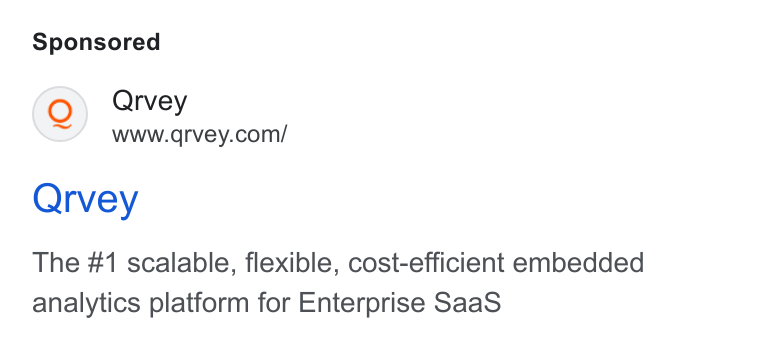
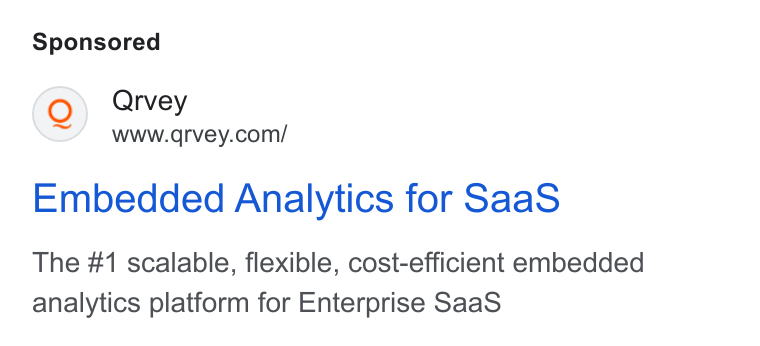
- GOOGLE · TEXTLast shown 30 Oct 2026
First shown 28 Jul 2026
- GOOGLE · TEXTLast shown 30 Oct 2026
First shown 14 Jul 2026
- GOOGLE · TEXTLast shown 30 Oct 2026
First shown 19 May 2026
- GOOGLE · TEXTLast shown 30 Oct 2026
First shown 20 Jun 2025
- GOOGLE · TEXTLast shown 30 Oct 2026
First shown 6 Feb 2025
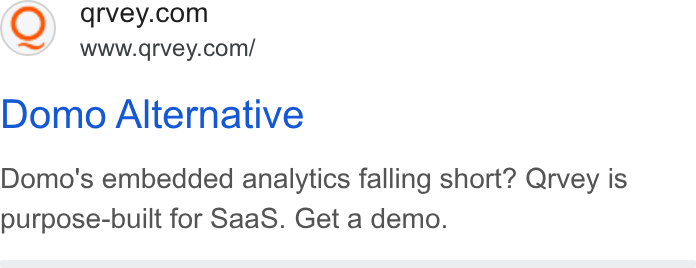
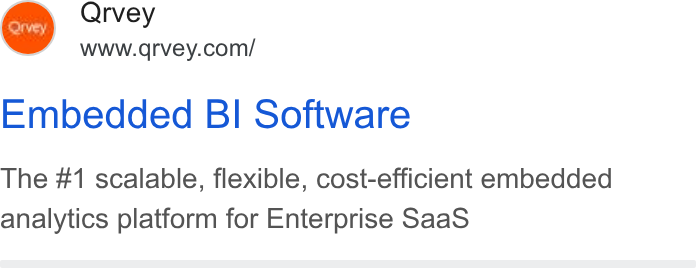

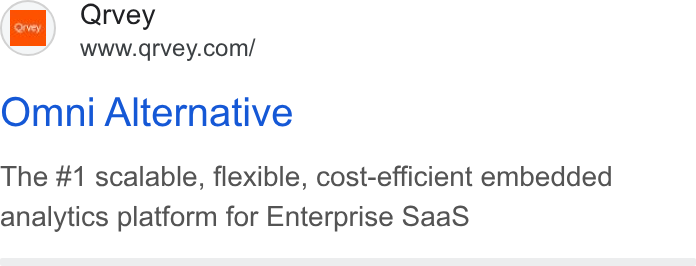
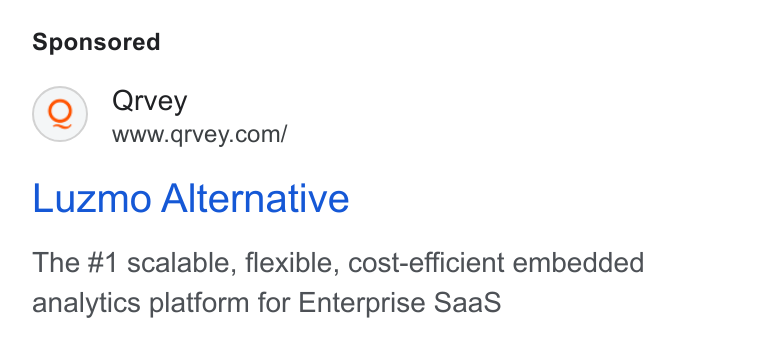
Show 2 more Google ads
- GOOGLE · TEXTLast shown 30 Oct 2026
First shown 26 Sept 2024
- GOOGLE · TEXTLast shown 30 Oct 2026
First shown 26 Sept 2024
Questions about Qrvey’s ads
Is Qrvey running LinkedIn ads?
We recorded no live LinkedIn ads for Qrvey on 9 Nov 2026.
How many LinkedIn ads has Qrvey run?
LinkedIn’s ad library lists 102 ads for Qrvey. We recorded 109 LinkedIn ads for Qrvey, first recorded on 29 Sept 2026 and last recorded on 1 Nov 2026.
Does Qrvey run Google ads?
Yes. We recorded 19 Google ads for the domain qrvey.com on 6 Nov 2026.
Which ad formats does Qrvey use?
The 6 LinkedIn ads on this page include 6 video ads.
Watch the companies you care about.
Filter every ad by industry, country, format and network, and get alerts when a company you watch starts running new ads.