Not on air · 2 of 3 networks checked

Predisys ads
- predisys.com
- Data Infrastructure and Analytics
- US
- 13 employees
Predisys’s ads on LinkedIn, Meta and Google, recorded by adsrunning. Browse the latest here for free. Sign up free to see all 117. Watch Predisys on any plan to get each new one in your feed.
Watchlist included in every plan
What Predisys runs
- Single image · LinkedIn
- 6
| Network | Status | Live ads | Nov 2025LinkedIn activity · 52 weeksNov 2026 | Checked | Next step |
|---|---|---|---|---|---|
| None recorded | 0 | Checked 7 Nov 2026 | See all 117 ads → | ||
| Meta | Not checked | — | |||
| None recorded | 0 | No ads found on the Google Ads Transparency Center | Checked 6 Nov 2026 | Collect them with the API → |
Predisys has no live LinkedIn ads. We recorded no Google ads on 6 Nov 2026.
Latest ads
- LINKEDIN · IMAGESince 4 Nov 2026
During many first visits to manufacturing customers, I have been taken to the returns and service center. This picture could represent one of those visits. The room may hold hundreds of thousands of dollars in returned products, and their value is only the beginning. Someone must inspect, analyze, repair or replace them. Engineers investigate production history, component lots and suppliers. Quality teams prepare corrective actions, while management assesses business and brand risk. Costs spread across the organization. Cost of Quality has given quality professionals a financial language for decades. Cost of Poor Quality captures internal failures found before delivery and external failures discovered by customers. Yet measured COPQ may capture only a fraction of the business loss. Scrap, rework, warranty and returns are visible. Production disruption, engineering time, expedited freight, supplier containment and management attention are harder to connect with the problem. The largest consequence may remain unreported: a customer may lose trust, avoid the next purchase and influence others. PPM and DPMO tell us how often something failed. They do not show how much value and scarce capacity accumulated before detection. The same DPMO before and after a constraint may look identical while the financial consequences differ completely. A defective component found before assembly may cost little. The same component becomes expensive after consuming process steps, bottleneck capacity or customer trust. The product may be repaired, but time lost at a fully loaded constraint can be unrecoverable. Even a small improvement can create significant value. At $1 billion in revenue, reducing COPQ by 0.5 percentage points represents a gross opportunity of $5 million per year. This is simplified. Realized value depends on the COPQ definition, prevented costs and whether lost output can be recovered. It excludes customer loyalty, reputation and future market share. COPQ is also a rear-view-mirror metric. By the time returns reach the service center and the cost appears, scrap has been created, bottleneck time consumed and customers disappointed. These rooms receive the consequences after the easiest opportunity for prevention has passed. The more valuable question is what can still be prevented. Manufacturing Intelligence can connect financial consequences with capability, supplier behavior, equipment history, material changes, field returns and statistical patterns. Manufacturing AI can use this real-time context to identify increasing variation, weakening capability, supplier drift or multivariate patterns before they become scrap, downtime, warranty claims or lost customers. Any recommendation still needs evidence and a path back to the process. What is the Cost of Poor Quality in your organization? How much of it can you actually see, and which process behavior may already be creating tomorrow’s loss before it appears in the COPQ report?
- LINKEDIN · IMAGESince 27 Oct 2026
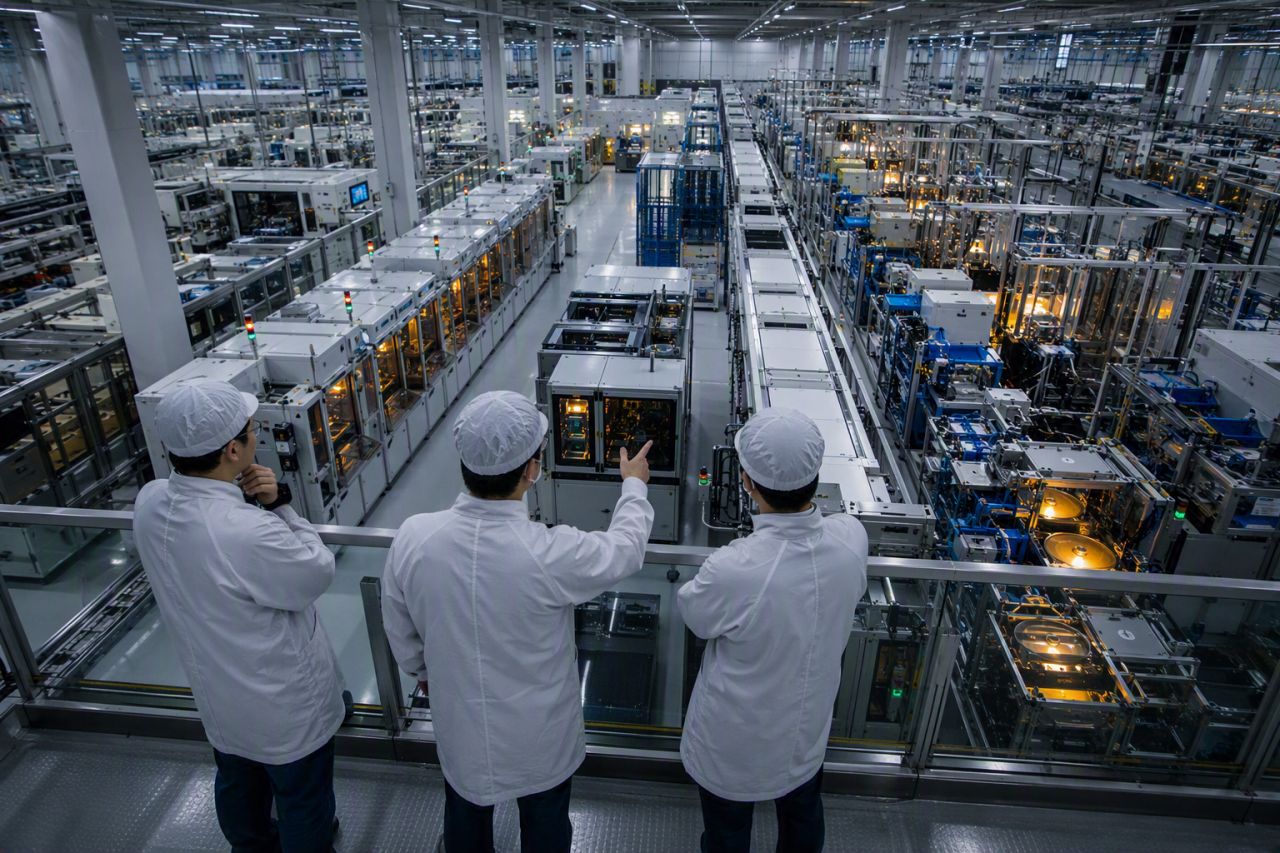
Years ago, our team helped build an analytical environment connecting global field returns with manufacturing statistics from the week each product was made. This was consumer electronics, where brand and customer experience meant everything. Repair and complaint data arrived globally, while manufacturing data came from a different environment. Connecting them required key transformations, data model design and extensive validation. The field-return side used SSAS cubes and the manufacturing side our application environment. Once both environments were built and validated, connecting them was the easy part. A rise in field failures could be traced back to factories, products, component lots, processes and statistical behavior. Manufacturing history could be examined through what customers experienced months later. Imagine an AI agent finding that many failed units contain components from the same supplier lot and recommending that it be blocked. It sounds convincing. Does the evidence support it? An engineer would ask: Did the lot perform normally on other lines? Did failures come from one work cell, product variant or period? Did test behavior change earlier? Was there a process shift, measurement issue or maintenance event? Has the pattern appeared before? These are some of the skills Manufacturing AI needs. A general AI model can explain a control chart or capability index. Manufacturing AI must know when to use them, which data and limits apply, and how to reach the evidence. It must navigate manufacturing hierarchies and recognize shifts, drift, increasing variation, weakening capability or multivariate patterns hidden within specification. It must understand process history. A question about today may require last year’s capability, long trends, an earlier investigation or evidence that an action produced lasting improvement. The agent should not reconstruct it from billions of raw measurements for every question. Manufacturing Intelligence preserves how the process has behaved over time and keeps that history connected to the underlying evidence. AI hallucination gets a lot of attention. In manufacturing, the requirement is simple: an important recommendation must trace back to process context and statistical evidence. Missing variables, incomplete traceability or an incorrect comparison group can make a plausible explanation unreliable. Manufacturing professionals already use these skills. They move from a signal to the relevant history, compare conditions, examine distributions and control charts, drill down to individual measurements and decide whether the evidence supports a conclusion. Manufacturing AI should support the same investigation faster and across larger environments. It can recognize signals, select analytics, retrieve history and bring evidence together for the decision-maker. A general AI model can produce a convincing explanation. Manufacturing AI must show why the explanation deserves to be trusted.
- LINKEDIN · IMAGESince 22 Oct 2026
When I first started working in automotive manufacturing, I kept hearing about the marriage station. I had no idea what it meant, and the name sounded funny in a factory. In final assembly, the painted vehicle body is joined with the powertrain. This is called marriage. How many people know about automotive marriage lines? The same vehicle may have different identifiers as it moves through production. Connecting body, powertrain, subassembly and order records to the same vehicle is part of the contextual challenge. Identifiers and process hierarchies may change through the factory. What can analytics do with this context? If an AI agent is asked why tightening quality changed at the marriage station, it may need to identify relevant variants, subassemblies, stations and tools, examine torque distributions and control charts, compare shifts, and trace affected vehicles through earlier and later operations despite changing identifiers. Is the change limited to one tool, fastener position or product configuration? Did capability change after maintenance? Is it related to dimensional measurements? Does it show up later in alignment? Has the same statistical pattern appeared before? This is why manufacturing context must be functional. A definition can tell an agent what a torque result represents. A process hierarchy shows where it belongs. Traceability connects it to a specific vehicle or subassembly. To investigate process behavior, it also needs analytical capabilities that calculate, compare, monitor and drill into the evidence. These capabilities may include real-time SPC, capability analysis, multivariate analysis, statistical alarms, process history, supplier intelligence and measurement-level drill-down. These are established manufacturing functions with governed logic, process-specific structures and operational history. They go far beyond retrieving information for a prompt. The same applies elsewhere. In injection molding, an agent may need to move from machine-level PPM into molds, cavities, component lots and process parameters. In electronics, it may need to connect test results with products, lines, work cells, components, suppliers and earlier process behavior, including field failures and returns. Manufacturing AI becomes useful when it can use context to investigate real manufacturing questions. The agent should not need to scan huge volumes of raw measurements for every question. Statistical KPIs and process history accumulate in the Manufacturing Intelligence layer. The agent can use that intelligence to guide the investigation, invoke relevant analytics, interpret results and bring supporting evidence to the decision-maker. The user may experience a simple conversation. Underneath it, the Manufacturing Intelligence environment must understand the process, preserve its statistical meaning and provide the functions needed to investigate it. Manufacturing AI needs context it can use.
- LINKEDIN · IMAGESince 13 Oct 2026
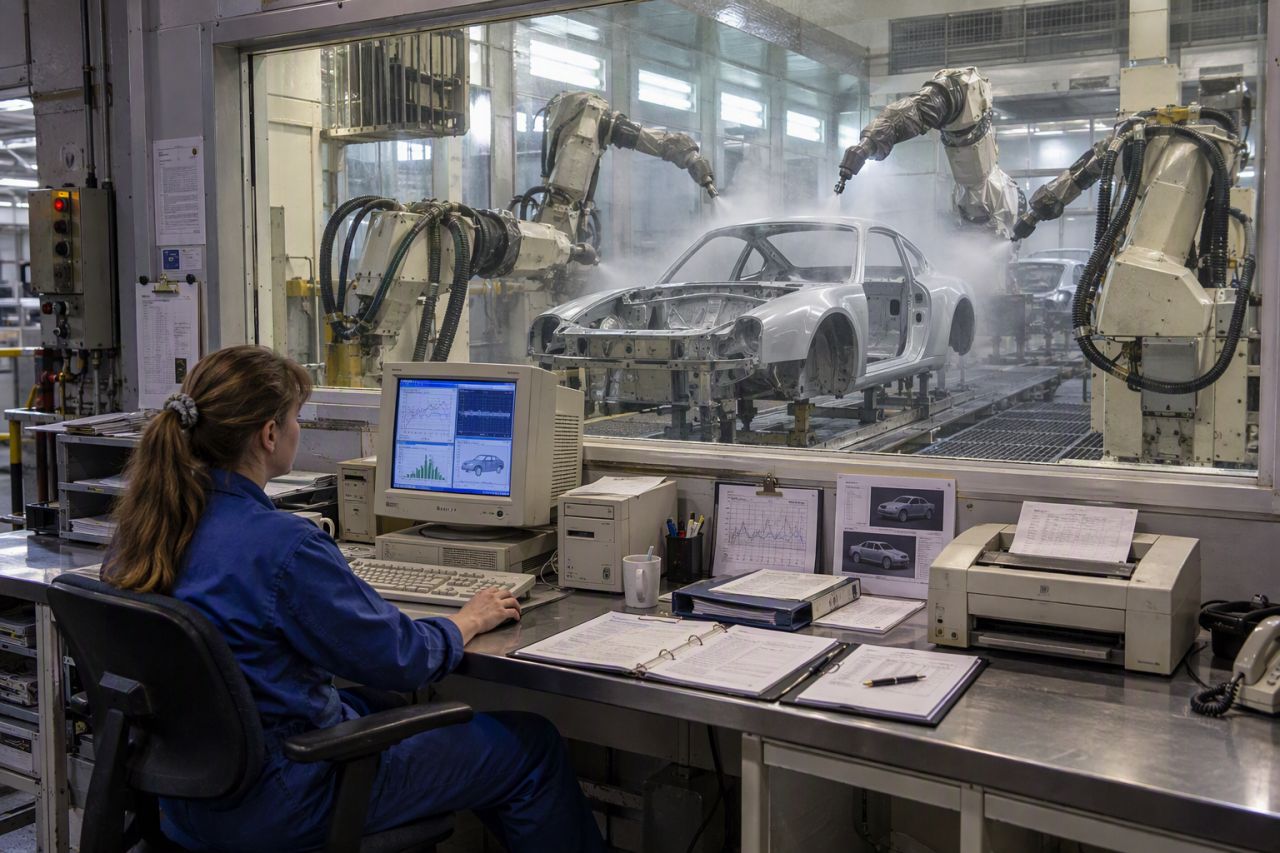
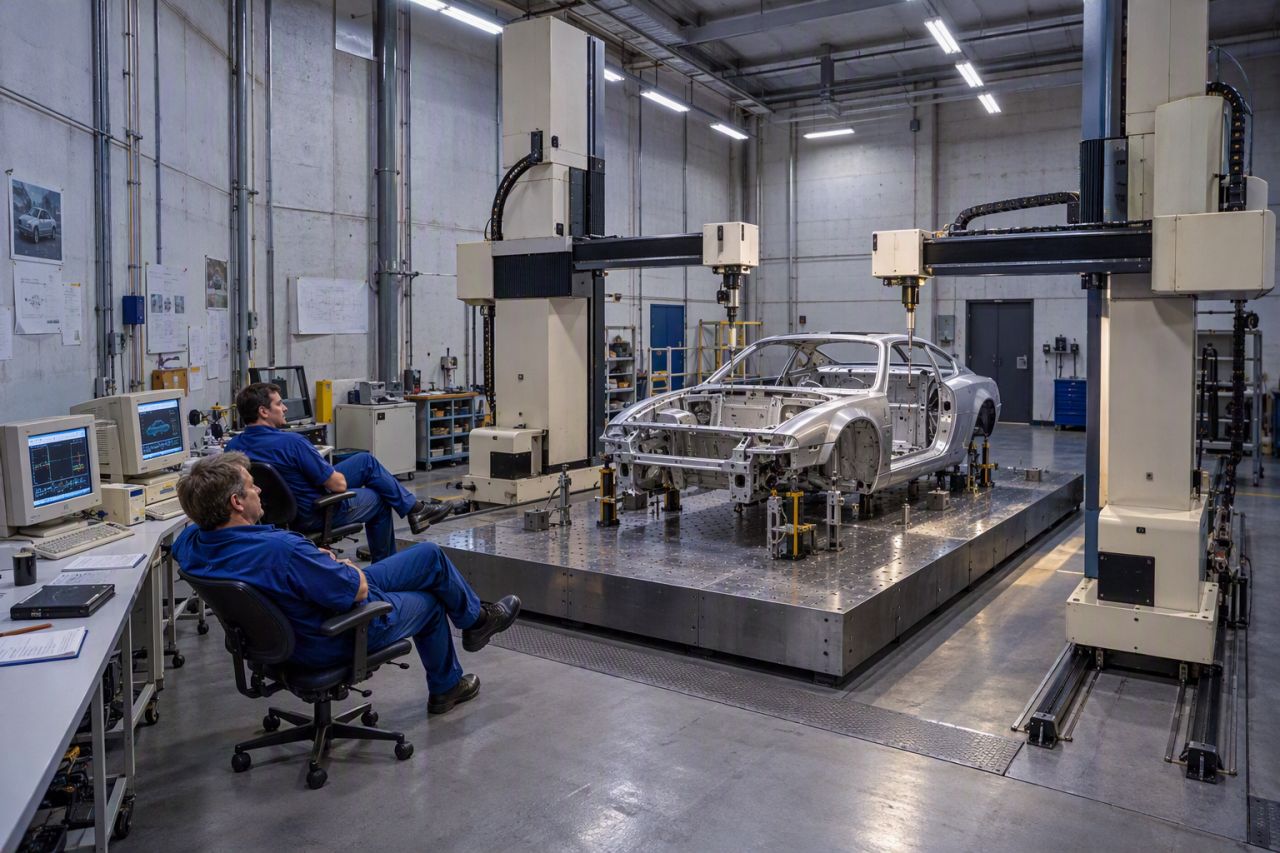
I asked AI to generate a picture of an automotive paint shop from the 1990s. The result looks real. Anyone familiar with automotive painting, however, will notice that the robots, vehicle body, workstation and computer do not quite fit together. AI recognized the elements of a paint shop and assembled them into a scene without understanding how the process actually worked. By the way, how many people know how yield is calculated in an automotive paint shop? Most people think yield is simply counted. In reality, the answer depends on what the process considers a successful first pass. Even that definition depends on a living body-level model. Inspections, repairs and other events may be recorded after a body has left the process, changing whether it qualifies as a successful first pass. In some cases, final yield can only be calculated later. This logic must be modeled in the data-management layer before analytics can investigate yield reliably. The overall yield figure is only the starting point. When yield changes, the analysis must move through lines, paint codes, body types and repair actions until it reaches control charts, distributions and individual measurements connected to a specific body. The origin of the problem may also be outside the paint shop. A quality problem discovered in painting may be connected to process behavior in body welding, surface preparation, material variation or another upstream operation. Each process has its own hierarchy, identifiers, measurements, specifications and statistical models. Connecting their data is an integration task. Connecting their statistical meaning is a Manufacturing Intelligence task. This is what I mean by Contextual Manufacturing Analytics: an analytical environment that connects factories, departments, suppliers and manufacturing processes while preserving their statistical meaning. ERP provides enterprise context. MES provides execution and traceability. Local systems may understand one operation in detail. The strategic question is whether the Manufacturing Intelligence layer can connect these environments while retaining real-time, process-specific statistical depth. It must recognize shifts, drift, variation and capability changes across processes. It must also learn how upstream process behavior changes the probability of downstream failure. A welding jig may be associated with later assembly problems. Certain oven conditions increase the likelihood of paint rework even when all values remain within specification. The objective is not merely to explain yesterday's yield loss. It is to recognize the process behavior that may create tomorrow's loss. That requires identifying upstream patterns before their downstream consequences become visible in the yield figure. Can Manufacturing AI recognize why yield will drop next week? And if the required Contextual Manufacturing Analytics does not exist beneath the corporate AI environment, where will that understanding come from?
- LINKEDIN · IMAGESince 6 Oct 2026
Advanced Manufacturing Intelligence includes both an analytical layer and an operational layer. Manufacturing AI may be able to recognize an unusual pattern or suggest a possible explanation very quickly, but a plausible explanation is not the same as understanding what is actually happening in a manufacturing process. A statistical change rarely exists in isolation. It belongs to a particular product, process, piece of equipment or parameter, with people responsible for understanding what happened and deciding what to do about it. The analytical layer of Manufacturing Intelligence helps us understand what changed. Statistical methods can show whether a process is behaving normally, whether variation is increasing, whether capability is deteriorating and which parameters may deserve attention. A statistical change can be detected in seconds, but someone still needs to know about it. The operational layer connects that analytical understanding to what follows. The right people need access to the information, someone needs to own the investigation, and the findings, decisions and actions that follow need to remain connected to what happened. The operational history may include previous investigations, annotations, alarms, corrective actions and, importantly, whether those actions actually worked. The operational layer also has to reflect the manufacturing environment. Across a supplier network, hundreds of companies may participate in the same Manufacturing Intelligence environment while each supplier sees only the information they are authorized to access. This layer may become a mission-critical part of the operational infrastructure, especially in regulated MedTech manufacturing, where analytical capabilities help maintain process control, support compliance and traceability, and identify quality risks before they affect products or customers. The analytical and operational layers work together throughout an investigation. A statistical change can be detected and investigated, the appropriate action taken and its effect verified, while the investigation, decisions and results remain part of the operational history. An AI agent becomes much more useful when it can work with this statistically validated process knowledge and the operational context around it. That means understanding more than the statistical signal itself. Who is authorized to see the information? Who owns the process? What has happened here before? Which actions were taken? Did they work? Does the issue require escalation? Those answers are rarely contained in the data alone.
- LINKEDIN · IMAGESince 6 Oct 2026
Manufacturing AI Becomes Useful When It Can Answer Process-Specific Questions Using Manufacturing Intelligence.



6 of 117 adsSign up to see every Predisys ad, filter by format and date, and get alerts on new ones.
See all 117 adsQuestions about Predisys’s ads
Is Predisys running LinkedIn ads?
We recorded no live LinkedIn ads for Predisys on 9 Nov 2026.
How many LinkedIn ads has Predisys run?
LinkedIn’s ad library lists 117 ads for Predisys. We recorded 117 LinkedIn ads for Predisys, first recorded on 28 Sept 2026 and last recorded on 7 Nov 2026.
Does Predisys run Google ads?
We recorded no Google ads for the domain predisys.com on 6 Nov 2026.
Which ad formats does Predisys use?
The 6 LinkedIn ads on this page include 6 image ads.
Watch the companies you care about.
Filter every ad by industry, country, format and network, and get alerts when a company you watch starts running new ads.