Not on air · 2 of 3 networks checked

Pibit.AI ads
- pibit.ai
- Insurance
- US
- 167 employees
Pibit.AI’s ads on LinkedIn, Meta and Google, recorded by adsrunning. Browse the latest here for free. Sign up free to see all 130. Watch Pibit.AI on any plan to get each new one in your feed.
Watchlist included in every plan
What Pibit.AI runs
- Single image · LinkedIn
- 5
- Video · LinkedIn
- 1
| Network | Status | Live ads | Nov 2025LinkedIn activity · 52 weeksNov 2026 | Checked | Next step |
|---|---|---|---|---|---|
| None recorded | 0 | Checked 7 Nov 2026 | See all 130 ads → | ||
| Meta | Not checked | — | |||
| None recorded | 0 | No ads found on the Google Ads Transparency Center | Checked 6 Nov 2026 | Collect them with the API → |
Pibit.AI has no live LinkedIn ads. We recorded no Google ads on 6 Nov 2026.
Latest ads
- LINKEDIN · VIDEORecorded 28 Sept 2026
AI sped us up… but we still had a problem. At InsureTech Connect Vegas 2025 I sat down with Michaela Morrison, Vice President & General Manager, Method Workers' Comp', and asked a blunt question: does saying “just use AI” actually fix submission intake? What she described is something many of us feel every day: automation can make things faster, but without confidence it just speeds up work people still have to check. They tried everything from hybrid to pure AI approaches. Yet halfway through our conversation she said, “we still had a problem.” Here is part 1 of 4 of my conversation with her. Next video drops on Thursday. Full recording of this conversation will be hosted on our events page later this week. If you’re curious how we think about the full submission workflow, there’s more here: https://pibit.link/ZTaCqhf
- LINKEDIN · IMAGERecorded 28 Sept 2026
AI alone cannot fix commercial underwriting. I keep coming back to a simple lens from Steve Jobs. Early smartphones felt “productive” because of tiny hardware keyboards. Until you asked the device to work beyond email. The keyboard stole a third of the screen. Apps were trapped in a cramped canvas. Keys were locked to one layout and one language. More parts meant more failure points and size limits. Jobs did not remove the keyboard for looks. He removed it for purpose. A software keyboard appears only when you need it. It adapts to the task, supports any language, improves with updates, and gives the screen back to what you are doing. That is design as deletion with intent. We need the same first-principles discipline in commercial underwriting. Not more layers on top of old habits. Start from the outcome. Challenge defaults. Delete what does not serve a cleaner, faster decision. Then let AI amplify a system that already makes sense. Exactly this is what i am going to talk at InsureTech Connect Vegas 2025 and way more deeper on this with Michaela Morrison in our session: “Stop Beating the Dead Horse: The Submission Intake Problem Doesn’t Just Need AI (and What Steve Jobs Would Have Done)” on Thursday, October 16, 2:00 PM at our Underwriting Track If you had to start from zero, which commercial underwriting step would you delete first and why? #underwriting
- LINKEDIN · IMAGERecorded 28 Sept 2026
Join us at ITC Vegas for a quiet evening away from the noise. A 4-course dinner, craft drinks, and a table of market leaders — no slides, no pitches, just real conversation.
- LINKEDIN · IMAGERecorded 7 Nov 2026
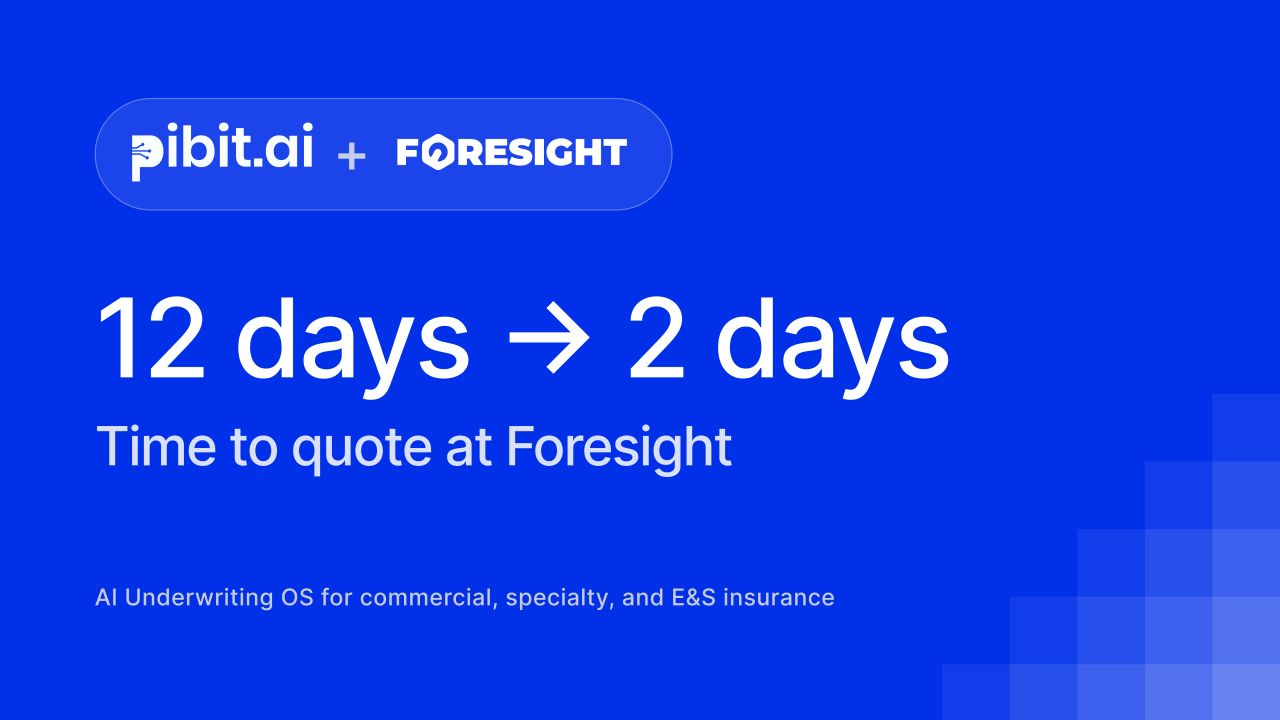
When we first started working with Foresight, Peter Grant and his team were very clear about where the pressure in their business actually sat. Foresight writes mid-market workers' compensation for construction, agriculture and manufacturing, and a lot of what they write is distressed risk that other carriers have already declined. Their whole model depends on looking properly at accounts that need more work, and then working with the insured through the policy year to change the loss picture. That model only works if underwriters actually get to every submission. Before this, someone had to open each file by hand, check it against guidelines, figure out what was missing and chase the broker, so some accounts were simply never worked. Today clearance runs in 30 to 37 minutes on average, and full document processing comes back in about an hour and a half compared with roughly three hours earlier. Time to quote has gone from 12 days to 2, and each underwriter now handles 190% more submissions than before. Around 4,600 submissions a year are cleared this way, and the output goes straight into Foresight's own database for the underwriting workbench their team already uses. What I keep coming back to is how Peter describes where they are heading, which is a pricing indication or quote on every deal within a few days, and in the best cases a few hours. Foresight is expanding into new industries quickly, and for brokers sending them complex accounts, that turnaround is a big part of why they send the account to Foresight in the first place. Thank you to Peter Grant, David Fontain and the whole Foresight team for trusting us with this work. The full case study with all the numbers is in the comments for anyone who wants the detail.
- LINKEDIN · IMAGERecorded 7 Nov 2026
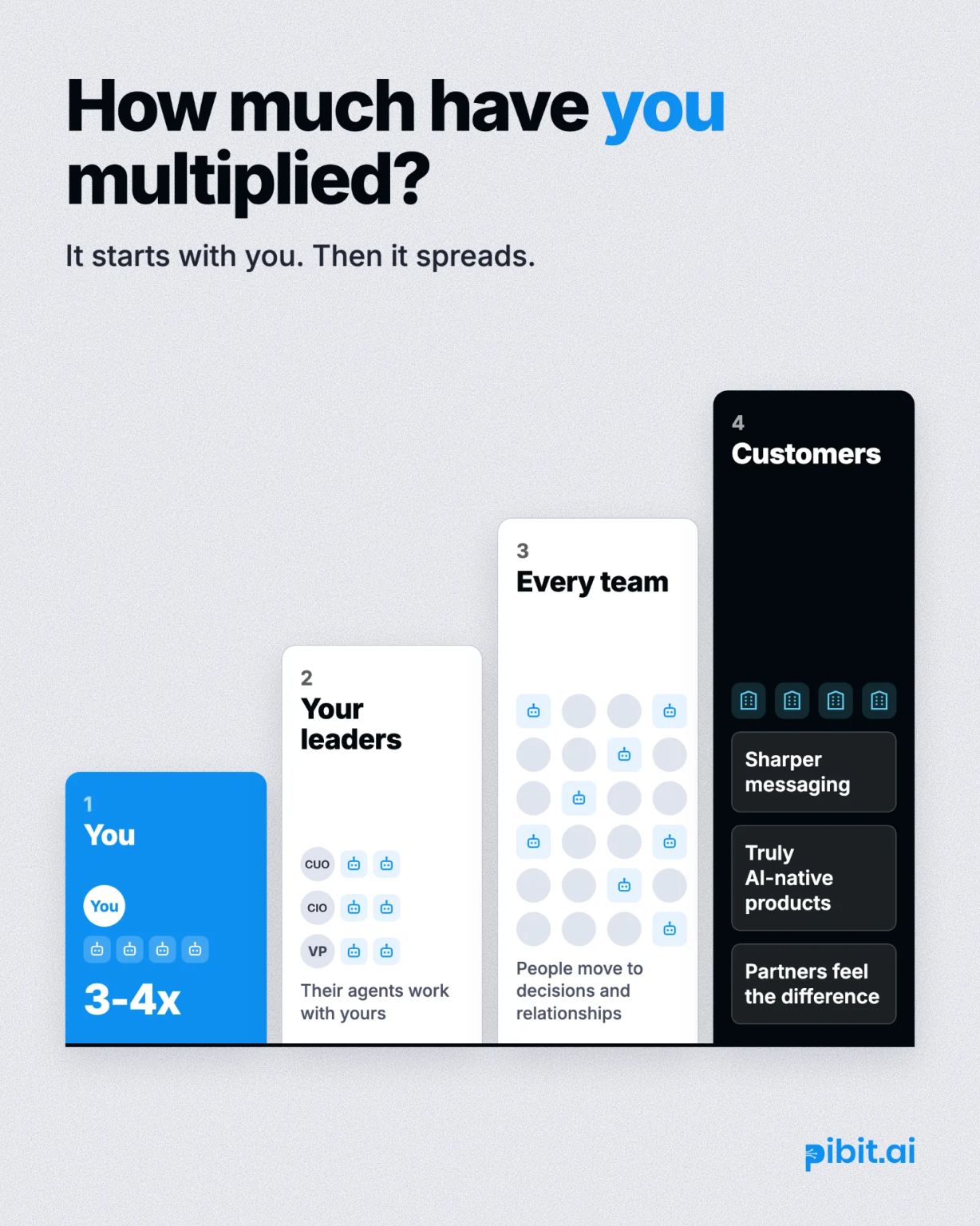
After my last post on working with AI agents, many leaders DM'd me asking the same question: "How do I drive this across my company?" My response to them was to ask what they were doing today. Most described the same things: introducing more AI tools, tracking adoption, and talking to teams about what's working. But the question they should first answer is: "How much have you multiplied yourself?" I have reason to believe that the answers would usually be 20%, 40%, maybe 50%, which is perhaps a great start. The next logical step is maximizing that output, which could perhaps look a little different for everyone, but honestly not so much. I'm a firm believer that you have to work through a problem yourself before you can show others what's possible. If I haven't solved a problem myself, I find it very hard to lead others through it. People don't follow instructions. They follow results they can see. This holds true for this use case as well. Driving AI adoption from the top through enablement alone gets people using tools, but it doesn't necessarily change how the work gets done. Here's how I've seen it actually flow: 1. You multiply yourself first. Take a weekend or a week. Build your own team of agents. Get to 3-4x. 2. Your leaders have to follow. Your agents now need their teams' agents, and anyone still working the old way is coached patiently, but as a priority. 3. Every team follows. People move toward what only humans can do: decisions and relationships. 4. Customers feel the difference. Your products get better, your teams respond faster, and the value you deliver becomes tangible. This matters even more for those of us building AI for insurance. Everyone says they want an AI-native product, not another SaaS tool. But if you can't use agents to solve your own problems, problems you understand deeply, how will you solve an underwriter's? How do you tell a carrier their team can multiply when you haven't done it yourself? So whether you're a CEO, a CUO, or a CIO, the first question isn't "Is my team using AI?", but rather "How much have I actually multiplied?" Answer that first. Everything else will follow.
- LINKEDIN · IMAGERecorded 7 Nov 2026
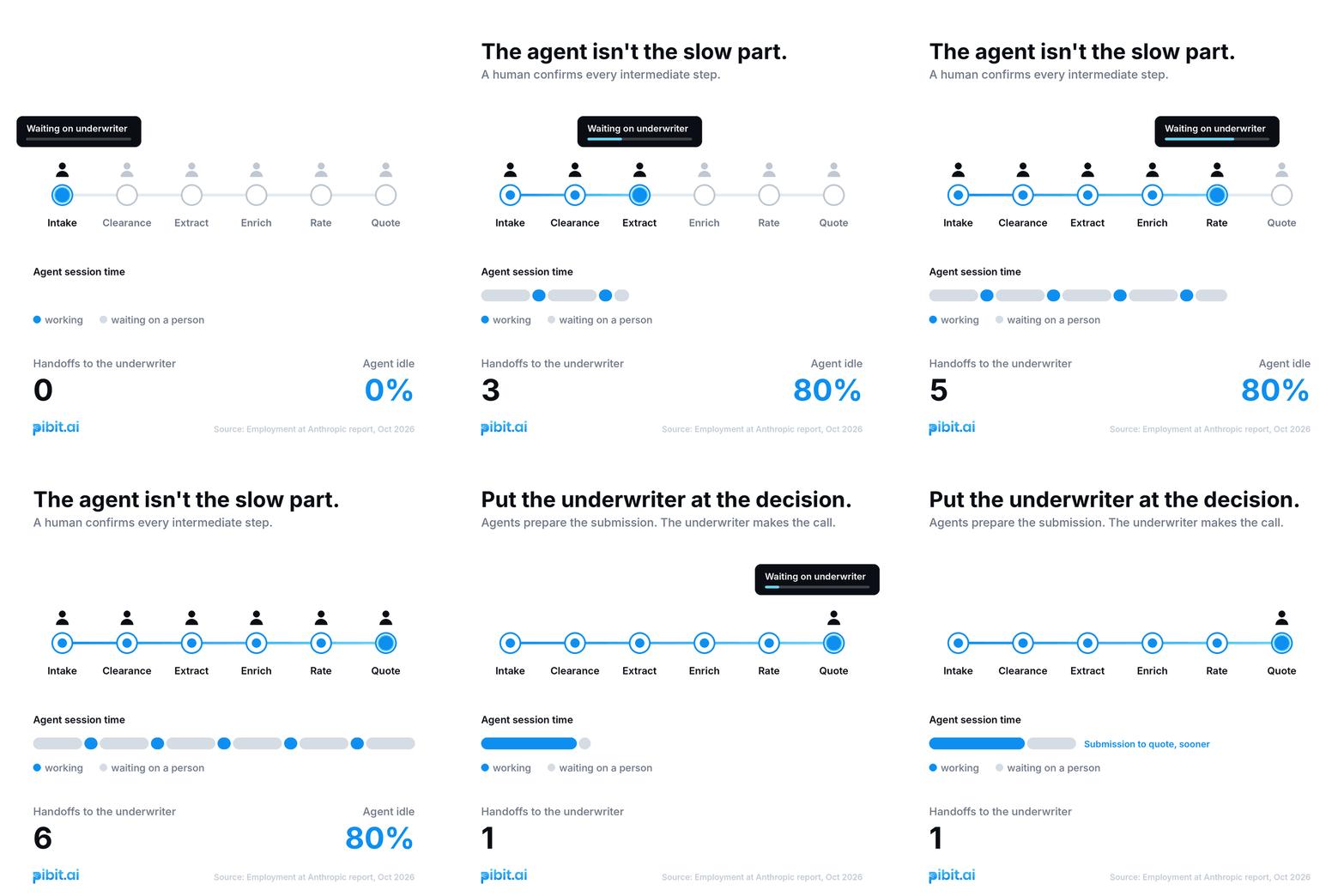
Anthropic published some data this month on how AI has changed its own workforce. The most useful number in it wasn’t about headcount. Their Claude agents sit idle about 80% of the time in working sessions, waiting for a person to respond. So the agents weren’t the slow part. The people were, or more accurately the handoffs were. We see a version of this in underwriting a lot. You can put a very capable model on a submission, but if it stops every few steps to have an underwriter confirm something, the underwriter just becomes a queue. The submission sits there, and the broker waits. A lot of what we work on at Pibit.AI is less about which model and more about where the human sits in the flow. Which steps the agents can run on their own from submission to quote, which decisions go to the underwriter, and how that question gets put to them so it doesn’t turn into a full context switch every time. Underwriters should be spending their time on the actual decision and on broker relationships, and much less on approving every intermediate step. I don’t think anyone has fully figured out the right handoff design yet. Curious how other carriers and MGAs are approaching it. Source: Employment at Anthropic report, Oct 2026


6 of 130 adsSign up to see every Pibit.AI ad, filter by format and date, and get alerts on new ones.
See all 130 adsQuestions about Pibit.AI’s ads
Is Pibit.AI running LinkedIn ads?
We recorded no live LinkedIn ads for Pibit.AI on 8 Nov 2026.
How many LinkedIn ads has Pibit.AI run?
LinkedIn’s ad library lists 139 ads for Pibit.AI. We recorded 130 LinkedIn ads for Pibit.AI, first recorded on 28 Sept 2026 and last recorded on 7 Nov 2026.
Does Pibit.AI run Google ads?
We recorded no Google ads for the domain pibit.ai on 6 Nov 2026.
Which ad formats does Pibit.AI use?
The 6 LinkedIn ads on this page include 5 image ads and 1 video ad.
Watch the companies you care about.
Filter every ad by industry, country, format and network, and get alerts when a company you watch starts running new ads.