On air · 1 of 3 networks

Partner Fleet ads
- partnerfleet.io
- Software Development
- US
- 18 employees
Partner Fleet’s ads on LinkedIn, Meta and Google, recorded by adsrunning. Browse the latest here for free. Sign up free to see all 30. Watch Partner Fleet on any plan to get each new one in your feed.
Watchlist included in every plan
What Partner Fleet runs
- Single image · LinkedIn
- 6
- Google ad on 5 Nov 2026
- 1
| Network | Status | Live ads | Nov 2025Activity · 52 weeksNov 2026 | Checked | Next step |
|---|---|---|---|---|---|
| None recorded | 0 | Checked 7 Nov 2026 | See all 30 ads → | ||
| Meta | Not checked | — | |||
| Running | 1 | Checked 5 Nov 2026 | Collect them with the API → |
Partner Fleet has no live LinkedIn ads. We recorded 1 Google ad on 5 Nov 2026.
Latest ads
- Text-onlyWe more than doubled the ZoomInfo partner ecosystem in 12 months — growing from 87 marketplace listings to 190+. And we did a lot of that growth while managing a highly manual onboarding process across multiple systems, with hundreds of requests coming through a team of just three people. That wasn’t going to scale. Over the last few months, we’ve completely reworked the partner onboarding experience with Partner Fleet, reducing 15+ manual steps down to 7 and automating much of the work across Salesforce, ServiceNow, and our marketplace. The result: more transparency for our partners, less manual work for our team, and the ability to bring new partners into the ecosystem much faster. And we’re not done. We’re continuing to make changes based on partner feedback and looking for every opportunity to make it easier to build, launch, and grow with ZoomInfo. 190+ is a great milestone — but there’s a lot more to come. See more here: https://lnkd.in/gVS7Udk9 The partnership team couldn't do it without Sneh Kakileti, Andres Perez, and their entire teams. You guys are the true rockstars. 🤘 If you want to check out our marketplace and all of our incredible partners: https://lnkd.in/gxiA-4WVLINKEDIN · TEXT-ONLYRecorded 7 Nov 2026
- Text-onlyA customer told me the biggest lever on their retention isn't CS, pricing, or the roadmap. It's integrations adoption. Here's the math: Customers who install just one integration churn about 50% less frequently than those with zero integrations. Every integration after that cuts churn by another 13%. Let me show you what that's worth to their $500M ARR SaaS business. Start with the customers who have zero integrations, say that's 20% of the base. That's $100M in ARR, and it's the shakiest $100M they've got, because customers with no integrations churn the most. Say that group churns at 25% annually. That's $25M ARR lost per year if nothing changes. Get them to turn on just one integration, and their churn roughly halves, meaning it's now about 12.5%. → That's $12.5M in revenue they keep. Now the other $400M. These customers already have an integration, so they're stickier, say they churn at 10%. That's still $40M lost a year at the status quo. Get each of them to install just one more integration, and their churn drops another 13%, meaning it's now at about 8.7%. → That's another $5.2M in ARR they keep. Looking at the full picture: by getting each account to either turn on their first integration or add just one more, you drop overall churn from 13% to 9.5% and save the company $17.7M in ARR. That moves them from average SaaS to top tier stats. Most teams throw budget at CS headcount and save attempts to move that number. The cheaper lever was sitting in their integrations data the whole time. What's a stronger retention lever than that?LINKEDIN · TEXT-ONLYRecorded 28 Sept 2026
- Text-onlyHow easy you make it for a third-party developer to build an integration with your product plays a huge part in how big your ecosystem can get. When a partner's engineer sits down to connect their product to yours, the first thing they look for is a standard API with the conventions and docs they already know. If you hand them a custom method specific to your product, they have to take time to learn a nonstandard way of connecting, which leads to frustration. From your end, the pull to build a custom method makes sense, because it maps more neatly to how your system works on the backend. But the standard API almost always wins with third-party developers, because they already know its conventions and can get the integration built without stopping to learn something new. The cost of choosing your own method over the standard one is not just a frustrated engineer. Integrations that are annoying to build get pushed down the list for easier work, and the ones that never get built are ones your customers never get to find and install. The stickiness you are counting on from your ecosystem quietly gets capped. This is a real tradeoff to consider. You are deciding whether to standardize around what is simplest for your team or what is simplest for the developer connecting to you. Curious how other people weigh that decision.LINKEDIN · TEXT-ONLYRecorded 28 Sept 2026
- Text-onlyLearned something wild from a Senior Product Manager at a $2B SaaS co the other day. They had 8 product teams dedicated to building integrations. One PM per team plus 5-10 engineers. That’s 48-88 heads on recurring payroll. Likely 💰 $7-13M 💰 annual headcount cost. Their goal was to have full integration coverage to meet customer demand. Yielding major sales and retention benefits over their competitors 📈. But they ran into some issues: ➡️ Integrations take a long time to build, test, deploy, update ➡️ They weren’t getting them right - they aren’t SMEs on third party products ➡️ Hard to get customers to use them once built ➡️ They thought a few dozen integrations would do the trick, but turns out hundreds and eventually thousands are needed The overarching problem was the lack of scalability in their approach. More integrations = more heads on payroll. Eventually they said enough is enough, let’s open this thing up and crowdsource integrations. So they enhanced their API infrastructure, pieced together a developer portal and built a publishing mechanism for their app marketplace. It was a big bet. But the inbound demand was there… third party devs were ready/willing to build. Now, they’re delivering integrations at an exponential rate. They’re not limited by the capacity of their internal team. The idea of having thousands of integrations is no longer a pipe dream. It’s just a matter of time. At Partner Fleet, we believe the decision to “open up” should not be a big, expensive bet. Every SaaS company should have the opportunity to create an integration ecosystem without spending millions to build the infrastructure from scratch. Our mission is to make this strategy accessible to anyone who wants to pursue it.LINKEDIN · TEXT-ONLYRecorded 28 Sept 2026
- Text-onlyPartner Fleet is launching our In-App Marketplace product today. Most people will notice the front end, so I want to talk about the part they won't see, because putting an integration marketplace inside your product sounds simple until you think about who's looking at it. A basic user on a starter plan shouldn't see the same integrations as an enterprise admin. A customer in Europe might need a different set of integrations than a customer in Canada. And when someone without access to an integration clicks install, you can't just show them an error message and stop there. You have to send them somewhere useful, whether that's an upgrade path, a request to their admin, or a conversation with sales. And that’s what we built with In-App Marketplace. Rules that control who sees which integrations based on tier, role, and region, and routing that takes each user to the right next step when they want something they don't have access to. I'm very proud of what our team has built, and excited to share more product news in a few weeks. To see how In-App Marketplace works, click the link in my comments.LINKEDIN · TEXT-ONLYRecorded 28 Sept 2026
- Text-onlyHear me out: ISV partner teams are judged on the wrong KPIs. Tech companies build integrations because they add value for mutual customers. Sales needs them to win deals, Product needs them to drive adoption, CS needs them to retain customers, and that's what justifies the roadmap slot. But once an integration is built, companies turn their attention toward relationship value rather than product value. ISV teams are judged on how many referrals they get from integration partners and partner-sourced revenue. The emphasis on referrals makes ISV managers focus on the wrong things. It’s like people forgot the original intent of the integration. The marker of success for any ISV program should be installs and usage, and how that impacts customer health. You should be asking: - What’s our ACV for customers with 0 integrations? 1 integration? 2-4? 5+? - What’s our churn rate in each of the cohorts above? - If every customer installs 1 additional integration, how much churn do we prevent? - Which integrations are the most used and most valuable? These questions align with the original intent. The problem is: the people who need this data don’t have access to it. It's buried deep in the wrong systems. So if you're running a tech partner program, the move is to get access to the usage data, overlay commercial data, and surface a trend report to leadership every month. Let the data make your case. Do that consistently, and you stop defending your program's existence and start unlocking budget and headcount instead.LINKEDIN · TEXT-ONLYRecorded 28 Sept 2026
6 of 30 adsSign up to see every Partner Fleet ad, filter by format and date, and get alerts on new ones.
See all 30 adsOn Google Search, YouTube and Display
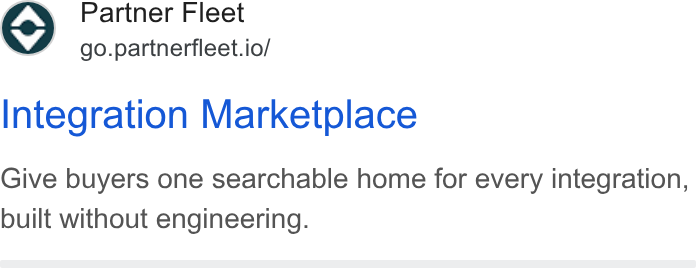
Domain partnerfleet.io · 1 ads on the Transparency Center, checked 5 Nov 2026 · 1 recorded
- All 1
- Text 1
- GOOGLE · TEXTLast shown 1 Oct 2026
First shown 27 Aug 2026
Questions about Partner Fleet’s ads
Is Partner Fleet running LinkedIn ads?
We recorded no live LinkedIn ads for Partner Fleet on 10 Nov 2026.
How many LinkedIn ads has Partner Fleet run?
LinkedIn’s ad library lists 32 ads for Partner Fleet. We recorded 30 LinkedIn ads for Partner Fleet, first recorded on 28 Sept 2026 and last recorded on 7 Nov 2026.
Does Partner Fleet run Google ads?
Yes. We recorded 1 Google ad for the domain partnerfleet.io on 5 Nov 2026.
Which ad formats does Partner Fleet use?
The 6 LinkedIn ads on this page include 6 image ads.
Watch the companies you care about.
Filter every ad by industry, country, format and network, and get alerts when a company you watch starts running new ads.