0 new LinkedIn ads in 30 days · 2 of 3 networks checked

Parity, Inc. ads
- paritygo.com
- Software Development
- CA
- 52 employees
Parity, Inc.’s ads on LinkedIn, Meta and Google, recorded by adsrunning. Browse the latest here for free. Sign up free to browse our full recording. Watch Parity, Inc. on any plan to get each new one in your feed.
Watchlist included in every plan
What Parity, Inc. runs
- Single image · LinkedIn
- 6
| Network | Status | Last 30 days | Total ads found | Ad activity | Checked | Next step |
|---|---|---|---|---|---|---|
| None recorded | 0 | 104+ | 11/11/2026 | View ads → | ||
| Meta | Not checked | — | — | View ads → | ||
| None recorded | — | — | 11/05/2026 | View ads → |
Parity, Inc. has no new LinkedIn ads in the last 30 days. We recorded no Google ads on 5 Nov 2026.
Latest ads
- LINKEDIN · IMAGESince 30 Mar 2026
I’m giving multifamily owners money. Okay, now that I’ve got your attention. Here’s what I mean: Parity, Inc. guarantees savings. We agree on a savings number before we start. If we don’t hit it, we pay you the difference. Why would we do that? Because HVAC is the largest unmanaged load in most multifamily buildings. And once you control it properly, the math is predictable. We remove the risk. You keep the upside. And in reality, we typically exceed our guarantee by 135%. Because when you actually control HVAC instead of letting it run unmanaged, demand charges shrink, runtime improves, and inefficiency gets cut fast. On top of that, we automate buildings demand response curtailment. In 2025, 63 of Parity, Inc.s customers capitalized on this using our automated curtailment service and generated $400K+ in DR revenue and curtailed over 56,000 kWh of electricity without human interaction. If you’re running a building and not monetizing your largest load, that’s a bigger risk than working with us.
- LINKEDIN · IMAGESince 23 Mar 2026
The world is accelerating - and both humans and the grid are struggling to keep up. Social media, constant notifications, AI tools, 24/7 information. Our attention is fragmented. Our dopamine systems are constantly stimulated. Most people are operating at cognitive peak demand all day long. The point is: we’re close to capacity. And the grid is going through the same thing. More EVs. More electrification. More AI. More cooling load. More heat pumps. It was built for a different era - predictable, centralized demand. Now everything is dynamic. Load moves fast. Peaks are sharper. Behaviour is less coordinated. Like the human brain, the grid hasn’t evolved at the same pace as the world around it. And like humans, it can’t evolve overnight. When humans overload, we burn out. When the grid overloads, it blacks out. In both cases, the solution isn’t more input. It’s managing demand more intelligently.
- LINKEDIN · IMAGESince 16 Mar 2026
OEMs are rolling out “cloud” platforms. Dashboards. Analytics suites. Remote monitoring. Energy optimization services. On the surface, that’s progress. And in many ways, it is. Cleaner data is better than no data. Proving when equipment is at the end of its life is better than guessing. Remote visibility beats rolling a truck blind. But here’s the question I keep coming back to: Is this real evolution, or a modern wrapper around the traditional service model? Many of these platforms bundle analytics with maintenance, optimization, and equipment upgrades. That makes commercial sense. If you control the data layer, you naturally play a bigger role in shaping decisions. That isn’t always a problem. It may even improve transparency. But it does change the dynamic. When the same company manufactures the equipment, monitors performance, interprets the data, and advises on next steps, the relationship becomes more vertically integrated than ever. The bigger issue isn’t dashboards. It’s operating models. The industry doesn’t just need software added on top of site visits and consulting. It needs systems that reduce the need for those visits in the first place. Remote-first support. Adaptive control. Continuous optimization without constant hardware churn. OEMs moving into software was inevitable. The real test is whether this shift fundamentally changes how buildings operate, or just modernizes how services are delivered. I’m still forming my view. But the distinction matters.
- LINKEDIN · IMAGESince 9 Mar 2026
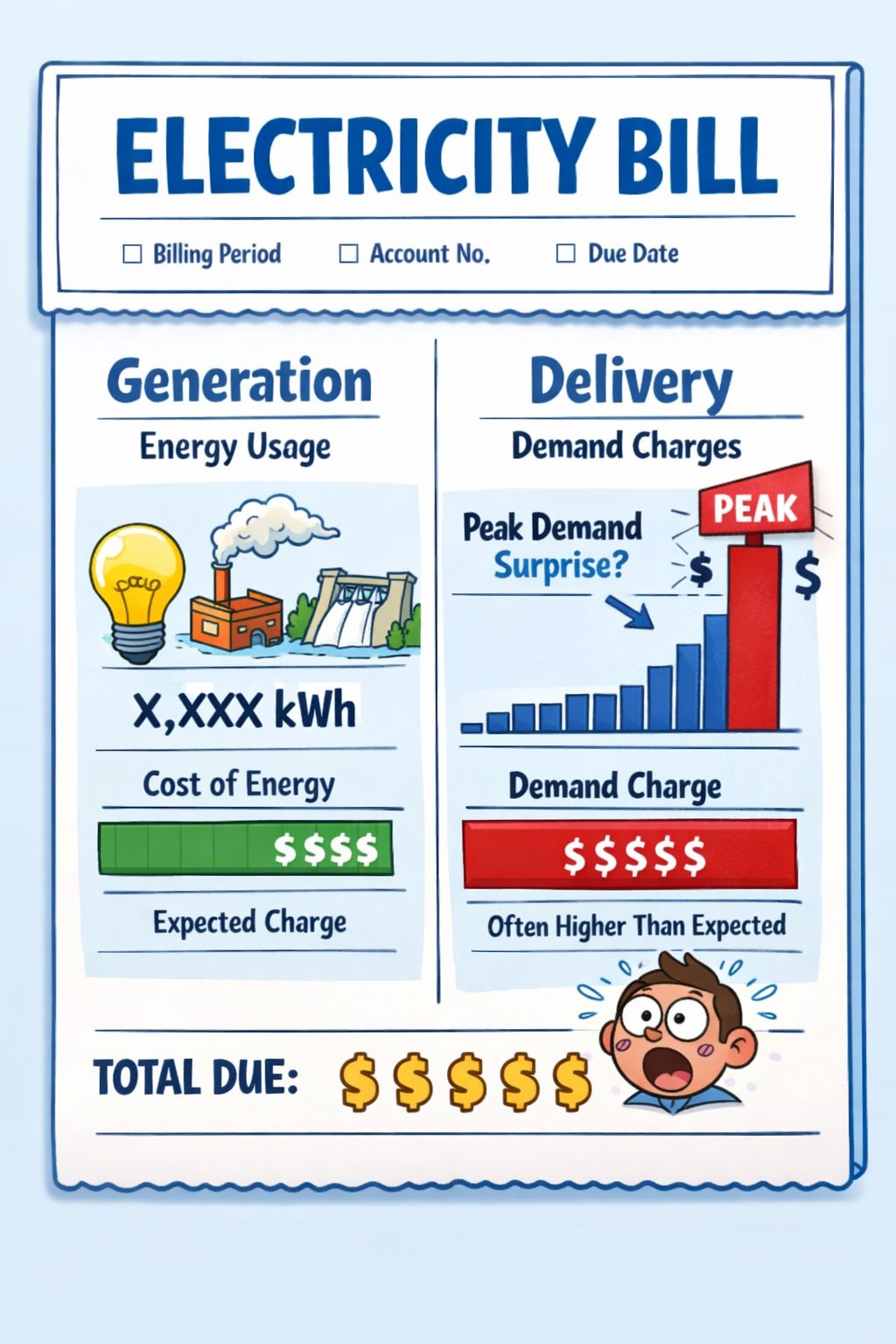
We talk a lot about energy costs but not enough about demand. Most building owners know what they pay per kWh. Fewer understand how much of their bill is driven by peak demand - and how little control they have over it. A typical electricity bill has two core components: Generation: the energy you consume Delivery: the cost to serve you Demand charges can make up 30–70% of a commercial building’s electricity bill. And they’re set based on your highest 15-minute spike in a billing period. One spike. One hot afternoon. One cold morning, when everything ramps up at once. And you pay for that all month. This is demand management: understanding when and how your building peaks, and shaping that load before it becomes expensive. Most buildings don’t actively manage their demand because they can’t. They lack real-time visibility and control. Systems ramp simultaneously. Peaks happen unintentionally. That has two consequences: Owners overpay... And the grid absorbs unnecessary stress. If we want more resilient grids, we need buildings that don’t all spike at once. Demand management is one of the simplest, most underutilised tools we have. And it’s sitting right there on your energy bill.
- LINKEDIN · IMAGESince 18 Feb 2026
Automated demand response is getting more attention now. and BAS upgrades But almost nobody can actually deliver it. OEMs know this space is the future. But they’re still asking about the ‘how.’ So they chase: → Automated demand management → Peak curtailment → Energy optimization services But here’s the problem: Retrofits, controls, and BAS upgrades are one-time wins. What they don’t have is: - Real-time utility data - Continuous optimization - Consistent ROI And that’s where most solutions fall apart. With the right data, buildings can: → Cut demand charges → Unlock 4x ROI → Save over $40,000 a year → Reduce grid strain without impacting tenants That’s the real opportunity. It’s not about selling more hardware or ripping and replacing systems. It’s about making buildings and the grid work in harmony. That’s what OEMs are trying to figure out. And what Parity, Inc. already has.
- LINKEDIN · IMAGESince 9 Feb 2026
Great piece in Reuters last week on how the industry is responding to the growing risks of blackouts. A lot of the focus is on emergency power auctions, price caps, and building more generation. And I get why: - When data centre demand explodes - When capacity prices jump 800% year on year - When blackout risks make headlines The instinctive reaction is always the same: “We need more power generation.” That’s the default answer: More generation. More delays. More billions. But we’re trying to solve a demand problem with a supply mindset. Yes - we need new generation long-term. But we also need to control the demand we already have. And that means pulling one of the biggest levers available to us. Because: 1. HVAC is one of the largest loads on the grid 2. Most buildings still run it blindly, 24/7 3. Peak demand - not total usage - is what drives grid stress and price spikes That’s the part that rarely gets discussed. You don’t only need more supply to manage peak demand. You need buildings that can respond. Buildings that can: - Read real-time grid conditions - Automatically curtail load during peaks - Shift demand without affecting comfort - Turn grid stress into revenue instead of risk This is what demand flexibility actually looks like. Before we spend $15B on a new generation. Before we cap prices. Before we threaten curtailment. Let’s optimize and refine what we already have. Credit to Jarrett Renshaw, Tim McLaughlin and Timothy Gardner for the great article. Original Article: https://lnkd.in/gVHFdEfr Other sources I found interesting: 1. EIAs analysis of record highs: https://lnkd.in/g5VGyQYA 2. As data grows, so does strain: https://lnkd.in/gYfKteju 3. Combatting overload: https://lnkd.in/gTrVKCx6





6 of 104+ adsSign up to see every Parity, Inc. ad, filter by format and date, and get alerts on new ones.
See all 104+ adsQuestions about Parity, Inc.’s ads
Does Parity, Inc. have new LinkedIn ads?
We found no new LinkedIn ads for Parity, Inc. in the 30 days to 12 Nov 2026.
How many LinkedIn ads has Parity, Inc. run?
LinkedIn’s ad library lists 69 ads for Parity, Inc.. We recorded 104 LinkedIn ads for Parity, Inc., first recorded on 28 Sept 2026 and last recorded on 28 Sept 2026.
Does Parity, Inc. run Google ads?
We recorded no Google ads for the domain paritygo.com on 5 Nov 2026.
Which ad formats does Parity, Inc. use?
The 6 LinkedIn ads on this page include 6 image ads.
Watch the companies you care about.
Filter every ad by industry, country, format and network, and get alerts when a company you watch starts running new ads.