Not on air · 2 of 3 networks checked
Orbital Eye
- orbitaleye.com
- Information Services
- NL
- 45 employees
Orbital Eye’s ads on LinkedIn, Meta and Google, recorded by adsrunning. Browse the latest here for free. Sign up free to see all 214. Watch Orbital Eye on any plan to get each new one in your feed.
Watchlist included in every plan
| Network | Status | Live ads | Nov 2025LinkedIn activity · 52 weeksNov 2026 | Checked | Next step |
|---|---|---|---|---|---|
| None recorded | 0 | Checked 3 Nov 2026 | See all 214 ads → | ||
| Meta | Not checked | — | |||
| None recorded | 0 | No ads found on the Google Ads Transparency Center | Checked 5 Nov 2026 | Collect them with the API → |
Orbital Eye has no live LinkedIn ads. We recorded no Google ads on 5 Nov 2026.
Latest ads
- LINKEDIN · VIDEOSince 21 Oct 2026
One thing I've learned over the years is that you can tell a lot about a technology by the questions people ask about it. Five years ago, most conversations about satellite monitoring started with questions like: "How does it work?" or "What can you actually detect?" Nowadays, operators are much more interested in how their peers are using it and what implementation looks like. I noticed that again recently when I spoke at an industry event. Instead of explaining the technology itself, most of the discussion was about operational deployments and real-world use cases. It's been really cool to see that shift happen and watch satellite monitoring become part of day-to-day operations for more and more operators.
- LINKEDIN · VIDEOSince 21 Oct 2026
Five years ago, I spent most meetings explaining what satellite monitoring was. People wanted to know how it worked, what satellites we used and whether it could actually detect anything useful. Nowadays, those questions rarely come up. Instead, operators want to know how their peers are using it and what implementation looks like. To me, that's one of the clearest signs that the industry is changing. I've really noticed the conversation has shifted from "does it work?" to "how do we make it part of our operations?" Have you noticed the same shift?
- LINKEDIN · VIDEOSince 21 Oct 2026
I see that something is shifting in the US pipeline industry. A year ago, every conversation with a North American operator started the same way: "Who else is using satellite monitoring and how is it being seen?" Today that conversation is changing fast. Interest is growing and so is our customer base there. European operators adopted satellite monitoring years earlier and those real operational deployments, actual detections in Spain, in France and across Europe, are now exactly what gives US operators the confidence to move. We see that as the first US operators are now using satellite monitoring operationally as well. PHMSA naming satellites and drones in approved language for right-of-way monitoring only accelerates that. The US market is moving and the operators who get ahead of it now won't be the ones asking for proof points in two years.
- LINKEDIN · CAROUSELSince 6 Oct 2026
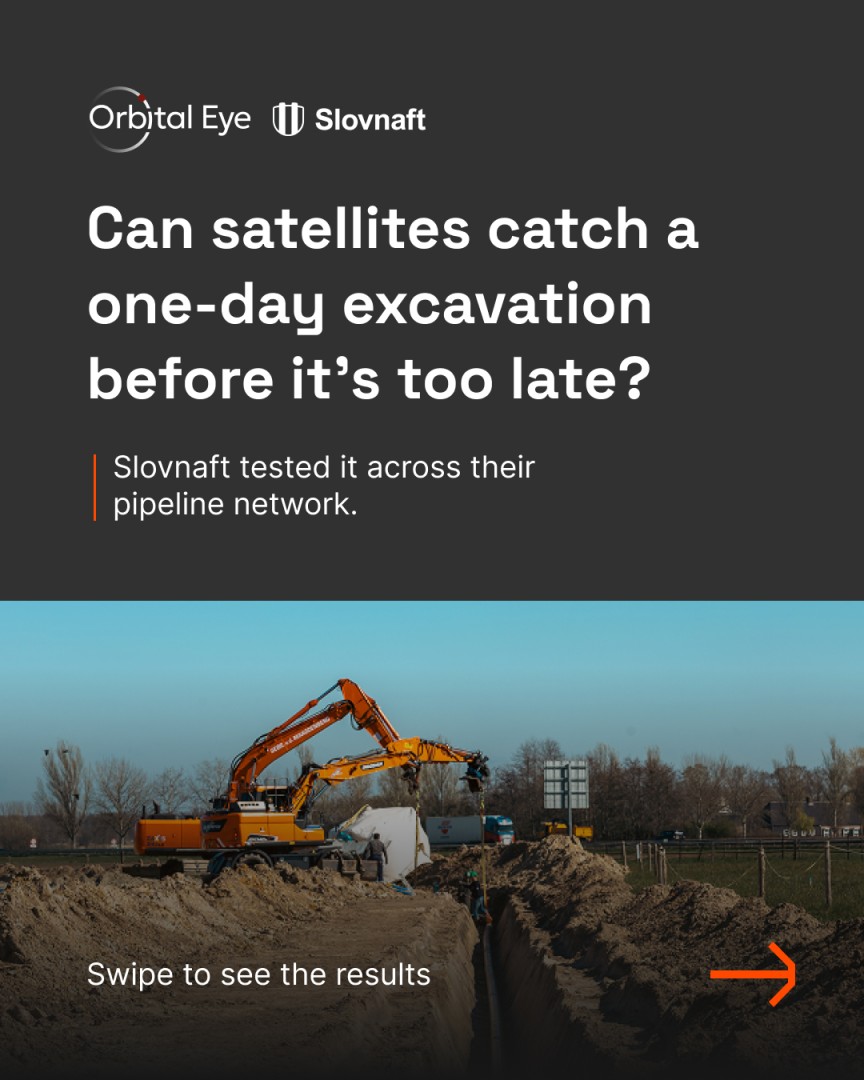
How do you detect excavation activity that starts and finishes within a single day? Slovnaft traditionally relied on car patrols and helicopter inspections to monitor its pipeline network in Slovakia. Over the past years, they transitioned to satellite-powered monitoring, increasing visibility across their network. But very small and short-lived excavation works remained particularly challenging to catch. Slovnaft partnered with Orbital Eye to integrate new daily satellite monitoring capabilities into their existing satellite-powered monitoring program, specifically targeting these small and short-lived activities. See how the test turned out.
- LINKEDIN · IMAGESince 6 Oct 2026
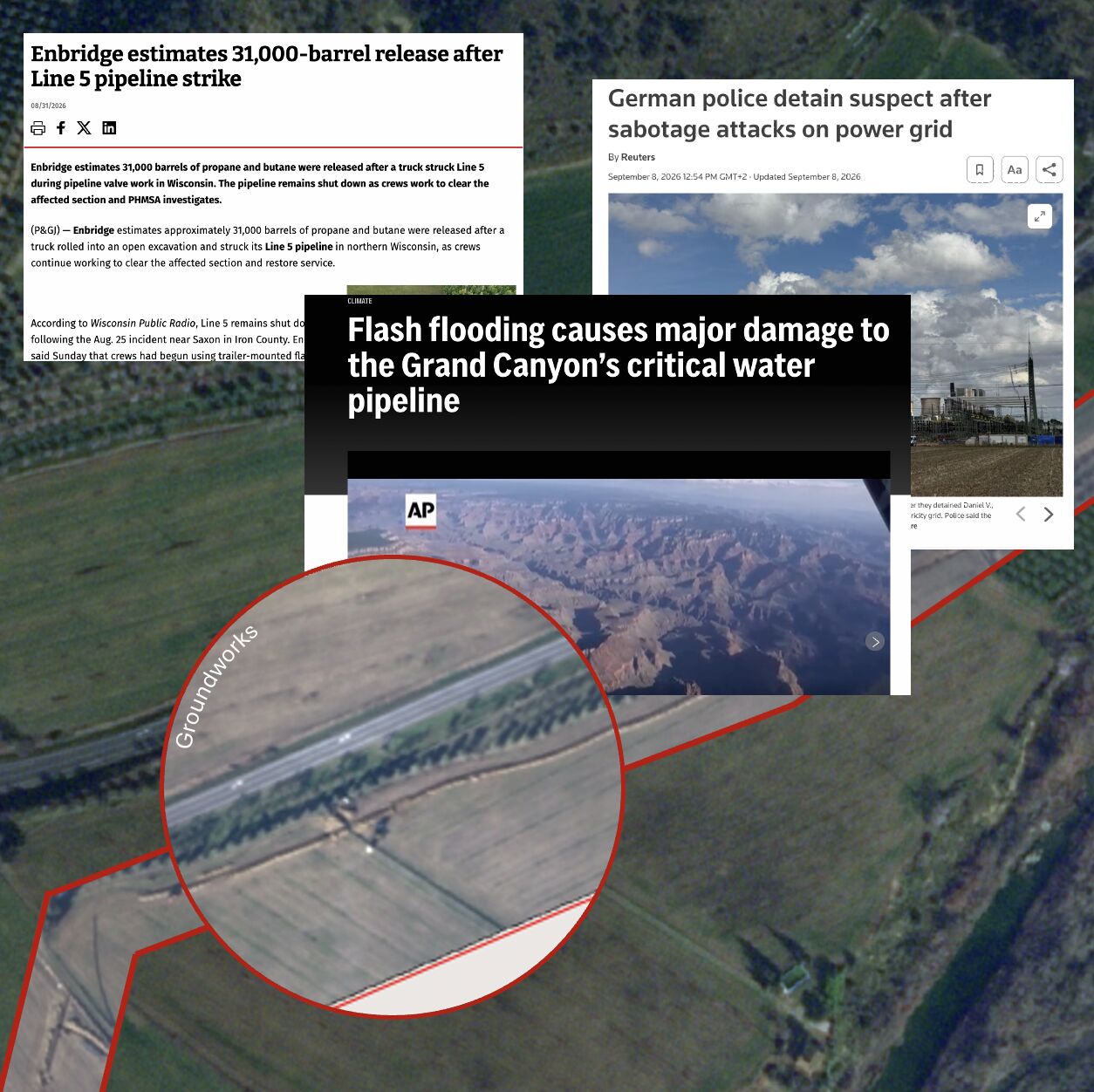
Do we build our pipeline damage prevention programs around the incidents happening today or around all the ones we're trying to prevent in the years ahead? Are we getting ahead of the curve or just getting better at cleaning up after it? Excavation, corrosion, extreme weather, sabotage, land use creeping closer to the line every year: all serious and all needing a response. Not all needing the same one. Underground utility damage now costs the US $83.2 billion a year, nearly triple what it cost in 2019, according to the Common Ground Alliance. Sabotage is a security problem: police, intelligence, a manhunt. Encroachment is a visibility problem: eyes on the corridor before the excavator shows up, not a task force after. Treat both the same way and you'll be too slow for either. Something happens, we add a rule. It happens again, we add an audit. Once more, and we add a committee. Before long, the whole program is just a map of red pins, marking everywhere something already went wrong. We're not falling behind on prevention. We're getting very good at aftermath. The next incident is already visible to anyone watching: a permit filed this week, ground being broken on a stretch with no pin on it yet. Waiting for it to happen so we can write a rule about it isn't a strategy. Stop designing for yesterday's incident and start to create a modern monitoring mix to prevent the ones that haven't happened yet.
- LINKEDIN · IMAGESince 6 Oct 2026
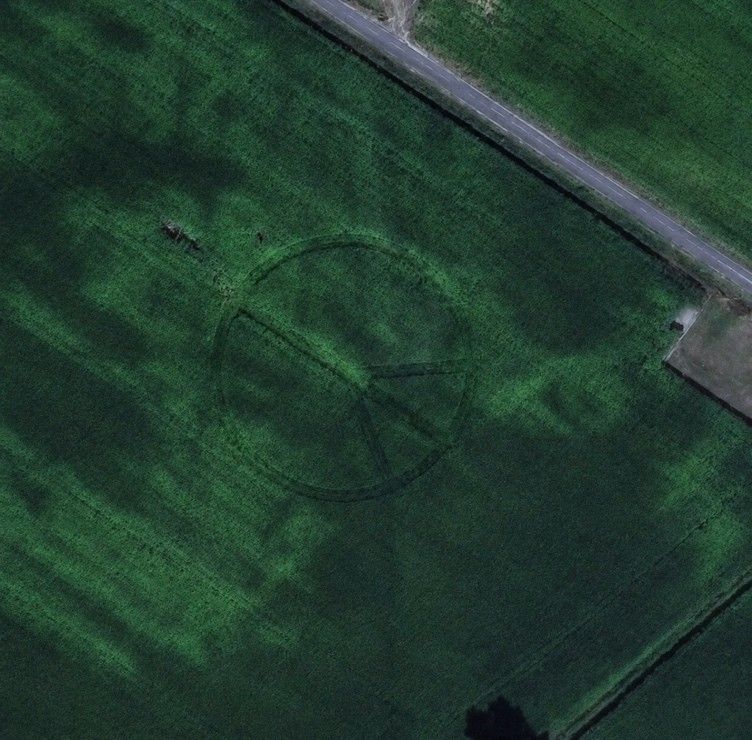
While monitoring critical infrastructure for a German customer, we came across something unexpected in the satellite imagery. A giant peace sign. Not exactly the kind of activity that requires an urgent field dispatch 😎 When you frequently monitor thousands of kilometres of infrastructure from space, you see all sorts of things happening around it. Most are harmless, some are unexpected, and every now and then someone leaves a message for anyone who might be watching. 👽 I figured I’d share it here too, just in case the intended audience is still on Earth. ☮️
6 of 214 adsSign up to see every Orbital Eye ad, filter by format and date, and get alerts on new ones.
See all 214 adsWatch the companies you care about.
Filter every ad by industry, country, format and network, and get alerts when a company you watch starts running new ads.