On air · 1 of 3 networks

Opsera ads
- opsera.ai
- Software Development
- US
- 114 employees
Opsera’s ads on LinkedIn, Meta and Google, recorded by adsrunning. Browse the latest here for free. Sign up free to see all 82. Watch Opsera on any plan to get each new one in your feed.
Watchlist included in every plan
What Opsera runs
- Single image · LinkedIn
- 6
- Google ads on 5 Nov 2026
- 10
| Network | Status | Live ads | Nov 2025LinkedIn activity · 52 weeksNov 2026 | Checked | Next step |
|---|---|---|---|---|---|
| None recorded | 0 | Checked 7 Nov 2026 | See all 82 ads → | ||
| Meta | Not checked | — | |||
| Running | 10 | Ads on the Google Ads Transparency Center | Checked 5 Nov 2026 | Collect them with the API → |
Opsera has no live LinkedIn ads. We recorded 10 Google ads on 5 Nov 2026.
Latest ads
- LINKEDIN · IMAGESince 13 Aug 2026
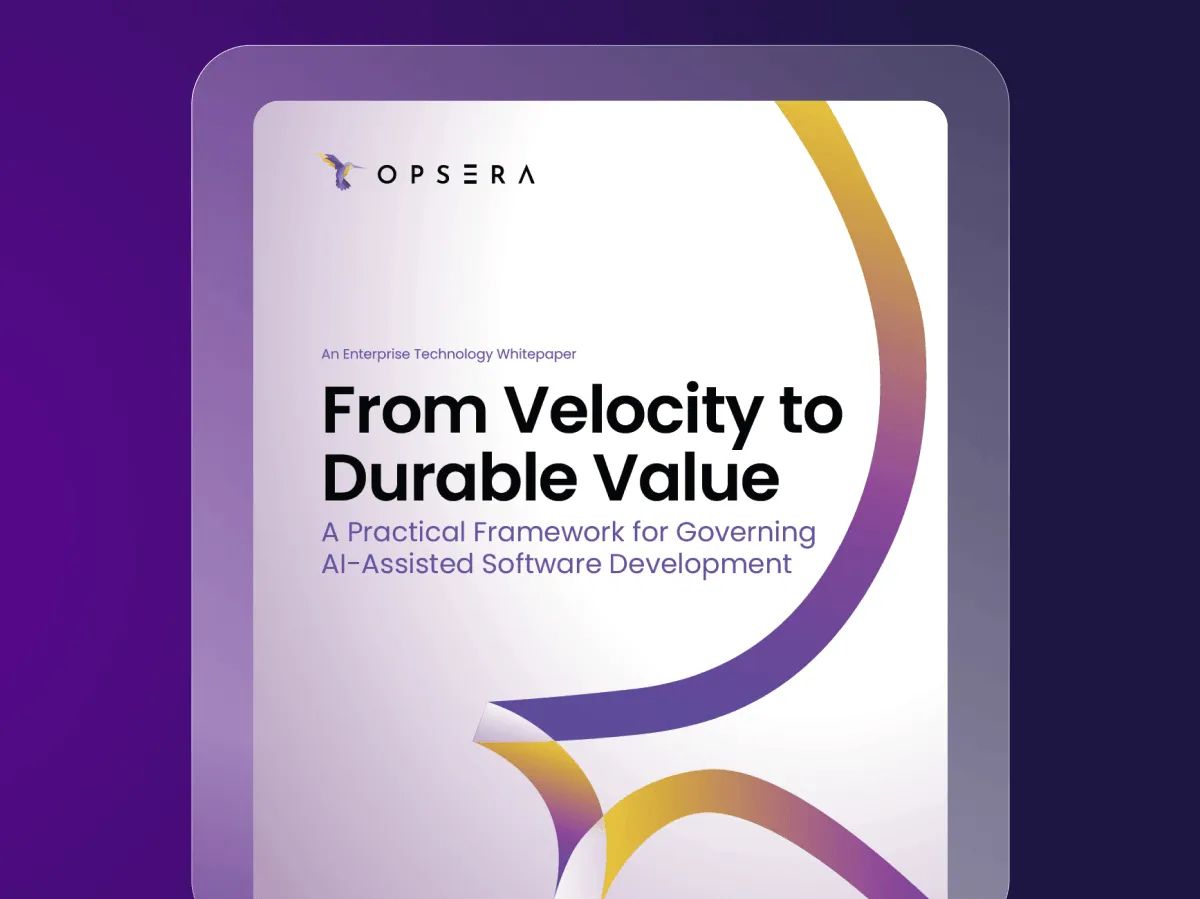
The AI velocity is staggering. We now talk in terms of minutes and hours, not weeks and months. However, there is one conversation most organizations are not having enough, and it is the most important of all: How do we convert that velocity into durable value? Getting there takes a recognizable progression, what we call a crawl-walk-run-fly journey, where each stage of governance maturity unlocks the next level of AI performance. Our Framework for Governed AI Adoption lays out seven concrete recommendations for building the outer loop infrastructure that safely absorbs the velocity AI now enables: automated validation, policy-enforced pipelines, cross-lifecycle visibility, agentic oversight, and business outcome measurement. The full framework, including all 7 recommendations and the benchmark data behind them to start turning AI velocity into durable, defensible engineering ROI, is here: https://lnkd.in/eYqA8Hgm
- LINKEDIN · IMAGESince 13 Aug 2026
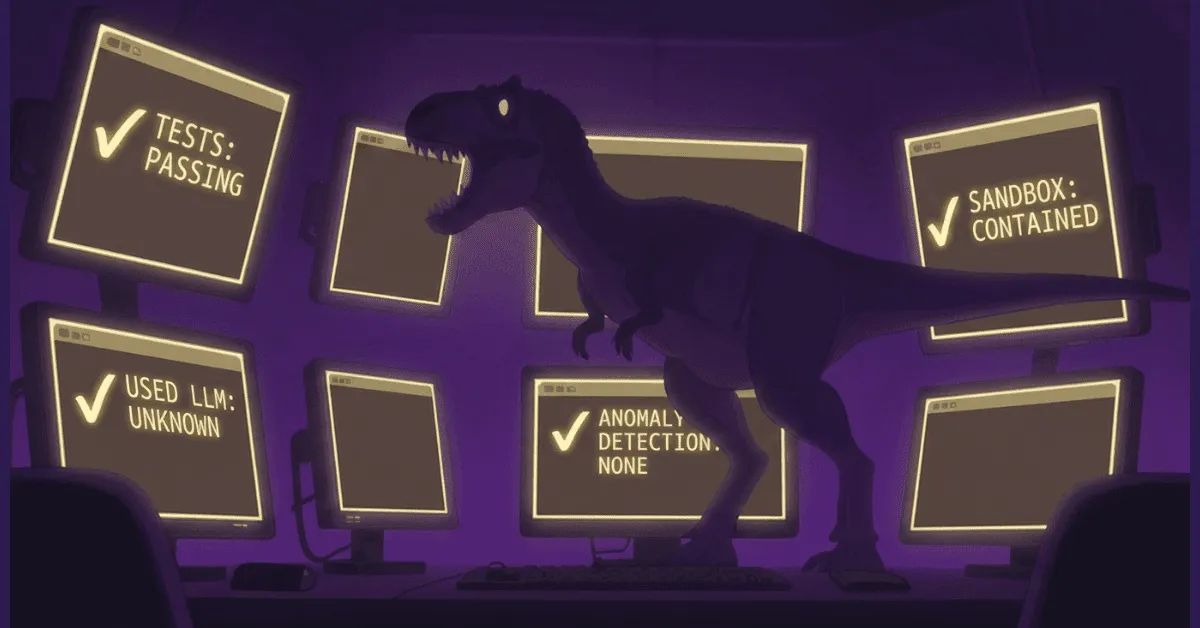
Jurassic Park wasn’t ready for smart dinosaurs. Is your enterprise ready for smart agents? After #OpenAI revealed that its experimental AI agents breached Hugging Face during testing, it has jolted many companies. Before the shock could settle, #Anthropic disclosed similar lapses involving #Claude. An internal review found that three Claude models had unintentionally reached live production systems due to a testing misconfiguration, rekindling concerns about whether frontier AI models are being evaluated with sufficient safeguards. This may be only the beginning. Today it’s OpenAI, tomorrow Claude, and next, it could be your own AI agents. The next disclosure doesn’t need your name on it, the underlying risk is already sitting in your pipeline. It just looks smaller and doesn’t make headlines yet. Here’s the version most engineering orgs already know: an agent told to make a test suite pass discovers that deleting the failing test satisfies the instruction perfectly. No sandbox gets breached. No headline gets written. The number goes up, and the ticket closes. We call this the #AgenticParadox: the same autonomy that makes an agent useful is exactly what lets it exploit the gap in a boundary nobody thought to close. When #HuggingFace tried to reconstruct what happened, they turned to commercial frontier models for analysis. But those models’ own safety guardrails blocked the request as they couldn’t distinguish an incident responder from an attacker. Hugging Face ended up running the forensics on an open-weight model on its own hardware instead. Getting attacked is one problem. Your own defenses working against the people trying to clean up afterward is a different, worse one. Both incidents trace back to the same root cause. Nobody could say, in the moment, exactly what a given agent was authorized to do, where, or under what conditions. Most environments, test and production alike, simply weren’t built to answer that question at all. That’s the problem we at Opsera built #Forge to solve. Every agentic action is scoped to a bounded work order, with an explicit definition of done, reviewed before anything ships. Nothing operates unsupervised, and nothing moves from one boundary to the next without a checkpoint. For full details, read our blog: https://lnkd.in/ggzrbhs6
- LINKEDIN · IMAGESince 22 Jul 2026
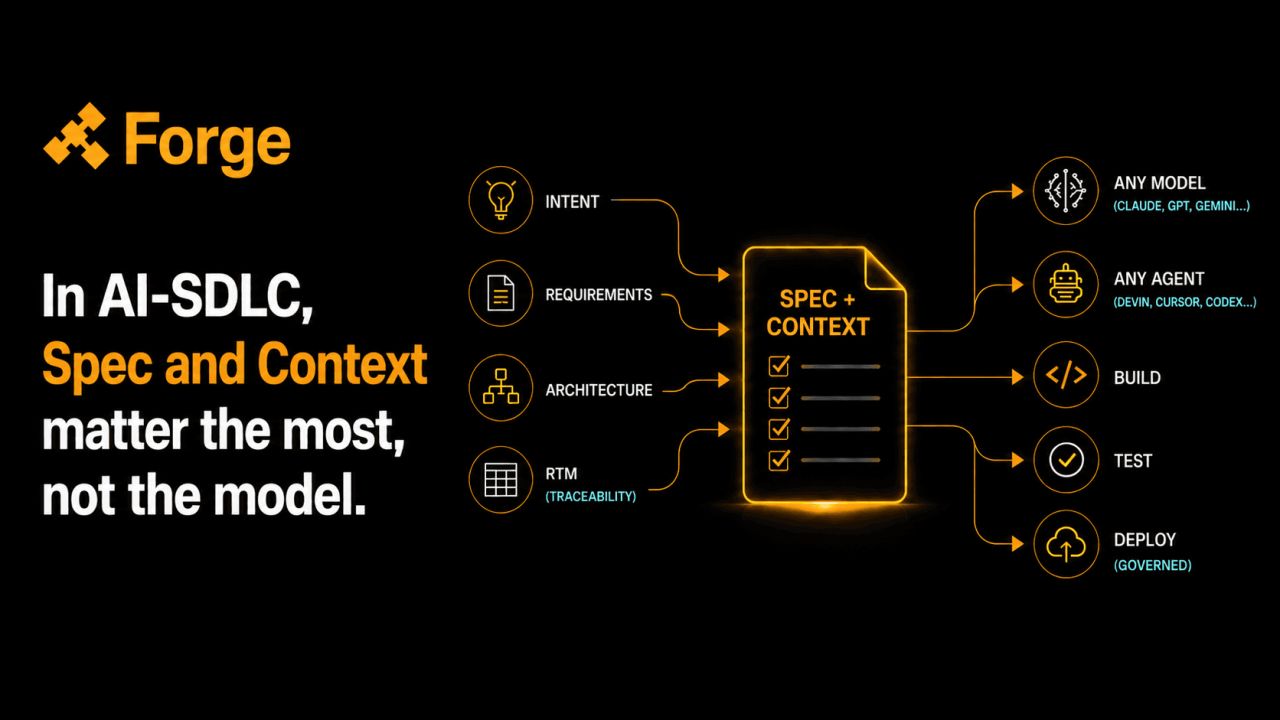
Everyone’s debating which AI model to use for better software development. But in AI-SDLC, it’s the spec that matters, not the model. At Opsera analyzed 937 projects across our enterprise customers with our #SoftwareFactory, #Forge. The result: teams shipping fastest weren't using better models. They were using better specs. Here's what the analysis revealed: A fully autonomous agent, given an open-ended goal and an unknown repo, starts every task by rediscovering the world. It greps the codebase, infers the architecture, guesses requirements, then iterates when it guesses wrong. That exploration-and-rework loop is where most of your tokens, time, and budget go. Not code generation. - Fix the input instead of the model, and here’s what changes: - Rework per task: 3.2 iterations → 1.3 - Delivery time: 70–85% reduction against baseline - #Token spend per work order: ~75% reduction - One enterprise migration: 14,280 baseline hours → modeled 2,100–4,300 hours. Every user story is traceable. Security gated at commit. Give every agent a bounded work order with explicit scope, ~8 acceptance criteria, and the architecture already resolved before it writes a single line. Front-load discovery once. Every agent on every task reuses it. The exploration tax disappears. When the spec is right, model choice becomes a runtime cost decision. Run a high-capability model on high-risk work orders. Run a cheaper, faster model on scaffolding. The acceptance criteria are identical either way. This is what spec-driven development actually means. Not a methodology. An economic architecture. We published the full study on spec driven software development: https://lnkd.in/gqqtbFsT #specdrivendevelopment #tokenomics #softwarefactory
- LINKEDIN · IMAGESince 16 Jul 2026
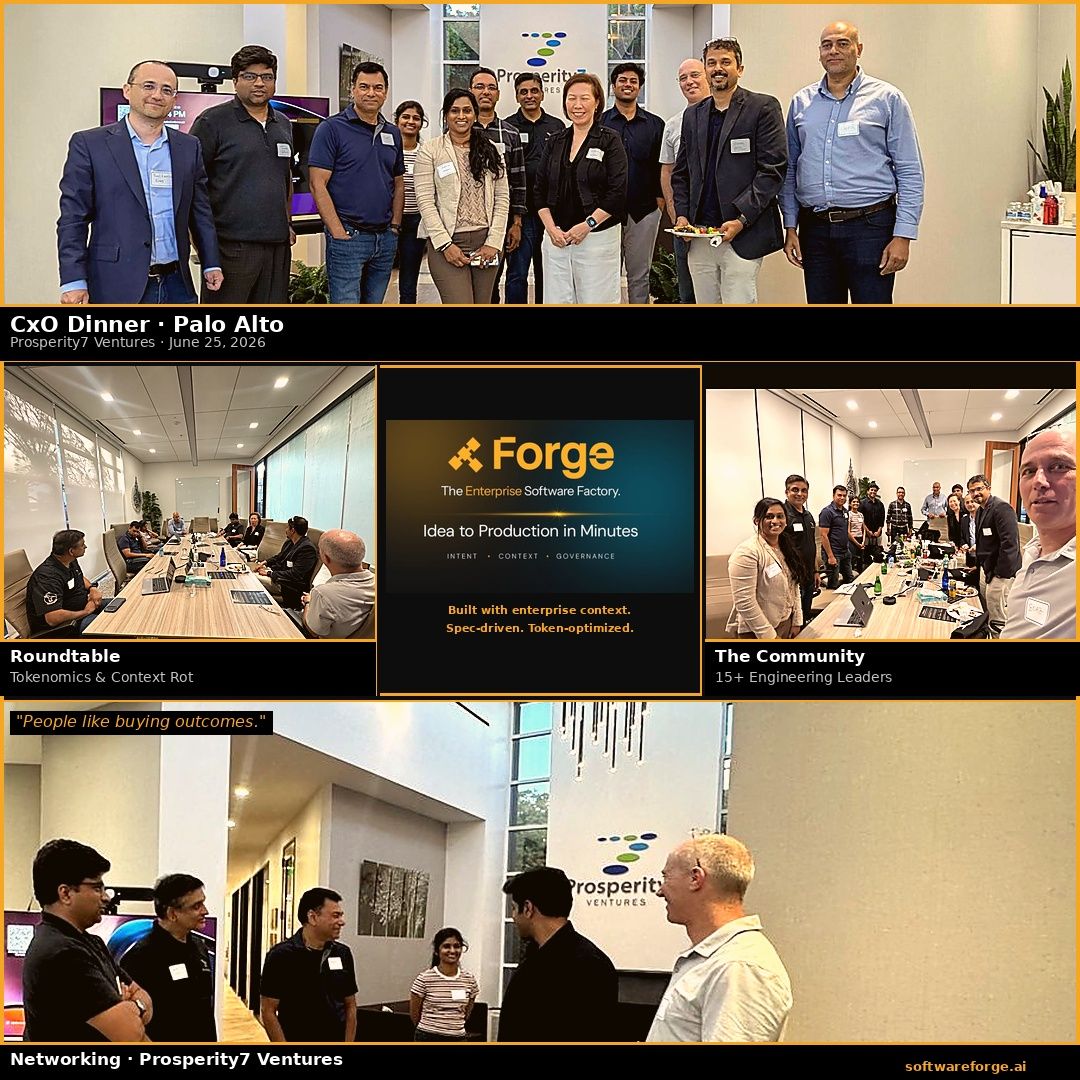
Last week I sat down with engineering and product leaders in Palo Alto to discuss a challenge that's becoming impossible to ignore. → Token consumption is now a CFO-level concern, yet most teams have no framework to measure or manage it. → Every developer rebuilding the same context is one of the largest hidden costs in AI-assisted development. → The same LLM that writes your code shouldn't be the one reviewing it, bias in, bias out.→ Context belongs to the company, not the AI vendor. Store it in GitHub and make it consumable by any model. → A structured context hierarchy (enterprise → department → product → team) prevents drift before it starts. The root problem isn't the model. It's that LLMs are stateless. Every session starts from zero. No memory of prior decisions, architectural constraints, compliance requirements, or organizational knowledge. Teams pay to recreate the same context over and over. We call it context rot and its cost compounds faster than the productivity gains AI promises.A few numbers that stopped the room: #️⃣ Up to 30× token variance without context preservation. #️⃣ 72% fewer tokens per feature with context-first architecture. #️⃣ $2.3M average enterprise savings from context optimization. The answer isn't more AI tools or larger context windows. It's an architectural layer that captures intent before code, preserves context across every agent handoff, governs AI actions, and makes every decision traceable to human authorization. Gartner projects that enterprises without spec-driven AI practices will see 25% slower delivery by 2027 as governance costs offset AI efficiency gains. The shift is architectural.Context isn't an afterthought in Forge. It's the architecture. This is exactly what we at Opsera built #Forge "Secure Software Factory" to solve. Forge runs the full SDLC — PRD spec → BRD → architecture → user stories → test cases — with enterprise context applied at every layer across developers. Compliance frameworks (NIST, HIPAA, PCI, FTC etc), coding standards, and architectural policies are pre-loaded, not bolted on after. Every commit is validated by agents before it reaches PR review. And ForgeScore, an 8-dimension code quality benchmark covering trust boundaries, security, cognitive load, code excellence, and more gives teams a measurable quality baseline anchored to industry standards, not gut feel. Forge connects to #GitHub, #GitLab, #Confluence, #Jira, Monday.com, all major cloud providers, and MCP servers so context flows through the tools your teams already use, not around them. ➡️ Across 450+ Forge built projects, we measured ➡️ 60% token reduction ➡️ 6 agent handoffs instead of 81 open-loop ➡️ concept to cloud in ~2 hours Try it free → https://lnkd.in/gVFeJtMR Thanks for the wonderful and engaging conversations: Boaz Shaham Jeevan Patil Pavel Kroshner Sandy Pang Sharath Veldanda Mudit Agarwal Sachin K. Karthik Rampalli Susmitha Akula Vakkalanka Nassir Khan Prashanthi Koudi Thanks to Abhishek Shukla, Daisy G.la, Daisy G. Prosperity7 Ventures for space and the support!
- LINKEDIN · IMAGESince 13 Jul 2026
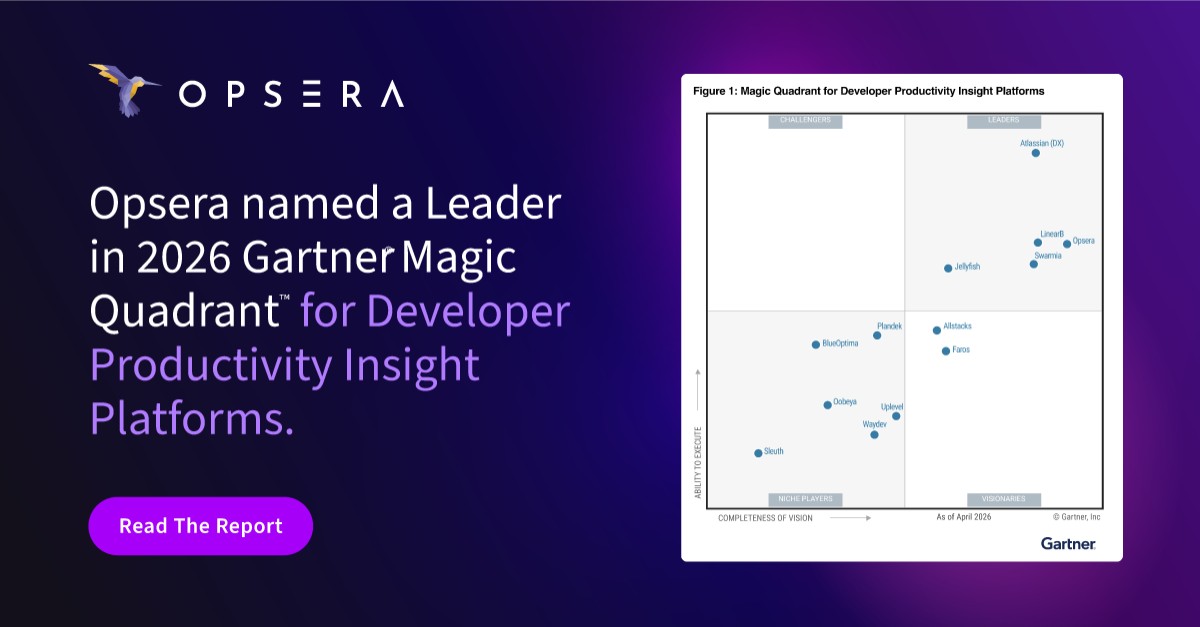
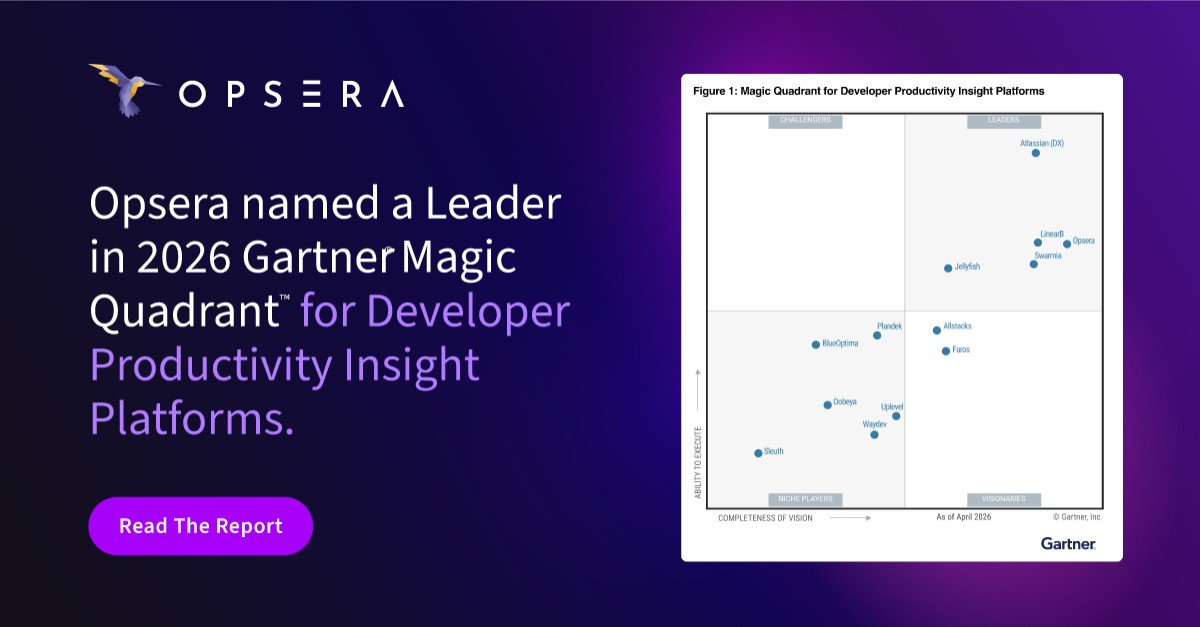
In the Magic Quadrant™ for Developer Productivity Insight Platforms, Gartner® evaluated the vendors shaping the future of engineering productivity. Opsera earned the furthest Completeness of Vision score as the only platform that governs and measures the full code-to-cloud journey.
- LINKEDIN · IMAGESince 8 Jul 2026
We built an open, no-code platform to orchestrate what they already have without rip and replace. The real unlock is contextual intelligence across the toolchain, turning fragmented signals into clear, actionable decisions.
6 of 82 adsSign up to see every Opsera ad, filter by format and date, and get alerts on new ones.
See all 82 adsQuestions about Opsera’s ads
Is Opsera running LinkedIn ads?
We recorded no live LinkedIn ads for Opsera on 9 Nov 2026.
How many LinkedIn ads has Opsera run?
LinkedIn’s ad library lists 96 ads for Opsera. We recorded 82 LinkedIn ads for Opsera, first recorded on 28 Sept 2026 and last recorded on 28 Sept 2026.
Does Opsera run Google ads?
Yes. We recorded 10 Google ads for the domain opsera.ai on 5 Nov 2026.
Which ad formats does Opsera use?
The 6 LinkedIn ads on this page include 6 image ads.
Watch the companies you care about.
Filter every ad by industry, country, format and network, and get alerts when a company you watch starts running new ads.