Not on air · 2 of 3 networks checked

Observata ads
- observata.com
- IT Services and IT Consulting
- SE
- 7 employees
Observata’s ads on LinkedIn, Meta and Google, recorded by adsrunning. Browse the latest here for free. Sign up free to see all 80. Watch Observata on any plan to get each new one in your feed.
Watchlist included in every plan
What Observata runs
- Single image · LinkedIn
- 4
- Video · LinkedIn
- 2
| Network | Status | Live ads | Nov 2025LinkedIn activity · 52 weeksNov 2026 | Checked | Next step |
|---|---|---|---|---|---|
| None recorded | 0 | Checked 7 Nov 2026 | See all 80 ads → | ||
| Meta | Not checked | — | |||
| None recorded | 0 | No ads found on the Google Ads Transparency Center | Checked 5 Nov 2026 | Collect them with the API → |
Observata has no live LinkedIn ads. We recorded no Google ads on 5 Nov 2026.
Latest ads
- LINKEDIN · VIDEOSince 4 Nov 2026
Enterprise IT constantly navigates familiar cycles. Centralised versus decentralised. Public cloud versus on-premises. Operational control versus team autonomy. These shifts are natural responses to changing conditions. Budgets fluctuate. Regulations tighten. New capabilities emerge. The challenge is rarely about picking one model. Nor is it about treating it as a permanent destination. The real advantage lies in architectural flexibility. It allows teams to adapt smoothly, without rebuilding the estate every three years. True engineering freedom is not about removing structure. It is about building the right foundation. It requires a resilient baseline: - Standardised telemetry contracts let teams adopt new tools safely. - Vendor-neutral pipelines make moving between environments straightforward. - Technology choices become operational decisions rather than structural risks. Platforms, hosting models and vendors will always change. You do not need to control every moving part across your organisation. Govern the foundational data layer. Let the technology adapt. #EnterpriseArchitecture #PlatformEngineering #CloudStrategy #DevOps #Observability #Observata
- LINKEDIN · IMAGESince 3 Nov 2026
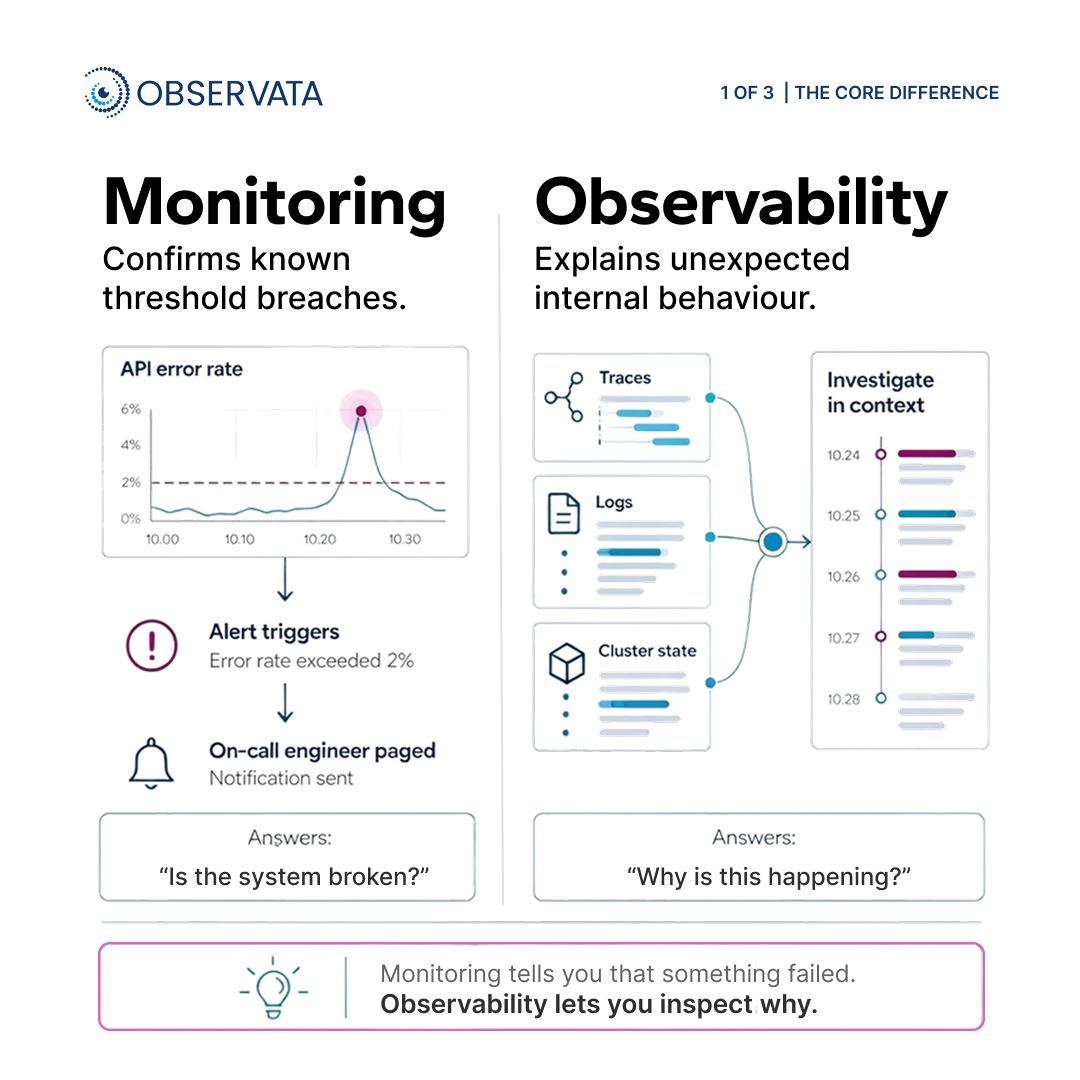
A threshold breaches. A dashboard spikes. An alert pages the on-call engineer. By then, users often feel the disruption first. Part 1 of 3: Monitoring vs. Observability. Most monitoring setups confirm what has already gone wrong. Observability serves a different purpose: Inspecting internal behaviour before a problem causes downtime. In modern distributed systems, failures rarely start as an outage. They begin with small performance changes: • Response times slowing down on a single endpoint • Resource contention in a background queue • Edge cases that static threshold alerts miss Monitoring answers one question: Is it broken? Observability answers: Why is it behaving this way? It links traces, logs and system state into a single timeline, so you can investigate without jumping between different tools. In part two, we look at why you can't write alert rules for failures you haven't seen before. When an alert goes off, how long does your team spend just trying to find where it started? #observability #monitoring #platformengineering #sre #devops
- LINKEDIN · IMAGESince 3 Nov 2026
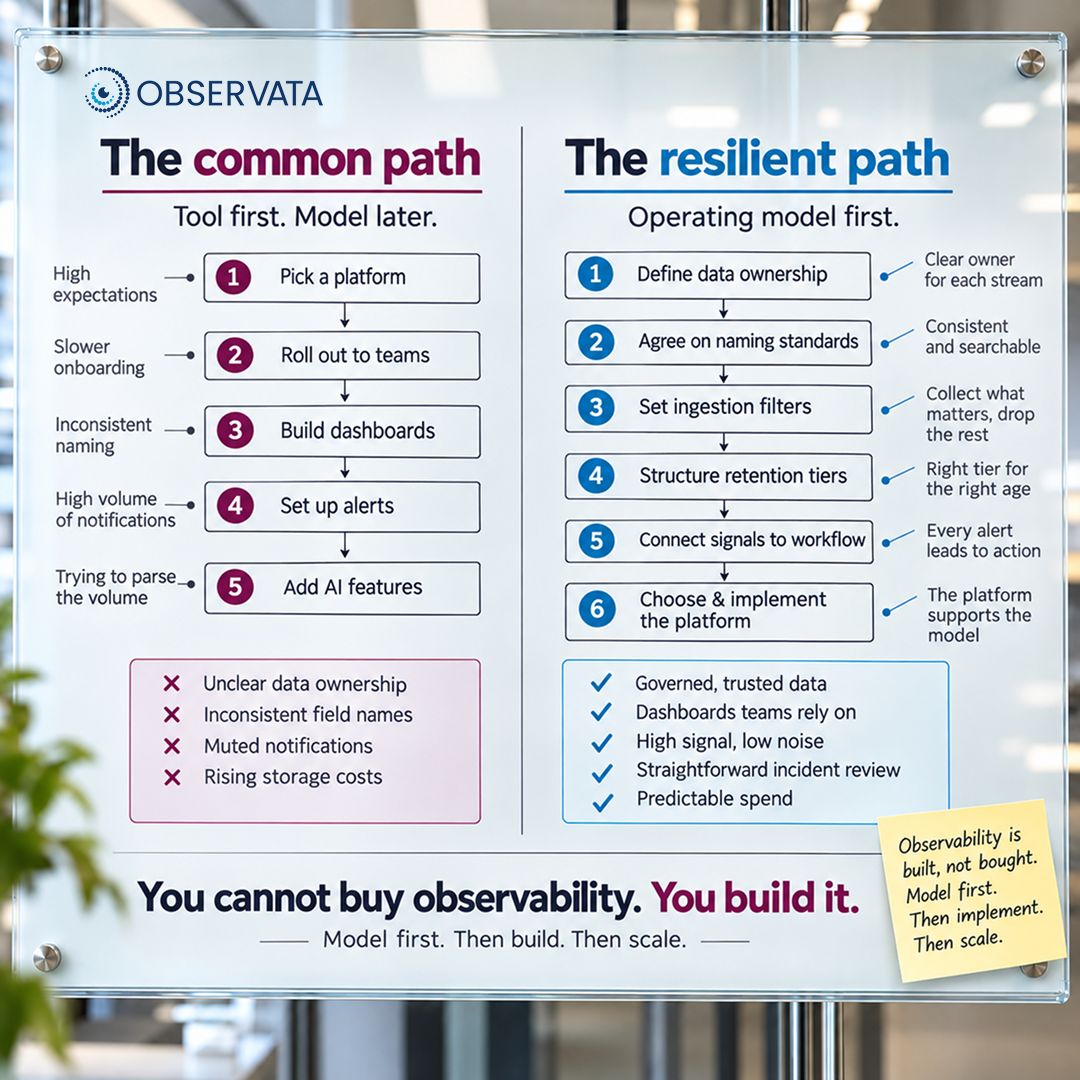
Most observability problems are treated as tooling problems. The invoice climbs. Alerts turn into noise. Teams look for a better platform. But switching tools only resets the clock. Six months pass: Ingestion and storage costs keep climbing. Teams use different field names across services. Default alerts turn into background notifications. Dashboards fall behind actual system changes. This is usually not because of a bad platform. It is a missing agreement on the basics: Who owns which data stream? Do services follow the same naming standards? What gets filtered out before ingestion? How long does each data type actually need to be kept? Does an alert trigger an action or just another notification? A tool cannot fix unmanaged telemetry on its own. Observability is built, not bought. Model first. Then implement. Then scale. #observability #platformengineering #datagovernance #sre #cloudinfrastructure
- LINKEDIN · IMAGESince 27 Oct 2026
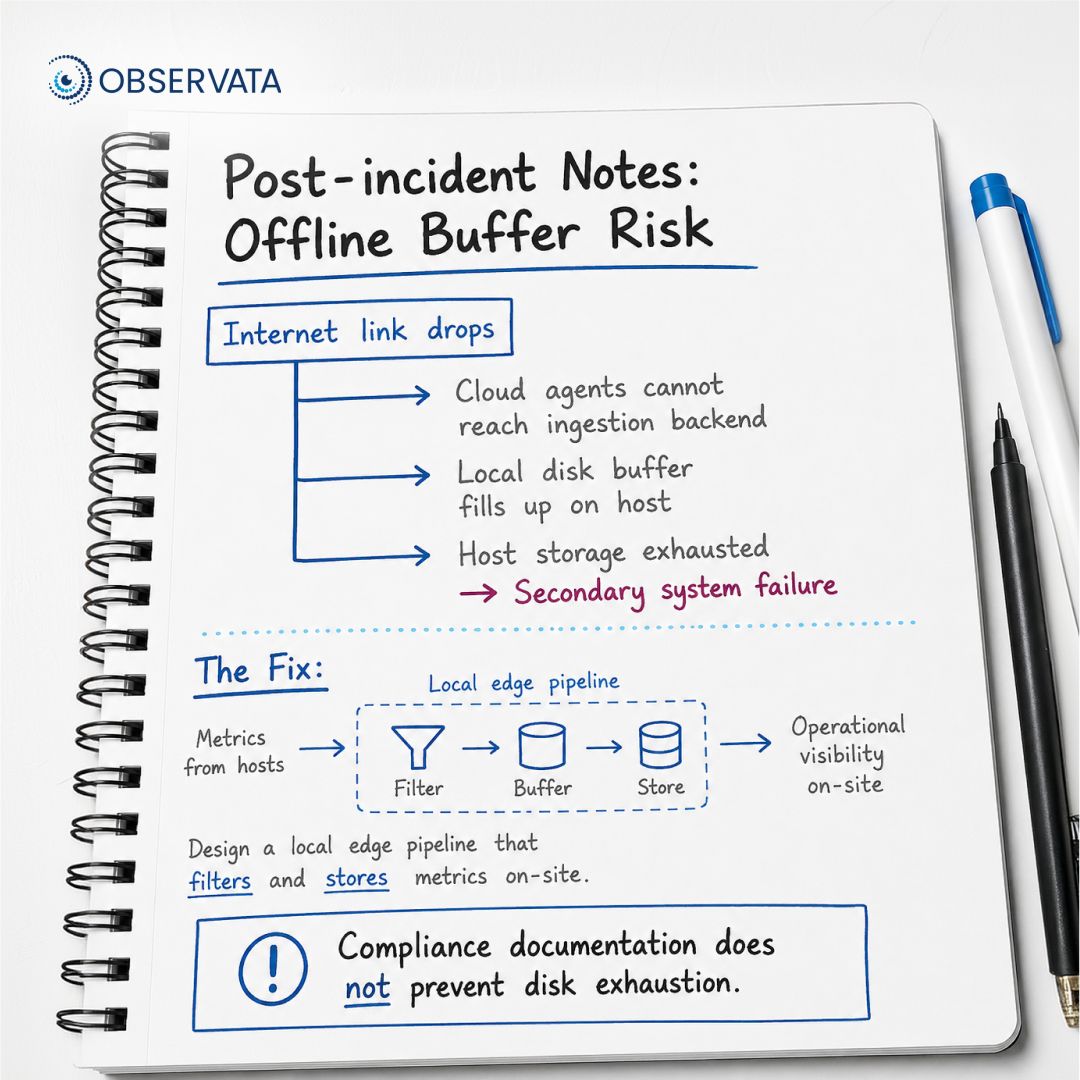
Most telemetry agents are built for permanent connectivity. Lose the uplink and the agent begins buffering on local disk. For standard web apps, that is fine. For critical infrastructure, that buffer can take down the host. When an uplink stays down for a few hours, local buffers fill up fast. When a host disk reaches 100%, production services halt. The monitoring tool ends up causing the secondary outage. Meeting NIS2 requirements is often not just a legal milestone. It is an architectural challenge around what happens when systems are genuinely cut off. A few principles we see working well in isolated setups: Decouple hosts from direct internet paths. Route telemetry through a dedicated local collector. Do not let individual agents manage their own uplinks. Cap agent disk limits aggressively. Set strict limits so telemetry never competes with application storage. Keep operational data local. Store a rolling window of critical telemetry on-site. Engineers can still triage incidents without internet access. Sync upstream when links stabilise. Compress and batch telemetry before backhauling it to central platforms. Resilience is not just about keeping the service running. It is about making sure you can still see inside the system when the network drops. #observability #NIS2 #criticalinfrastructure #platformengineering #sre
- LINKEDIN · IMAGESince 27 Oct 2026
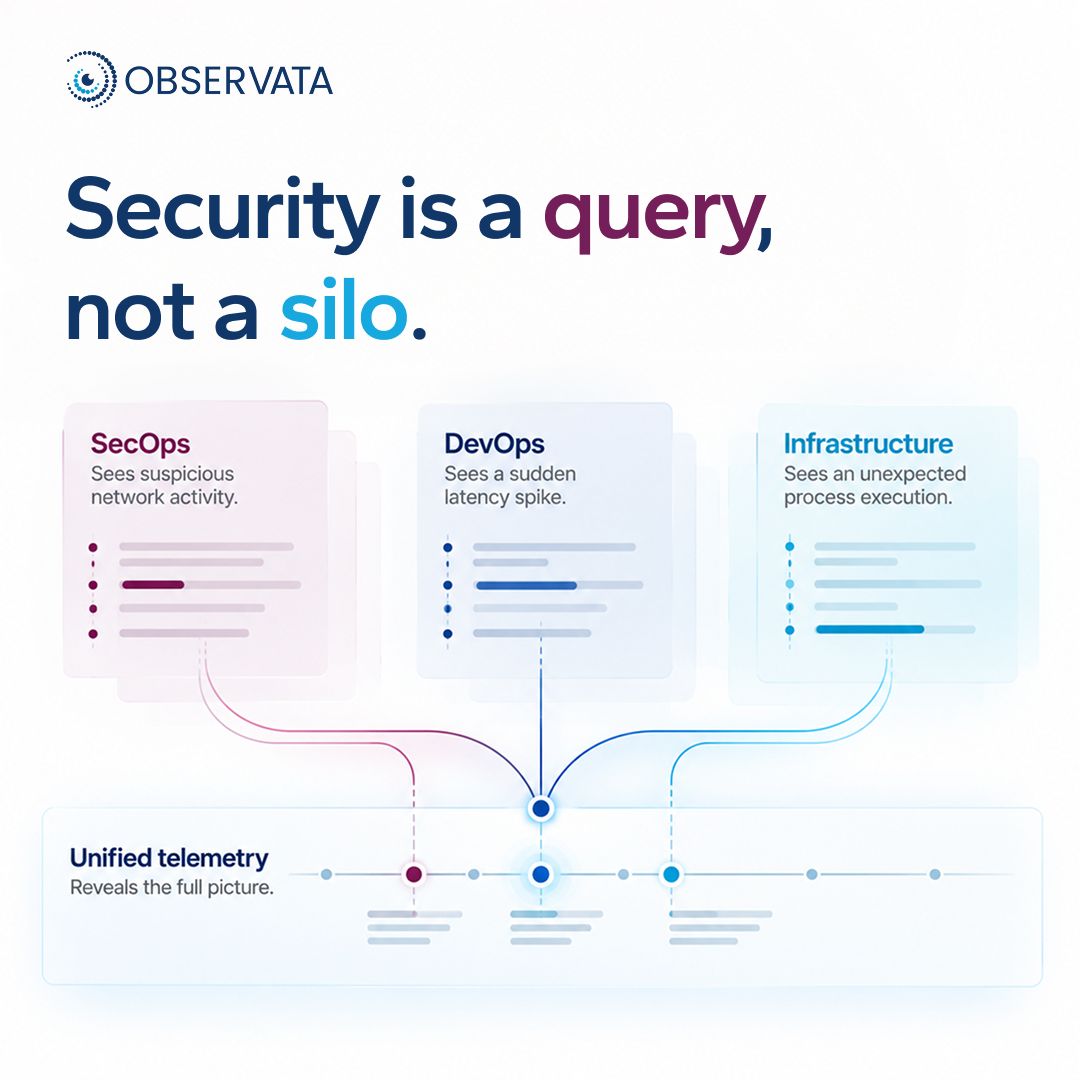
The first ten minutes of a major enterprise incident are revealing: Infrastructure checks container health and memory usage. SecOps audits firewall logs in an isolated SIEM. Leadership asks the urgent question: Is this a system failure or are we experiencing a cyber attack? This division made complete sense historically. Security teams needed strict data controls and dedicated compliance tooling. Reliability teams needed low-latency metrics to protect uptime. Separate stacks were the rational choice. Yet at the infrastructure layer, this boundary does not exist. An authentication failure, an abnormal connection, a rogue process and a latency spike are all generated by the exact same systems. When you standardise telemetry at the collection layer, you bridge operations and defence naturally: SREs use metrics to protect application uptime. SOC analysts use the same event stream to trace adversarial behaviour. Both teams evaluate a single timeline without losing time translating data. Resilience does not come from isolating security data in dedicated silos. It comes from realising that security is not a separate data stream. It is a query run against your core operational context. #CyberSecurity #SecOps #DevOps #SRE #EnterpriseArchitecture #PlatformEngineering #Observata
- LINKEDIN · VIDEOSince 22 Oct 2026
The talent shortage in our industry is real. Yet the real risk is not the shortage itself. It is operational dependence on individuals. When key knowledge depends on a few individuals, two things happen: Scaling halts the moment those engineers are unavailable. Senior engineers maintain systems instead of building value. Hiring more people does not solve a structural dependency. Resilient organisations solve this by embedding operational knowledge directly into the architecture. When telemetry standards, guardrails and context live in the platform layer: Knowledge transfers automatically across the organisation. Senior teams shift from routine triage to creating value. Systems remain dependable regardless of staff turnover. Resilience is not about who is on call. It is about building architectures that do not depend on individuals. #PlatformEngineering #SRE #Observability #EnterpriseArchitecture #DevOps #Observata
6 of 80 adsSign up to see every Observata ad, filter by format and date, and get alerts on new ones.
See all 80 adsQuestions about Observata’s ads
Is Observata running LinkedIn ads?
We recorded no live LinkedIn ads for Observata on 10 Nov 2026.
How many LinkedIn ads has Observata run?
LinkedIn’s ad library lists 80 ads for Observata. We recorded 80 LinkedIn ads for Observata, first recorded on 27 Sept 2026 and last recorded on 7 Nov 2026.
Does Observata run Google ads?
We recorded no Google ads for the domain observata.com on 5 Nov 2026.
Which ad formats does Observata use?
The 6 LinkedIn ads on this page include 4 image ads and 2 video ads.
Watch the companies you care about.
Filter every ad by industry, country, format and network, and get alerts when a company you watch starts running new ads.