Not on air · 1 of 3 networks checked
Momentic
- momentic.ai
- Software Development
- US
- 55 employees
Momentic’s ads on LinkedIn, Meta and Google, recorded by adsrunning. Browse the latest here for free. Sign up free to see all 276. Watch Momentic on any plan to get each new one in your feed.
Watchlist included in every plan
| Network | Status | Live ads | Nov 2025LinkedIn activity · 52 weeksNov 2026 | Checked | Next step |
|---|---|---|---|---|---|
| None recorded | 0 | Checked 3 Nov 2026 | See all 276 ads → | ||
| Meta | Not checked | — | |||
| Not checked | — |
Momentic has no live LinkedIn ads. We recorded 33 Google ads on 5 Oct 2026.
Latest ads
- LINKEDIN · FOLLOWRecorded 26 Sept 2026
Get the latest jobs and industry news
- LINKEDIN · VIDEORecorded 15 Oct 2026
We raised $15M for this moment. Introducing Mo, the world's first AI QA engineer. Nobody I’ve met enjoys writing Playwright tests. All they want is no bugs. Now you can point Mo at your app and 100+ agents bug bash it in parallel. At the end, you get a report: what was tested, what failed, repro steps, logs, and a video of each bug. AI made writing code fast, and testing never caught up. Claude Code, Cursor, and Devin write the code. Mo bug bashes it so your customers don't find the bugs first. In our evals against Codex with Playwright MCP, Mo found: - 3.8x more bugs - 9x more bugs per hour - at half the cost per bug In beta, Mo already ran 1,100+ bug bashes and caught 3,500 verified bugs. A few special thank-yous: The teams at Notion, Glide, Superpower, Boundless Life, Gumloop, Hamming AI, Tamarind Bio, Iris, Committee for Children, Kibu, WisdomAI, and our other beta customers, who bug bashed Mo as hard as Mo bug bashed their apps. Standard Capital, Y Combinator, and our other investors, who backed us to build this. And most of all, the Momentic team, who built Mo. Comment “Mo” to get $250 in free credits. Drop your app URL in the comments too. Mo will bug bash it and DM you the report today.
- LINKEDIN · VIDEORecorded 12 Oct 2026
We just made bug bashing an iOS or Android app a one-prompt job. Agnes Shan on our team gave Mo, our AI QA engineer, this prompt: “bug bash this app thoroughly” It came back with 8 bug reports, and nobody wrote a single test. Every bug came with a recording of what Mo tapped and where the app broke, so you can confirm it's real before anyone starts on a fix. Before a release, most mobile teams find these bugs in one of two ways: (1) someone taps through every flow by hand, or (2) the team maintains end-to-end tests that fail whenever a screen gets rearranged. Mo does the tapping itself. It explores the app on an emulator first, then splits the app into sections and hands each one to a subagent. All the subagents run in parallel. We gave every subagent its own emulator on purpose. When agents share an emulator, they wait on each other and change each other's app state. So adding more agents stops making the run any faster. One emulator per subagent is only practical because our hosted emulators boot in ~1s. We're still onboarding every mobile team ourselves. If you have an iOS or Android app, DM me and we'll get Mo running on your build.
- LINKEDIN · IMAGERecorded 12 Oct 2026
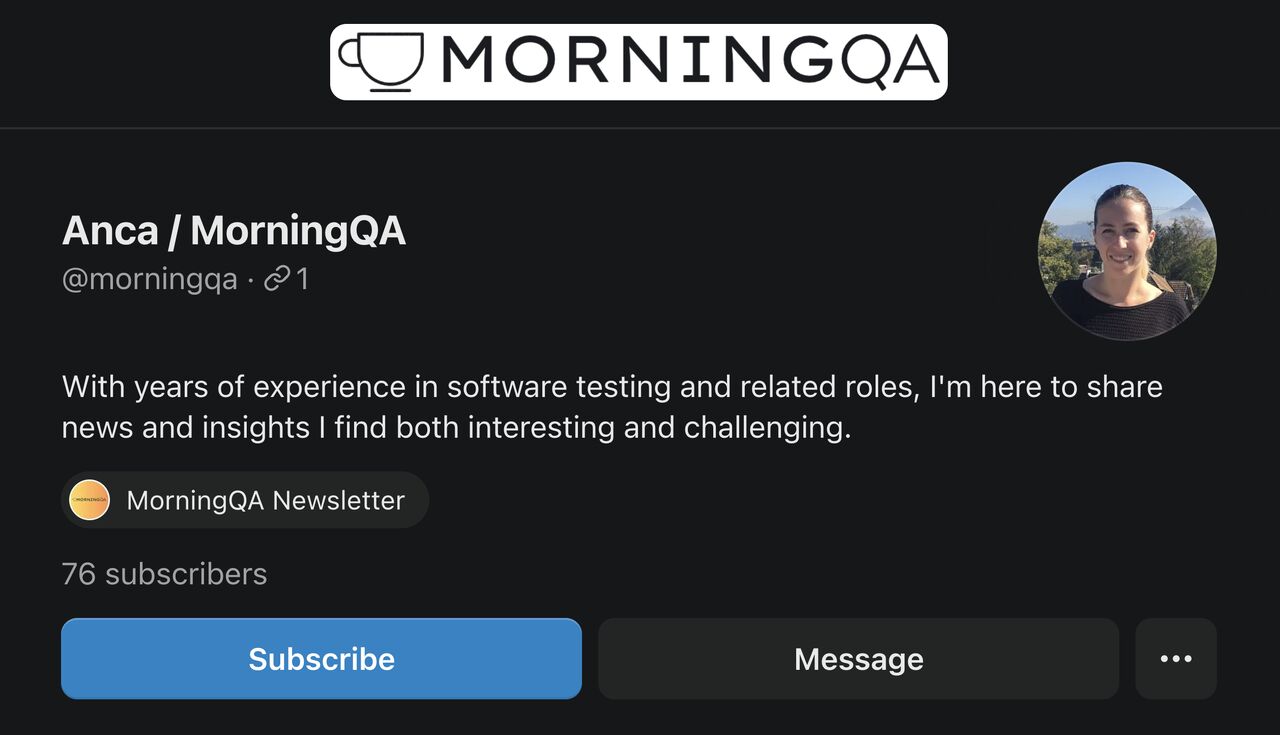
I just spoke with Anca Oaida, who writes MorningQA and has spent years in software testing. She asked what happens to the QA role when agents can write and repair tests. I told her, "Judgment is what will stay in the role." After watching 100+ engineering teams use Momentic, I've seen the strongest teams change where QA expertise sits. QA becomes the quality bar and infrastructure layer, and engineers own the tests for the features they ship. With Momentic, teams describe important user flows in plain English, keep the tests with their code, and run them in CI. When intended behavior changes, the agent can propose a repair, but a person reviews whether it still protects the original user flow. This matters because writing a test is only a fraction of the work. In a cost model we published recently, a 25-developer team spends about $186K a year writing tests and $548K investigating failures and maintaining the suite. Agents can take on a lot of that repetitive work. But good QA engineers know where users get stuck, which edge cases matter, and when a failure signals a stale test instead of a product regression. As agents execute more of the work, that context matters more. I think QA professionals will spend less time babysitting scripts and more time deciding what the product must do and reviewing whether agent work still protects it. Thanks to Anca for the great questions and thoughtful conversation. She publishes MorningQA every other week for engineers and testing leaders. Interview in the comments!
- LINKEDIN · IMAGERecorded 12 Oct 2026
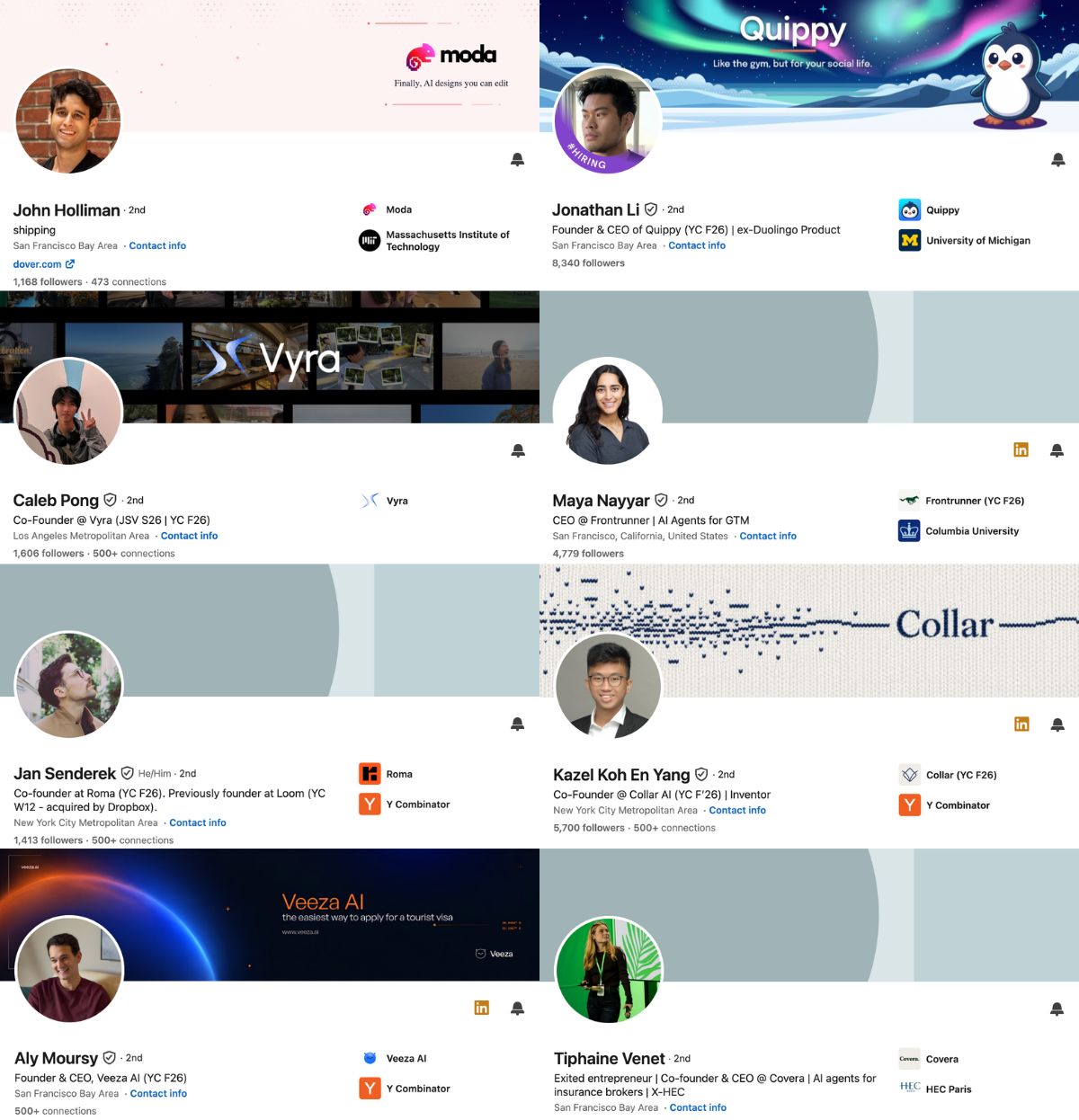
I did Y Combinator W24. F26 just kicked off, and I'd already use half of what this batch is building. Here are 9 teams I'm following all the way to demo day: 1. Moda (John Holliman , Anvisha Pai & Ravi Parikh) raised $7.5M to build a design agent that makes on-brand slides on a fully editable canvas. 2. Vyra (YC F26) (Caleb Pong & Sulan Zhang) edits your video from a description. Upload footage, describe the cut you want and get it back without ever touching a timeline. 3. Quippy (Jonathan Li) lets you practice real social conversations, with line-by-line feedback and a curriculum built around your weak spots. 4. Roma (Jan Senderek, Tobias Eichenwald & A. Cody Osborne) turns the to-do list into an everyday assistant that helps you actually finish things. 5. Frontrunner (YC F26) (Maya Nayyar & Carl Bager) built a GTM agent workspace that researches accounts, finds prospects, runs campaigns and updates the CRM. 6. Veeza AI (YC F26) (Aly Moursy) uses agents to prepare tourist visa applications, check documents and book appointments. 7. Covera (YC F26) (Tiphaine Venet & Thibaut Regerat) automates insurance broker work, from submission intake to carrier quotes, claims and collections. 8. Collar (YC F26) (Kazel Koh En Yang & Jamie Yau) preps earnings materials, tracks peers and helps companies find the right investors. 9. Ascenix (YC F26) (Rishi Mehta & Ayaan Esmail) reads nursing home EHR notes to automate incident reporting, compliance flags and reimbursement recovery. Between now and demo day, everyone in F26 will be shipping nonstop. And it's really hard to write quality software that fast. Trust me, I know. So we're giving the entire F26 batch $12K in Momentic credits to have Mo, our AI QA engineer, bug bash whatever you ship before demo day on web, iOS or Android. Go ham. 100+ agents click through your app in parallel, and you get back every bug with repro steps, logs and a video. Grab it on Bookface. Who else in F26 deserves a spot on this list?
- LINKEDIN · IMAGERecorded 12 Oct 2026
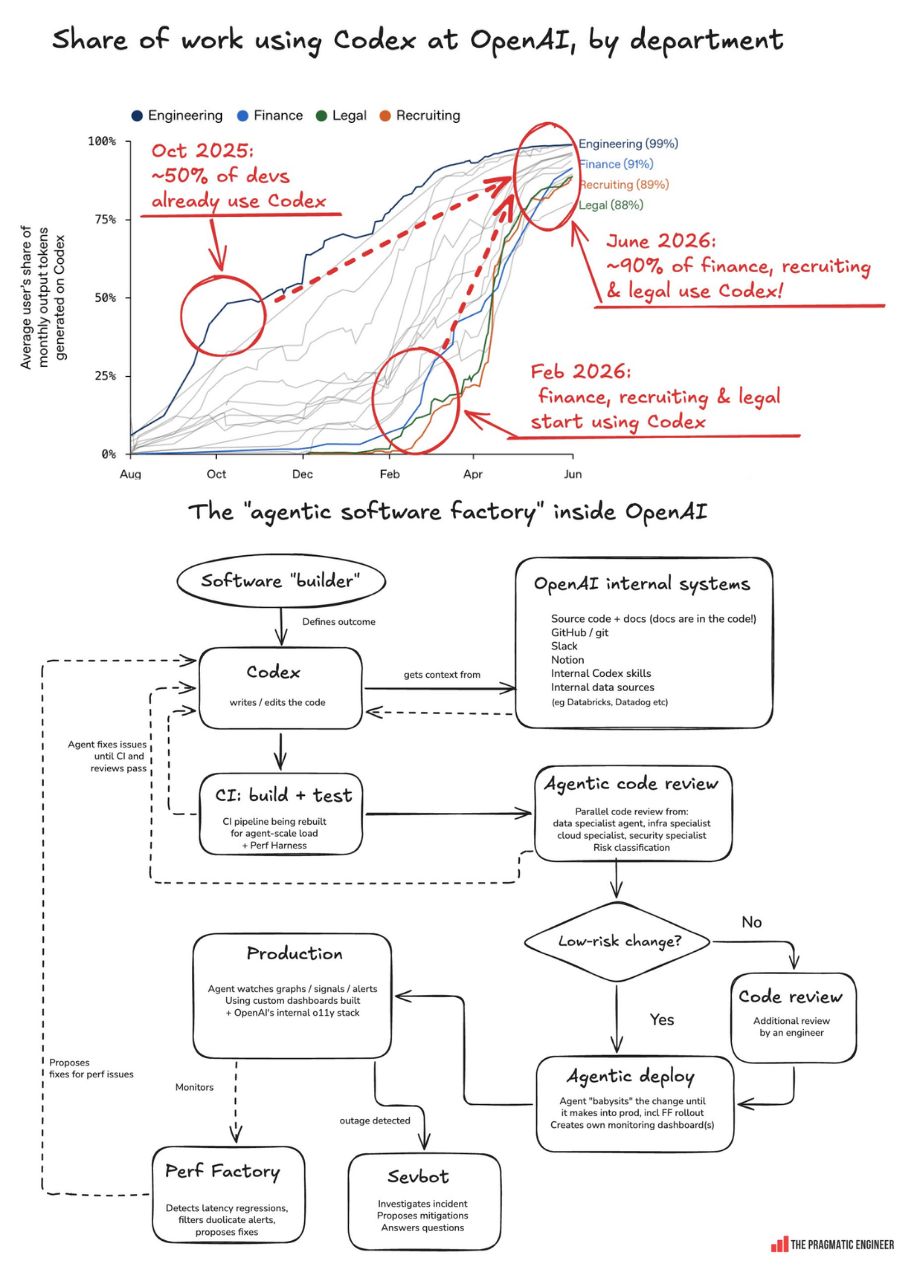
Gergely Orosz interviewed 7 people across OpenAI engineering about how they ship software now. Here's their agentic software factory, step by step: 1. An engineer or PM defines the outcome 2. Codex pulls context from the repo, Slack, Notion, and Datadog 3. Codex writes the change, runs tests, and fixes failures until CI is green 4. Specialist agents review the PR for data, infra, and security issues, and risky changes go to a human 5. After a human approves the release, an agent watches the rollout on a dashboard it builds for that change 6. Perf Factory finds latency regressions in production and proposes fixes 7. Sevbot suggests ways to mitigate an incident, and an engineer decides whether to apply them Like Gergely, I think Perf Factory is the most interesting piece. It works because latency is already a number on a dashboard. When it goes up, an agent can spot the regression and find the likely cause. But a lot of the bugs users notice don't show up as a number. A feature can stop working while requests still succeed and the dashboards look normal. To catch those, someone has to use actually the product. At OpenAI, that's still one of the slow steps. Gergely lists QA as a bottleneck, along with CI/CD capacity and app store review. OpenAI's harness engineering team wrote about this in Feb. Early on, human QA limited how fast they could ship. To fix it, they had Codex start the app for each change and use it through Chrome DevTools to reproduce bugs and check fixes. Still, OpenAI is a roughly 4,500-person company that builds its own coding models, so it can build that tooling in-house. More and more companies are trying to build software factories, and most of them won't have internal tooling. Uber, StrongDM, and Microsoft have all written about theirs this year. Post-deploy agents can only work from telemetry, so a factory also needs a step before release that uses the product. If you're building one, I'm happy to share notes on how we're handling that with Mo, our AI QA engineer.

6 of 276 adsSign up to see every Momentic ad, filter by format and date, and get alerts on new ones.
See all 276 adsWatch the companies you care about.
Filter every ad by industry, country, format and network, and get alerts when a company you watch starts running new ads.