On air · 1 of 3 networks

Mission Bio ads
- missionbio.com
- Biotechnology Research
- US
- 90 employees
Mission Bio’s ads on LinkedIn, Meta and Google, recorded by adsrunning. Browse the latest here for free. Sign up free to see all 124. Watch Mission Bio on any plan to get each new one in your feed.
Watchlist included in every plan
What Mission Bio runs
- Single image · LinkedIn
- 6
- Google ads on 3 Nov 2026
- 200+
| Network | Status | Live ads | Nov 2025Activity · 52 weeksNov 2026 | Checked | Next step |
|---|---|---|---|---|---|
| None recorded | 0 | Checked 7 Nov 2026 | See all 124 ads → | ||
| Meta | Not checked | — | |||
| Running | 200+ | Checked 3 Nov 2026 | Collect them with the API → |
Mission Bio has no live LinkedIn ads. We recorded 200+ Google ads on 3 Nov 2026.
Latest ads
- LINKEDIN · IMAGESince 3 Nov 2026
[New eBook] Choosing a single-cell method starts with one question: what do you need to measure? This field guide sorts the single-cell technology landscape by analyte rather than by supplier. It covers genomic, epigenomic, transcriptomic, proteomic, spatial, and multiomic methods. For each analyte class, it explains what is measured, how it is amplified or captured, and where its main limits are. It pays particular attention to the trade-off between throughput and per-cell completeness that shapes nearly every method. A decision framework then matches common research questions to the method families best suited to answer them, from clonal mutations and chromatin state to immunophenotype and gene editing outcomes. The guide ends with practical adoption considerations, including bioinformatics maturity, sample format, and workflow fit. It also includes a feature reference table comparing 19 method families and 20 primary references from the peer-reviewed literature. Get the guide here 👉 https://lnkd.in/g_TGikPT
- LINKEDIN · IMAGESince 26 Oct 2026
Bulk VAF tells you a mutant clone is shrinking. It can’t tell you which cells are going, or whether normal hematopoiesis is coming back. See how single-cell DNA + protein profiling on the Tapestri Platform supported exploratory biomarker analysis in phase 1 trials of a first-in-class mutCALR antibody in ET and MF.
- LINKEDIN · IMAGESince 23 Oct 2026
Rare clones and off-target edits hide in bulk data. This free eBook shows how single-cell resolution catches what averages miss.
- LINKEDIN · IMAGESince 19 Oct 2026
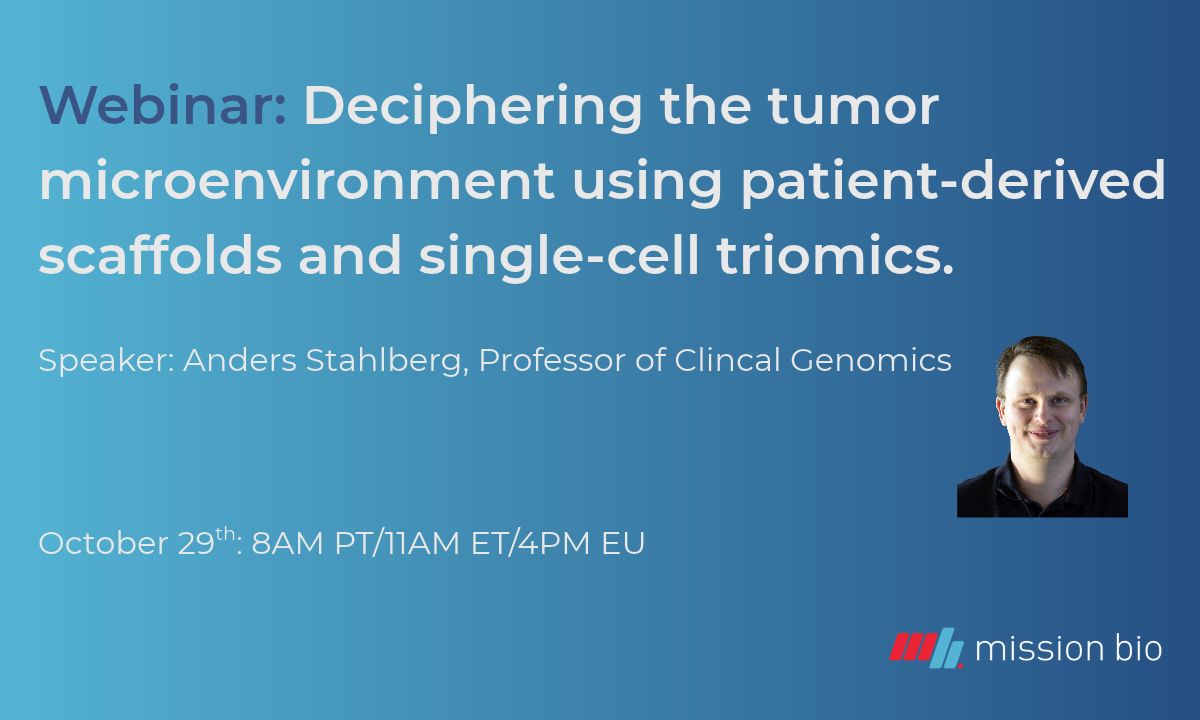
[Upcoming Webinar] The tumor microenvironment shapes how cancer cells grow, adapt, and respond to therapy. Yet most laboratory models, such as two-dimensional monolayer cultures, strip away the extracellular matrix and tissue architecture that define tumors in patients. Patient-derived scaffolds, decellularized tumor tissue that retains its native structure and composition, recreate in vivo-like growth conditions when repopulated with tumor cells of interest. In this live webinar, Dr. Anders Ståhlberg will present how his group has applied patient-derived scaffolds in breast cancer, colon cancer, and sarcoma to study the cellular and non-cellular tumor microenvironment. Molecular characterization of scaffolds and repopulated cells revealed cell-to-cell signaling and biological processes that drive tumor development. Single-cell triomics on Mission Bio's Tapestri platform, using a targeted approach, then measured DNA, RNA, and protein within the same cells, linking genotype directly to phenotype. In breast cancer cells grown in monolayers and in scaffolds, with and without chemotherapy, triomics reliably resolved distinct subpopulations across genetic, transcriptional, and protein biomarkers. Chemotherapy shifted these subpopulations and their biomarker expression, while scaffolds derived from different patients' tumors influenced cell heterogeneity and drug resistance in distinct ways, reflecting each tumor's unique microenvironment. Together, this approach can help reveal how the tumor microenvironment shapes cellular heterogeneity, phenotypes, and treatment response, and provide new insight into the mechanisms underlying tumor development and therapy resistance. Register here: https://lnkd.in/gtE4nnBz
- LINKEDIN · IMAGESince 6 Oct 2026
Biology driving acute myeloid leukemia (AML) development isn't just gene mutations. Asif Javed showed that chromosomal gain, aka trisomy, can be a driver due to a cumulative sequence of these mutations. Join us live: https://lnkd.in/g5aS2mCj What you will learn: • Bulk sequencing across three independent cohorts of myeloid malignancies (1,650 cytogenetically normal and 229 trisomy patients) identified regulatory gene mutations associated with whole-chromosome gains, with ASXL1, SRSF2, STAG2, and EZH2 remaining significant after multiple-testing correction. • Single-cell DNA sequencing on Mission Bio's Tapestri platform profiled 51,092 cells across 16 AML patients to reconstruct clonal phylogenies, showing regulatory gene mutations typically arise before the chromosome gain. • In 71% of trisomy-positive cases, more than one regulatory mutation occurred before or within the same clonal branch as the chromosome gain supporting a cumulative mechanism rather than a single driver mutation. • CRISPR screen data and evolutionary simulation modeling support a model in which progressive disruption of transcription and chromatin regulation destabilizes chromosome segregation over time.



6 of 124 adsSign up to see every Mission Bio ad, filter by format and date, and get alerts on new ones.
See all 124 adsOn Google Search, YouTube and Display
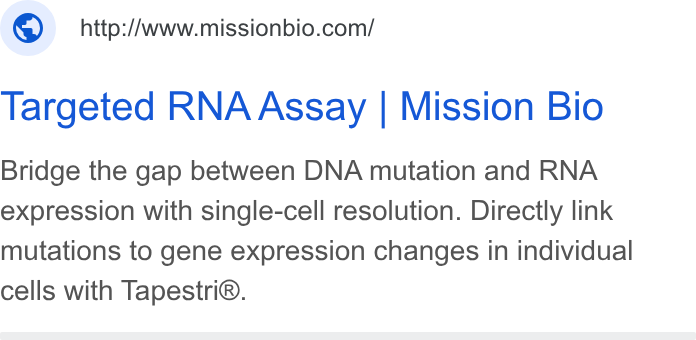
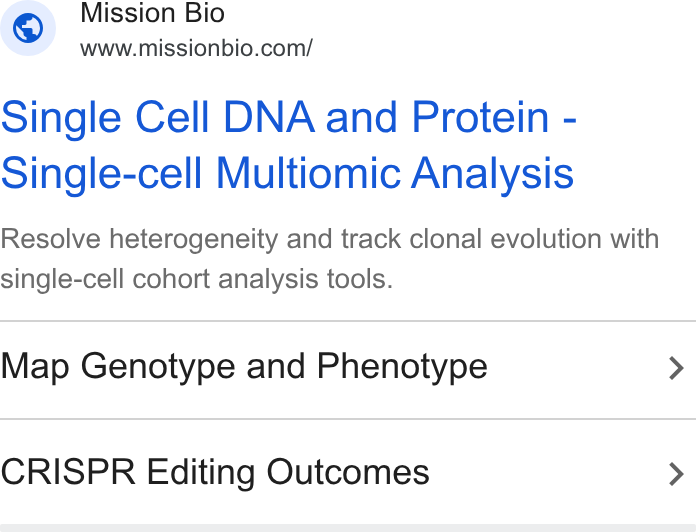
Domain missionbio.com · 200+ ads on the Transparency Center, checked 3 Nov 2026 · 50 recorded
- All 20
- Image 17
- Text 3
- GOOGLE · IMAGELast shown 30 Oct 2026
First shown 16 Oct 2026
- GOOGLE · IMAGELast shown 30 Oct 2026
First shown 24 Sept 2026
- GOOGLE · IMAGELast shown 30 Oct 2026
First shown 22 Sept 2026
- GOOGLE · IMAGELast shown 30 Oct 2026
First shown 8 Sept 2026
- GOOGLE · IMAGELast shown 30 Oct 2026
First shown 7 Sept 2026
- GOOGLE · IMAGELast shown 30 Oct 2026
First shown 7 Sept 2026




Show 14 more Google ads
- GOOGLE · IMAGELast shown 30 Oct 2026
First shown 7 Sept 2026
- GOOGLE · IMAGELast shown 30 Oct 2026
First shown 7 Sept 2026
- GOOGLE · IMAGELast shown 30 Oct 2026
First shown 3 Sept 2026
- GOOGLE · IMAGELast shown 30 Oct 2026
First shown 20 Apr 2026
- GOOGLE · IMAGELast shown 30 Oct 2026
First shown 20 Apr 2026
- GOOGLE · IMAGELast shown 30 Oct 2026
First shown 15 Apr 2026
- GOOGLE · IMAGELast shown 30 Oct 2026
First shown 8 Apr 2026
- GOOGLE · IMAGELast shown 30 Oct 2026
First shown 8 Apr 2026
- GOOGLE · IMAGELast shown 30 Oct 2026
First shown 8 Apr 2026
- GOOGLE · IMAGELast shown 30 Oct 2026
First shown 8 Apr 2026
- GOOGLE · IMAGELast shown 30 Oct 2026
First shown 1 Apr 2026
- GOOGLE · TEXTLast shown 30 Oct 2026
First shown 9 Dec 2025
- GOOGLE · TEXTLast shown 30 Oct 2026
First shown 8 Dec 2025
- GOOGLE · TEXTLast shown 30 Oct 2026
First shown 7 Nov 2025


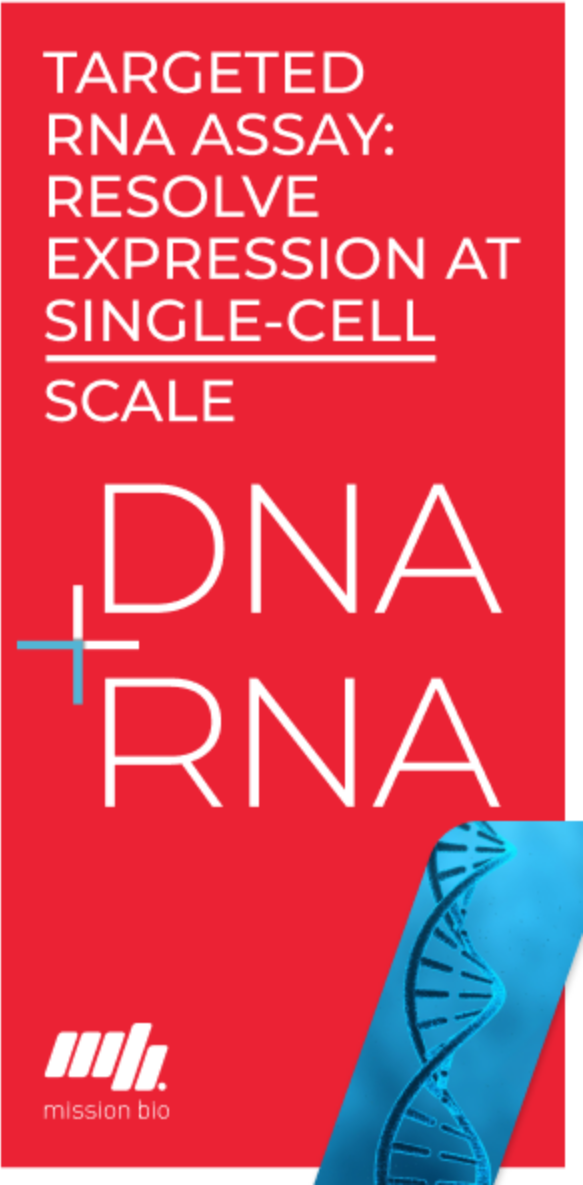


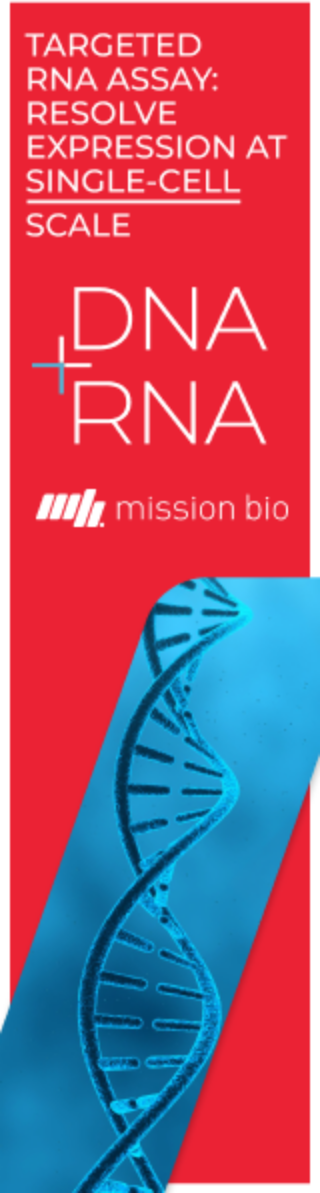

Questions about Mission Bio’s ads
Is Mission Bio running LinkedIn ads?
We recorded no live LinkedIn ads for Mission Bio on 9 Nov 2026.
How many LinkedIn ads has Mission Bio run?
LinkedIn’s ad library lists 123 ads for Mission Bio. We recorded 124 LinkedIn ads for Mission Bio, first recorded on 26 Sept 2026 and last recorded on 7 Nov 2026.
Does Mission Bio run Google ads?
Yes. We recorded 200+ Google ads for the domain missionbio.com on 3 Nov 2026.
Which ad formats does Mission Bio use?
The 6 LinkedIn ads on this page include 6 image ads.
Watch the companies you care about.
Filter every ad by industry, country, format and network, and get alerts when a company you watch starts running new ads.