Not on air · 3 of 3 networks checked
Lumen Research
- lumen-research.com
- Technology, Information and Internet
- GB
- 79 employees
Lumen Research’s ads on LinkedIn, Meta and Google, recorded by adsrunning. Browse the latest here for free. Sign up free to see all 34. Watch Lumen Research on any plan to get each new one in your feed.
Watchlist included in every plan
| Network | Status | Live ads | Nov 2025LinkedIn activity · 52 weeksNov 2026 | Checked | Next step |
|---|---|---|---|---|---|
| None recorded | 0 | Checked 3 Nov 2026 | See all 34 ads → | ||
| Meta | None recorded | 0 | No active ads recorded on the Meta Ad Library | Checked 23 Oct 2026 | Collect them with the API → |
| None recorded | 0 | No ads found on the Google Ads Transparency Center | Checked 2 Nov 2026 | Collect them with the API → |
Lumen Research has no live LinkedIn ads. Its Facebook page had no active ads on 23 Oct 2026, and we recorded no Google ads on 2 Nov 2026.
Latest ads
- LINKEDIN · IMAGESince 7 Oct 2026
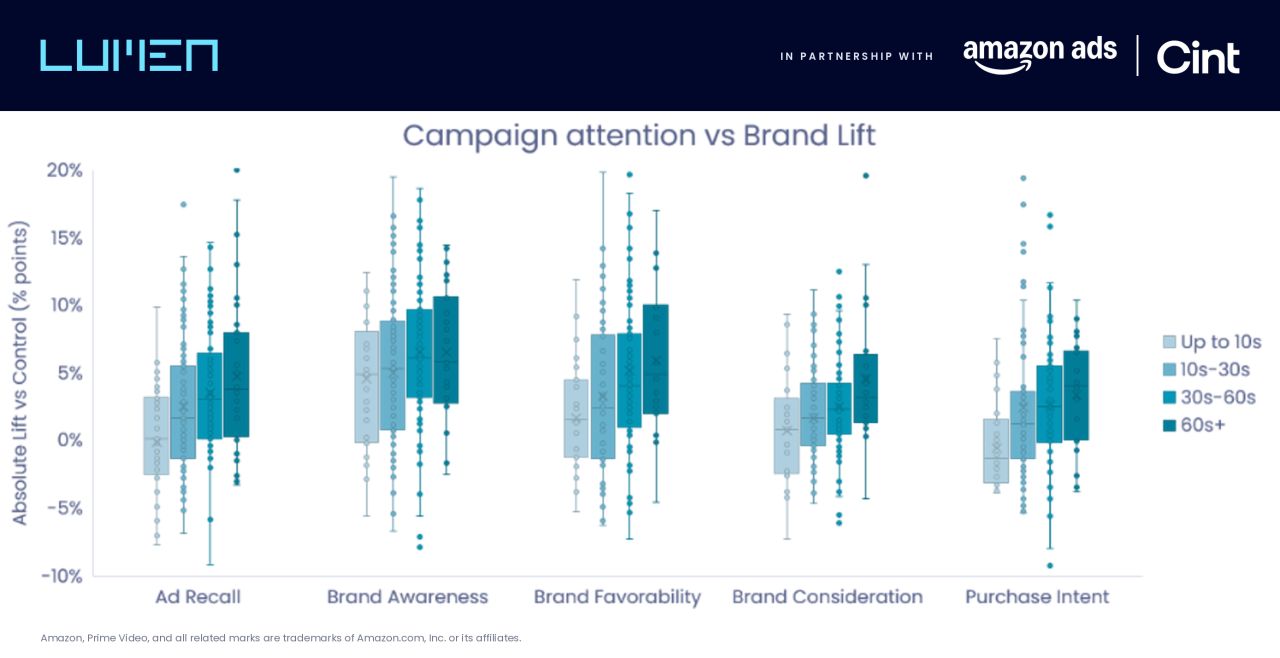
From lots of littles to lots of bigs and littles Really excited to share our latest research with Amazon Ads and Cint looking at the impact of Cumulative Attention across multiple ad impressions. Key take aways: - Attention can be accumulated across different media to create significant levels of Cumulative Attention - Different brand objectives have different Cumulative Attention Thresholds: it might take 21 seconds of attention to improve general brand awareness, but much more to move preference or purchase intent - Repetition (aka Frequency) is essential for building Cumulative Attention - whatever objective you have. - Multi media drives attention efficiency. For the same amount of Cumulative Attention, multi-media campaigns deliver better results that single-media campaigns. - Sequencing matters. Starting your campaign with TV makes subsequent digital ads work harder; starting your campaign with digital doesnt seem to amplify TV effects I think this is an important step forward from the Lots of Littles thinking championed by Dr Grace Kite and Tom Roach. Yes, you can move the needle by aggregating lots of little slivers of attention. But is this the optimal way of operating? Perhaps we should be aiming for lots of Bigs then some littles? Or, perhaps go even further and start asking: how much attention is enough to get my job done? Link to article and key slides in the comments Les Binet Andrew Tindall Mark Ritson Orlando Wood Stefano Cirillo Eleonora Gallerani Piers Heaton-Armstrong Emma Hunt David Bassett Meghan Nosal
- LINKEDIN · IMAGESince 28 Jan 2026
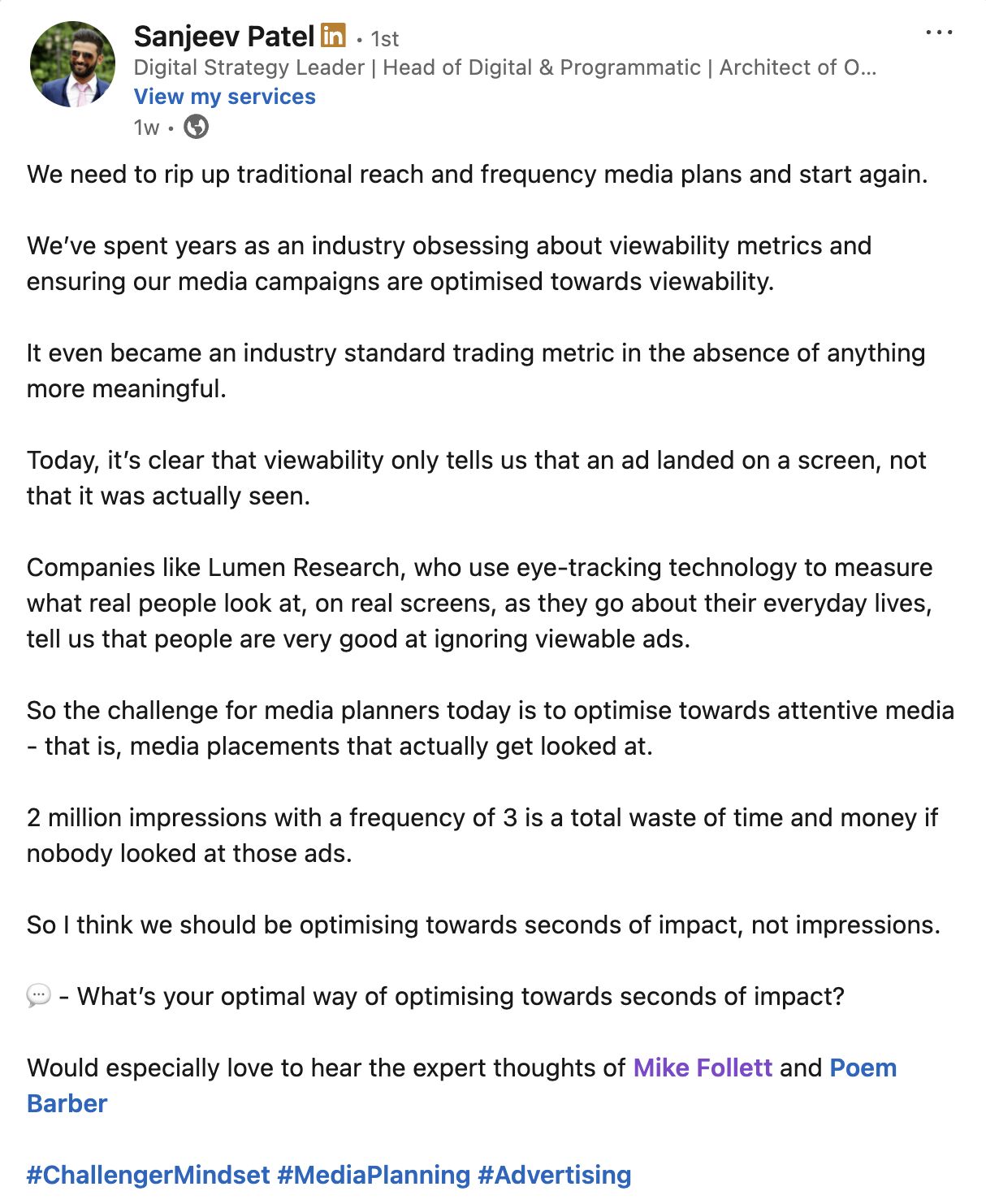
Totally agree with you Sanjeev. Media planning was built on the practice of reach & frequency because it’s all we were able to do. Now that the technology exists that enables you to know which of your ads actually get looked at, why wouldn’t you use that? It should be about attentive reach and frequency now, because unseen ads don’t add reach, or frequency ... but they do add cost. (link to Sanjeev's post in the comments)
- LINKEDIN · IMAGESince 22 Jan 2026
The one thing that everyone outside of advertising knows about advertising is that it is very boring. This may come as a surprise to you, if you work in advertising. We think that what we do is very interesting. Original. Entertaining. Thumb-stopping. But that’s not what a whole economy of adblockers, VPNs and ad-free subscriptions tell us. When people are literally paying money to avoid you in the public square, you’ve got to realise that we have to understand boredom better. But what is ‘boredom’? Psychologists James Danckert and John Eastwood define boredom as “the aversive experience of wanting, but being unable, to engage in satisfying activity.” That definition matters, because boredom isn’t just the absence of interest - it’s the frustration of blocked engagement. They distinguish between state boredom (a temporary condition we all experience) and trait boredom or ‘boredom proneness’ - a more chronic disposition that disproportionately affects certain groups: young men, the unemployed, the depressed. In other words, people with less agency, fewer resources, and less control over their time. Now consider TV advertising. TV ads don’t merely fail to interest us. They actively interrupt a satisfying activity (engaging with a show) and replace it with an unsatisfying one (enduring an ad). They render us temporarily powerless. You can’t skip. You can’t choose. You wait. This is almost a textbook recipe for state boredom. Worse news: those most exposed to this form of advertising are often those who can only afford ad-supported TV - people already more likely to suffer from trait boredom. We may be systematically amplifying boredom in the very audiences least equipped to buffer against it. At Lumen Research we measure attention. Recall. Persuasion. We rarely measure boredom - its texture, its duration, or its downstream effects on memory and behaviour. That feels like a blind spot. So here’s the plan: to investigate how boredom interacts with attention, memorisation, and action. Not to make advertising more “interesting,” but to understand what happens when people are forced to endure it. Anyone interested in that? Danckert and Eastwood’s accessible introduction to boredom science: https://lnkd.in/eu2S8t3z Boredom and sustained attention (or lack thereof): https://lnkd.in/eiWpDDaX #AttentionAndAction #Boredom
- LINKEDIN · IMAGESince 22 Jan 2026
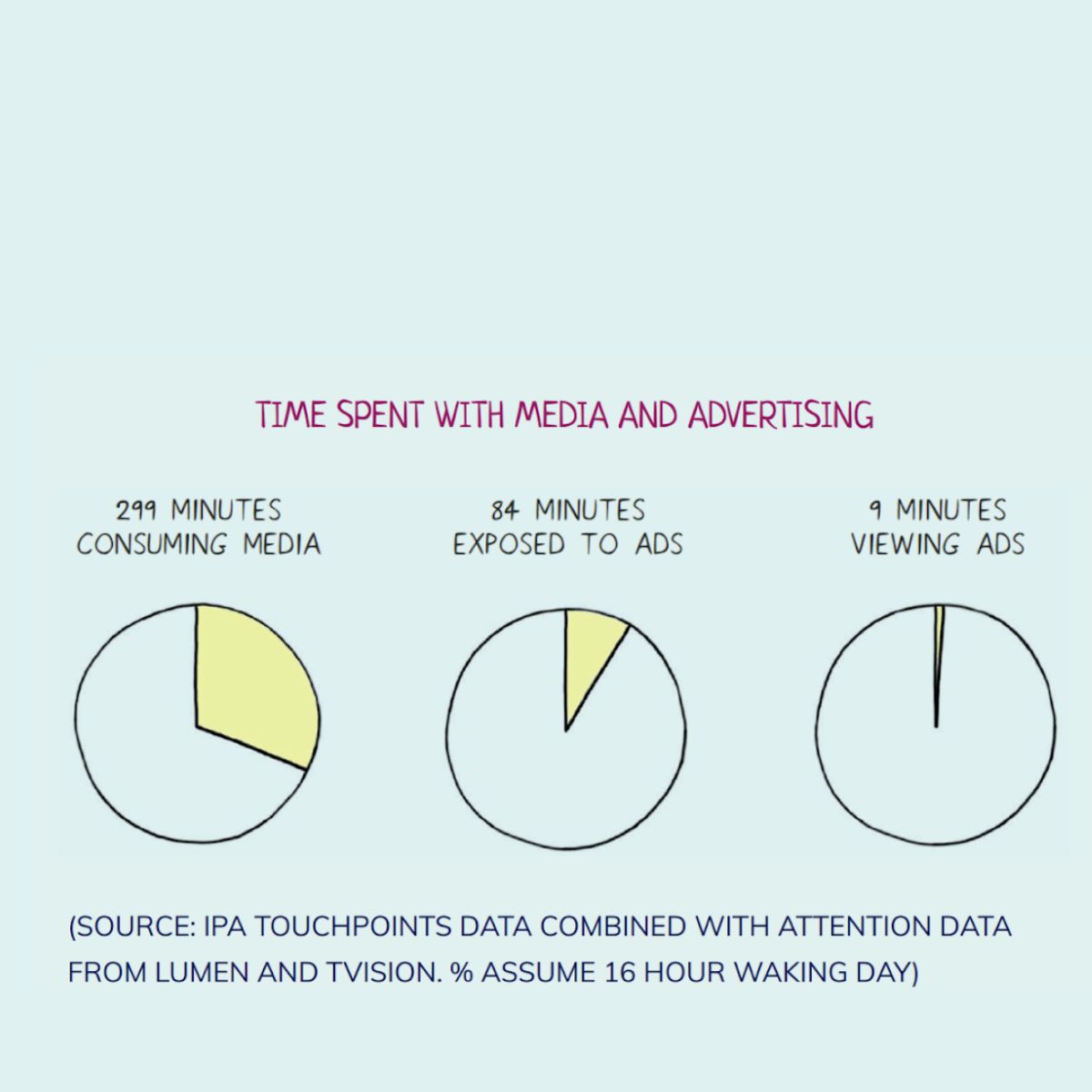
Ignorance expertise. We talk a lot about expertise in marketing. Less about ignorance. Which is odd, because consumers may be the most highly trained ignorers in human history. And I mean that literally. Anders Ericsson famously argued that it takes roughly 10,000 hours of deliberate practice to become truly skilled at something. Chess. Music. Surgery. By that logic, we should ask: what have consumers been practising, every day, for most of their lives? Ignoring advertising. The average Western consumer is exposed to around 84 minutes of advertising per day. Do the maths and you hit 600,000 minutes - 10,000 hours - by the age of 20. By their twenties, people are not amateurs at ad evasion. They are black belts. This helps explain a paradox marketers love to complain about: people are surrounded by ads, yet pay attention to almost none of them. On average, consumers give advertising roughly 9 minutes of genuine attention per day. The rest? Filtered out automatically, effortlessly, often without conscious awareness. This isn’t apathy. It’s expertise. Decades of exposure have trained the brain to recognise, predict, and suppress commercial stimuli with astonishing efficiency. We have built a cognitive immune system - fast, selective, and ruthless. So when an ad is ignored, it’s rarely because the consumer is stupid, lazy, or “not engaged.” It’s because they are very, very good at not looking. The uncomfortable implication for our industry is this: attention isn’t scarce because people don’t have it. It’s scarce because they’ve spent a lifetime learning how not to give it away. Ignoring advertising may be the most widely practised skill on Earth. Dan White, Ruben Schreurs, Nic Pietersma Links in the comments: 🔗 IPA touchpoints data 🔗 Anders Ericsson #Attention #Advertising
- LINKEDIN · IMAGESince 31 Dec 2025
Repetition, repetition, repetition. At school, the importance of repetition was stressed to us in the form of revision (or lines if you were naughty): ‘I must do more revision, I must do more revision, I must do more revision.’ In advertising, repetition works the same way. Even fleeting exposures to advertising are effective with enough repetition, and multiple impressions of ‘long enough’ attention drive better results than single impressions of ‘sustained’ attention. One second of attention, delivered ten times, might be better than one single exposure with ten seconds of attention. In their research - the largest ever study into the link between attention and memory - Havas Media Network called this ‘Aggregate attention’, and WARC named that as one of their ideas of 2024. Talking of repetition, this outstanding research - conducted in partnership with Brand Metrics and Lumen Research - won another award last week, this time Silver in the Research Insight category at the Campaign UK MediaWeek Awards! Huge congratulations to Jonathan Waite and the team at Havas Media Network, Anders Lithner and team at Brand Metrics, and of course David Bassett and team at Lumen Research. The research paper can be downloaded via the link that I will paste into the first comment of this post and provides essential reading for anybody with a professional interest in media effectiveness. Lumen Research #AttentionAndAction #AggregateAttention
- LINKEDIN · VIDEOSince 31 Dec 2025
Last week I shared an example of how much attention Vodafone needed to be effective. This week, as we have Christmas in sight, I thought I'd share the same for the John Lewis Christmas ad. In the Vodafone example (link in the first comment) the attention threshold for that campaign was around 1 second, for it to start driving memory. It’s not really Christmas until you have seen the John Lewis ad, especially if you work in the media and advertising industry, but what’s interesting is that the attention required to start driving memory for John Lewis - on Facebook - is nearly double that of Vodafone. When we compare the two ads, a few things stand out: The Vodafone ad was red, with a Vodafone logo and product in the first frame, so the distinctive brand assets were instantly recognisable. The John Lewis ad, on the other hand, is a story that plays out over time, so perhaps the human mind needs a little longer to recognise the characters and remember this is ‘when you can’t find the words, find the gift’ by John Lewis? Every brand and campaign has a different optimal attention time, and this is really important, because if you buy too little attention, you get poor performance on your campaigns, and if you buy too much attention, you can often inflate your media costs without increasing your ROI. Brands that know how much attention their ads need to be effective, can use attention as their leading indicator to make better, more granular planning & buying decisions. All links for the studies in the comments. Lumen Research | #AttentionAndAction #Marketing #Media

6 of 34 adsSign up to see every Lumen Research ad, filter by format and date, and get alerts on new ones.
See all 34 adsWatch the companies you care about.
Filter every ad by industry, country, format and network, and get alerts when a company you watch starts running new ads.