Not on air · 2 of 3 networks checked

Leap ads
- leaphealth.com
- Software Development
- US
- 67 employees
Leap’s ads on LinkedIn, Meta and Google, recorded by adsrunning. Browse the latest here for free. Sign up free to see all 166. Watch Leap on any plan to get each new one in your feed.
Watchlist included in every plan
What Leap runs
- Single image · LinkedIn
- 4
- Video · LinkedIn
- 2
| Network | Status | Live ads | Nov 2025LinkedIn activity · 52 weeksNov 2026 | Checked | Next step |
|---|---|---|---|---|---|
| None recorded | 0 | Checked 3 Nov 2026 | See all 166 ads → | ||
| Meta | Not checked | — | |||
| None recorded | 0 | No ads found on the Google Ads Transparency Center | Checked 2 Nov 2026 | Collect them with the API → |
Leap has no live LinkedIn ads. We recorded no Google ads on 2 Nov 2026.
Latest ads
- LINKEDIN · IMAGERecorded 23 Oct 2026
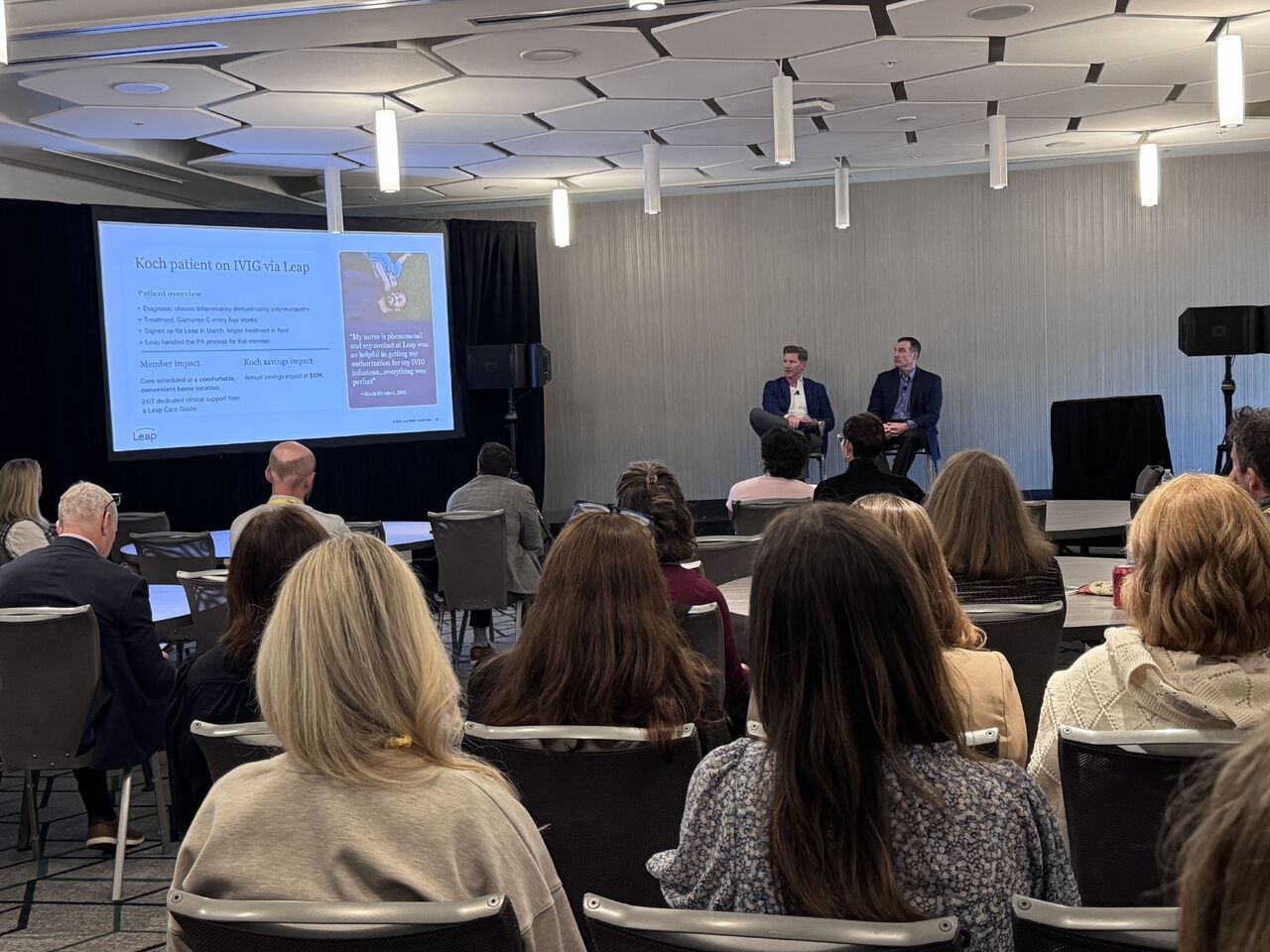
"Our site-of-care program has specialty infusion costs under control." That's what most benefits leaders hear from their carrier, and most end the conversation there. Matthew Hall from Koch and I co-presented last week at The Conference Board's Annual Employee Health Care Conference on what happens when it doesn't. Koch didn't take it at face value. They ran an impact analysis with Leap and surfaced meaningful savings and a better member experience in a category most plans assume is already optimized. Two reasons this opportunity is so silent. A small share of any workforce is on specialty infusion, so benefits leaders don't hear much directly from those members. And when the carrier says "under control," most take the win and move on. But the harder lesson from our conversation on stage: finding the savings is one thing. Capturing them is another. Koch did the work with us to: ✅ Turn the data into a targeted engagement approach ✅ Layer in plan design incentives that move member behavior ✅ Connect their existing ecosystem into a more coordinated care journey Savings opportunity is one thing. Capturing savings requires a partnership, execution, and a willingness to look beyond what appears to be working. Thank you to The Conference Board for another great conference – and to Matt for sharing Koch’s story and what it looks like when an employer is willing to dig deeper into specialty care. Benefits leaders: what's the specialty spend line on your plan you're assuming is optimized but haven't re-tested lately? 🐸 Learn more: https://lnkd.in/eNMacwpA #SpecialtyCare #HealthcareInnovation #EmployeeBenefits #HealthcareCosts #InfusionCare
- LINKEDIN · VIDEORecorded 22 Oct 2026
Here's something that should bother more benefits leaders than it does: Simply understanding you specialty infusion savings opportunity depends as much on which carrier is printed on their ID card as it does the actual programs, networks and discounts that are in place. Some carriers share claims data openly. Most treat it like a competitive asset and make every integration a fight. Employers and patients did not choose this dynamic. And if your carrier is unwilling to show you the data, you should really question your partners. We get upset about money managers taking basis point fees, but don't question why payers are unwilling to break down a $100,000 J-code. It's your data. Fight for it! Learn more: https://lnkd.in/eedZ-DiU #healthcareinnovation #healthtech #patientcare
- LINKEDIN · IMAGERecorded 9 Oct 2026
Sometimes the deals you don't do are more important than the ones you do. A well-known site-of-care solution once asked us to join their network as an infusion provider, on the condition that we build in a markup and a shared-savings fee on top of it. We said no. Not because the partnership wasn't valuable. It would have put us in front of a lot more members, faster. But the entire reason Leap exists is that specialty drugs often are marked up as much as 400% by the time they're billed back to the plan. A model that asks employers to trust a smaller, better-dressed version of the same markup was never something we were willing to build. We walked. A few months later, a different partner brought us on as their sole infusion provider, specifically because we wouldn't compromise on pass-through pricing. I would rather turn down a deal that pays us more than build a model that quietly recreates the exact problem we started this company to fix. Learn more about why we started Leap: https://lnkd.in/eeB6DGb5 #healthcareinnovation #healthtech #patientcare
- LINKEDIN · IMAGERecorded 25 Sept 2026
One member. Crohn's disease. Coverage lapsed. Four months without an infusion. This is what a coverage transition can quietly cost a patient. Jacob is a Wisconsin-based employee with Crohn's disease, prescribed an infusion therapy every six weeks. When his insurance lapsed in late 2025, his treatment stopped. By April 2026, when coverage was restored, four months had passed without a dose. For a chronic condition like Crohn's, missed doses can mean a return of symptoms, disease progression, and difficult clinical recovery. Then his referral reached Leap. ✅ A Leap Care Guide connected with Jacob the same day the referral came in ✅ Prescribing orders were secured within 24 hours ✅ His first infusion was delivered at home 13 days later, with an ongoing six-week schedule in place Jacob's story is personal, but it is not rare. Open enrollment, benefits changes, M&A, vendor transitions. Each is a moment when a patient on specialty infusion therapy can quietly fall through the cracks. Adherence is not a soft KPI. Every missed infusion raises the odds of a flare, an ER visit, or a hospitalization the employer pays for later. Jacob's four-month gap was trending that way when the referral reached Leap. In Jacob's case, moving infusion therapy from a clinic setting to home also eliminated the buy-and-bill markup on the drug, generating $15,334 in claims-validated annual savings for his employer. Coverage lapses are treated as an administrative issue. For patients on specialty infusion, they are a clinical one. Someone has to be watching for the moment care stops. That's the job of a modern specialty infusion benefit. Learn more: https://lnkd.in/dgRgq62d #SpecialtyDrugs #EmployerHealthcare #PatientExperience #InfusionCare #Healthcare
- LINKEDIN · IMAGERecorded 25 Sept 2026
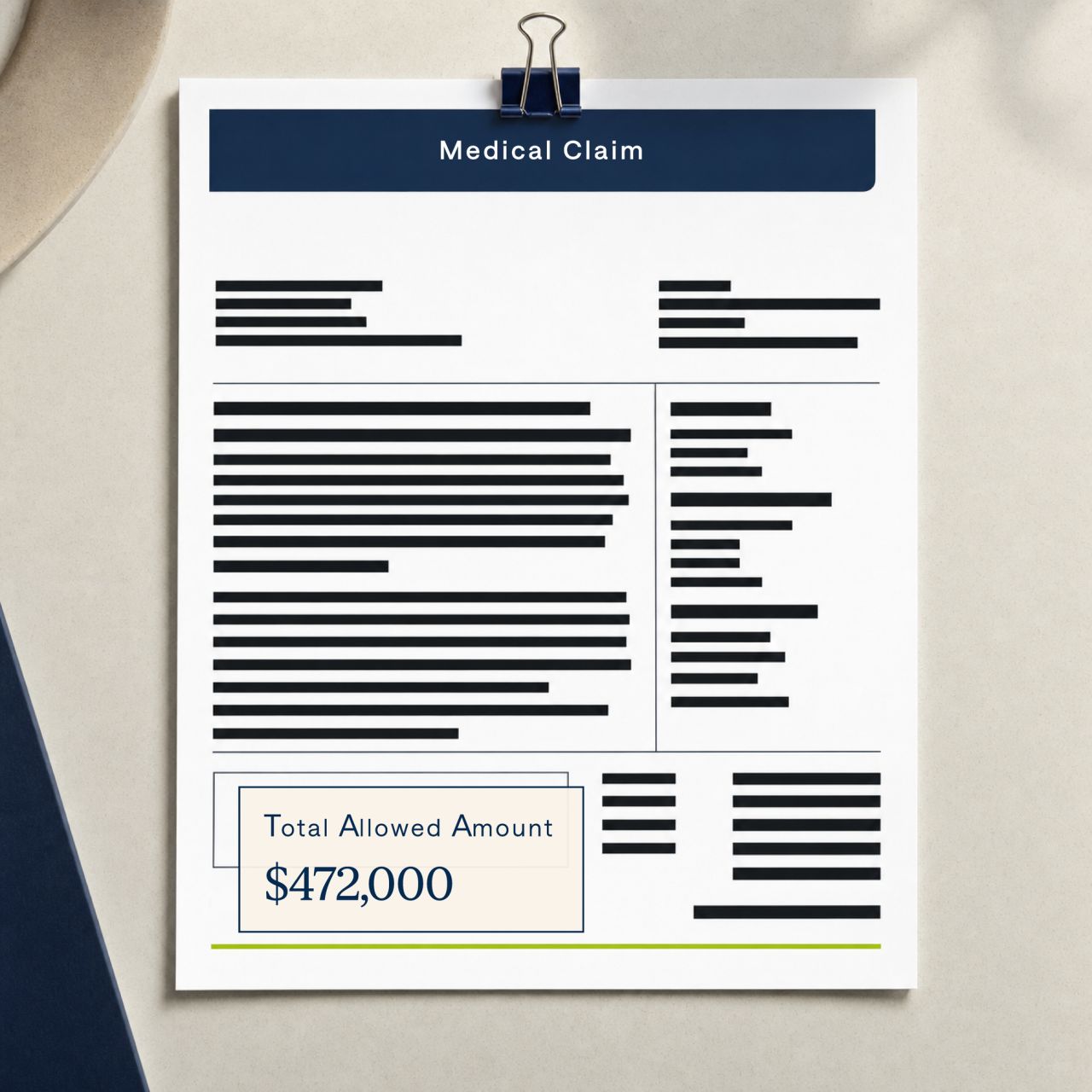
Self-funded employers pay 100% of the claim. They don't always get to see 100% of the claim. The National Alliance of Healthcare Purchaser Coalitions 2026 Pulse of the Purchaser found 37% of employers don't have complete claim-level access to their own medical spend. 41% aren't allowed to audit their own files. The restriction is written into the carrier contract. As one survey respondent put it, "Our major medical carriers place contractual restrictions on extracting complete, unredacted claim-level financial fields." Employers with complete medical-spend claims access use 12 cost-management strategies on average vs. 8 among those with limited or no access. The former group can identify cost drivers, evaluate their partners, and make informed decisions about where their healthcare dollars are going. The rest are working from what the carrier is willing to share. The takeaway is simple: you can’t manage what you can’t see. We can’t expect employers to control healthcare costs while limiting their visibility into those costs. Leap was built on transparency: every self-funded plan we work with sees a fully itemized specialty infusion claim rather than a bundled allowed amount. We believe complete data access is foundational to better healthcare purchasing and to holding every part of the system accountable. 📊 Learn more at https://lnkd.in/emBaW-Wu #Healthcare #HealthData #Employers #HealthcareCosts #Transparency #Benefits
- LINKEDIN · VIDEORecorded 9 Oct 2026
Full unbundling of the specialty benefit is going to become more and more commonplace by 2030. I’d bet on it. As the category gets bigger, buyers are going to start asking a pretty simple question: What am I actually paying for? There are nearly 1,000 specialty drugs on the market today, up from ~30 in 1995. And there are another ~7,000 in the FDA pipeline. Cardinal Health’s 2026 Advanced Therapy Report projects the number of advanced therapies approved in the U.S. to nearly triple by 2030. That’s a lot of therapies. And a lot of money flowing through the system. The difference will be whether the claim shows the true cost of the therapy or hides it inside a buy-and-bill bundle. I think employers are going to demand the former. The question is: who will you be working with when you want to know the true cost? Learn more: https://lnkd.in/ed3m7hBv #healthcareinnovation #healthtech #patientcare


6 of 166 adsSign up to see every Leap ad, filter by format and date, and get alerts on new ones.
See all 166 adsQuestions about Leap’s ads
Is Leap running LinkedIn ads?
We recorded no live LinkedIn ads for Leap on 7 Nov 2026.
How many LinkedIn ads has Leap run?
LinkedIn’s ad library lists 183 ads for Leap. We recorded 166 LinkedIn ads for Leap, first recorded on 25 Sept 2026 and last recorded on 23 Oct 2026.
Does Leap run Google ads?
We recorded no Google ads for the domain leaphealth.com on 2 Nov 2026.
Which ad formats does Leap use?
The 6 LinkedIn ads on this page include 4 image ads and 2 video ads.
Watch the companies you care about.
Filter every ad by industry, country, format and network, and get alerts when a company you watch starts running new ads.