Not on air · 2 of 3 networks checked

Lean Leaders Plus ads
- leanleadersplus.com
- Business Consulting
- US
- 4 employees
Lean Leaders Plus’s ads on LinkedIn, Meta and Google, recorded by adsrunning. Browse the latest here for free. Sign up free to see all 23. Watch Lean Leaders Plus on any plan to get each new one in your feed.
Watchlist included in every plan
What Lean Leaders Plus runs
- Single image · LinkedIn
- 4
- Video · LinkedIn
- 2
| Network | Status | Live ads | Nov 2025LinkedIn activity · 52 weeksNov 2026 | Checked | Next step |
|---|---|---|---|---|---|
| None recorded | 0 | Checked 7 Nov 2026 | See all 23 ads → | ||
| Meta | Not checked | — | |||
| None recorded | 0 | No ads found on the Google Ads Transparency Center | Checked 18 Oct 2026 | Collect them with the API → |
Lean Leaders Plus has no live LinkedIn ads. We recorded no Google ads on 18 Oct 2026.
Latest ads
- LINKEDIN · IMAGERecorded 19 Oct 2026
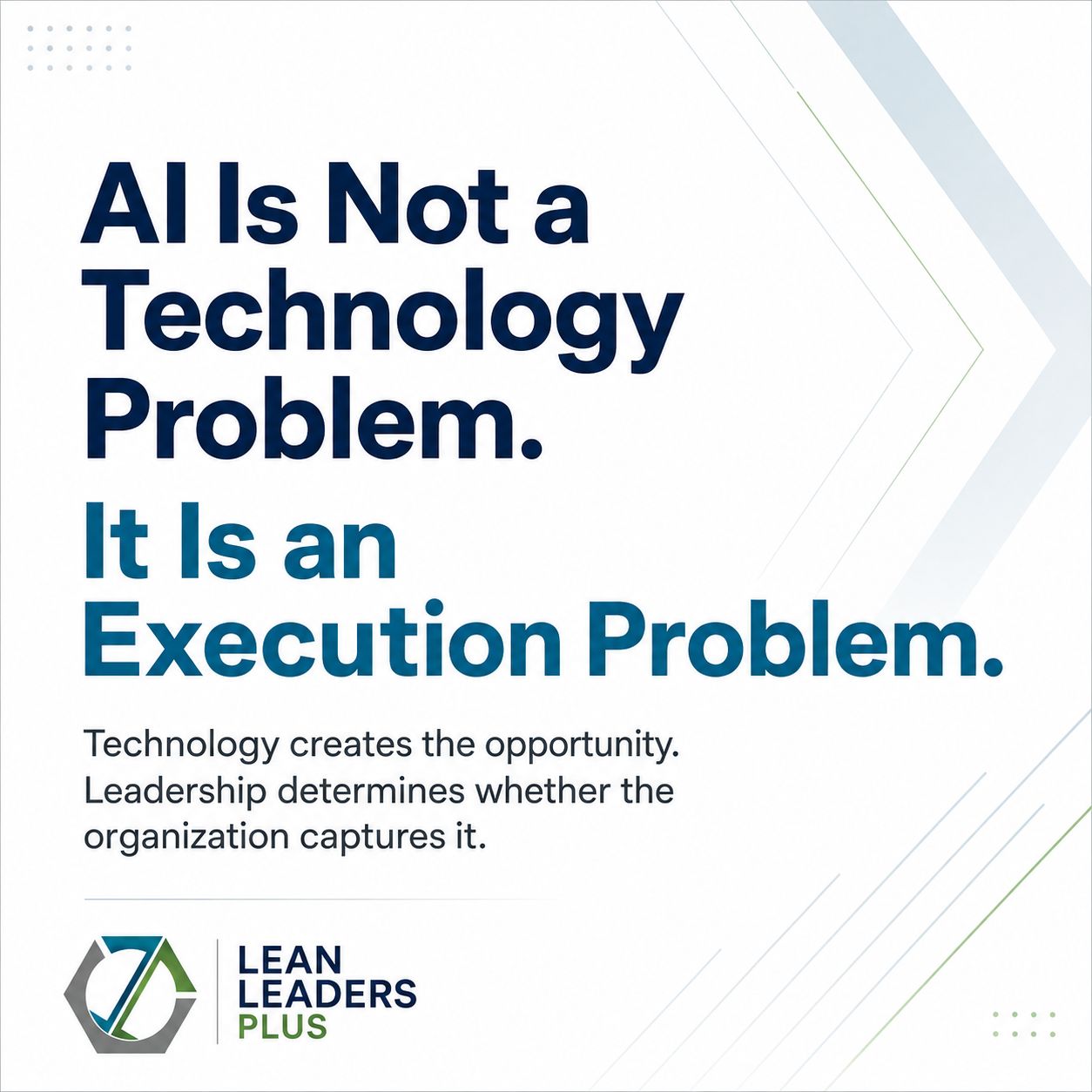
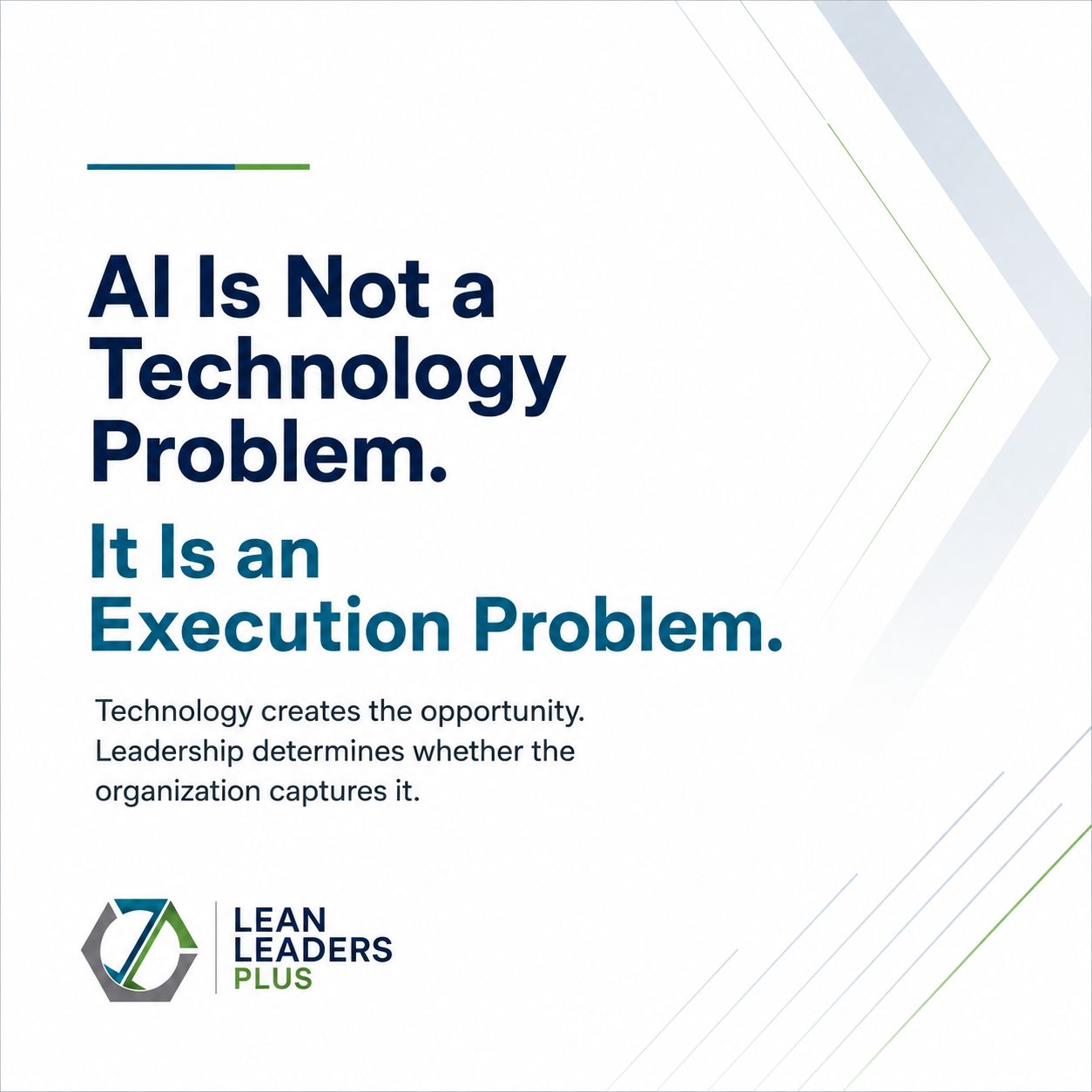
AI Is Not a Technology Problem. It Is an Execution Problem. Most conversations about AI start with the technology. Which tools should we use? What should we automate? Where can we save time? How quickly should we move? Those are important questions. But they are not usually where AI succeeds or fails. The harder questions come next. Who owns the change? How will roles and workflows change? What decisions should AI support, and where does human judgment still matter? How do leaders maintain trust? What happens when departments move at different speeds? How does a successful pilot become the way the organization actually operates? That is where AI becomes a leadership and execution issue. For COOs, AI is increasingly an operating model question. It can expose bottlenecks, outdated approval layers, unclear ownership, and processes that were already broken before the technology arrived. For HR leaders, it is also a people and culture question. Employees are already forming opinions about what AI means for their jobs, their value, and their future. Silence does not remove that uncertainty. And for managers, AI may change what good leadership looks like. If employees can research, analyze, draft, and develop recommendations faster, managers may need to spend less time being the source of answers and more time providing context, judgment, coaching, priorities, and accountability. AI does not make leadership less important. It raises the standard for leadership. The organizations that create the most value from AI will not simply be the ones with the best tools. They will be the ones with clear ownership, stronger decision-making, better communication, thoughtful workflow redesign, and the operating discipline to turn experimentation into execution. AI is powerful technology. Turning it into better business outcomes is a leadership responsibility. Read the full article here: https://lnkd.in/gUNS7GGc And if you want a clearer picture of where execution may be breaking down inside your own organization, take the Execution Gap Diagnostic. It is designed to help surface the leadership and execution issues that often sit underneath slower decisions, unclear ownership, weak accountability, and stalled initiatives. CLICK BELOW for Diagnostic https://lnkd.in/ebsVRyGT
- LINKEDIN · IMAGERecorded 19 Oct 2026
AI is increasing what individuals can do faster than many organizations are changing how their teams actually work. That may be one of the biggest reasons companies are struggling to turn AI access into better execution. Microsoft’s 2026 Work Trend Index found that only 26% of AI users say leadership is clearly and consistently aligned on AI. At the same time, 65% fear falling behind if they don’t adapt quickly, while 45% say it feels safer to focus on current goals than redesign how work gets done with AI. That tension matters. People are being told to use new technology while many are still working inside structures, incentives and approval processes designed for the old way of working. And Deloitte found something even more interesting: people on higher-value AI teams were nearly twice as likely to say they learn from one another and feel empowered to make decisions. Cross-functional teams were also 30% more likely to report significant gains in AI-driven efficiency and innovation. Those are not AI capabilities. They are team capabilities. AI can make analysis faster. It can automate work. It can expand what an individual can produce. But it cannot fix unclear accountability, slow decision rights, silos or a team that still sends every important decision back to the manager. That is where leadership enters the AI conversation. Who owns the outcome? Who has authority to act? Where is human judgment essential? What actually requires escalation? And when AI contributes to the work, accountability cannot become “the AI did it.” AI can contribute to the work. Accountability still belongs to the team. Deloitte’s 2026 Human Capital Trends research found that only 6% of leaders say their organizations are making progress designing effective human-AI interactions, while 65% believe their culture will need to change significantly because of AI. The technology is moving quickly. Team design often isn’t. We saw the same leadership principle in Daniel Pastran’s manufacturing team: approximately 25% more output in eight weeks without adding resources or longer hours after accountability shifted across the team and the system became less dependent on the leader. So the question is not only: How do we get our people using AI? It is: Are we using AI to make the team stronger — or simply putting better tools into the same old operating model? If this sounds familiar, the Execution Gap Diagnostic is a free, 5-minute self-assessment designed to help uncover where leadership bottlenecks, unclear accountability, silos, and inconsistent follow-through may be slowing execution. You’ll get personalized results immediately. No meeting required. Take the Execution Gap Diagnostic: https://lnkd.in/ebsVRyGT Read the full article: https://lnkd.in/gESA8QkU
- LINKEDIN · VIDEORecorded 19 Oct 2026
An organization scored 8.3 out of 10 on the Execution Gap Diagnostic, yet still uncovered friction involving conflict, silos, trust, and credibility. Strong overall performance can hide costly leadership gaps.
- LINKEDIN · IMAGERecorded 19 Oct 2026
25% MORE OUTPUT IN JUST 8 WEEKS NO ADDITIONAL RESOURCES NO LONGER HOURS 25% increase in output in eight weeks will get almost any operations leader’s attention. What makes this result more interesting is what didn’t produce it. Daniel Pastran’s manufacturing team didn’t add resources. Nor work longer hours. And the problem wasn’t Daniel’s capability. He was a highly capable leader. The problem was that too much of the system had come to depend on him. Decisions flowed upward. Problems were escalated to Daniel. Team members looked to the leader for accountability instead of looking across the team. Daniel had become the hub of the system. When the leader becomes the hub for every decision, problem, and update, even a highly capable leader can become a constraint on execution. So the goal wasn’t to “fix” Daniel. It was to change how the team worked. Accountability began moving horizontally instead of only vertically. Team members reported progress to one another. Meeting ownership was distributed. Structured problem-solving replaced open-ended escalation. People worked more directly with cross-functional partners instead of routing everything through the leader. Daniel began stepping back. The team began stepping forward. Within eight weeks, the team increased output by roughly 25%. Daniel describes the shift: “In just a matter of weeks, our team increased output by roughly 25% — not by working harder, but by changing how we work together. Ownership shifted to the team, visibility improved, and people started holding each other accountable instead of relying on me.” There’s a lesson here for COOs, operations executives, CHROs, HR leaders and anyone responsible for performance, culture and execution. Sometimes an execution problem isn’t a people problem. It isn’t necessarily a process problem. And it isn’t always an effort problem. Sometimes the leadership system itself has become the constraint. If that sounds familiar, the Execution Gap Diagnostic is a free, 5-minute self-assessment designed to help uncover where leadership bottlenecks, unclear accountability, silos, and inconsistent follow-through may be slowing execution. It identifies the three execution gaps most likely slowing your leadership team down — and the primary driver behind them. You’ll get personalized results immediately. No meeting required. Diagnostic link: https://lnkd.in/ebsVRyGT At Lean Leaders Plus, we talk a lot about TCR — Trust, Credibility and Respect — because influence isn’t created by title alone. It is earned through how people experience your leadership. Leadership effectiveness isn’t measured only by what a leader can accomplish. It is also reflected in what the team can accomplish without requiring the leader to drive every decision. Where do you see this most often: leaders holding too much themselves, or teams waiting too long for the leader to make the call? Curious what you’re seeing. Read the full story: https://lnkd.in/gMUMpEtu
- LINKEDIN · VIDEORecorded 19 Oct 2026
I am hosting an executive roundtable for senior operations leaders to discuss the leadership side of AI. Organizations focused only on selecting AI tools may be solving the wrong problem. Business value requires redesigned workflows, ownership, decision rights, trust, judgment, and accountability. DM me "AI" if you are interested.
- LINKEDIN · IMAGERecorded 19 Oct 2026
AI Is Not a Technology Problem. It Is an Execution Problem. Most conversations about AI start with the technology. Which tools should we use? What should we automate? Where can we save time? How quickly should we move? Those are important questions. But they are not usually where AI succeeds or fails. The harder questions come next. Who owns the change? How will roles and workflows change? What decisions should AI support, and where does human judgment still matter? How do leaders maintain trust? What happens when departments move at different speeds? How does a successful pilot become the way the organization actually operates? That is where AI becomes a leadership and execution issue. For COOs, AI is increasingly an operating model question. It can expose bottlenecks, outdated approval layers, unclear ownership, and processes that were already broken before the technology arrived. For HR leaders, it is also a people and culture question. Employees are already forming opinions about what AI means for their jobs, their value, and their future. Silence does not remove that uncertainty. And for managers, AI may change what good leadership looks like. If employees can research, analyze, draft, and develop recommendations faster, managers may need to spend less time being the source of answers and more time providing context, judgment, coaching, priorities, and accountability. AI does not make leadership less important. It raises the standard for leadership. The organizations that create the most value from AI will not simply be the ones with the best tools. They will be the ones with clear ownership, stronger decision-making, better communication, thoughtful workflow redesign, and the operating discipline to turn experimentation into execution. AI is powerful technology. Turning it into better business outcomes is a leadership responsibility. If you want a clearer picture of where execution may be breaking down inside your own organization, take the Execution Gap Diagnostic. It is designed to surface the leadership and execution issues underneath slower decisions, unclear ownership, weak accountability, and stalled initiatives.
6 of 23 adsSign up to see every Lean Leaders Plus ad, filter by format and date, and get alerts on new ones.
See all 23 adsQuestions about Lean Leaders Plus’s ads
Is Lean Leaders Plus running LinkedIn ads?
We recorded no live LinkedIn ads for Lean Leaders Plus on 8 Nov 2026.
How many LinkedIn ads has Lean Leaders Plus run?
LinkedIn’s ad library lists 23 ads for Lean Leaders Plus. We recorded 23 LinkedIn ads for Lean Leaders Plus, first recorded on 19 Oct 2026 and last recorded on 19 Oct 2026.
Does Lean Leaders Plus run Google ads?
We recorded no Google ads for the domain leanleadersplus.com on 18 Oct 2026.
Which ad formats does Lean Leaders Plus use?
The 6 LinkedIn ads on this page include 4 image ads and 2 video ads.
Watch the companies you care about.
Filter every ad by industry, country, format and network, and get alerts when a company you watch starts running new ads.