Not on air · 3 of 3 networks checked

Kosmoy ads
- kosmoy.com
- Software Development
- IT
- 37 employees
Kosmoy’s ads on LinkedIn, Meta and Google, recorded by adsrunning. Browse the latest here for free. Sign up free to see all 43. Watch Kosmoy on any plan to get each new one in your feed.
Watchlist included in every plan
What Kosmoy runs
- Single image · LinkedIn
- 1
- Video · LinkedIn
- 5
- Google ads on 1 Nov 2026
- 12
| Network | Status | Live ads | Nov 2025Activity · 52 weeksNov 2026 | Checked | Next step |
|---|---|---|---|---|---|
| None recorded | 0 | Checked 7 Nov 2026 | See all 43 ads → | ||
| Meta | None recorded | 0 | No active ads recorded on the Meta Ad Library | Checked 22 Oct 2026 | Collect them with the API → |
| Recently | 12 | Checked 1 Nov 2026 | Collect them with the API → |
Kosmoy has no live LinkedIn ads. Its Facebook page had no active ads on 22 Oct 2026, and we recorded 12 Google ads on 1 Nov 2026.
Latest ads
- LINKEDIN · IMAGESince 4 Mar 2026
I've spent the last few months watching something extraordinary happen in software development. A year ago, AI tools gave developers a 30% productivity boost. Nice. Useful. Incremental. Then OpenAI Codex and Anthropic Claude Code happened. We're now at 500-700% productivity gains. That's not a typo. One senior architect with Claude Code does what five engineers did before. Let me be precise about what that means in organizational terms, because this is where it gets uncomfortable. The classic development team building block: one Product Manager with strategic vision, overseeing four or five engineering squads, each with five or six people and a tech lead. Call it 25 people to ship a meaningful product. A year ago, AI gave each of those 25 people a 30% boost — useful, but the structure remained intact. Today? The squads are structurally redundant. The senior architect and the PM can do the work. We went from 25 to 6. Maybe from 25 to 2. The exact floor is still being discovered. But Wall Street figured out the consequence before most executives did. For how long are you paying Salesforce $20M a year for a CRM your sales team uses 30-40% of? Here's context that makes this concrete: over 2,000 companies pay Salesforce more than $1M a year. ServiceNow tells a similar story: roughly 500 of their customers have contracts exceeding $5M a year. These aren't marginal costs — they're among the largest discretionary technology line items in a Fortune 500 P&L. The matrix I'm sharing maps this simply: annual license cost on the X axis, percentage of features your people actually use on the Y axis. The bottom-right quadrant is where millions of dollars are sitting exposed. High annual spend, low utilization, and now, for the first time in history, a credible internal alternative. Here's what every CFO and CIO should do this quarter: 1. Build this matrix for your top 20 SaaS contracts. 2. For anything sitting on the bottom right corner, commission a build estimate. Ask: what does it cost to rebuild the 50% we actually use, AI-native, in 9 months? 3. Walk into your next renewal with that number. You don't have to build. The credible threat is enough. The era of the 8% annual "renewal and raise" is over. 50-75% discounts are now the opening position for any negotiation. Wall Street priced this in fast. P/S multiples compressed from 9x to 6x in weeks. Salesforce down 14% in five days. Investors understand that the "renew and raise" revenue engine is broken. Revenues won't just grow slowly; they'll actively shrink as procurement teams wake up. For SMBs — different story, different opportunity. AI-native entrants are coming with 60% of the features at 10% of the price. The Innovator's Dilemma, running at AI speed. The SaaS apocalypse isn't coming. It's already here. The question is whether you're the one holding the leverage — or writing the check.
- LINKEDIN · VIDEOSince 25 Feb 2026
At Adopt AI - Grand Palais I joined a panel titled: “Building AI-Native Financial Services: Infrastructure, Governance & Performance.” Together with Claire Calméjane (Foundever), Kris Wulteputte (bunq) and Ben Richardson (CoreWeave), we addressed a question boards are increasingly asking: Is AI a capability — or is it becoming core infrastructure? The financial institutions that treat AI as infrastructure will move confidently. The rest will move cautiously. Here’s a short extract from the panel. The link to the full YouTube video in the first comment.
- LINKEDIN · VIDEOSince 26 Jan 2026
AI has moved from cool demo to enterprise system. And enterprise systems need controls. In this video excerpt, I explain how an AI gateway works and why it’s emerging as a best practice for AI governance and AI compliance in large organisations. An AI gateway sits between your apps and the AI models. That’s where you can: 1. allow or block specific models 2. track usage and costs in real time 3. set spending limits 4. enforce guardrails for safety and run compliance checks, including EU AI Act–related guardrails This is the difference between “AI pilots everywhere” and AI you can actually scale with confidence.
- LINKEDIN · VIDEOSince 15 Jan 2026
“It’s like what type of flour is in the cake. Why does it matter? Do you like the cake?” That’s Marc Benioff talking about AI models. The market has shifted from bundling AI to unbundling it. We’re now firmly in the era of BYOM — Bring Your Own Model. At Salesforce, Rahul Auradkar put it plainly: “a BYOM approach that allows customers to use the most relevant AI models.” And they’re not alone: ServiceNow, Genesys, GitHub — different markets, same direction. Even agentic software development has flipped. Tools like Cursor and Windsurf now effectively say: bring your own key, pick your own intelligence. But here’s the architectural consequence most leaders miss 👇 When teams bring their own models — or when SaaS vendors route your data to any model they choose — where is your security perimeter? This quietly changes the business case for AI Gateways: at first, we thought they were mainly for custom internal apps. Now they matter just as much for the software you buy. I discussed this shift during our recent Kosmoy offsite with advisors and partners. The 5-minute video excerpt is below. 👇 #BYOM #AIGovernance #GenAI #TechTrends #Kosmoy
- LINKEDIN · VIDEOSince 15 Jan 2026
“AI Governance” sounds complicated. It isn’t. Strip away the buzzwords and it’s very simple. AI governance means just two things: • Controlling who gets access to AI • Monitoring what happens — including costs Today, most companies try to enforce this with policies and spreadsheets. That’s a nightmare. Here’s a quick look at how we approach this at Kosmoy.
- LINKEDIN · VIDEOSince 15 Jan 2026
Three years ago, a Massachusetts Institute of Technology professor sent me down a rabbit hole. At a conference, Prof. Tomaso Poggio remarked: “With LLM, we are living between Volta and Maxwell.” Meaning: the invention exists (Volta’s battery). It works. The theory that fully explains it has not quite caught up. That comment led me to revisit the early adoption of electricity: nearly 100 years after Volta’s battery, only about 5% of factories were using electricity. By 1930, roughly 80% had made the switch from steam to electricity. The productivity gain was massive, unlocking what we now call the Roaring Twenties. The delay is often blamed on missing infrastructure. That is true—but incomplete: There was fear. In the late 19th century, newspapers warned of “electric wire panic.” After a widely reported lineman’s death in New York, public confidence faltered. The U.S. President at the time (President Harrison) refused to touch the White House light switches, delegating the task to staff. There was organizational inertia. Productivity only arrived when factories were redesigned around workers rather than shafts. And yes, there was also infrastructure: circuit breakers and meters—the quiet inventions that made electricity safe, measurable, and governable. Fear had to recede. Organizations had to change. Only then did the technology deliver. AI feels uncomfortably familiar. This video is the opening section of a presentation I recently shared with the Kosmoy team and advisory board during an offsite. If you’re curious—and want to hear why President Harrison once avoided light switches—the video is below. ⚡️ #AI #Electricity #LLM #Productivity
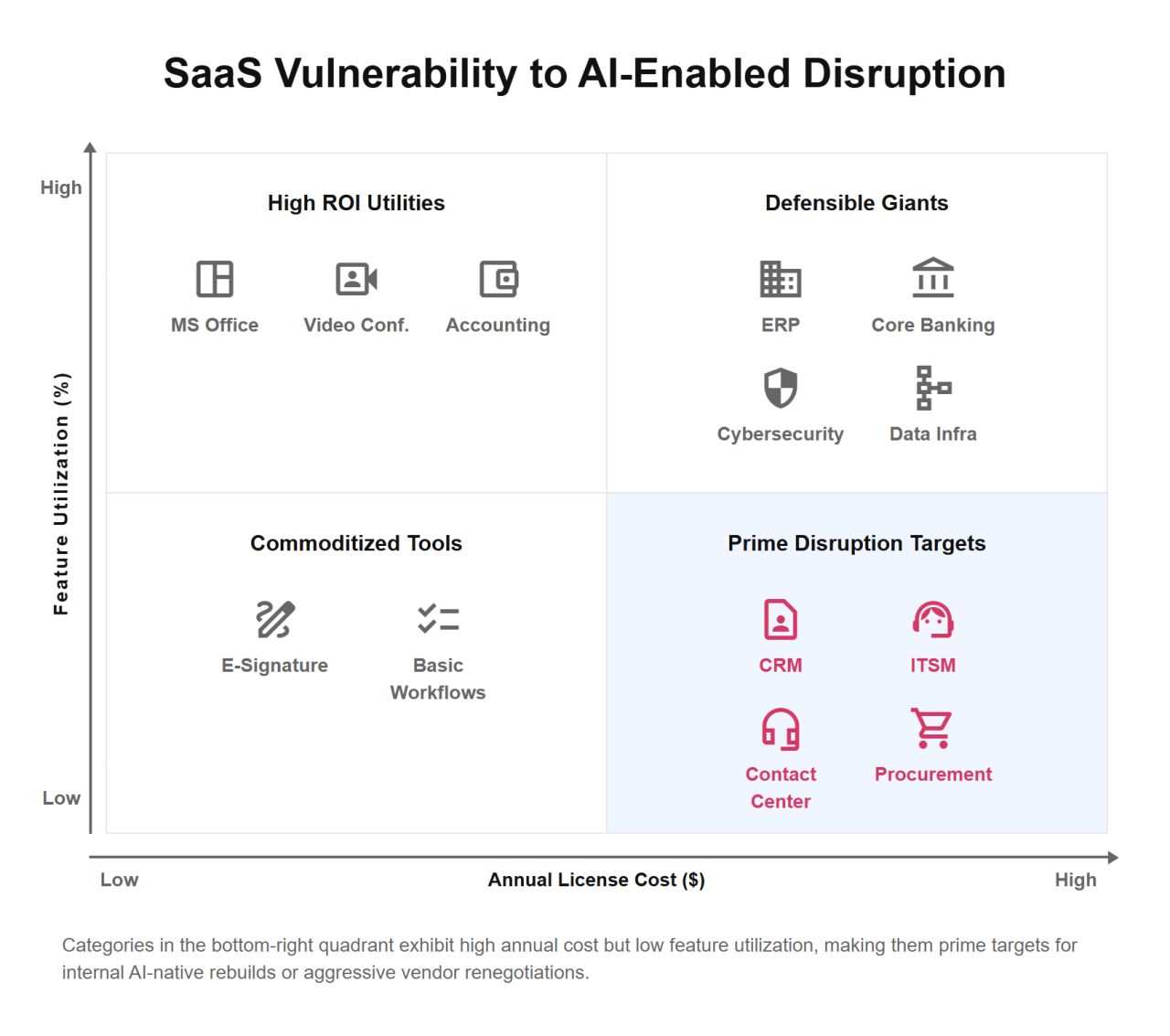
6 of 43 adsSign up to see every Kosmoy ad, filter by format and date, and get alerts on new ones.
See all 43 adsOn Google Search, YouTube and Display
Domain kosmoy.com · 12 ads on the Transparency Center, checked 1 Nov 2026 · 5 recorded
- All 5
- Text 5
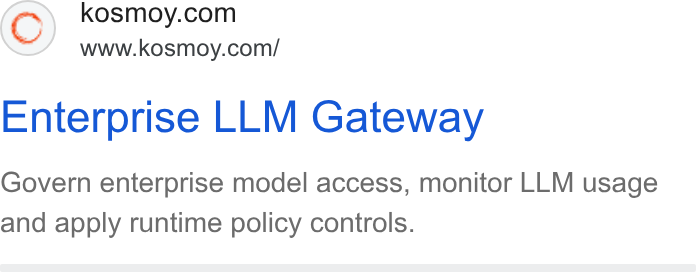
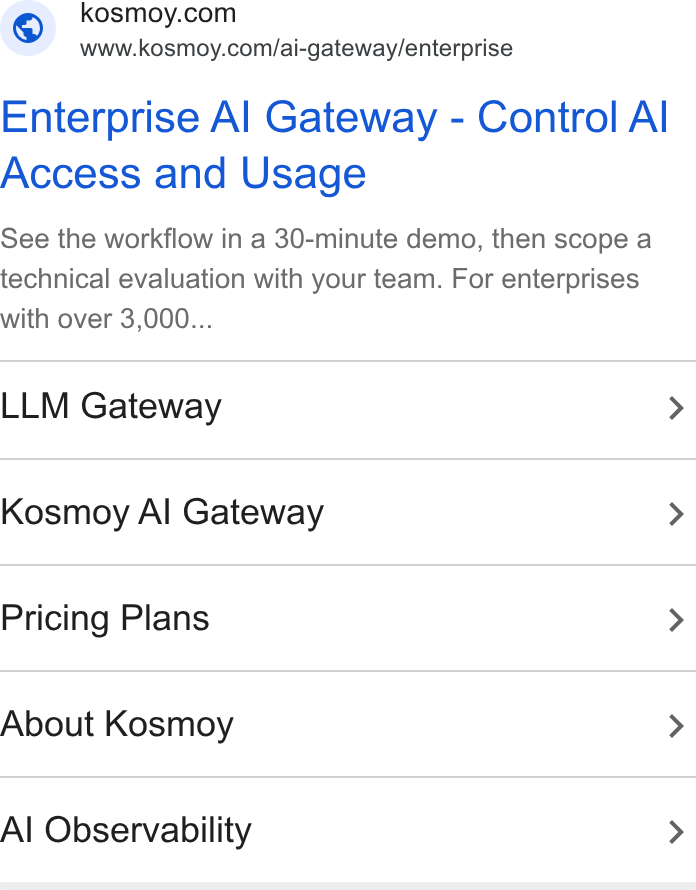
- GOOGLE · TEXTLast shown 30 Oct 2026
First shown 19 Oct 2026
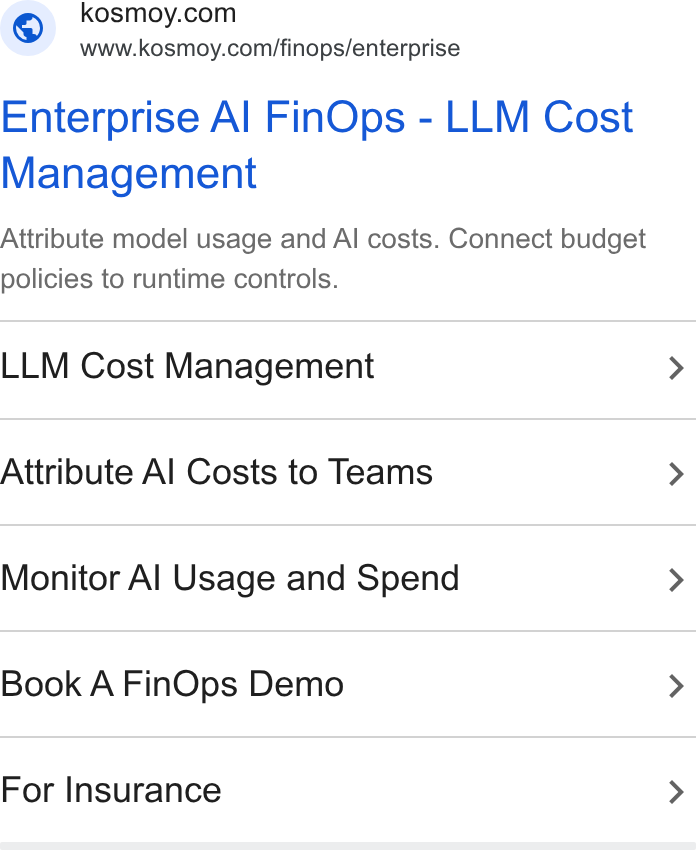
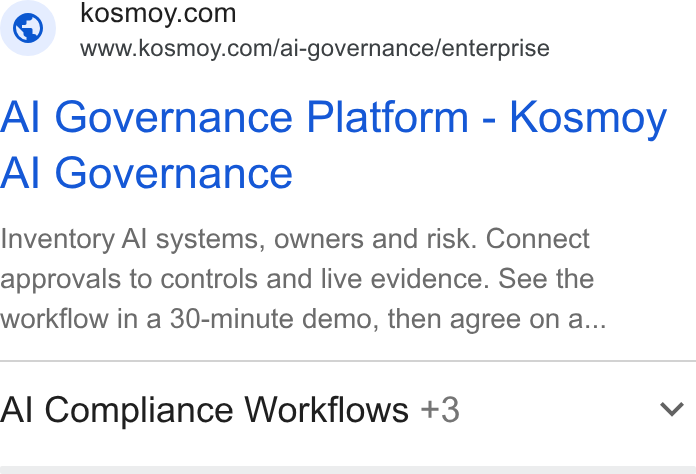
- GOOGLE · TEXTLast shown 30 Oct 2026
First shown 19 Oct 2026
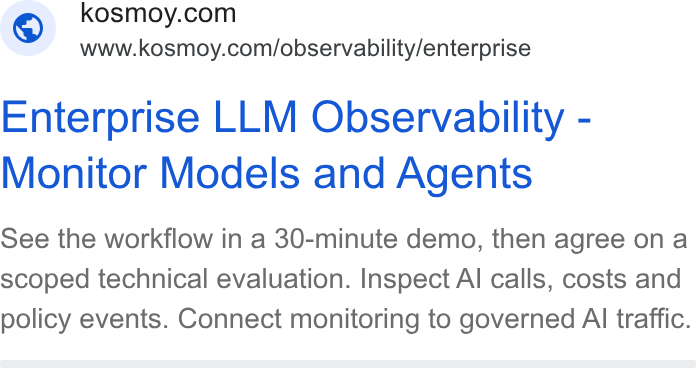
- GOOGLE · TEXTLast shown 30 Oct 2026
First shown 19 Oct 2026
- GOOGLE · TEXTLast shown 30 Oct 2026
First shown 19 Oct 2026
- GOOGLE · TEXTLast shown 29 Oct 2026
First shown 19 Oct 2026
Questions about Kosmoy’s ads
Is Kosmoy running LinkedIn ads?
We recorded no live LinkedIn ads for Kosmoy on 9 Nov 2026.
How many LinkedIn ads has Kosmoy run?
LinkedIn’s ad library lists 27 ads for Kosmoy. We recorded 43 LinkedIn ads for Kosmoy, first recorded on 24 Sept 2026 and last recorded on 24 Sept 2026.
Does Kosmoy advertise on Facebook and Instagram?
Kosmoy’s Facebook page had no active ads in Meta’s Ad Library, last recorded on 22 Oct 2026.
Does Kosmoy run Google ads?
Yes. We recorded 12 Google ads for the domain kosmoy.com on 1 Nov 2026.
Which ad formats does Kosmoy use?
The 6 LinkedIn ads on this page include 1 image ad and 5 video ads.
Watch the companies you care about.
Filter every ad by industry, country, format and network, and get alerts when a company you watch starts running new ads.