On air · 1 of 3 networks
Helm.ai
- helm.ai
- AI
- US
- 81 employees
Helm.ai’s ads on LinkedIn, Meta and Google, recorded by adsrunning. Browse the latest here for free. Sign up free to see all 50. Watch Helm.ai with Starter to get each new one in your feed.
Watchlist with Starter · $49/mo
| Network | Status | Live ads | Nov 2025LinkedIn activity · 52 weeksOct 2026 | Checked | Next step |
|---|---|---|---|---|---|
| Running | 6 | Checked 29 Oct 2026 | See all 50 ads → | ||
| Meta | Not checked | — | |||
| Not checked | — |
Helm.ai has 6 live LinkedIn ads.
Latest ads
- LINKEDIN · IMAGESince 12 Oct 2026
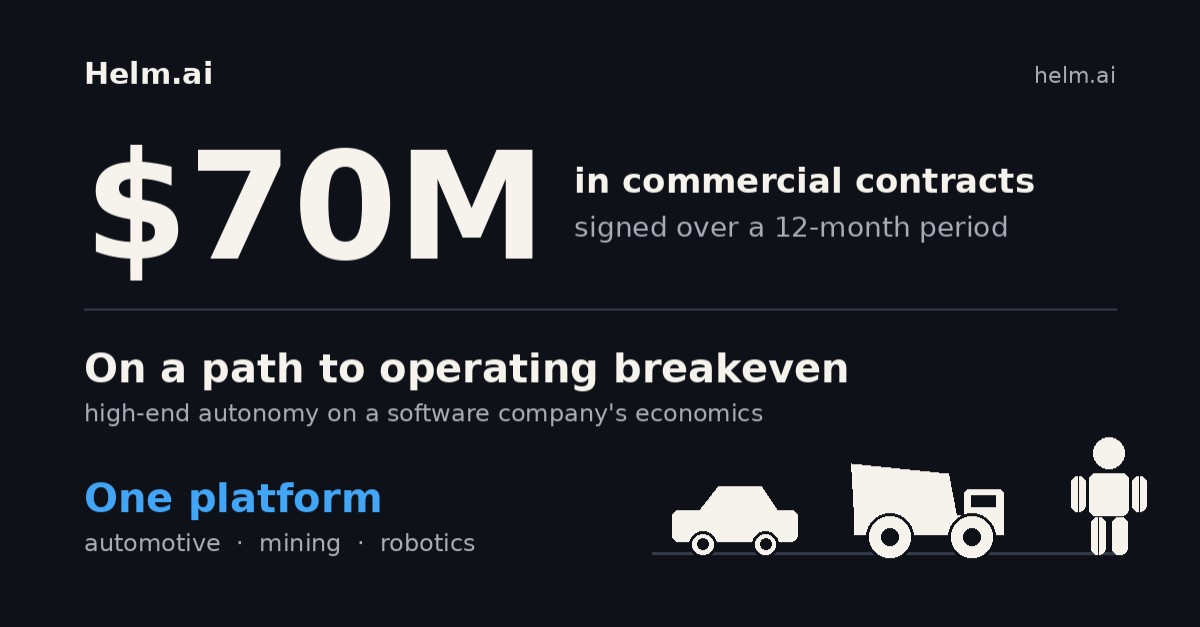
We have signed $70 million in commercial contracts over a 12-month period and is on a path to operating breakeven — high-end autonomy on a software company’s economics. Physical AI has its own scaling law, and ours is capital-efficient: more capability per dollar of data, compute and fleet. One foundation-model platform, trained with unsupervised learning on the structure of the physical world, runs on mass-market automotive-grade compute with a fraction of the typical data, and carries a single model lineage from L2+ passenger vehicles to heavy industrial equipment and robotics. By the numbers: 🔵 $70M in commercial contracts signed over a twelve-month period, across global automotive OEMs, Tier 1 suppliers and industrial automation companies 🔵 Perception, full-stack ADAS/autonomous driving, automated data labeling and generative simulation on one platform 🔵 Production-bound vehicle programs in deep integration with next-generation architectures ahead of start of production 🔵 Production-track deployment beyond the road: perception for heavy industrial equipment in open-pit mining That is what capital-efficient scaling looks like for physical AI: the economics of a software business, applied to the physical world. Read more: https://lnkd.in/gUGjuWTP #AutonomousVehicles #PhysicalAI #Robotics #DeepTech #AI #Automotive #HelmAI
- LINKEDIN · VIDEOSince 4 Jun 2026
We have built a generative world model that hits a new industry benchmark for simulation: native Full HD (2MP) resolution per camera across a synchronized 6-camera surround view. Traditional simulation approaches introduce a severe "sim-to-real" domain gap. Our world model eliminates this gap by generating a 12-megapixel fully synchronized synthetic canvas per timestep, ensuring autonomous driving systems train on the exact pixel density they will encounter on the road. Our architecture provides global automakers with two core capabilities: 🔵 VidGen-3: Simulates entirely synthetic driving sequences from scratch to bridge geographic and environmental data gaps. 🔵 GenSim-3: Performs high-fidelity scene transfer, re-stylizing real-world footage to instantly change parameters like weather, lighting, and textures. We achieved this resolution milestone using an optimized cluster of only hundreds of GPUs rather than thousands. This massive compute efficiency makes high-fidelity simulation commercially viable for enterprise scaling and accelerates the path to safe, scalable autonomy.
- LINKEDIN · VIDEOSince 4 Jun 2026
We have built the first generative simulation platform that delivers native Full HD (2MP) resolution per camera across a synchronized, 6-camera surround view—yielding a 12-megapixel fully synchronized synthetic canvas per timestep. By delivering five times the pixel density of current industry standards, we are solving a critical infrastructure bottleneck for Physical AI. Training an AI system on sub-HD synthetic data creates a significant "sim-to-real" domain gap that hinders real-world performance. By achieving native hardware parity, we ensure that autonomous systems are trained on the exact pixel density they will encounter in physical reality. Our platform provides two powerful methods for data generation: 🔵 VidGen-3 creates entirely synthetic driving sequences from scratch to bridge geographic and environmental data gaps. 🔵 GenSim-3 performs high-fidelity scene transfer by re-stylizing real-world footage to change parameters like weather, lighting, and textures. We achieved this resolution milestone using an optimized cluster of only hundreds of GPUs rather than thousands. This massive compute efficiency makes high-fidelity simulation commercially viable for enterprise scaling and accelerates the path to safe, scalable autonomy.
- LINKEDIN · VIDEOSince 3 Jun 2026
Scaling a physical vehicle test fleet is an incredibly capital-intensive way to train autonomous driving systems. AI-generated synthetic data is the only mathematically viable way to generate the volume of training data required for safety validation—but legacy sub-HD synthetic data degrades real-world performance. We have built a generative simulation platform that delivers native Full HD (2MP) resolution per camera across a synchronized 6-camera surround view, setting a new industry benchmark for synthetic data fidelity. By delivering five times the pixel density of current standards, we achieve true hardware parity. Autonomous driving systems can finally be trained in simulation on the exact pixel density their physical camera suites utilize on the road, eliminating the traditional "sim-to-real" domain gap. The platform provides two core data generation pipelines: 🔵 VidGen-3: Creates entirely synthetic surround-view sequences from scratch to bridge critical data gaps. 🔵 GenSim-3: Performs high-fidelity scene transfer, allowing developers to re-stylize real-world footage to alter weather, lighting, and textures on the fly. We achieved this resolution milestone using an optimized cluster of only hundreds of GPUs rather than thousands. This massive compute efficiency removes the cost-prohibitive infrastructure barriers, making high-fidelity synthetic data commercially viable for global automakers today.
- LINKEDIN · VIDEOSince 1 Jun 2026
We’ve hit the new industry benchmark for generative simulation by delivering five times the pixel density of current standards! Our foundation models, VidGen-3 and GenSim-3, are the first to generate native Full HD (2MP) resolution per camera across a synchronized 6-camera surround view. This produces a 12-megapixel fully synchronized synthetic canvas per timestep. The breakthrough is critical for the "sim-to-real" transition. Training a Full HD perception stack on sub-HD synthetic data creates a significant domain gap that hinders real-world performance. By achieving native hardware parity, we ensure that autonomous systems are trained on the exact pixel density they will encounter on the road. Our platform provides two powerful methods for data generation: 🔵 VidGen-3 creates entirely synthetic driving sequences from scratch to bridge geographic and environmental data gaps 🔵 GenSim-3 performs high-fidelity scene transfer by re-stylizing real-world footage to change parameters like weather, lighting, and textures. We achieved this resolution milestone using an optimized cluster of only hundreds of GPUs rather than thousands. This massive compute efficiency makes high-fidelity simulation commercially viable for global automakers and accelerates the path to safe, scalable autonomy. Read the full announcement: https://lnkd.in/gpUaeKyE
- LINKEDIN · VIDEOSince 26 Feb 2026
Mass-market autonomy is as much an economic challenge as it is a technical one. For an automaker, the "brute-force" approach—requiring massive capital and endless data collection—is no longer a viable path to production. Today, we are announcing the expansion of Helm.ai Driver to change that equation. Helm.ai Driver is a production-ready, vision-only software stack now capable of urban autonomy. It allows OEMs to deploy high-end Level 2+ systems immediately, while using the exact same underlying architecture to unlock Level 3 and Level 4 capabilities as their roadmaps evolve. Our AI architecture is designed specifically to help the industry move past the “Data Wall”: 🔹 Unprecedented Efficiency: Powered by Deep Teaching™, our system reached this level of maturity using only 1,000 hours of real-world data—bypassing the need for millions of miles of training. 🔹 Certifiable Safety: We are moving the industry past the monolithic “end-to-end” black box. By splitting autonomy into distinct Perception and Policy layers, we provide the transparent, auditable foundation required for ISO 26262-certifiable deployments. 🔹 Global Generalization: Paired with Semantic Simulation, our system trains on infinite geometric scenarios, allowing for global scalability without the prohibitive cost of city-by-city data collection. 🎥 Watch the video below to see the Helm.ai Driver navigating Redwood City, CA. The system autonomously handles intersections, traffic lights, and dynamic road users. It is safely supervised in accordance with standard testing protocols, with the safety driver requesting lane changes and turns via the turn signal. The future of autonomy isn't about the volume of data—it’s about the efficiency of the architecture. We are providing the only realistic path to mass-market autonomous deployment. 📰 Read the full announcement: https://lnkd.in/gm5EyvHJ #AutonomousDriving #ADAS #ArtificialIntelligence #DeepLearning #MachineLearning #AutomotiveTech #ComputerVision
6 of 50 adsSign up to see every Helm.ai ad, filter by format and date, and get alerts on new ones.
See all 50 adsWatch the companies you care about.
Filter every ad by industry, country, format and network, and get alerts when a company you watch starts running new ads.