Not on air · 2 of 3 networks checked

GCCNexus ads
- gccnexus.com
- Technology, Information and Internet
- 5 employees
GCCNexus’s ads on LinkedIn, Meta and Google, recorded by adsrunning. Browse the latest here for free. Sign up free to see all 25. Watch GCCNexus on any plan to get each new one in your feed.
Watchlist included in every plan
What GCCNexus runs
- Single image · LinkedIn
- 6
| Network | Status | Live ads | Nov 2025LinkedIn activity · 52 weeksNov 2026 | Checked | Next step |
|---|---|---|---|---|---|
| None recorded | 0 | Checked 8 Nov 2026 | See all 25 ads → | ||
| Meta | Not checked | — | |||
| None recorded | 0 | No ads found on the Google Ads Transparency Center | Checked 16 Oct 2026 | Collect them with the API → |
GCCNexus has no live LinkedIn ads. We recorded no Google ads on 16 Oct 2026.
Latest ads
- LINKEDIN · IMAGERecorded 4 Oct 2026
Forward Deployed Engineer hiring has a supply problem that no recruiter can solve, and most companies are responding to it exactly wrong. The numbers: 643 open FDE roles in April 2025. 5,330 in April 2026. Roughly 2,000 engineers in the US can actually deliver AI ROI at deployment level. You cannot hire your way out of that. Bidding higher moves the offer, not the delivery date. So what actually works? Split the role. Not the person, the work. What needs proximity: * Reading the customer's org and finding the real problem * Learning the exceptions nobody wrote into the spec * Deciding which actions are irreversible and who signs off What does not: * Legacy system integration * Data pipeline repair * Connector builds * Security review cycles * Production hardening The second list is most of the hours. It runs on specs and consistent throughput, which is exactly what a structured engineering team in India delivers. One FDE with a deployment pod behind them covers three accounts in the time they used to cover one. The honest limit: a pod working from documentation will not develop the instinct to catch what nobody thought to write down. That part stays in the room, with the person who has been sitting in it. We are still working out how much of that instinct transfers. If you have solved it, I want to hear how. gccnexus.com #ForwardDeployedEngineer #EnterpriseAI #EngineeringTeamsIndia #GCCNexus
- LINKEDIN · IMAGERecorded 4 Oct 2026
Let's talk about the line item nobody puts in the India business case: attrition. Each engineer who leaves costs you roughly six months of their salary in replacement and ramp. At IT services companies attrition runs 18-22%. At product companies and GCCs it's 12-16%. On a 10-person team that's one or two people walking out the door every year, and the bill never shows up in any salary benchmark. Most of those decisions get made in the first three months. Someone joins, onboarding is thin, nobody owns their ramp, a better offer arrives in week ten, and they're gone before they shipped anything. The companies that hold their teams together aren't the ones paying the least. They pay fairly, they build something worth staying for, and they treat the first 90 days as the actual product. Retention is the part of the India equation most founders underprice. The salary saving is easy to model. The cost of rebuilding a team twice is the one that erases it. Attrition by city and company type is in the benchmark: https://lnkd.in/gB8xeBaP GCCNexus #TalentRetention #GCC #GlobalCapabilityCenters #IndiaTechTalent #EngineeringTeams #OffshoreEngineering
- LINKEDIN · IMAGERecorded 4 Oct 2026
What does an offer band actually tell a candidate in India? More than most founders realise. Here's how it usually plays out. A company decides to build in India. Someone pulls a market rate, lands on a number that feels fair, and the JD goes live. The role asks for product thinking, ownership, and the ability to work directly with an HQ team. The applications arrive. Plenty of them. And every interview feels slightly off. Solid engineers, good execution, but nobody who has owned a product decision or pushed back on a spec. Here's what happened. In India, compensation isn't just a number, it's a sorting mechanism. Engineers know roughly what tier of company each band belongs to. Price at the market median and you're read as an IT services role, so the product-company engineers you wrote the JD for never apply. They aren't rejecting you. They're never seeing you. So the interviews weren't testing your bar. They were testing a pool your budget had already chosen. Two practical moves: → Set the band before you write the JD, not after → Price per role, not per team. The premium over median that attracts the right profile varies widely by role Percentile data across 11 roles: https://lnkd.in/gB8xeBaP How we help companies build in India: gccnexus.com If you've run an India loop that felt off, was it the bar, or the band? #HiringInIndia #GCCIndia #EngineeringHiring #GCCNexus
- LINKEDIN · IMAGERecorded 4 Oct 2026
Before you sign with any India provider, ask one question: can I own this team later? Their answer separates a partnership from a rental. Most offshore setups are rentals. The provider staffs your team, the work ships, and for a year or two it feels like yours. Then you try to move those engineers into your own entity and the contract says no. The people who know your product best were never on your books. For short-term work, that structure is fine. When the team becomes core to what you're building, it's a problem you've already locked in. The TALENT BOT model starts from ownership instead of arriving at it. A dedicated company, hiring exclusively for you, run on your culture and policies, with full transfer to you whenever you're ready. You build the team now and take it in-house later, on your timeline. Renting and owning lead to very different places three years out. Ask the ownership question before you sign, not after. GCCNexus See how build-and-own works: https://lnkd.in/gQhimGNh #GCCNexus #TalentModel #Talent
- LINKEDIN · IMAGERecorded 4 Oct 2026
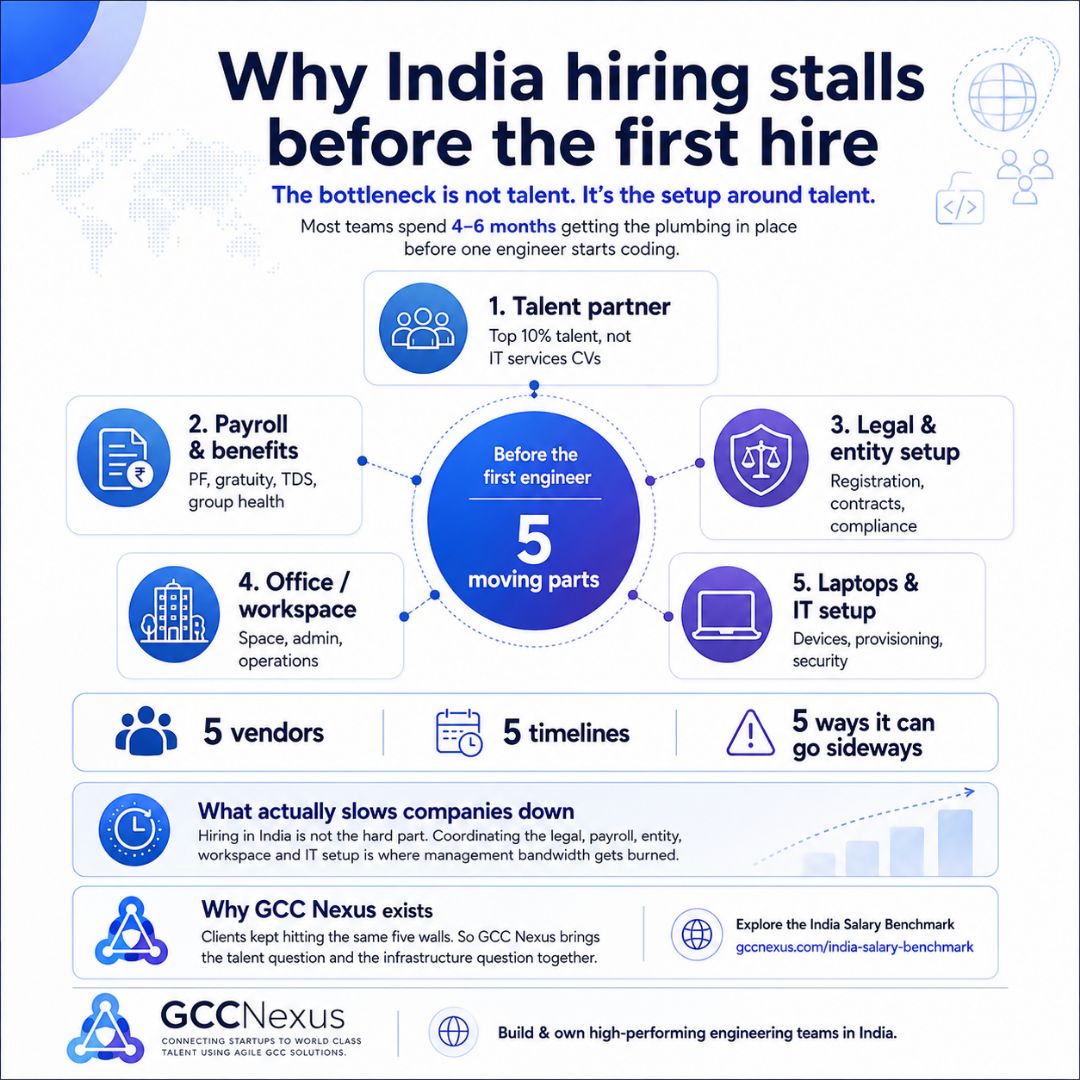
Most companies spend four to six months setting up in India before they hire a single engineer. Not because hiring is slow. Because of everything around the hire. To build a team that's actually legal and compliant, you're running all of this at once: a talent partner who understands the top 10% bracket and won't flood you with IT services CVs, a payroll provider who can handle PF, gratuity, TDS and group health, a legal firm for entity registration and contracts, office space, and laptops and IT setup for people sitting twelve hours off your timezone. Five vendors. Five timelines. Five separate ways for the thing to go sideways. All of it before anyone writes a line of code. This is the part that gets skipped in every "just hire in India and save" thread. The talent is genuinely there. The plumbing to reach it legally is where most teams stall, burn a quarter of management bandwidth, and start questioning the whole plan. We built GCCNexus because clients kept hitting the same five walls. So we took on the walls.. The talent question and the infrastructure question, both with the numbers: https://lnkd.in/gB8xeBaP #GCC #GlobalCapabilityCenters #IndiaTechTalent #EngineeringTeams #OffshoreEngineering #BuildInIndia
- LINKEDIN · IMAGERecorded 4 Oct 2026
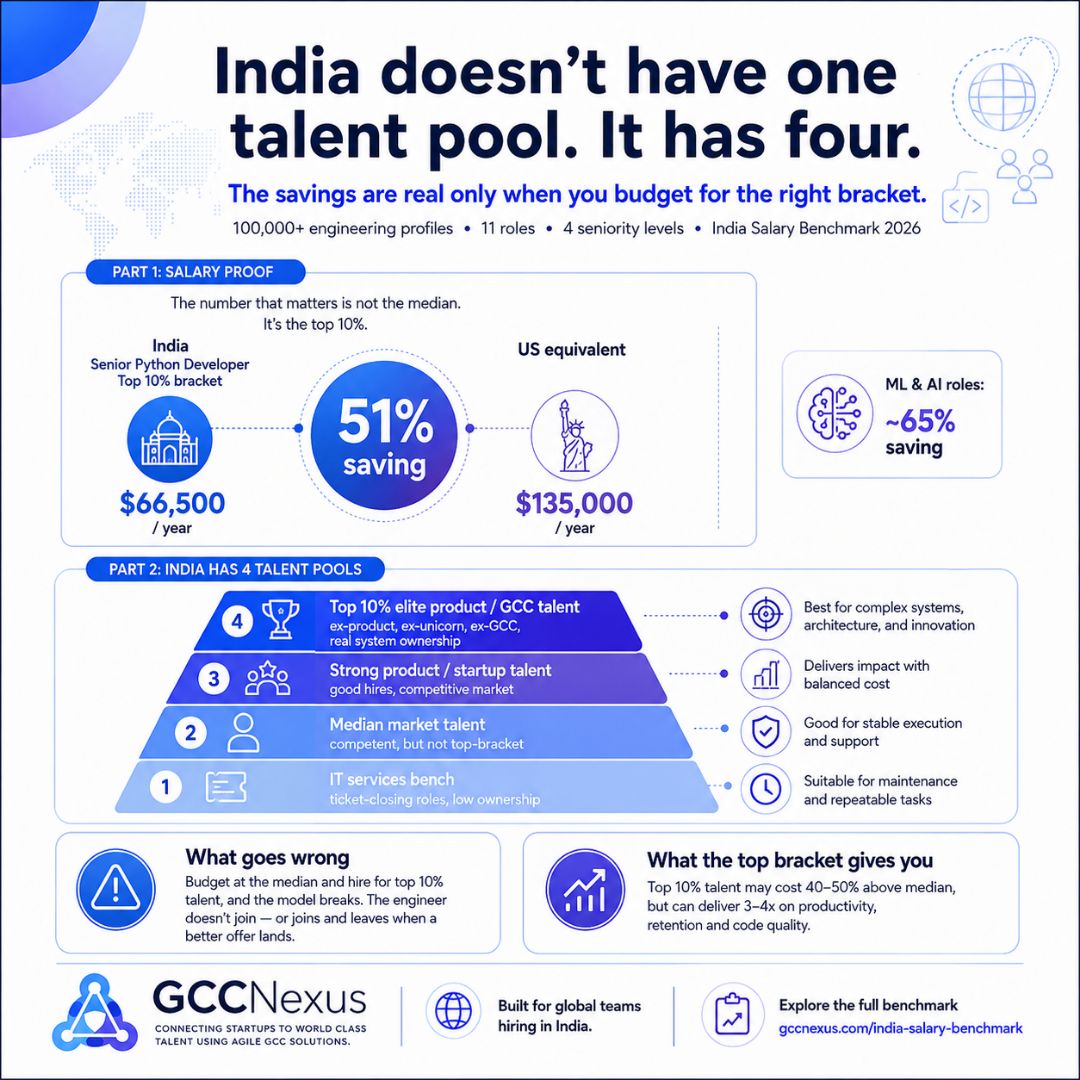
Every founder I talk to has heard some version of "India engineers cost 50%+ less than the US." But nobody ever shows you the actual numbers, broken down by role, seniority, and the specific bracket you actually need to hire from. So we pulled the data. 100,000+ engineering profiles across GCCs, funded startups, and product companies in India. Here's what it says. The number that matters isn't the median. It's the top 10%. A senior Python developer in that bracket costs $66,500 a year. The US equivalent is $135,000. That's a 51% saving. ML and AI engineers land closer to 65%. So yes, the saving is real. It disappears the moment you budget at the median and try to hire top-10% talent. The engineer either doesn't join, or joins and quits inside six months when a better offer lands. I've watched this play out across dozens of setups. The company walks away blaming "India quality." They hired from the wrong bracket. Because India doesn't have one talent pool. It has several. At the bottom is the IT services bench: engineers trained to close tickets, not own problems. That's most of the 5 million number everyone quotes, and the reason so many companies leave disappointed. The top 10% is a different market, ex-Flipkart, ex-Swiggy, ex-CRED, ex-FAANG India. People who've run distributed systems under real load. They cost 40-50% more than the median. The output gap isn't 40%. It's 3-4x on productivity, retention, and code quality. Google, Goldman, Walmart Tech hire only from this bracket. So do we. Full benchmark is public: 11 roles, 4 seniority levels, split by company type → https://lnkd.in/gB8xeBaP If you're building in India, or still deciding whether to, the numbers are there. Use them. GCCNexus #GCC #GlobalCapabilityCenters #IndiaTechTalent #EngineeringTeams #OffshoreEngineering #TechSalaries




6 of 25 adsSign up to see every GCCNexus ad, filter by format and date, and get alerts on new ones.
See all 25 adsQuestions about GCCNexus’s ads
Is GCCNexus running LinkedIn ads?
We recorded no live LinkedIn ads for GCCNexus on 9 Nov 2026.
How many LinkedIn ads has GCCNexus run?
LinkedIn’s ad library lists 26 ads for GCCNexus. We recorded 25 LinkedIn ads for GCCNexus, first recorded on 4 Oct 2026 and last recorded on 4 Oct 2026.
Does GCCNexus run Google ads?
We recorded no Google ads for the domain gccnexus.com on 16 Oct 2026.
Which ad formats does GCCNexus use?
The 6 LinkedIn ads on this page include 6 image ads.
Watch the companies you care about.
Filter every ad by industry, country, format and network, and get alerts when a company you watch starts running new ads.