Not on air · 2 of 3 networks checked

Fortiv ads
- fortiv.io
- Software Development
- DK
- 23 employees
Fortiv’s ads on LinkedIn, Meta and Google, recorded by adsrunning. Browse the latest here for free. Sign up free to see all 135. Watch Fortiv on any plan to get each new one in your feed.
Watchlist included in every plan
What Fortiv runs
- Single image · LinkedIn
- 6
- Google ads on 29 Oct 2026
- 5
| Network | Status | Live ads | Nov 2025Activity · 52 weeksNov 2026 | Checked | Next step |
|---|---|---|---|---|---|
| None recorded | 0 | Checked 4 Nov 2026 | See all 135 ads → | ||
| Meta | Not checked | — | |||
| Recently | 5 | Checked 29 Oct 2026 | Collect them with the API → |
Fortiv has no live LinkedIn ads. We recorded 5 Google ads on 29 Oct 2026.
Latest ads
- LINKEDIN · IMAGESince 2 Oct 2026
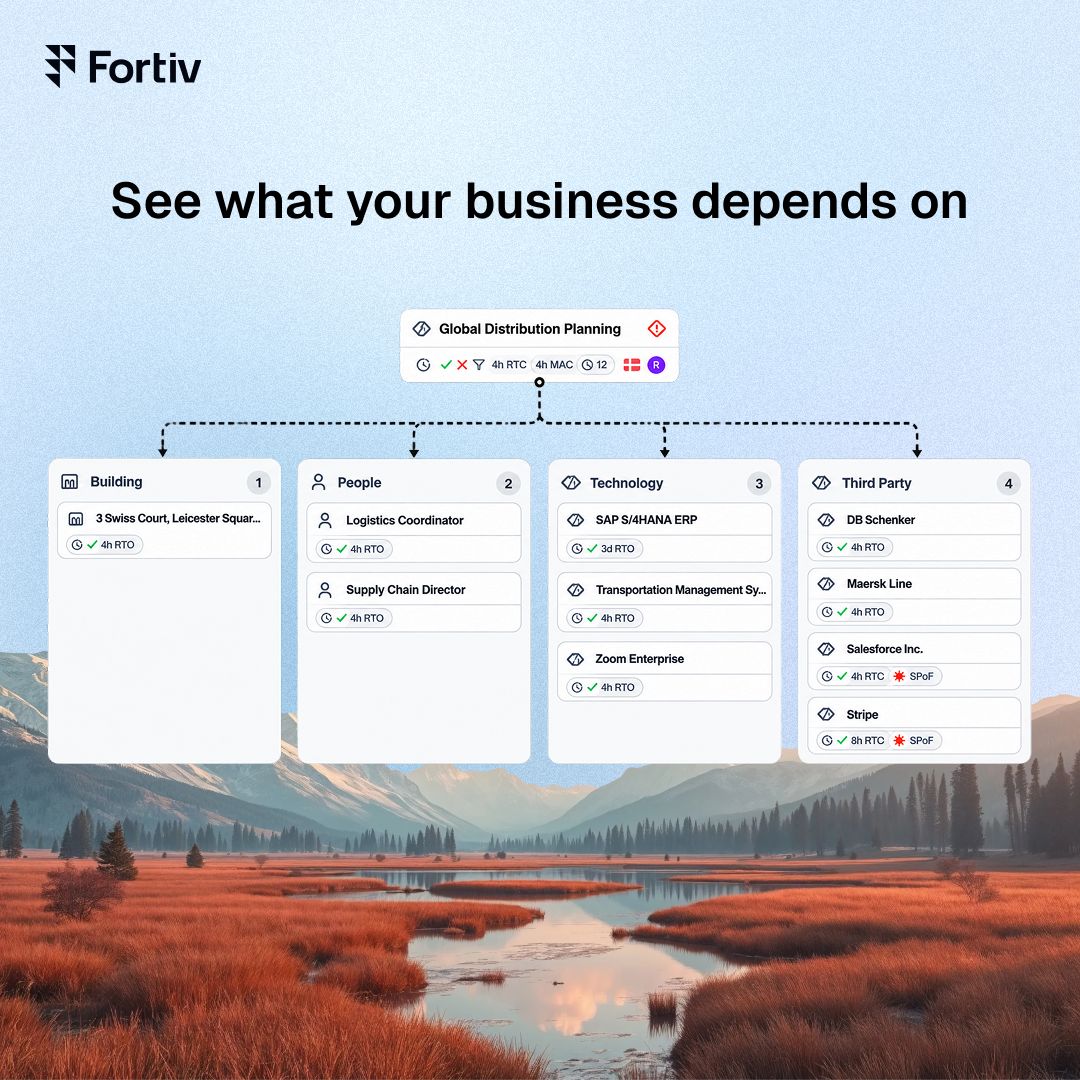
The value of BCM isn't always obvious. Until you can see your own business in it. I saw this quite clearly during a BIA project with a customer. We were working with people who knew their business inside out. Ask them how their processes worked, and they could explain it in detail. But ask what they depended on to perform those activities, or when it would become critical if a key system or piece of equipment was unavailable, and the conversation became much harder. When we came back with their BIA data structured and visualised in the Fortiv platform, something changed. They could suddenly see the picture they had helped build: how their activities connected, what they depended on, and where potential vulnerabilities existed. And when we showed them the continuity plan built from that same information, it all connected. The questions from the workshops suddenly had a purpose. For me, it was a good reminder that collecting the data is only part of the job. Making the connections visible is what helps turn it into something people can actually relate to.
- LINKEDIN · IMAGESince 21 Sept 2026
When theory meets practice, assumptions get challenged. Since I started working with business continuity, one of the things I’ve found most interesting is seeing how the frameworks and approaches we talk about actually play out in practice. Working with clients, being part of conversations, and seeing the challenges they face has made me question some of my own assumptions - and become curious about where our approaches might need to evolve. I wanted a place to share and explore some of those thoughts. So, I’m starting Field Notes on Resilience. It will be shaped by what I encounter in my day-to-day work, the conversations and workshops I’m part of, and my perspective from working inside an AI-native technology company. My first field note explores what working with BCM has taught me about crisis management - and why more preparedness doesn’t always mean better preparedness. I'd be curious to hear whether you’ve seen the same in practice. https://lnkd.in/eQFFnB2m #BusinessContinuity #BCM #CrisisManagement #OperationalResilience
- LINKEDIN · IMAGESince 21 Sept 2026
We are two weeks away from #DRJ and the #Fortiv hosted dinner to discuss all things BCP and Artificial Intelligence. Our solution is native AI and we look forward to showing it off to all attendees. Feel free to email or message me for a meeting at the booth or to attend the exclusive dinner. We look forward to hosting you😊
- LINKEDIN · IMAGESince 21 Sept 2026
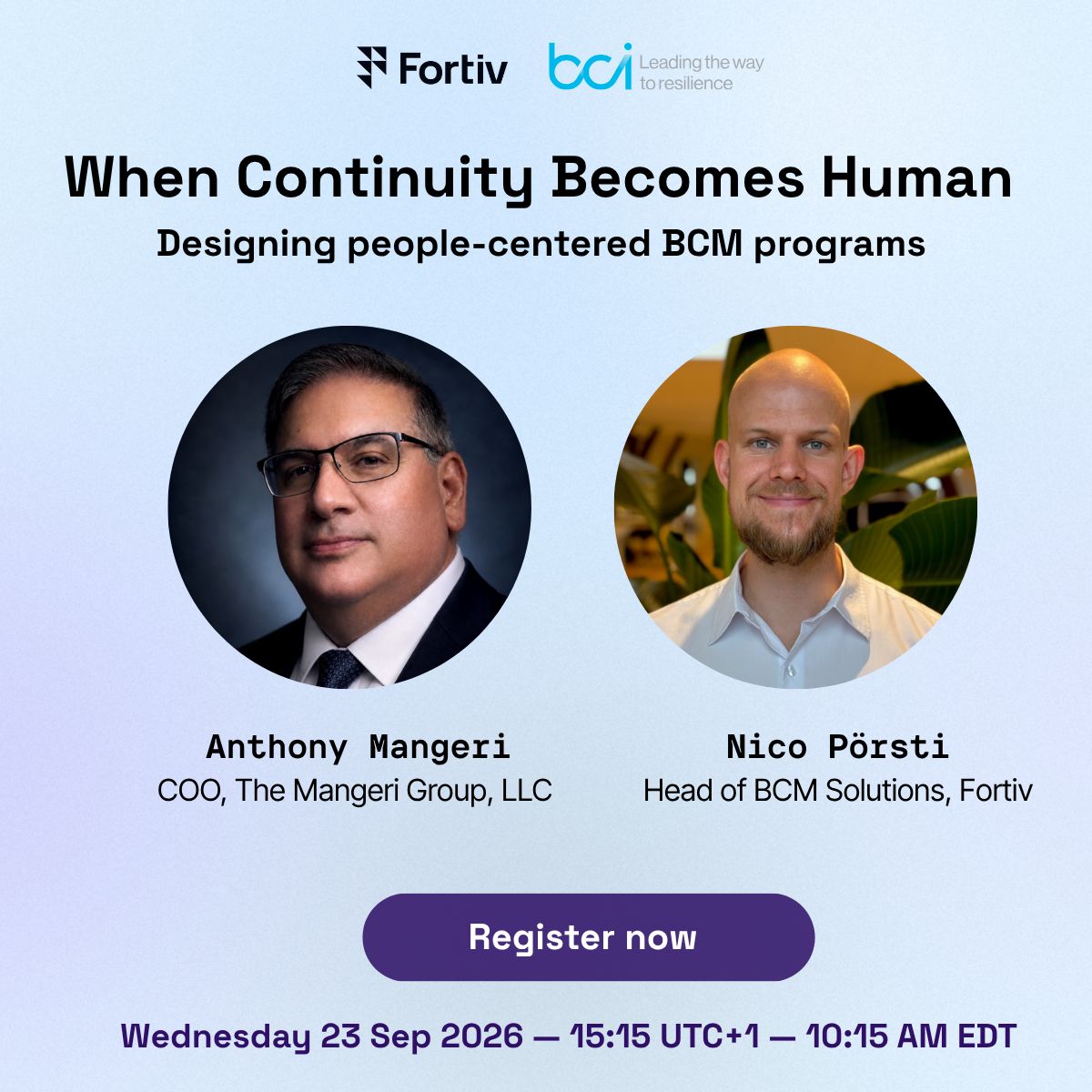
Your continuity plan assumes people will show up. Mine did too. Then came the snowstorm. Roads blocked. Power out. The continuity strategies were solid. Everything was in place. And the people responsible for executing the strategies stayed home. Their families needed them. The plan assumed they'd show up, however the reality made that impossible. Most programs assume people want to work during a crisis. The right person will step up. Commitment outweighs personal impacts. When it matters, they'll log in and execute. System dependencies get mapped. Technical requirements get documented. Governance gets built around processes and controls. People availability? That's treated as a given. I've seen plans that account for regional disruptions affecting both the business and the people running it. But there's rarely much written about the crisis manager managing their own family emergency in the same affected area. Or the backup facing the same disruption who can't reasonably prioritize your continuity over their own situation. The BIA documents who is responsible. It rarely asks: when would they choose to stay home? In a workshop last week, I asked this. The response: we have backup people, so for unavailability to matter, everyone would have to be dead. That's the avoidance. Make the scenario absurd - everyone dead - and you never have to plan for what actually happens: some people stay home. When the disruption is big enough, that assumption breaks fast. You're asking someone to choose organizational continuity over their own crisis. We govern for capability, however capability assumes willingness. And willingness isn't a checkbox in a BIA. This is what we're exploring in the BCI session next week with Anthony Mangeri, MPA,CPM,CEM: how to design this assumption out of your program. What would happen to your continuity if the people you're counting on made the reasonable choice not to show up?
- LINKEDIN · IMAGESince 7 Sept 2026
Nearly 500 people signed up for our webinar last week. 200 watched live. Here's what we did differently. We went back through months of customer calls and mapped what we were hearing against where the industry is moving. Then we asked: would I actually sign up for this? Or would the invitation go straight to the trash? The topic that survived that filter: the annual BCM cycle that creates activity without building capability. Then we did the part most companies skip. We asked one of our customers to present. So instead of us talking about the problem, the people living it did. That's it. No growth hack. Just genuine problems, genuine conversation and real-world solutions. Your best content is already sitting in your notes. And your best speaker is probably your customer, not you. And, of course, none of this happens without an incredible team behind it. Miriam Konradsen Ayed and Magnus Ottosen did the hard work upfront. And Christian Thygesen was willing to share his reality with nearly 500 people.
- LINKEDIN · IMAGESince 4 Sept 2026
September is here, which means #DRJ is coming up quickly! This will be my first DRJ in several years, and I’m really looking forward to reconnecting with the #BCM community and having conversations about one of the biggest topics right now: how can AI actually help us achieve the goals we’ve set for our BCP programs? I’d also love to have you join us for the #Fortiv dinner on Tuesday night. It should be a great opportunity to connect, share ideas, and talk about where AI is taking business continuity. If you’re interested in joining us, send me a message and I’ll get you on the list!




6 of 135 adsSign up to see every Fortiv ad, filter by format and date, and get alerts on new ones.
See all 135 adsOn Google Search, YouTube and Display
Domain fortiv.io · 5 ads on the Transparency Center, checked 29 Oct 2026 · 4 recorded
- All 4
- Video 1
- Text 3
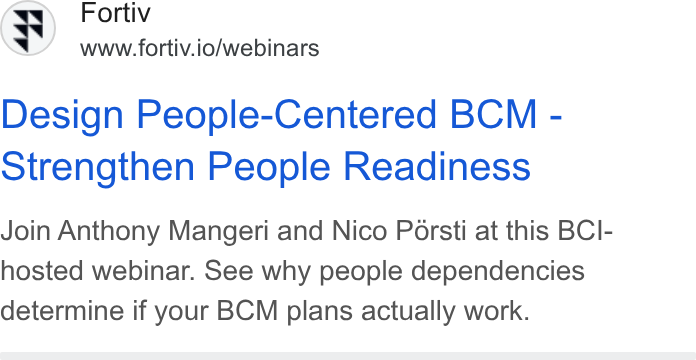
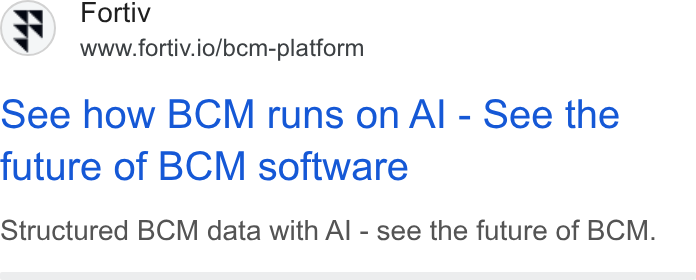
- GOOGLE · TEXTLast shown 14 Sept 2026
First shown 3 Sept 2026 · 2 regions
 Video previewGOOGLE · VIDEOLast shown 3 Sept 2026
First shown 26 Aug 2026 · 38 regions
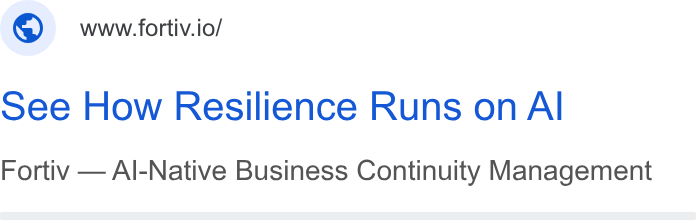
- GOOGLE · TEXTLast shown 29 Sept 2026
First shown 7 Aug 2026 · 10 regions
- GOOGLE · TEXTLast shown 29 Oct 2026
First shown 10 Jun 2026 · 7 regions
Questions about Fortiv’s ads
Is Fortiv running LinkedIn ads?
We recorded no live LinkedIn ads for Fortiv on 8 Nov 2026.
How many LinkedIn ads has Fortiv run?
LinkedIn’s ad library lists 137 ads for Fortiv. We recorded 135 LinkedIn ads for Fortiv, first recorded on 19 Sept 2026 and last recorded on 16 Oct 2026.
Does Fortiv run Google ads?
Yes. We recorded 5 Google ads for the domain fortiv.io on 29 Oct 2026.
Which ad formats does Fortiv use?
The 6 LinkedIn ads on this page include 6 image ads.
Watch the companies you care about.
Filter every ad by industry, country, format and network, and get alerts when a company you watch starts running new ads.