Not on air · 2 of 3 networks checked

Fastformulator Inc ads
- fastformulator.com
- Chemical Manufacturing
- US
- 7 employees
Fastformulator Inc’s ads on LinkedIn, Meta and Google, recorded by adsrunning. Browse the latest here for free. Sign up free to see all 25. Watch Fastformulator Inc on any plan to get each new one in your feed.
Watchlist included in every plan
What Fastformulator Inc runs
- Single image · LinkedIn
- 1
| Network | Status | Live ads | Nov 2025LinkedIn activity · 52 weeksNov 2026 | Checked | Next step |
|---|---|---|---|---|---|
| None recorded | 0 | Checked 8 Nov 2026 | See all 25 ads → | ||
| Meta | Not checked | — | |||
| None recorded | 0 | No ads found on the Google Ads Transparency Center | Checked 29 Oct 2026 | Collect them with the API → |
Fastformulator Inc has no live LinkedIn ads. We recorded no Google ads on 29 Oct 2026.
Latest ads
- LINKEDIN · ARTICLESince 12 Oct 2026
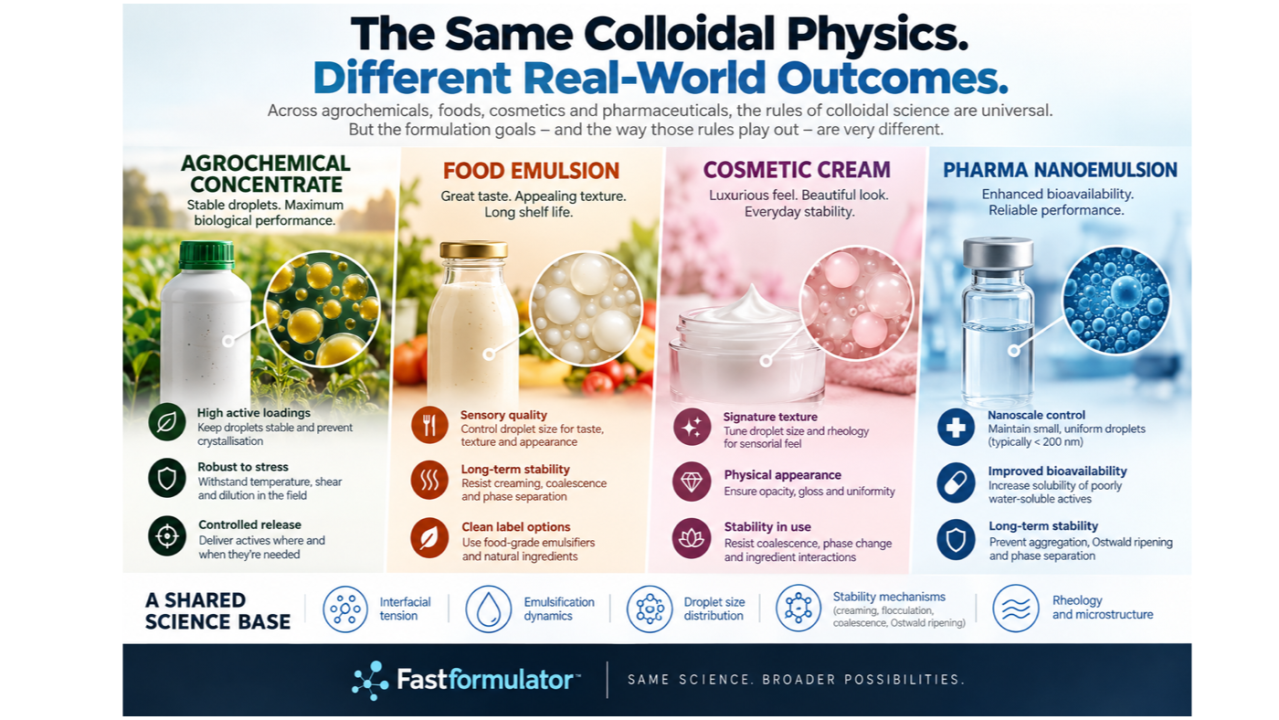
A food scientist joins a pharmaceutical development team. Within her first month, she recognizes that the protein-based parenteral emulsion she has been asked to stabilize is structurally identical to a problem she spent three years solving in plant-based dairy alternatives. Her new colleagues find this surprising. It shouldn't be. The colloidal physics governing stability in a herbicide suspension concentrate, a vinaigrette, a moisturizing cream, and an injectable nanoemulsion are not analogous. They are identical. What differs is the ingredient toolkit available to address them, the consequences of failure, and the time allowed to find out. Our latest FastFormulator article covers what this means in practice: → Why crystal growth in agrochemical suspension concentrates is the most distinctive stability challenge of the group, and why the dispersant selection principles developed there apply directly to pharmaceutical nanosuspension development → How food science carries the deepest practical understanding of protein-stabilized interfaces under thermal stress, and why that knowledge transfers directly to biopharma protein formulation → Why emulsion type selection in cosmetics (O/W, W/O, or W/O/W) is a sensory design decision as much as a stability one, and what that framework offers pharmaceutical topical and transdermal development → How the FastFormulator Chemistry World Model handles cross-industry colloidal problems from a single molecular foundation, without needing to be rebuilt for each sector Cross-industry knowledge transfer is one of the least exploited advantages available to formulation teams. The techniques exist. What is missing is the recognition that every industry is solving the same problem under different constraints. For more info reach us at visit FastFormulator.com or email us [email protected]. #FormulationScience #ColloidalStability #Emulsions #Agrochemicals #FoodScience #Cosmetics #Pharmaceuticals #FastFormulator #ChemistryWorldModel
- LINKEDIN · ARTICLESince 29 Sept 2026
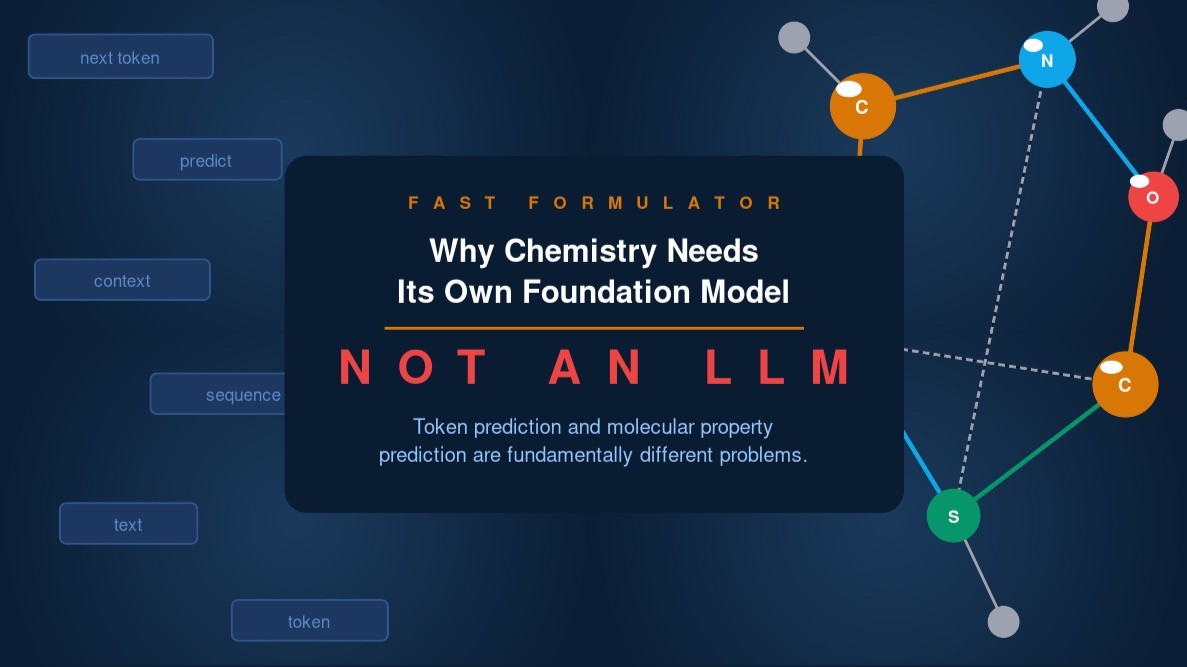
A formulation team spends three weeks evaluating an AI tool for viscosity and stability prediction. The interface is polished. The tool answers questions about surfactants fluently, cites relevant papers, and returns numbers with the correct units when asked for property predictions. The team builds a shortlist of candidate compositions based on those outputs. None of the top three candidates hit the viscosity target in the lab. There was no error message. No confidence flag. The numbers looked exactly like predictions whether the tool was retrieving text patterns from scientific literature or computing from a learned model of chemistry. The team had no way to tell the difference from the output alone. That is not a product quality problem. It is an architecture problem, and it is invisible until you are in the lab. Our latest article makes the technical case for why that distinction matters: language model architecture predicts tokens, molecular pretraining encodes chemical relationships, and those differences determine what each type of system can reliably deliver for formulation property prediction. → The invisible failure mode: A large language model predicts the next token in a text sequence. When asked for a property value, it searches for text that corresponds to the query. For well-characterized systems with good literature coverage, the output may be approximately correct. For novel compositions, it extrapolates in text space without physical grounding, and the output looks equally confident either way. → What gets embedded: Language models encode semantic relationships between words. Molecular foundation models encode structural relationships between molecules. These answer different questions: "what does the literature say?" versus "what does chemistry predict?" For novel formulations outside the published literature, only one produces a useful answer. → What 350 million molecules buys: Pretraining on molecular structures before any property task gives the model transferable chemical representations. It learns how functional groups behave, how molecular geometry affects interfacial activity, how chain length influences packing at a surface. Those representations transfer to formulation property prediction in ways that training on text about chemistry does not. → The practical test: Does the tool predict properties by learning quantitative structure-property relationships from experimental data, or does it retrieve information from text? The answer determines whether it generalizes to novel compositions, predicts coupled properties simultaneously, and supports inverse formulation design. If you work in formulation R&D, CMC development, or AI strategy for chemistry and are navigating a market where every tool claims to understand molecules, this one is worth the read. #ChemistryWorldModel #FoundationModel #FormulationScience #MolecularAI #FormulationDevelopment #Biopharma #ConsumerProducts #AIForChemistry
- LINKEDIN · ARTICLESince 15 Sept 2026
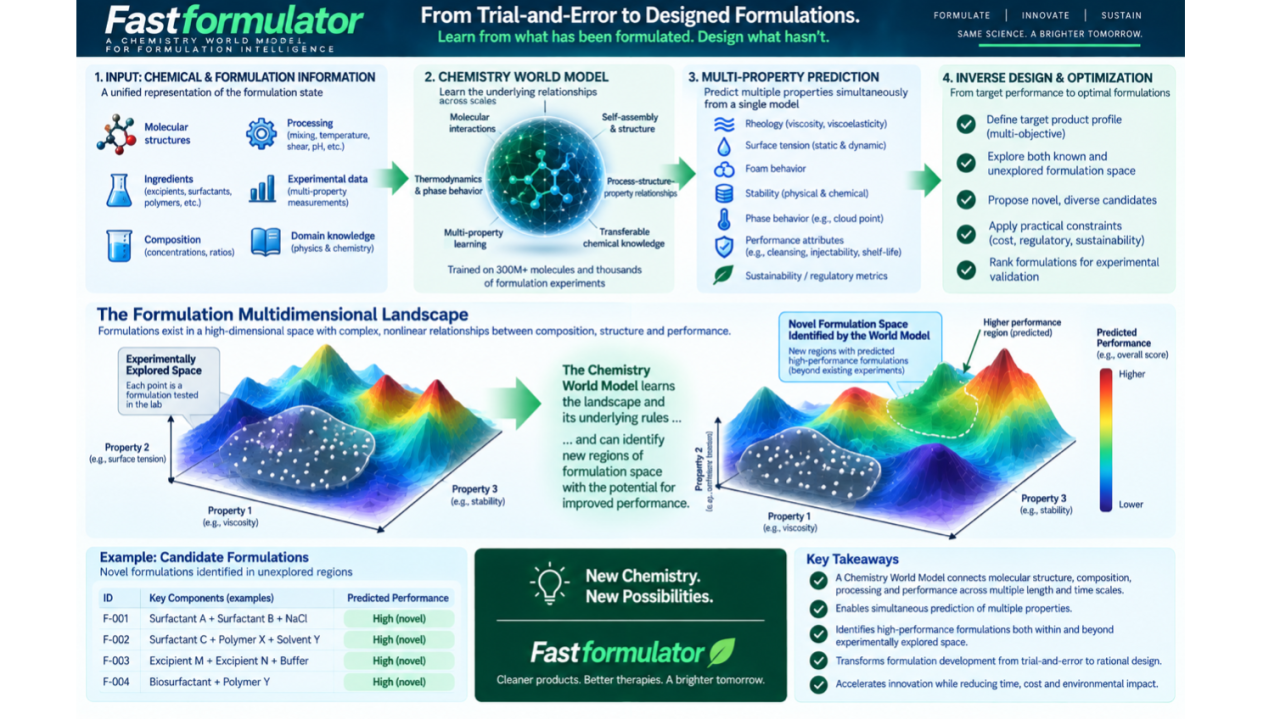
How many formulations does your team test before finding one that actually meets the target? 20? 50? 100? Most formulation R&D runs in one direction: propose a composition, measure its properties, adjust, and repeat. The experimental space grows faster than the team can search it, and the formulation that actually meets the target may never appear in the data. Fastformulator is approaching formulation development from the opposite direction. Instead of asking "What properties will this formulation have?" we start with the properties the R&D team needs: rheology, stability, surface tension, foam behavior and other performance targets. We then identify compositions predicted to deliver them. The Chemistry World Model learns the relationship between molecular structure, ingredient composition and formulation behavior. The inverse design platform searches that learned space backward from performance requirements to candidate formulations. Our new white paper explains the architecture and the evidence behind this approach: → Why conventional formulation AI is limited by small, formulation-specific datasets, and why a foundational model pretrained on 350 million molecules changes what is possible → How inverse formulation design works: starting from a target performance profile and searching for compositions predicted to meet it, rather than testing compositions to discover their properties → Experimental validation across formulation complexity: transfer learning, rapid adaptation from sparse data, and early inverse-design results from our DNN preprint → Industry case studies in consumer products (surfactant systems, coupled foam and rheology) and biopharma (high-concentration mAb excipient selection and multidimensional stability) We are now working with industrial R&D teams to apply this approach to real formulation problems across pharmaceuticals, consumer products and specialty chemicals. If your team has a formulation challenge where the experimental search space has become too large to explore efficiently, we would like to hear about it. Reach out to us at: www.fastformulator.com or [email protected] #ChemistryWorldModel #FormulationScience #InverseDesign #FormulationDevelopment #Biopharma #ConsumerProducts #SpecialtyChemicals #DrugFormulation #FormulationAi
- LINKEDIN · IMAGESince 1 Sept 2026
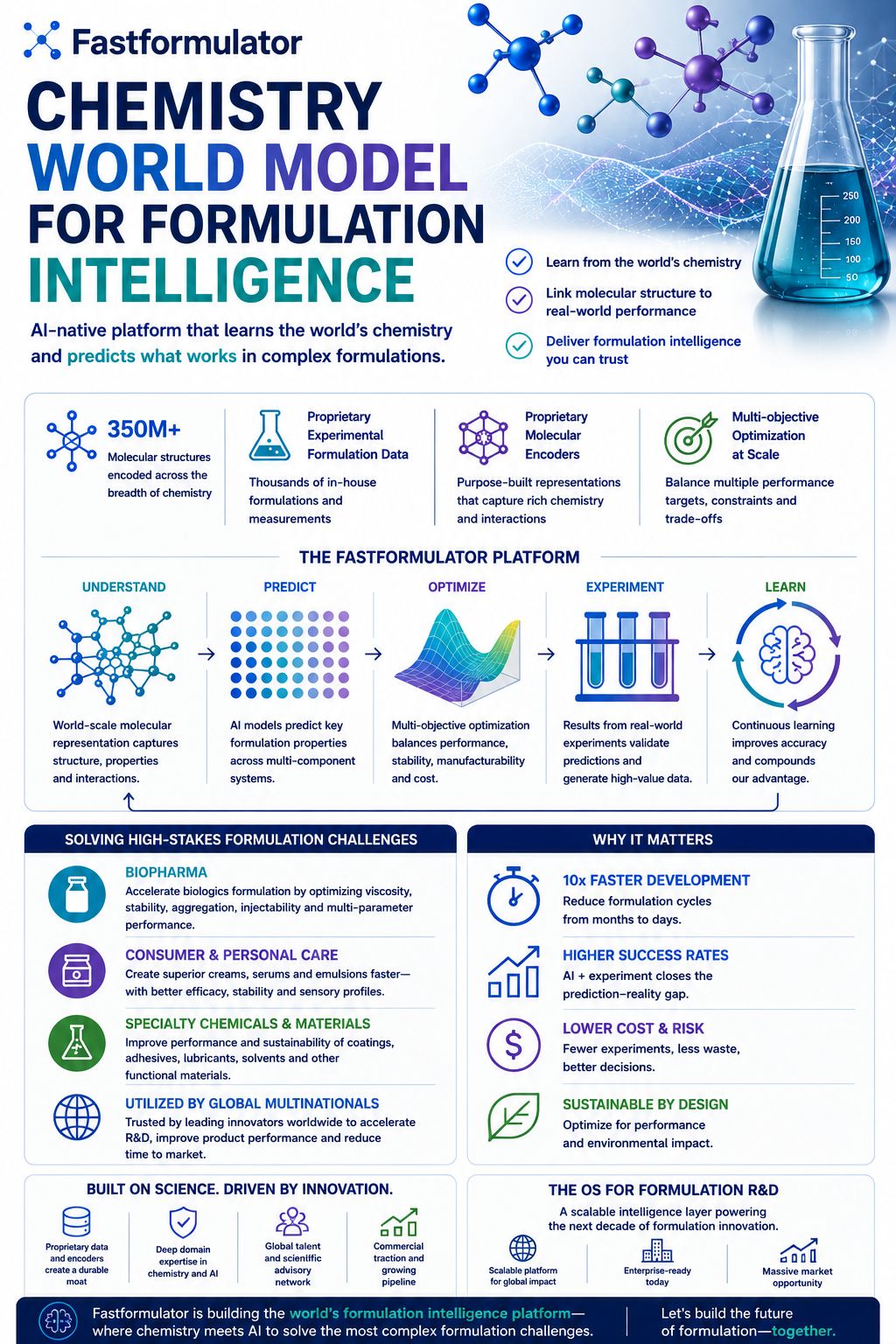
What if Formulation Development could start with knowledge of chemistry at World Scale?
- LINKEDIN · ARTICLESince 29 Aug 2026
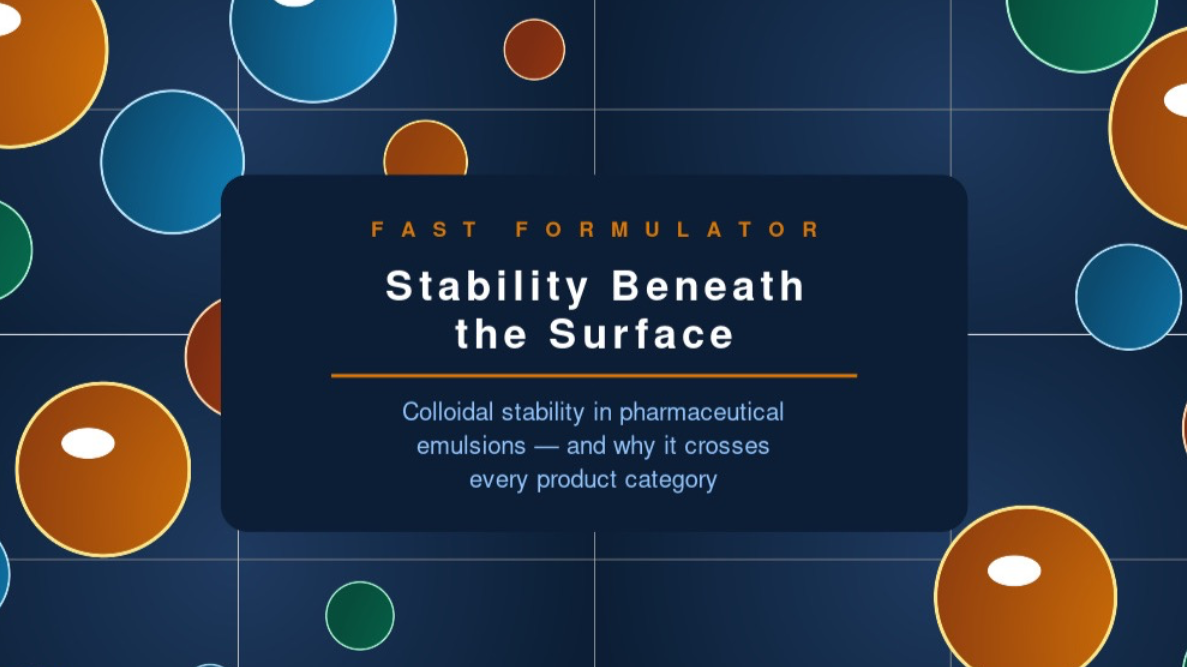
A formulation team submits samples for accelerated stability testing. The nanoemulsion looks right at time zero: droplet size around 120 nanometers, zeta potential at negative 32 millivolts. Four weeks at 40 degrees Celsius later, the vials show visible creaming, a droplet size distribution shifted upward by nearly 200 nanometers, and a zeta potential collapsed to negative 14 millivolts. The molecule is intact. The chemistry is unchanged. But the formulation has failed, and a formulation that has separated cannot reliably deliver its dose. This is not a rare outcome. It is the predictable result of treating colloidal stability as a confirmatory check rather than a design constraint from the beginning. The forces that drove that emulsion toward separation were present from the moment it was first prepared. They simply took time to become visible. Our latest article examines colloidal stability in pharmaceutical emulsions. Why these systems destabilize, why the same physics governs every lipid-based formulation category, and what it takes to find a stable formulation window before material is consumed pursuing dead ends. → The four destabilization pathways: Creaming, flocculation, coalescence, and Ostwald ripening each have a distinct driving force and require a different formulation response. We explain what each mechanism is, what causes it, and why Ostwald ripening (mediated by diffusion, not collision) requires a fundamentally different fix than coalescence. → The physics of colloidal stability: The DLVO energy barrier determines whether droplets can approach closely enough to aggregate. We walk through zeta potential, what electrostatic and steric stabilization do at the interface, and why ionic strength management matters more than most formulation workflows treat it. → Cross-category colloidal stability: Lipid nanoparticles, liposomes, nanosuspensions, and coarse emulsions are all governed by the same physical forces. We examine how failure modes translate across categories and why insight from one formulation type applies directly to the next. → Predictive tools for the coupled design space: FastFormulator's Virtual Viscometer and Virtual Stability Chamber allow formulation teams to screen excipient combinations against both viscosity and stability requirements computationally, identifying where both constraints are satisfied before material is committed to experiments that may confirm dead ends. If you work in lipid-based formulation, CMC development, lipid nanoparticle manufacturing, or any program where a colloidal system must remain intact through manufacture, storage, and delivery, this one is worth the read. #PharmaceuticalEmulsions #ColloidalStability #LipidNanoparticles #Nanoemulsions #FormulationDevelopment #DrugDelivery #PharmaceuticalScience #CMC
- LINKEDIN · ARTICLESince 16 Aug 2026
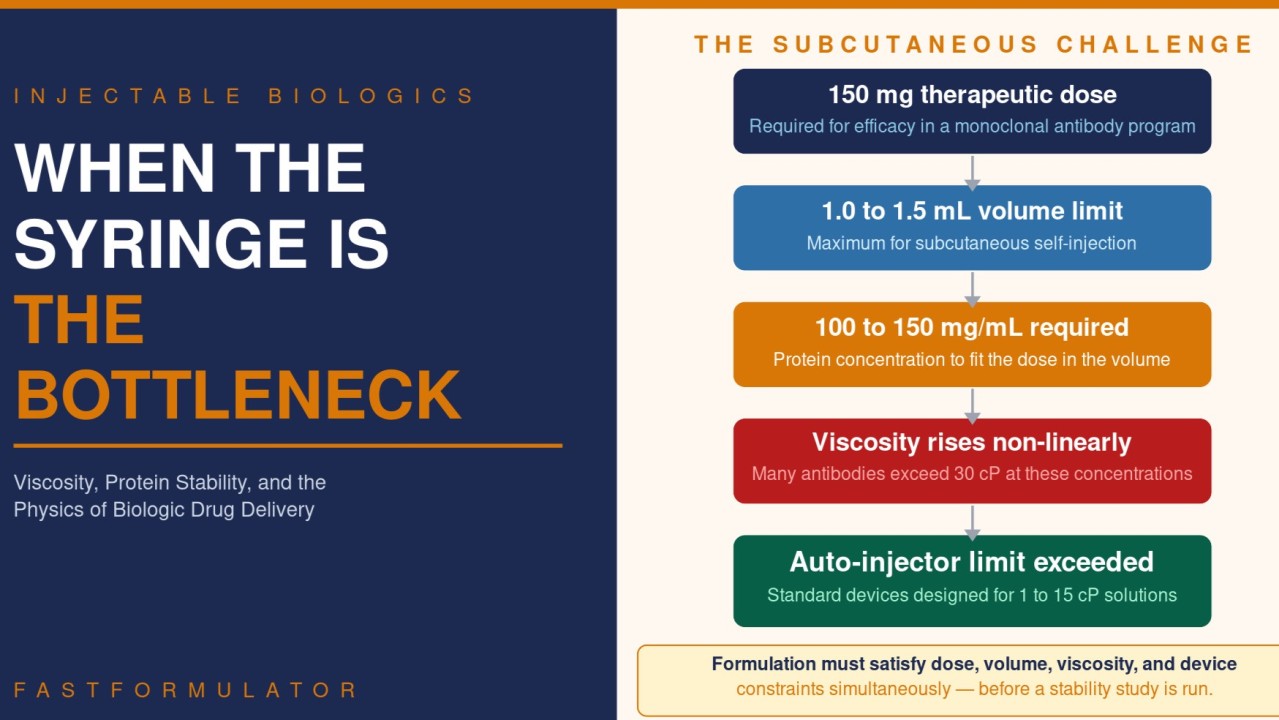
A patient with a chronic autoimmune condition fills their prescription for a subcutaneous biologic. The drug has been approved. The autoinjector has been engineered. The instructions are clear. They press the device against their skin, push the button, and nothing happens. The mechanism fires, but the dose doesn't deliver. The formulation is too thick for the spring to push through the needle at the force and speed the device was designed to produce. The drug works. The pharmacology is sound. The clinical data is strong. The problem is not the molecule, it is the physics of what happens when a high-concentration protein solution meets a fine-gauge needle inside a device with fixed mechanical tolerances. This is one of the least-discussed failure modes in biologic drug development. And it surfaces late: after formulation decisions have been made, after device selection, often after Phase II. Our latest article examines the coupled physics of injectable biologic formulation: why viscosity, protein stability, and device compatibility are not separate problems to solve in sequence, and what it takes to find a viable formulation window before material is consumed confirming dead ends. → Syringeability and the Hagen-Poiseuille law: Moving from a 25-gauge to a 29-gauge needle for patient comfort increases flow resistance by a factor of four. We explain what that means for your viscosity target before a single injection force test is run, and why needle selection and formulation development have to happen together. → The aggregation cascade: Protein molecules progress from native structure through oligomers to subvisible particles under stresses that include temperature, shear, interfacial exposure, and freeze-thaw cycles. We walk through each stage, what drives it, and why aggregation control is a formulation design problem rather than a manufacturing quality problem. → Concentration as the fixed constraint: The therapeutic dose and the delivery volume are determined before formulation work begins. Viscosity, stability, and excipient selection all have to be designed around a protein concentration the formulator didn't choose and cannot change, which is what makes high-concentration biologics so difficult to optimize sequentially. → Predictive tools before the bench: FastFormulator's Virtual Viscometer and Virtual Stability Chamber allow formulation teams to screen excipient systems against both viscosity and stability requirements computationally, identifying the formulation space where both constraints are satisfied before protein material is committed to experiments that may confirm the wrong direction. If you work in biologics formulation, CMC development, or drug delivery device strategy, this one is worth the read. #InjectableBiologics #Syringeability #ProteinStability #MonoclonalAntibodies #FormulationDevelopment #BiologicsDevelopment #SubcutaneousDelivery #PharmaceuticalScience
6 of 25 adsSign up to see every Fastformulator Inc ad, filter by format and date, and get alerts on new ones.
See all 25 adsQuestions about Fastformulator Inc’s ads
Is Fastformulator Inc running LinkedIn ads?
We recorded no live LinkedIn ads for Fastformulator Inc on 10 Nov 2026.
How many LinkedIn ads has Fastformulator Inc run?
LinkedIn’s ad library lists 29 ads for Fastformulator Inc. We recorded 25 LinkedIn ads for Fastformulator Inc, first recorded on 18 Sept 2026 and last recorded on 14 Oct 2026.
Does Fastformulator Inc run Google ads?
We recorded no Google ads for the domain fastformulator.com on 29 Oct 2026.
Which ad formats does Fastformulator Inc use?
The 6 LinkedIn ads on this page include 1 image ad.
Watch the companies you care about.
Filter every ad by industry, country, format and network, and get alerts when a company you watch starts running new ads.