Not on air · 2 of 3 networks checked

All Marketing Services ads
- allmarketing.co
- Advertising Services
- US
- 3 employees
All Marketing Services’s ads on LinkedIn, Meta and Google, recorded by adsrunning. Browse the latest here for free. Sign up free to see all 28. Watch All Marketing Services on any plan to get each new one in your feed.
Watchlist included in every plan
What All Marketing Services runs
- Single image · LinkedIn
- 6
- Google ads on 17 Oct 2026
- 4
| Network | Status | Live ads | Nov 2025LinkedIn activity · 52 weeksNov 2026 | Checked | Next step |
|---|---|---|---|---|---|
| None recorded | 0 | Checked 7 Nov 2026 | See all 28 ads → | ||
| Meta | Not checked | — | |||
| Recently | 4 | Ads on the Google Ads Transparency Center | Checked 17 Oct 2026 | Collect them with the API → |
All Marketing Services has no live LinkedIn ads. We recorded 4 Google ads on 17 Oct 2026.
Latest ads
- LINKEDIN · IMAGERecorded 18 Oct 2026
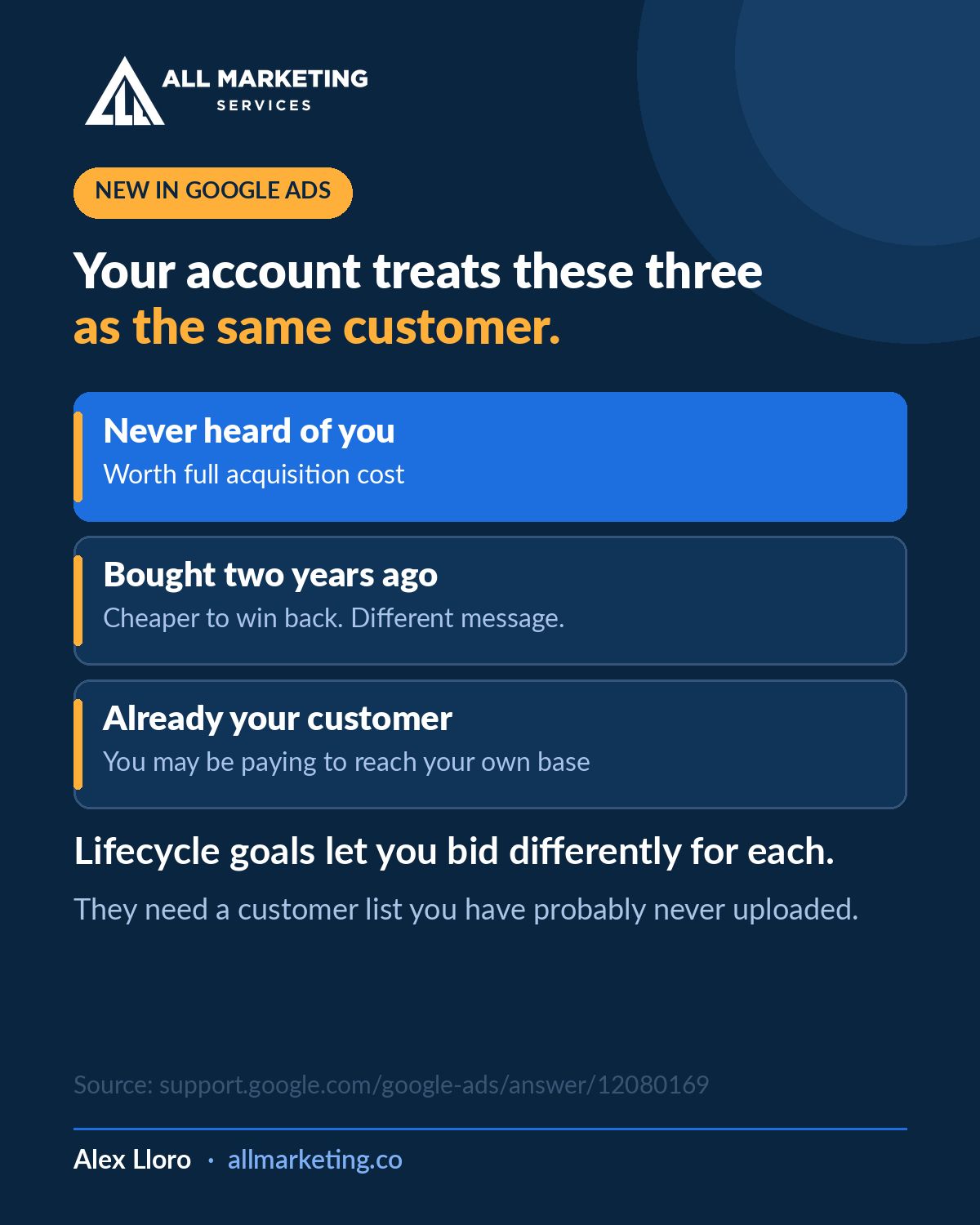
Your account treats these three people as the same customer. Someone who has never heard of you. Someone who bought two years ago and drifted. Someone who is already your customer. Google Ads counts each of them as one conversion, at one value, and bids the same to reach all three. That has always been wrong, and now there is a way to fix it. Customer lifecycle goals let you tell Google which segment someone belongs to, and bid accordingly. New customer acquisition, retention, and win-back become separate objectives instead of one undifferentiated pile. Why this matters more than it sounds: A brand new prospect is worth the full acquisition cost. A lapsed customer is usually far cheaper to win back and needs a completely different message, because they already know what you do and stopped anyway. And an existing customer? You may be paying premium prices to advertise to people who were going to come back regardless. That last one is the quiet budget leak in almost every account I audit. The catch is the part nobody mentions in the announcement posts. Lifecycle goals only work if you upload a customer list. Not a marketing list, your actual customer data, properly hashed and kept current. Most businesses have never done it, which is why most accounts will never benefit from the feature. So the work is not in the settings. It is in your CRM. Export your customers, segment them by active and lapsed, upload, and keep it refreshed. It is unglamorous, it takes an afternoon, and it changes what the algorithm is capable of. This is the same pattern as everything else this year. The platforms keep removing manual levers and adding places to feed them better information. If you do not feed them, the defaults decide for you. Your customer list is the input. Almost nobody uses it. #GoogleAds #PPC #MarketingOps
- LINKEDIN · IMAGERecorded 18 Oct 2026
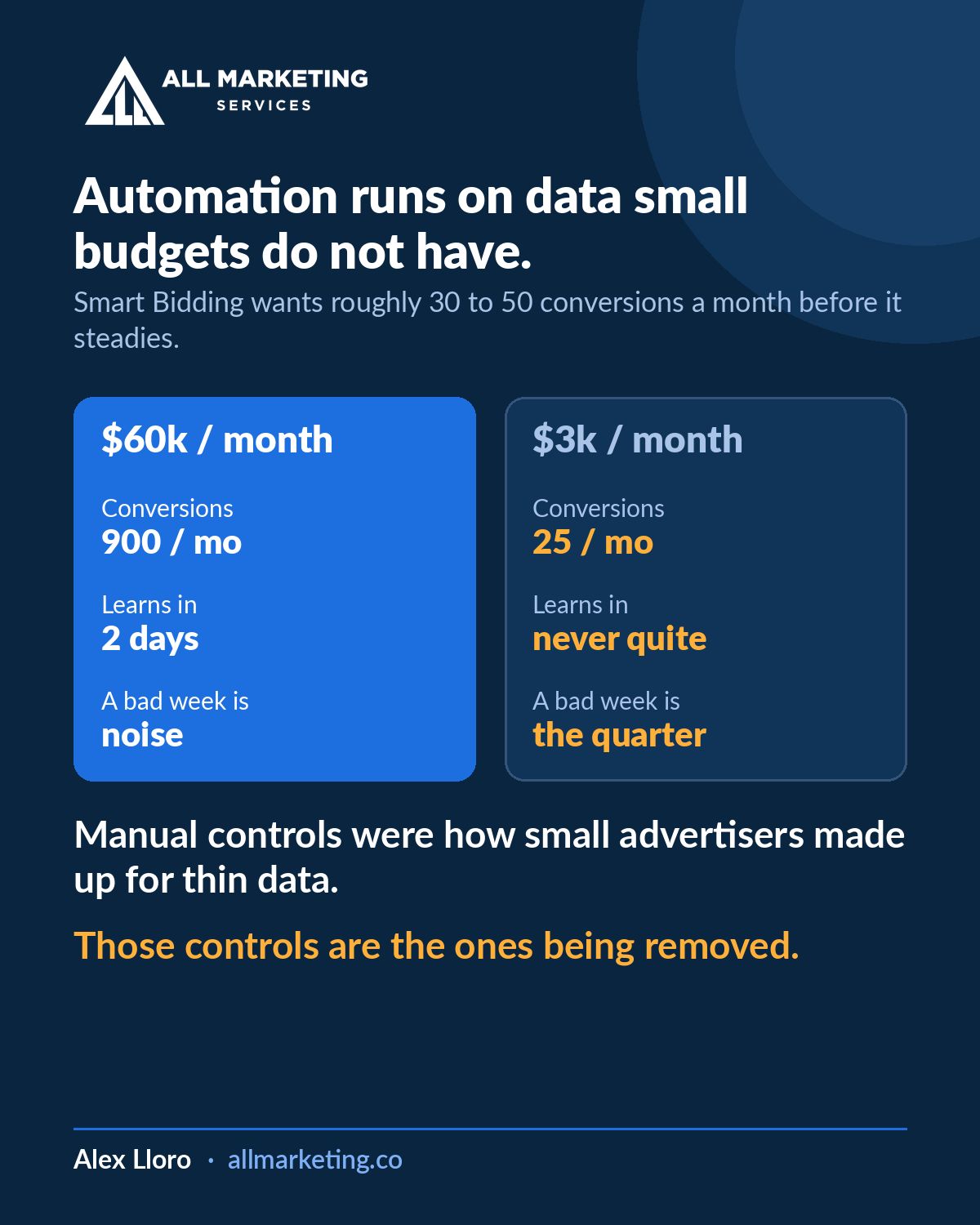
Four platform announcements in one month. All pointing the same direction. Microsoft removing Max CPC from new campaigns. Google changing how budget-limited target campaigns behave. Local Services Ads folded into Performance Max. Display folded into Demand Gen. Fewer campaign types. Fewer manual levers. More decisions made by the system. The industry response has been a shrug. Automation does win at scale, and anyone still hand-adjusting bids on a large account is wasting their life. But there is a group this quietly hurts, and almost nobody is writing about them. Automation runs on conversion data. Small budgets do not produce much of it. Smart Bidding wants roughly 30 to 50 conversions a month before its decisions steady. A company spending $60,000 a month clears that in days. A local business spending $3,000 a month might generate 25 leads in a month, total. One advertiser gets an algorithm that has seen enough to be confident. The other gets an algorithm permanently guessing, swinging hard on thin evidence, unable to absorb a bad week because a bad week is most of the sample. This is exactly what the manual controls were for. A CPC cap. A bid adjustment by time of day. A target set by category instead of by account. They were how a small advertiser compensated for not having volume. Those are the controls being removed. The Northbeam H1 data already shows it. Accounts under $200,000 a month performed meaningfully worse year over year than accounts above it. Businesses under $10M in revenue saw acquisition costs rise roughly twice as fast as businesses over $100M. So what do you do with a $3,000 budget? Count something frequent enough to learn from. If signed clients are rare, optimize toward qualified calls or booked consultations, with values attached. Twenty-five monthly events barely register. A hundred and twenty works. Concentrate the spend. Three campaigns at $1,000 each is three campaigns that never learn. One at $3,000 might. Fix the landing page. It is the one lever no platform can remove, and it improves both things that matter: conversion volume, which feeds the algorithm, and cost per lead, which pays for everything. Give changes time. Reacting to a bad week is how small advertisers destroy the little data they have. I have said before that blame is not a strategy. Still true. But this deserves to be said plainly: consolidation is easier for big spenders than small ones, and the businesses I care about are on the small side of that line. Be deliberate about the inputs you still control. Be more patient than the platforms want you to be. #PPC #SmallBusiness #GoogleAds
- LINKEDIN · IMAGERecorded 18 Oct 2026
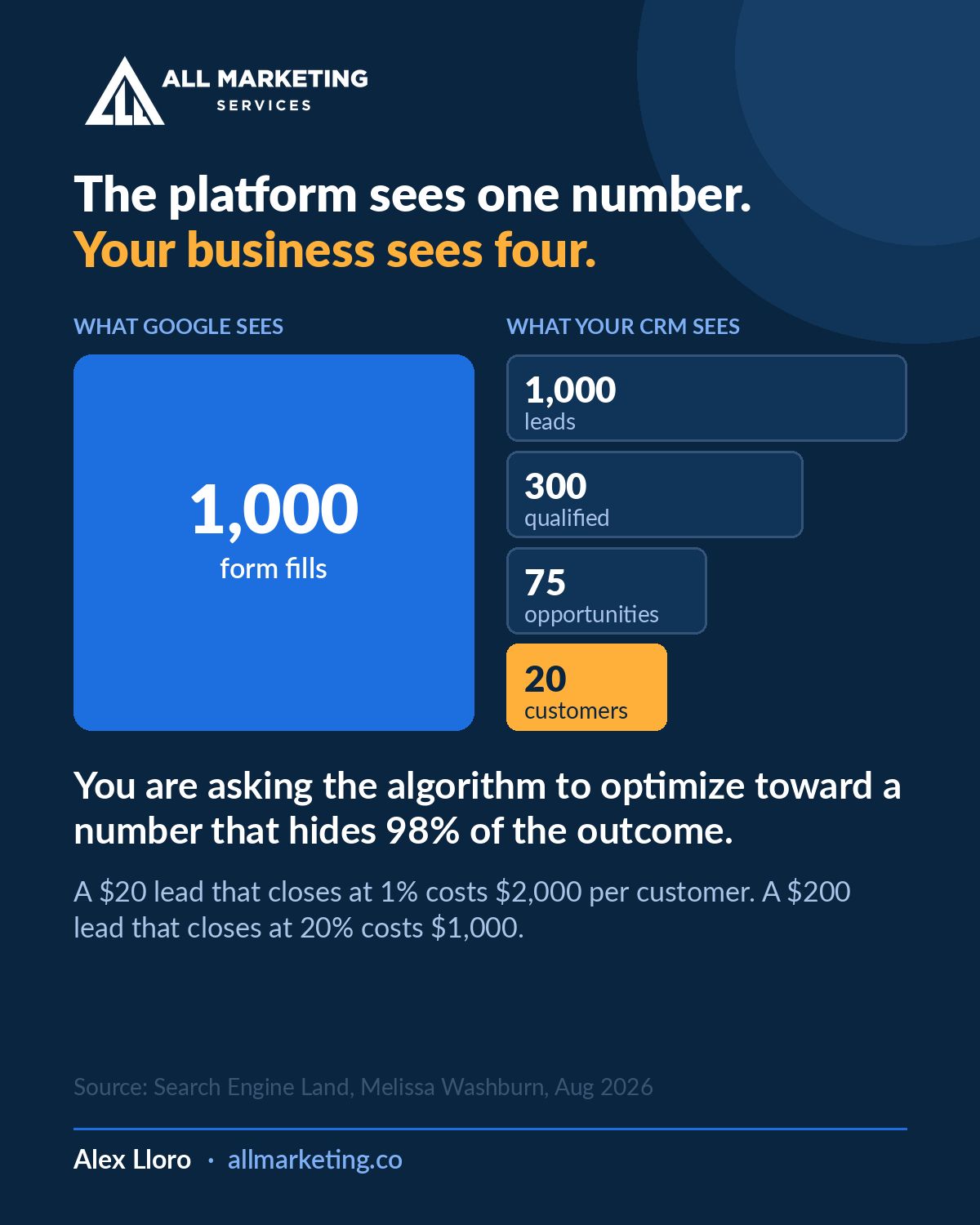
A $20 lead can cost you $2,000. A $20 cost per lead looks excellent, until those leads close at 1%. That is $2,000 per customer. A $200 cost per lead looks expensive, until those leads close at 20%. That is $1,000 per customer. Same market. Same spend. One number on the report says you are winning and the other says you are failing, and both are wrong. The ad platform sees 1,000 form submissions. Your CRM sees 1,000 leads, 300 qualified, 75 opportunities, 20 customers. The platform only ever receives the first number. So you are asking an increasingly sophisticated machine learning system to optimize with a definition of success that hides almost everything that mattered. That is not a targeting problem or a creative problem. It is a signal problem, and it explains a pattern I see constantly: the campaign that produces the cheapest leads is often the one quietly making the business poorer. The fix is to move the conversion point deeper. Google supports qualified-lead and converted-lead goals. Meta accepts down-funnel CRM data through the Conversions API. Both let you tell the system that a booked consultation matters and a curiosity form fill does not. You should pick the deepest event that still has enough volume to teach the algorithm something. If you sign 8 clients a month, optimizing toward signed clients starves the system. Qualified leads or booked appointments will usually be the right altitude. Deep enough to mean something, frequent enough to learn from. And the strategic point underneath all of it: volume and quality are not opposites, they are different objectives requiring different inputs. If sales has spare capacity, loosen constraints and chase volume. If sales is drowning in bad fits, feed the platforms better signals. Deciding which problem you actually have is the work. Most teams skip it and then blame the channel. The easiest metric to measure should never become your definition of success. #PPC #LeadGeneration #GoogleAds
- LINKEDIN · IMAGERecorded 18 Oct 2026
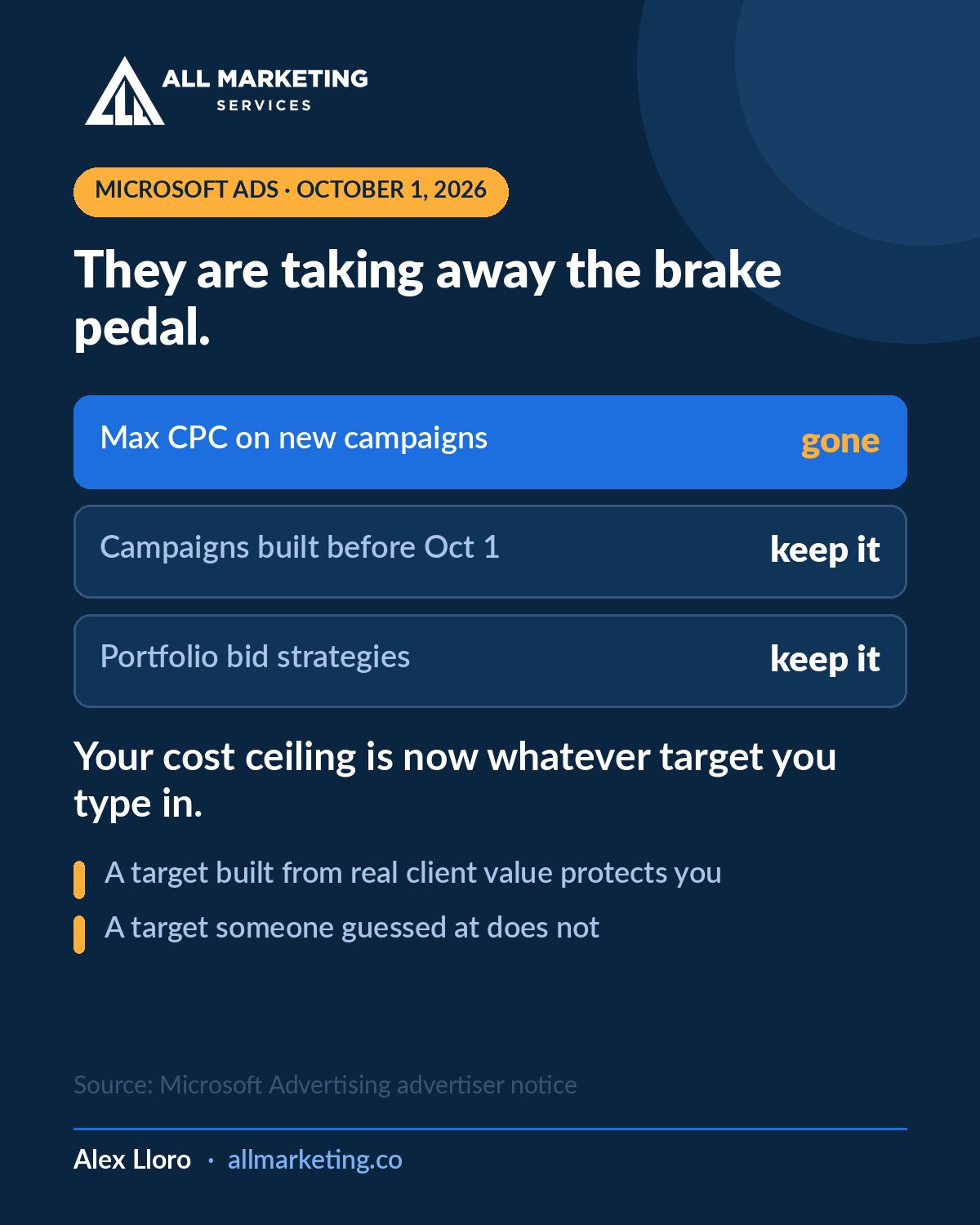
Microsoft just emailed advertisers to say they're removing the brake pedal. From October 1, 2026, Max CPC will no longer be available when creating new non-portfolio campaigns on Microsoft Ads. Their reasoning, quoted directly: Max CPCs "can get in the way of automated bidding's ability to meet and deliver strong performance against your targets." Translation: your cost ceiling was interfering with their algorithm, so the ceiling is going. What actually changes: New campaigns after October 1: no Max CPC Campaigns built before that date: keep it Portfolio bid strategies: keep it So there is a workaround, and it is worth knowing. But the direction of travel could not be clearer, and Google is walking the same road. Two weeks ago, they changed how budget-limited tCPA campaigns behave. Now Microsoft removes CPC caps entirely. Every platform is converging on the same message: stop telling us what a click is worth, tell us what a customer is worth, and trust us with the rest. Here is what that means practically. Your only remaining cost control is the target you type in. Target CPA, target ROAS, budgets, value rules. Which raises an uncomfortable question for most advertisers: where did your target come from? If it was derived from what a client is actually worth, minus your costs, times your close rate, you are fine. Arguably better off, because you were never supposed to manage profitability with a click cap anyway. If someone typed a number in 2023 that felt about right, that number is now the single guardrail on your spend, and the platforms are getting more willing to use every dollar of it. The platforms are not wrong that automation beats manual bidding at scale. They are wrong to imply the inputs do not matter. Automation is an amplifier. Feed it a target built on real client economics and it compounds. Feed it a guess and it executes that guess faithfully, at speed, with your budget. Before October: go find out where your targets came from. #MicrosoftAds #PPC #LeadGeneration
- LINKEDIN · IMAGERecorded 18 Oct 2026
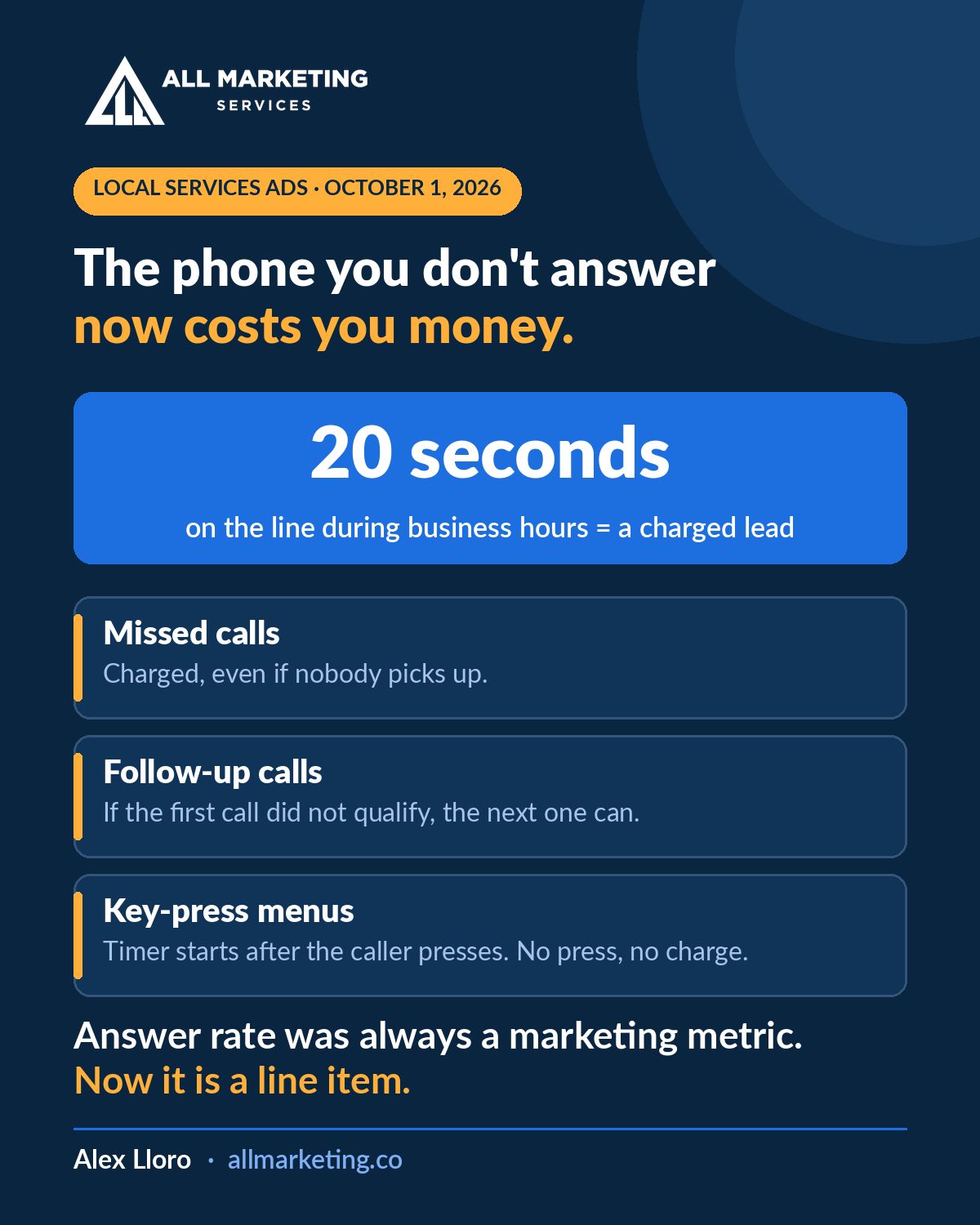
Google is about to charge you for calls you never answer. An email went out to Local Services Ads advertisers today, August 25th. From October 1, missed calls during business hours will be charged as valid leads if the caller stays on the line more than 20 seconds. Read that again. Nobody picks up. You still pay. Two more changes in the same notice: Follow-up calls now count. If the first call does not qualify as a charged lead, any subsequent call between you and that customer that meets the criteria will be charged. Phone tag now has a price. Key-press menus start the clock late. If your setup makes callers press a number to reach a department, the 20 seconds only begins after they press. No press, no charge. That is a meaningful detail for anyone running an IVR. Google also says it is adding safeguards against robocalls and spam abuse, which the change clearly needs. Their stated reasoning is worth quoting: this "rewards businesses that provide excellent responsiveness." Here is the thing. They are not wrong. I have argued for years that answer rate is a marketing metric, not an operations detail. A lead nobody picks up is just a click you paid for. The only difference now is that Google made the invoice explicit. What this actually means, practically: Your ring-to-answer time is now a direct cost. Count how many LSA calls went unanswered last month, multiply by your average lead cost, and you have your October budget increase if nothing changes. After-hours routing matters more than ever. The charge applies during business hours, so make sure your stated hours match when someone is genuinely available to answer. If you use a key-press menu, understand what you have. It reduces charges on abandoned calls, but every extra step also loses real customers. Cheaper leads and fewer of them is not automatically a win. Answering machines and voicemail greetings will now cost you. A caller who reaches voicemail and listens for 20 seconds is a billable lead. The uncomfortable part is that this is fair. The comfortable part is gone. If you run Local Services Ads, the thing to fix before October 1 is not your campaign. It is who picks up the phone at 4:55pm on a Friday. #LocalServicesAds #GoogleAds #HomeServices
- LINKEDIN · IMAGERecorded 18 Oct 2026
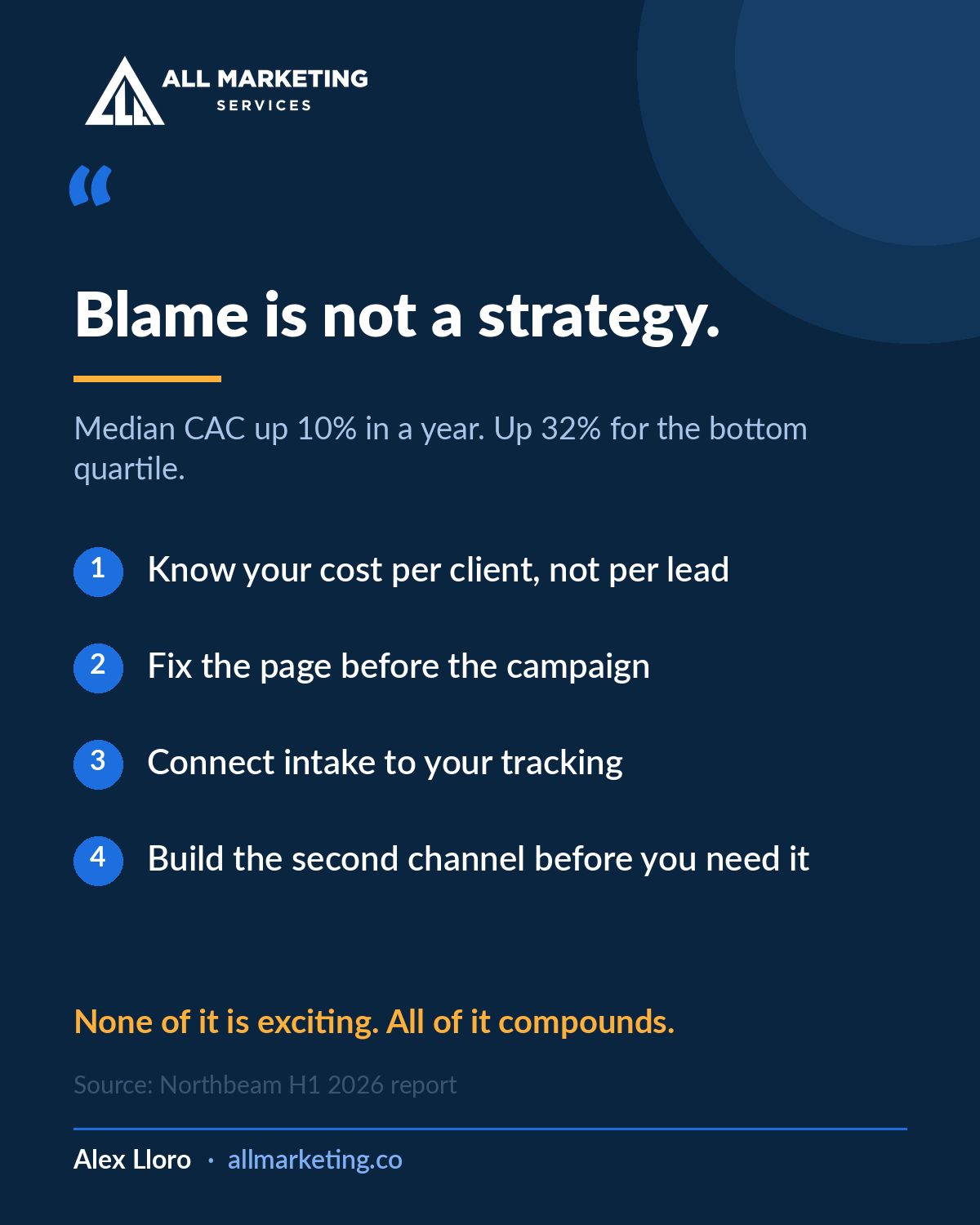
The most useful sentence in Northbeam's H1 2026 report is not a statistic. It is this: "Blame is not a strategy. We must adapt." The data behind it is grim. Median ad spend up 12%. Median customer acquisition cost up 10%. For the bottom quartile of accounts, CAC rose 32% in a year. Everyone wants a villain. Meta's algorithm. Google's auction. AI. The economy. Some of that blame is even earned. None of it is actionable. Here is what is, in the order we work through it with clients: - Know your real cost per client, not per lead. You cannot make a smart bidding decision without the number that ends the argument. - Fix the page before the campaign. Rising click costs punish a weak conversion rate twice, once in wasted spend and once in worse quality scores. - Connect intake to tracking. If the algorithm never learns which leads became clients, it optimizes toward the wrong people with your money. - Build a second channel before you need it. Not for growth. So you have somewhere to move budget when one auction turns against you. None of this is exciting. All of it compounds. The advertisers who did this work in the cheap years are the ones outperforming now. The rest are still looking for someone to blame. #PPC #MarketingStrategy #LeadGeneration
6 of 28 adsSign up to see every All Marketing Services ad, filter by format and date, and get alerts on new ones.
See all 28 adsQuestions about All Marketing Services’s ads
Is All Marketing Services running LinkedIn ads?
We recorded no live LinkedIn ads for All Marketing Services on 9 Nov 2026.
How many LinkedIn ads has All Marketing Services run?
LinkedIn’s ad library lists 28 ads for All Marketing Services. We recorded 28 LinkedIn ads for All Marketing Services, first recorded on 18 Oct 2026 and last recorded on 18 Oct 2026.
Does All Marketing Services run Google ads?
Yes. We recorded 4 Google ads for the domain allmarketing.co on 17 Oct 2026.
Which ad formats does All Marketing Services use?
The 6 LinkedIn ads on this page include 6 image ads.
Watch the companies you care about.
Filter every ad by industry, country, format and network, and get alerts when a company you watch starts running new ads.