On air · 1 of 3 networks
AI Verse
- ai-verse.com
- AI
- FR
- 25 employees
AI Verse’s ads on LinkedIn, Meta and Google, recorded by adsrunning. Browse the latest here for free. Sign up free to see all 58. Watch AI Verse with Starter to get each new one in your feed.
Watchlist with Starter · $49/mo
| Network | Status | Live ads | Nov 2025LinkedIn activity · 52 weeksOct 2026 | Checked | Next step |
|---|---|---|---|---|---|
| Running | 7 | Checked 30 Oct 2026 | See all 58 ads → | ||
| Meta | Not checked | — | |||
| Not checked | — |
AI Verse has 7 live LinkedIn ads.
Latest ads
- LINKEDIN · IMAGESince 26 Oct 2026
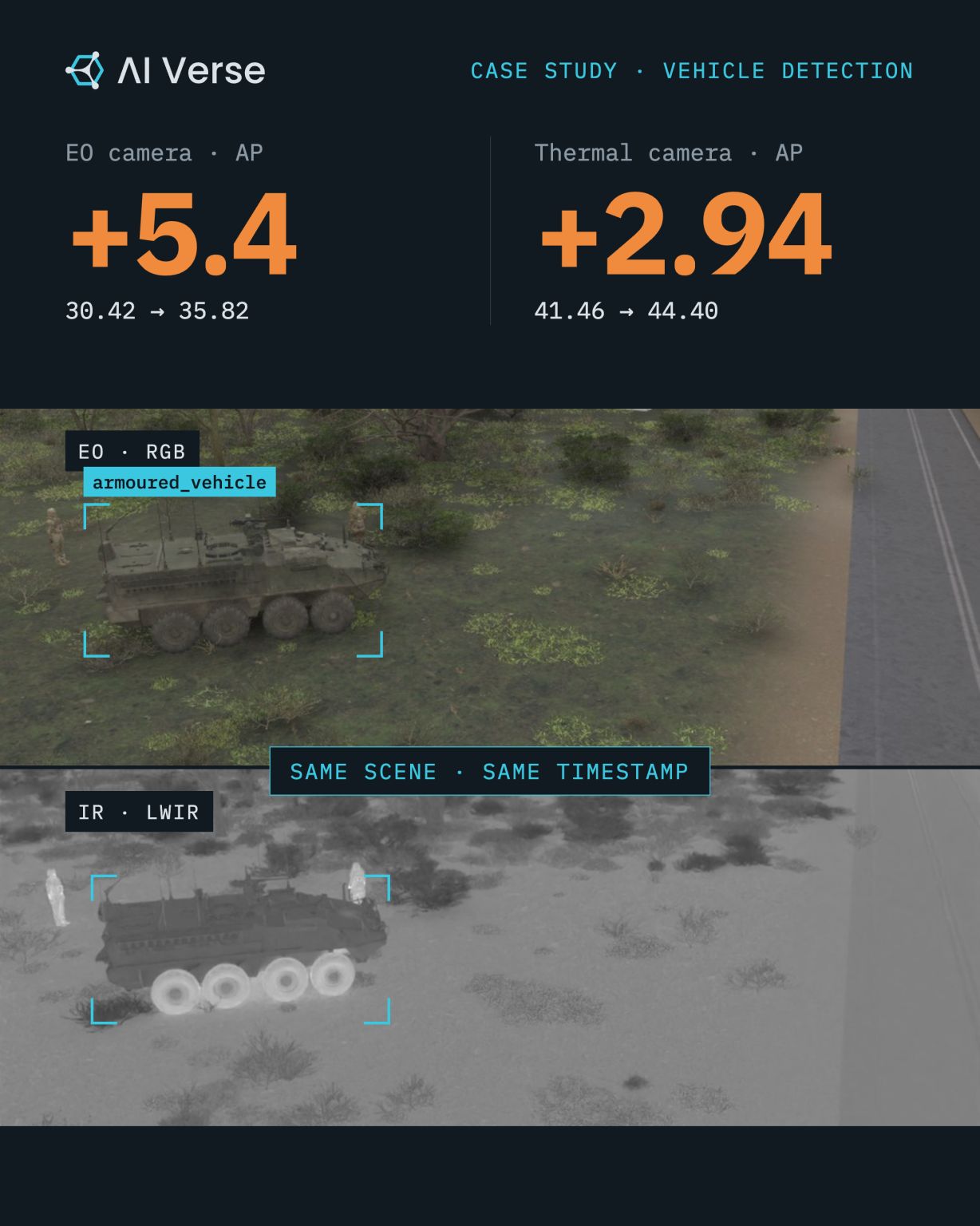
+5.4 AP on EO. +2.94 AP on thermal. A leading German drone manufacturer added 30,000 AI Verse synthetic images to its own training data. Its vehicle detector improved on both cameras. The EO gain beat the +3 mAP benchmark from our last project with them, on a camera we had never built for. Small, far-away targets gained the most: +7.97 AP and +11.27 recall. Read more in our article, link in the comments ⬇️
- LINKEDIN · IMAGESince 12 Oct 2026
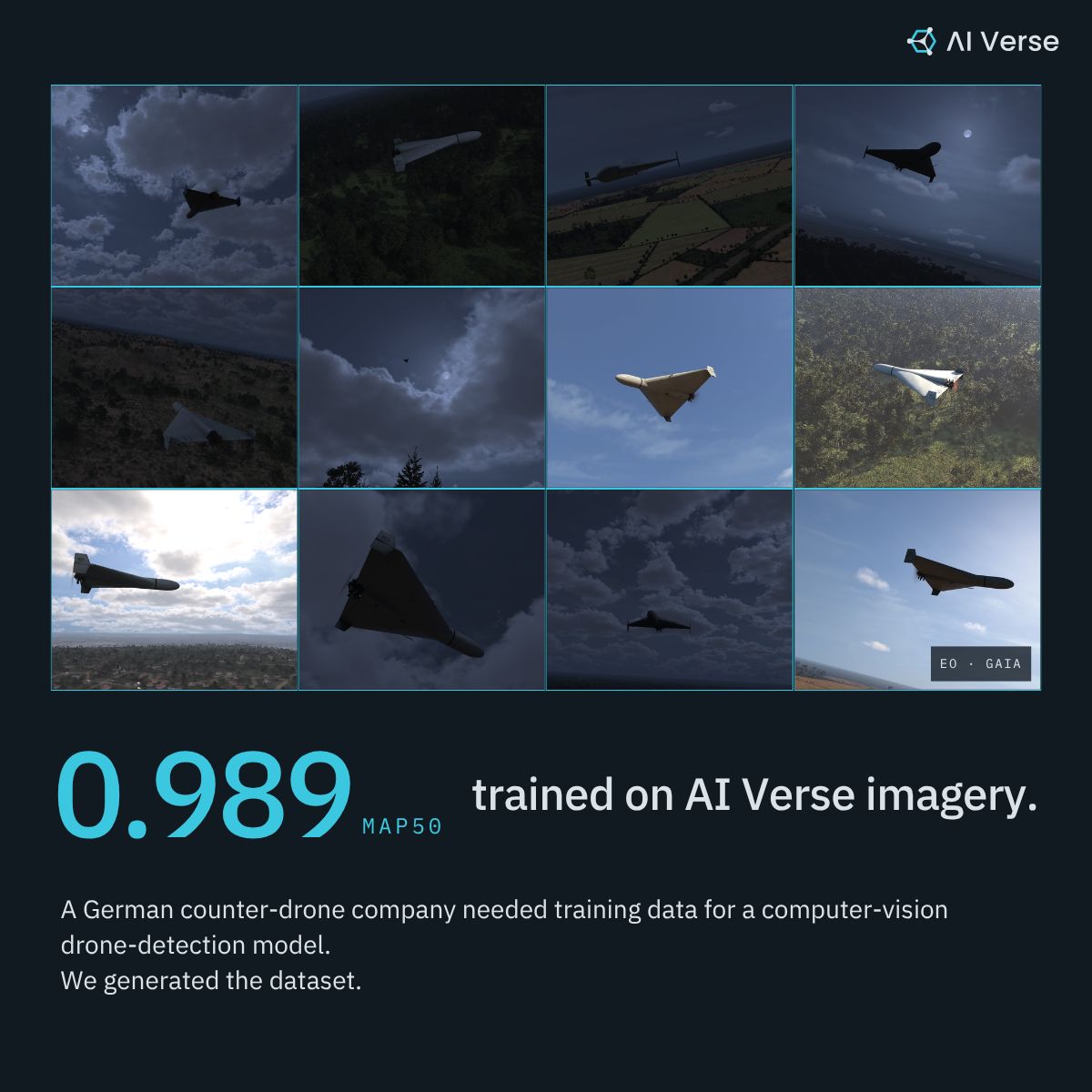
AI Verse gave a German counter-drone company the detection capability its flight schedule could not deliver. Capture campaigns set the roadmap for you. Every new airframe, sensor or customer requirement means another flight window, another labelling contract, another quarter of delay. AI Verse removed that constraint. We generated roughly 17,000 labelled images to the company's spec: two camera settings, two drone models, both views rendered from the same scene, every frame labelled to the pixel. Four batches, each one shaped by their review of the last, from a 50-image sample to full delivery. No aircraft left the ground. What our data produced: 0.989 mAP50 on the narrow camera, and a working small-object detector for the wide search view. Both trained on AI Verse imagery alone. Our engine generates the dataset whenever the requirement changes. A new drone model becomes a spec change, not a headache. Tell us which capability you need to prove and we will scope the dataset. Link to the case study in the comments ⬇️
- LINKEDIN · ARTICLESince 6 Oct 2026
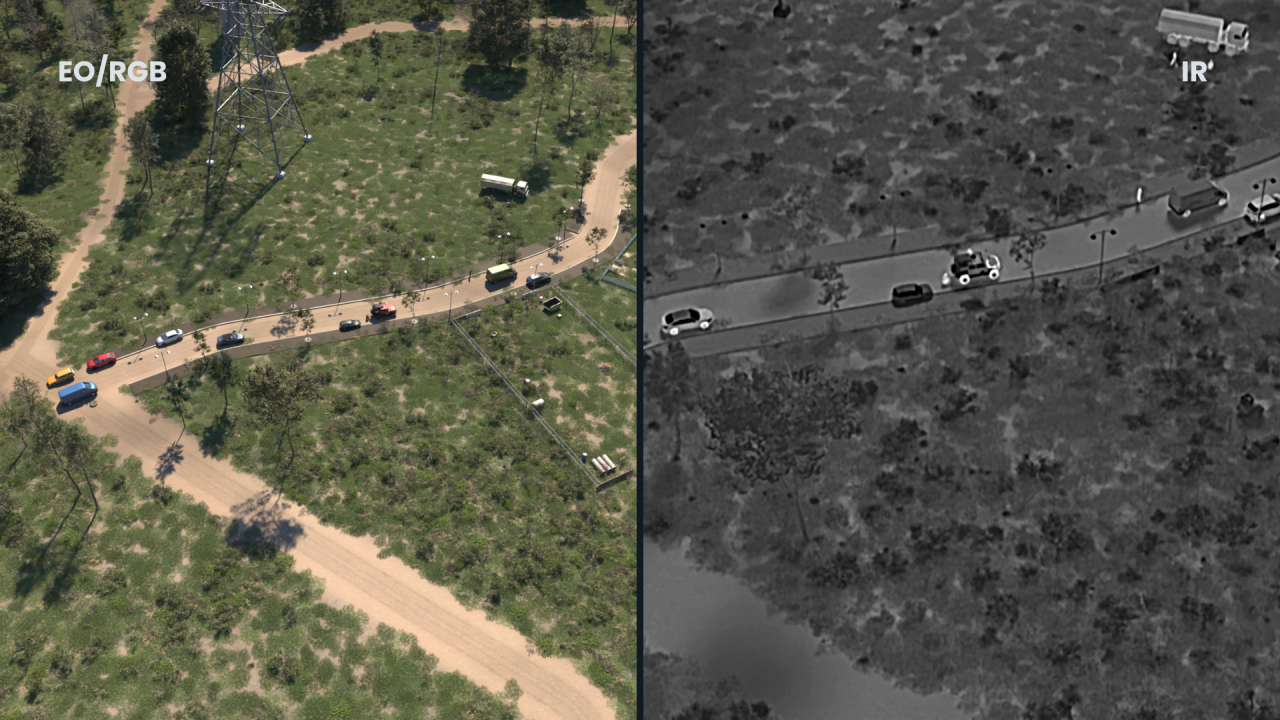
+5.4 AP on EO. +2.94 AP on thermal. No new flight trials. A leading German drone manufacturer added 30,000 AI Verse synthetic EO and IR images to its own training data. Its vehicle detector beat a +3 mAP target on a camera it had just fitted. In the article we explain how we built the dataset in five rounds of feedback and the full EO and IR results. Read the case study ⬇️
- LINKEDIN · IMAGESince 12 May 2026
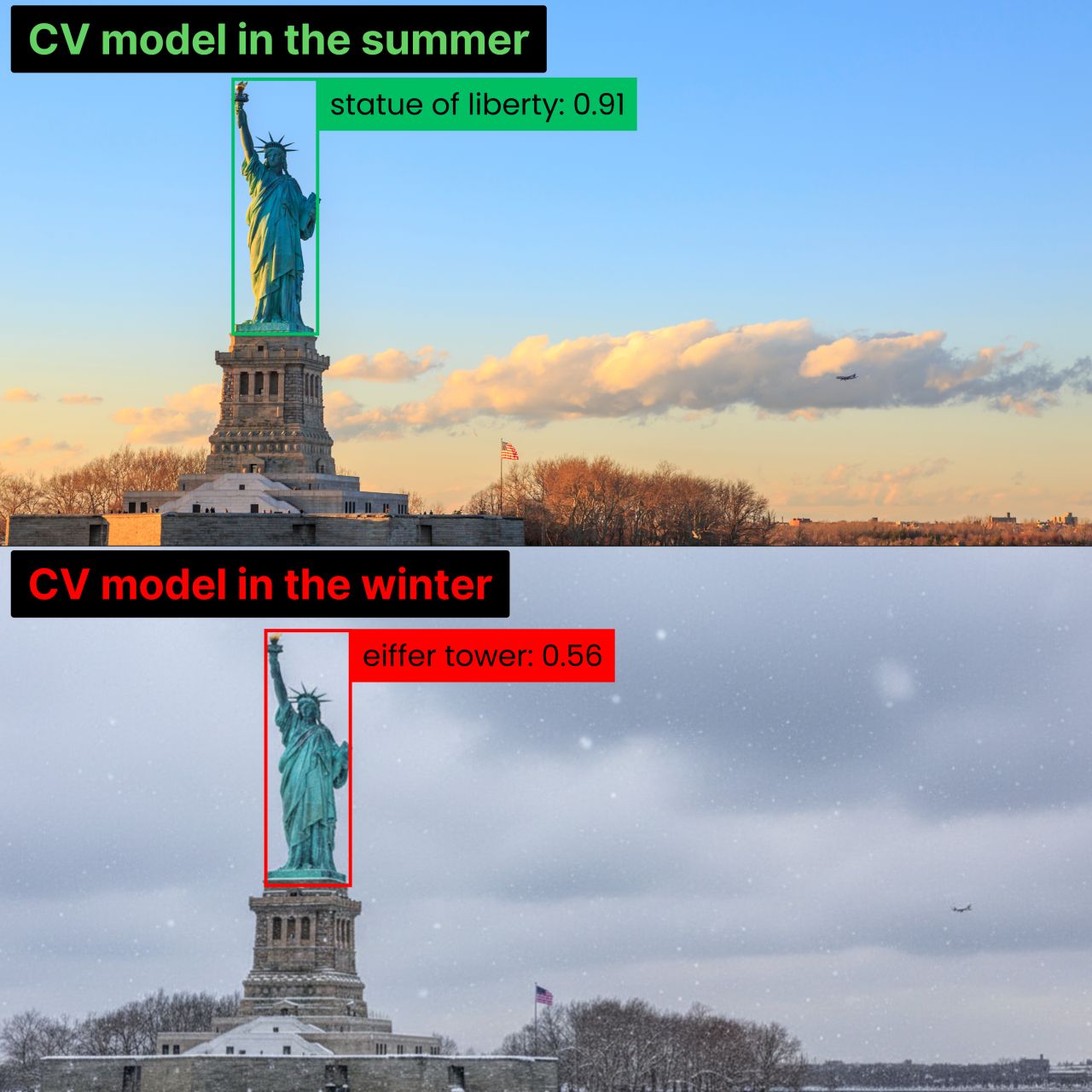
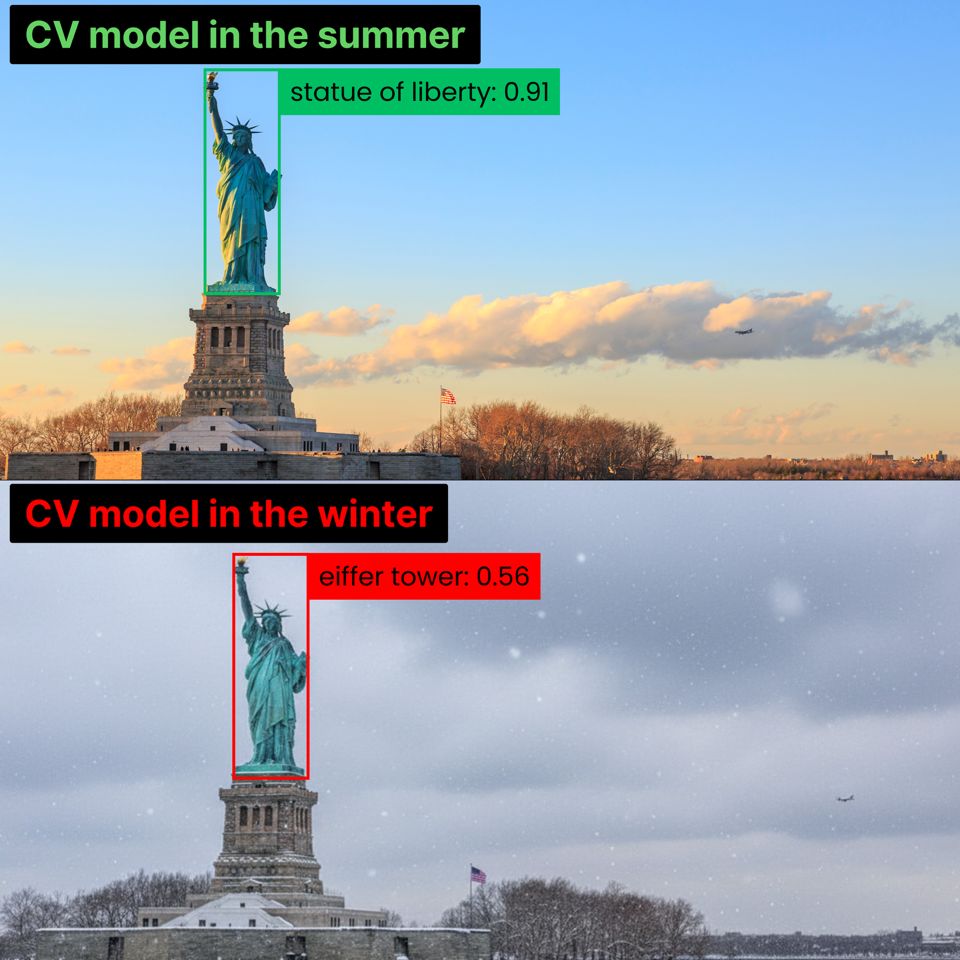
If your model was trained in July, it hasn’t met December yet. Most computer vision models fail unassumingly across seasons. The culprit is the training images that never saw the shift. Five failure modes we keep seeing based on our work with clients: 1. Leaf-off occlusion Trees lose foliage. Objects that were hidden in summer become visible in winter, changing scene geometry and detection patterns. 2. Salt and grit on roads Surface texture changes. Lane markings fade. Reflectivity shifts. Models trained on clean asphalt struggle with noisy winter roads. 3. Winter clothing Human silhouettes expand. Bulkier shapes, hoods, scarves. Pose estimation and tracking degrade fast. 4. Bare trees reshape skylines Vegetation density drops. Background structure changes. Models relying on consistent horizon features lose context. 5. Low-sun glare Winter sun sits lower. Long shadows and direct glare saturate sensors, especially in RGB. Detection confidence drops at the worst times of day. This is the domain gap in plain sight. AI Verse generates physics-based synthetic datasets that cover seasonal variation on demand. RGB, infrared, thermal. Pixel-perfect labels. 4 seconds per image on 1 GPU. We simulate the conditions your model hasn’t seen yet, before deployment forces the lesson. Contact us now if you want to test it yourself! 💬
- LINKEDIN · IMAGESince 12 May 2026
If your model was trained in July, it hasn’t met December yet. We see this all the time. Models don’t fail loudly. They drift when the season changes. Not because the model is weak. Because the data never covered the shift. A few patterns keep coming up: 1️⃣ Leaf-off occlusion Objects hidden in summer suddenly appear. Scene geometry changes and detections follow. 2️⃣ Salt and grit on roads Texture changes. Lane markings fade. Reflection behaves differently. Clean-road training doesn’t hold up. 3️⃣ Winter clothing Silhouettes get bulkier. Hoods, scarves, layers. Tracking and pose estimation lose precision. 4️⃣ Bare trees reshape skylines Less vegetation means a different background. Models that rely on stable horizons lose context. 5️⃣ Low sun glare Sun sits lower. Long shadows and glare hit sensors directly. Confidence drops at the worst time. This is the domain gap in plain sight. At AI Verse, we generate physics-based synthetic data to cover these seasonal shifts on demand. RGB, infrared, thermal. Pixel-level labels. About 4 seconds per image on a single GPU. You can train on conditions your model hasn’t seen yet, before it faces them in production. Happy to show how this looks in practice. DM me 💬!
- LINKEDIN · IMAGESince 5 May 2026
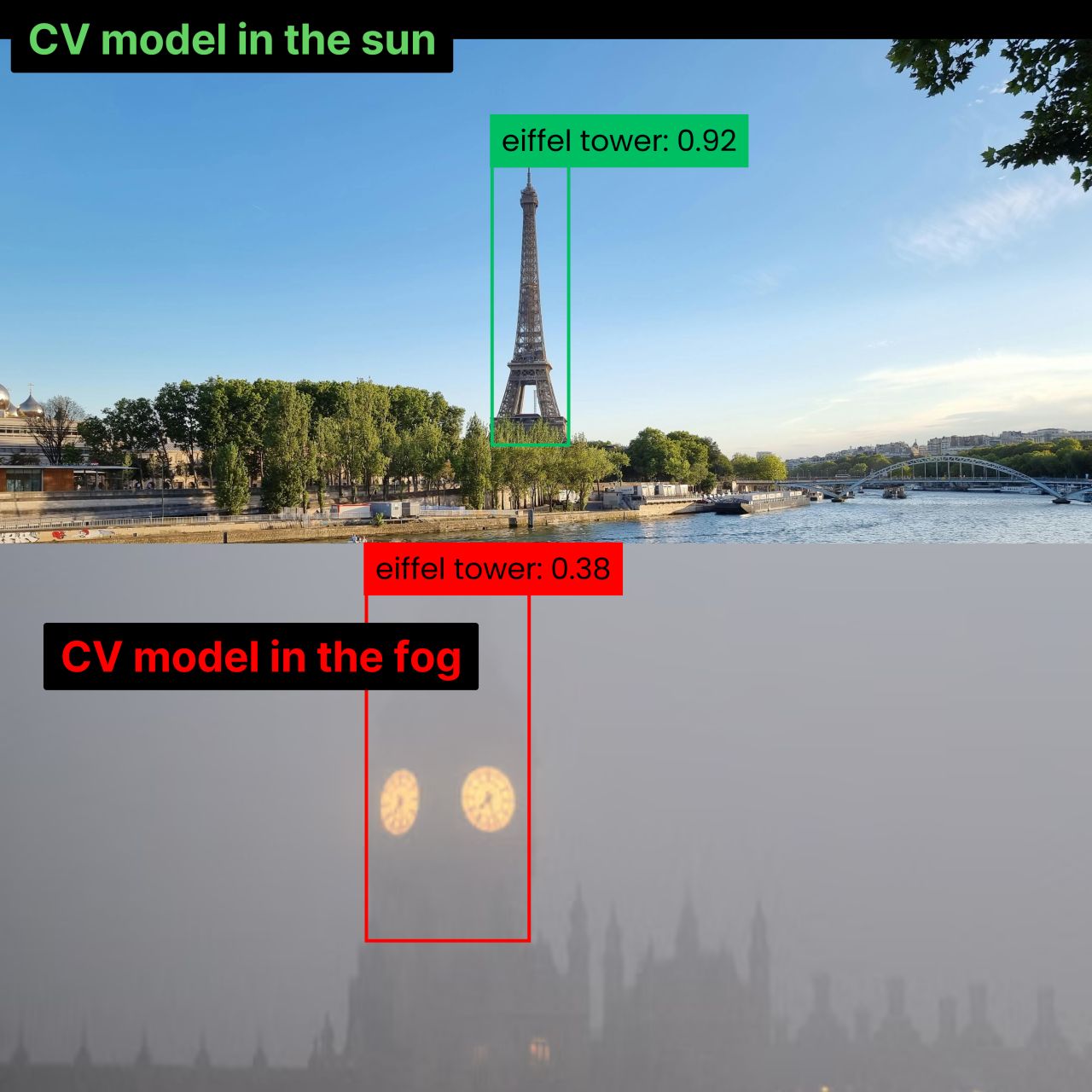
Sunny Paris. Foggy London. Same model. Different outcomes. We see this gap often. A model performs well in controlled environments, then degrades when conditions shift. This is usually not a model issue. It is a data coverage issue. Here are five ways weather affects perception in defense scenarios: 1. Rain on EO sensors creates fast-moving streaks that act as occlusions and false edges, lowering detection confidence for vehicles and personnel at distance. 2. Fog reduces contrast over distance, pushing objects below detection thresholds sooner than expected, especially for appearance-based models. 3. Snow and ground glare introduce noise that hides useful features, increasing false positives in threat classification. 4. Wet surfaces create reflections that mimic shapes and thermal signatures, leading to false detections and unstable tracking. 5. Wind-driven clutter like dust and vegetation disrupts temporal consistency, which video-based models rely on for motion cues. We tested this with a client. The same detector ran on clear and light rain footage. Precision stayed stable. Recall dropped. The model depended heavily on clean visual features, and partial occlusions reduced the signal it needed. For ISR, autonomous airborne and ground systems, and perimeter monitoring, weather can degrade model performance. In our work, we treat image distortion as a core variable in the data. This means collecting data across real conditions and applying physics-based rules and lens effects. In our work, we treat image distortion as a core variable in the data. If you are looking to close data gaps and improve how your models perform in real conditions, we are here to help.
6 of 58 adsSign up to see every AI Verse ad, filter by format and date, and get alerts on new ones.
See all 58 adsWatch the companies you care about.
Filter every ad by industry, country, format and network, and get alerts when a company you watch starts running new ads.