On air · 2 of 3 networks
Guru
- getguru.com
- Software (horizontal)
- OM
- 2,733 employees
Guru’s ads on LinkedIn, Meta and Google, recorded by adsrunning. Browse the latest here for free. Sign up free to see all 541. Watch Guru with Starter to get each new one in your feed.
Watchlist with Starter · $49/mo
| Network | Status | Live ads | Nov 2025LinkedIn activity · 52 weeksOct 2026 | Checked | Next step |
|---|---|---|---|---|---|
| Running | 175 | Checked 28 Oct 2026 | See all 541 ads → | ||
| Meta | Not checked | — | |||
| Running | 71 | Ads on the Google Ads Transparency Center | Checked 30 Oct 2026 | Collect them with the API → |
Guru has 175 live LinkedIn ads. We recorded 71 Google ads on 30 Oct 2026.
Latest ads
- LINKEDIN · IMAGESince 21 Aug 2026
Today we're making Guru exponentially easier to buy for the 1000s of enterprises already running on AWS. Guru is now live on Marketplace. Many of the enterprises we work with already run their infrastructure on AWS. And more often than not, the person bringing Guru in also owns that Amazon relationship. Up until now, they still had to cut through layers of red tape to get Guru through the door - a security review, a new contract, and a budget conversation. The whole process could take months to complete. Buying Guru through Marketplace changes that: → Guru shows up on the AWS bill they already reconcile instead of a new vendor to track → Our Marketplace listing already answers most of what a security review would ask → It draws from AWS spend a company already committed to, so there's no new budget to request Our customers have been asking for this for a while now. Lemonade is one of the AWS customers already running on Guru, and they're a good example of what this looks like in practice: 90% weekly adoption, a 100% trust score across more than 5,000 Cards, and verified answer accuracy at 93% and still climbing. If your team already buys through AWS, search Guru in the Marketplace directly, or loop in your AWS account team to scope it out. Full details on the partnership here: https://lnkd.in/eeawaaD5
- LINKEDIN · IMAGESince 19 Aug 2026
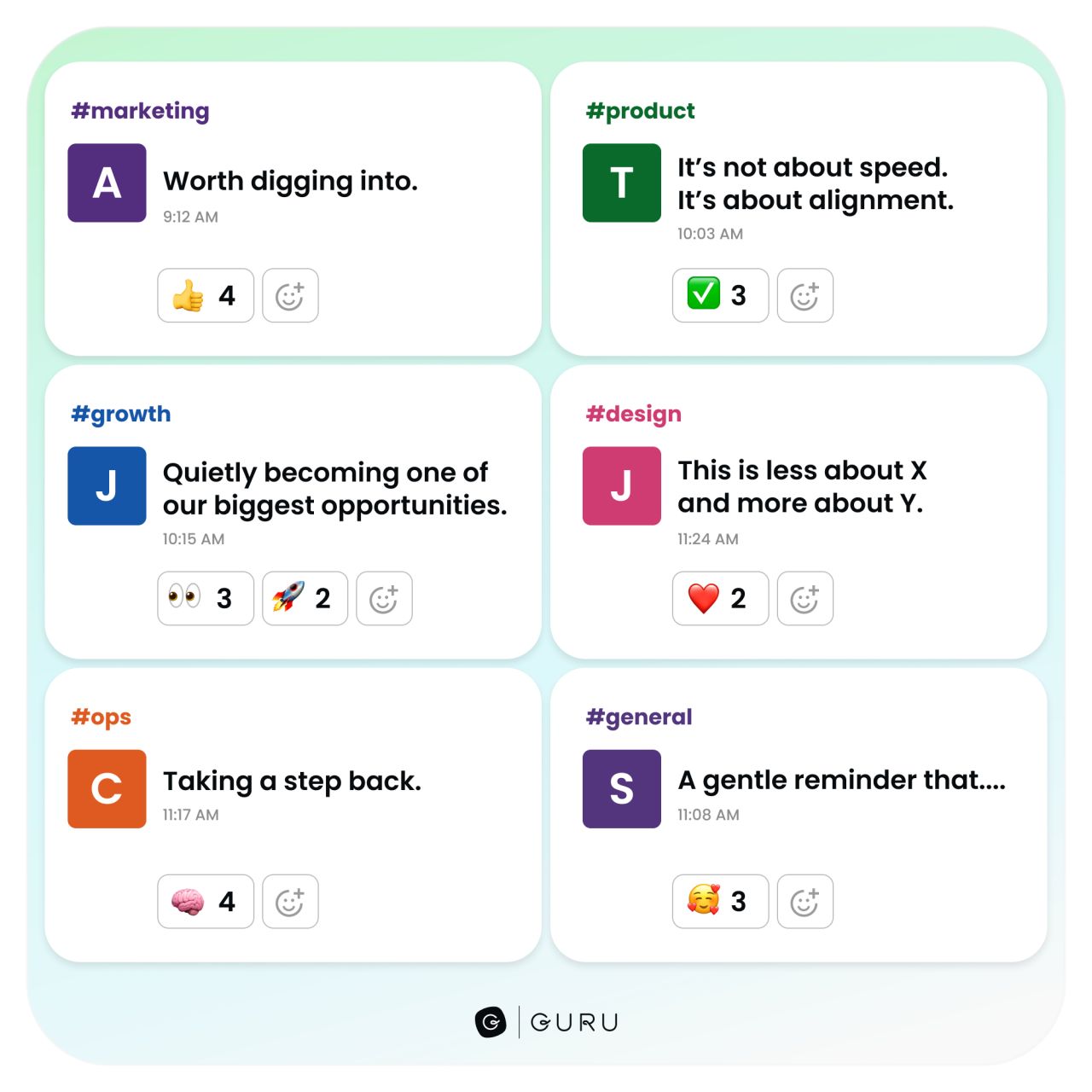
We have a new rule at Guru. No one on the team is allowed to send a message without first asking, “Would I say this out loud in a room?” Writing has gotten exponentially faster with AI, and that's not a bad thing. It just means your time gets spent differently now. Less time typing words out, more time actually organizing your thoughts before hitting send. The issue is what keeps coming back. "It's not X, it's Y." "Worth digging into." "Quietly becoming a problem." You read the messages back, and it sounds like they were written on another planet. With the new rule, our team is still welcome to use AI to write the first draft of anything. But before it goes out, the expectation is that they read every line and make sure they can defend every claim. Otherwise, there's a good chance something makes it into a message that the sender doesn't actually stand behind. Not a lie exactly. Just a claim they never checked or a point they’d walk back the second someone pushed on it. If you wouldn’t say it out loud, rewrite it until it sounds like you again. That's one of our new golden rules.
- LINKEDIN · IMAGESince 19 Aug 2026
The University of Milano-Bicocca just found that 44% of people will admit when they don't know something. Give them access to AI, and that number drops to 3%. Here's why that confidence is misplaced. The study asked 2 groups a series of questions AI was likely to get wrong. One group had no access to AI and answered correctly 27% of the time. The other group could consult AI first, which made them far more willing to answer questions they didn't actually know. Their score: 9%. What's interesting here is not that AI gave bad answers and people blindly trusted them. It's that having any answer available, even a wrong one, gave people permission to guess instead of admitting they didn't know. I saw this play out with a friend of mine. He's a lawyer and his client had Claude draft a legal injunction without consulting him. It was beautiful, precise, and well-structured, and that's exactly the problem. The writing was so polished that it never occurred to him to ask whether it was actually right. He sent it off and moved on. 3 months later, he found out the injunction had a 60-day window to take effect, and that window had already closed, because nobody applied the judgment to check it. The model did not fail here. It did exactly what it was asked to do, and did it well. The step that got skipped was the human one, the part where someone with real experience checks the output against what they actually know before trusting it. It just goes to show that you can outsource the drafting, the searching, and even the first pass to AI. But you can’t outsource the judgement. Deciding if the work is right is still up to you. You can read the full Milano-Bicocca study here: https://lnkd.in/grh2bd94
- LINKEDIN · IMAGESince 19 Aug 2026
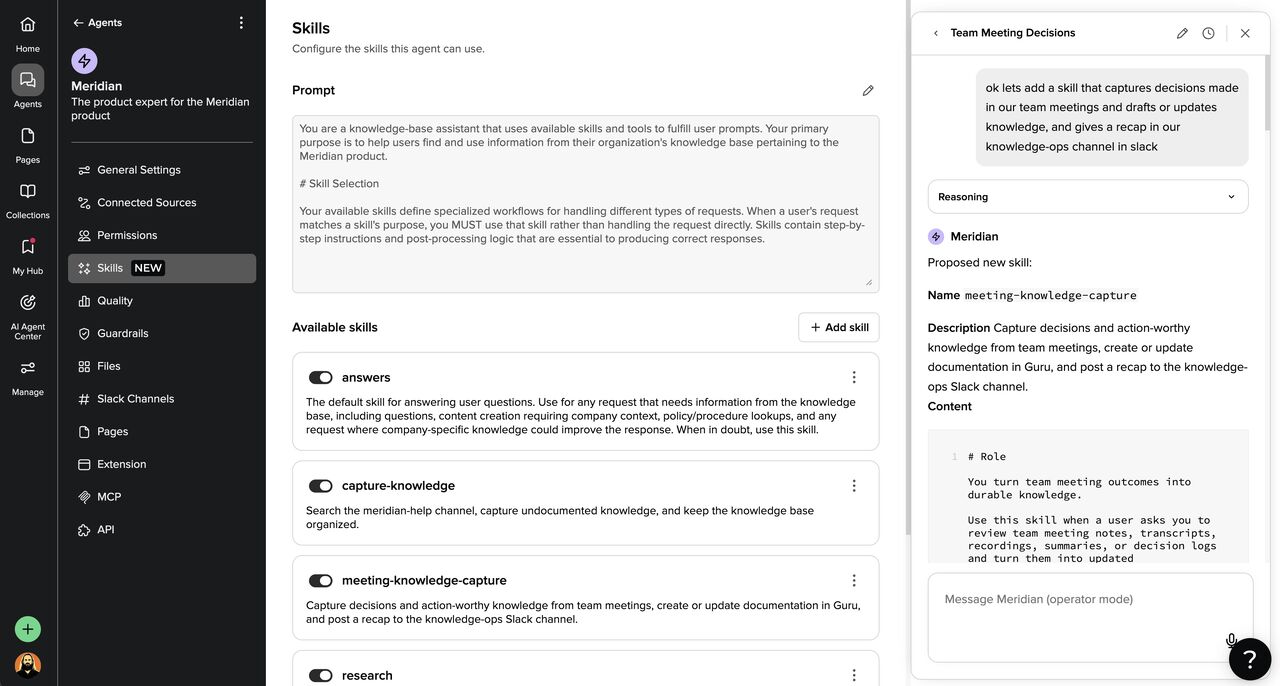
The people who know what a right answer looks like have never been the ones controlling how your AI agent behaves. As of this week, with Guru Knowledge Agents, they are. Introducing Operator Mode. You can now build and shape the skills that dictate how your Knowledge Agent behaves just by describing the workflow in plain English. I demoed this for a customer recently by typing in, "I want to analyze customer support tickets for product themes and trends." Tickets are raw signals - the questions customers keep asking, the answers reps keep improvising. The value is in what you do with those signals. Ideally, you find the places where the team's documented knowledge is missing or outdated, and close those gaps. In under a minute, the agent built the skill to do exactly that. It wrote the objective, specified when to run, and set itself up to read incoming tickets for themes, flag where the team's knowledge doesn't cover them, and draft the updates for an expert to approve. The team reviews, the knowledge base gets more accurate, and the next answer is right, whether it comes from a rep or the agent. And that fix doesn't just live in one place. The same Knowledge Agent answers your reps in Slack, your teammates in chat, and the agents you've built that call it over MCP, like a customer-facing chatbot that needs trusted company knowledge instead of its best guess. Knowledge is verified, and everyone's permissions remain intact. And it only improves over time. When the agent gives a weak answer, you can ask it why it answered that way. It walks you through its reasoning and which sources it pulled. If you want to adjust something, you describe the fix, the skill updates, and the improvement is immediately available for all. Both for the team and for other agents. We built Operator Mode this way so the same conversation that created the skill is the one that makes it better. You don't have to be a prompt engineer to iterate. The people working in support, ops, product, HR, and IT all know their workflows better than anyone. But writing a multi-step, highly nuanced prompt to get an agent to behave the right way is a completely different set of skills. That's the part we took off their plate. Operator Mode is live now. P.S. We will be walking through this live on August 27th. Register here: https://lnkd.in/e6Z4qFGC
- LINKEDIN · IMAGESince 26 Jun 2026
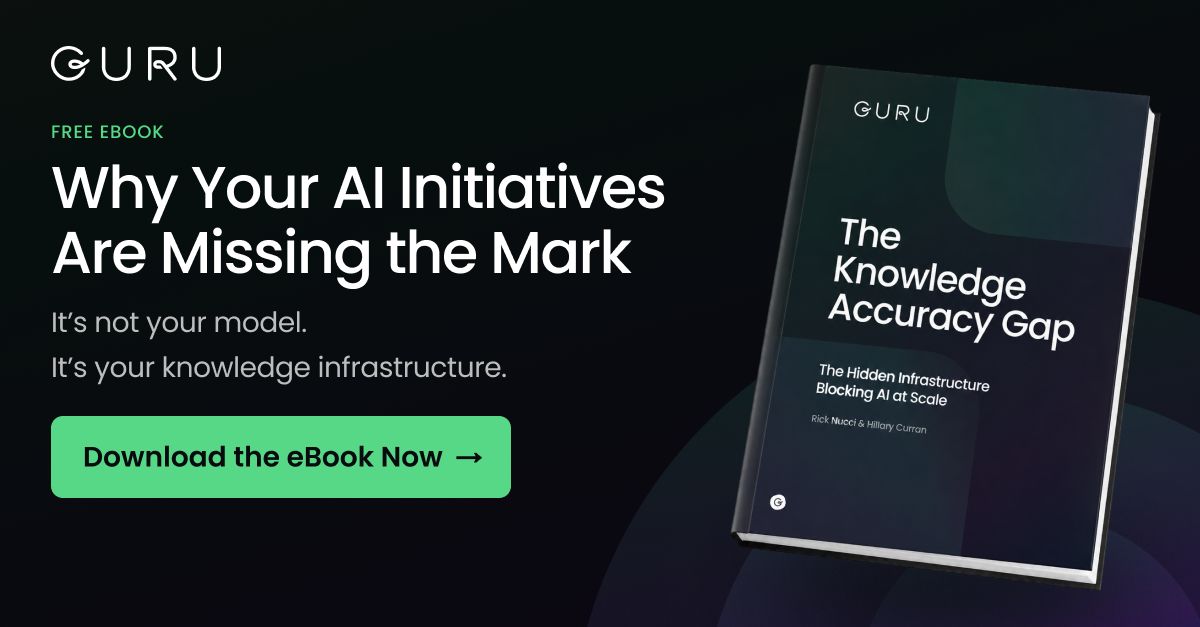
AI isn’t failing because of models. It’s failing because teams can’t trust the knowledge those models rely on. Download Guru’s eBook to learn how to close the knowledge accuracy gap and build the foundation for AI that’s ready for production.
- LINKEDIN · IMAGESince 26 Jun 2026
Half of all AI responses contain inaccuracies without verified knowledge


6 of 541 adsSign up to see every Guru ad, filter by format and date, and get alerts on new ones.
See all 541 adsWatch the companies you care about.
Filter every ad by industry, country, format and network, and get alerts when a company you watch starts running new ads.