On air · 1 of 3 networks
Boomerang
- boomerangapp.com
- Software (horizontal)
- US
- 27 employees
Boomerang’s ads on LinkedIn, Meta and Google, recorded by adsrunning. Browse the latest here for free. Sign up free to see all 57. Watch Boomerang with Starter to get each new one in your feed.
Watchlist with Starter · $49/mo
| Network | Status | Live ads | Nov 2025LinkedIn activity · 52 weeksOct 2026 | Checked | Next step |
|---|---|---|---|---|---|
| Running | 26 | Checked 30 Oct 2026 | See all 57 ads → | ||
| Meta | None recorded | 0 | No active ads recorded on the Meta Ad Library | Checked 18 Oct 2026 | Collect them with the API → |
| None recorded | 0 | No ads found on the Google Ads Transparency Center | Checked 9 Oct 2026 | Collect them with the API → |
Boomerang has 26 live LinkedIn ads. Its Facebook page had no active ads on 18 Oct 2026, and we recorded no Google ads on 9 Oct 2026.
Latest ads
- LINKEDIN · IMAGESince 27 Oct 2026
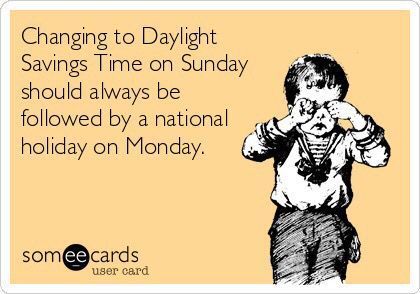
It's every American's favorite time of the year! Everyone gets an extra hour of sleep this Sunday. Daylight saving time change is sneaking up on us while we are all focused on Halloween! But I hope you're ready for a week of chaos. As any parent of a young kid knows, that "extra hour" is a complete fantasy. It's really just a 6:00 AM jolt from a child whose internal clock doesn't care about the new time. It's the official start of the week-long crankiness for the entire family. It’s not just the parents of young kids who will be suffering. Anyone without the flexibility to sleep in will be missing a precious hour of sleep a day next week. The transition typically takes up to a week or more. And that disruption doesn't stay at home. It follows us right into the office, and this "fall back" brings its own set of serious problems. First, there's a serious safety risk. That jarring shift to darkness during the 5 PM commute is dangerous. One study found that pedestrians are nearly 3 times more likely to be struck and killed by cars in the dusk hours immediately following the fall time change. A Carnegie Mellon study found the risk-per-mile for pedestrians jumps by 186% in November. I want you to be extra defensive when you're walking or driving home next week. Second, there's the mental health risk. That abrupt loss of evening light is a known, documented trigger for mood disorders. A large-scale Danish study found an 11% increase in hospital visits for depression that begins immediately after the fall transition to standard time. This is the same mechanism that triggers Seasonal Affective Disorder (SAD) for so many. My guess is it disproportionately affects night owls. The sudden shortage of daylight disrupts our circadian rhythm. For team leaders, your team isn’t going to be at the top of their game next week. They will be accumulating some sleep debt. Try to not schedule meetings too early and let everyone adjust to new time! If you want to be extreme about it, just cancel the in-office days for hybrid people.* To make the transition easier, we have to start shifting our internal clocks. Here's how: 🚧 Start the Shift Now. Don't wait for Sunday. Starting tonight, try to go to bed and wake up 15-20 minutes later each day. This also applies to mealtimes. 🌅 Get Morning Light. On Sunday and especially Monday, get outside in the sunlight as soon as you can. Morning light is the most powerful signal to reset your body's clock for the new day. 🦉 Stay up later this Friday & Saturday nights and try to sleep in the next morning. Any other tips you found that worked for DST change? Please share! * Imagine you might just be accidentally saving lives from reducing traffic for one week! ** Who am I kidding? It’s Halloween! You are going to stay up with kids hyped up on sugar anyway. P.S. The American Academy of Sleep Medicine has called for the ending of this biannual mess, citing all these public health risks. I'm with them.
- LINKEDIN · IMAGESince 2 Oct 2026
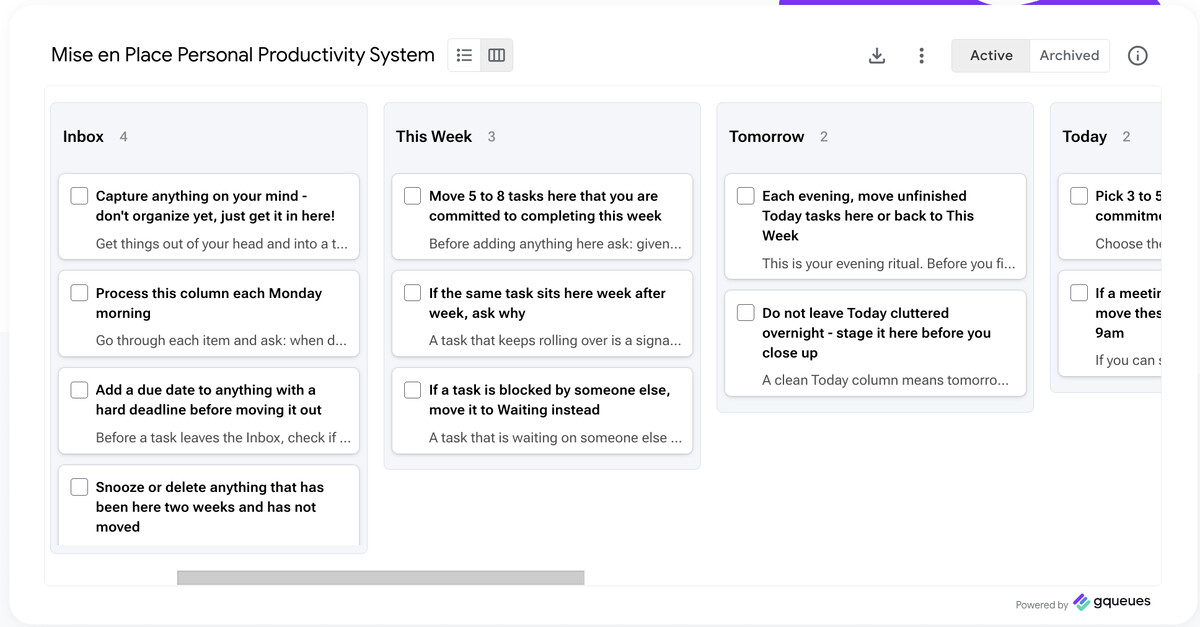
The absolute worst time to plan your work day is 9:00 AM. After 16 years of running a productivity company, people expect me to have a super sophisticated system for keeping track of what I need to do. You might expect to see automated multi-app pipelines, multiple AI agents, intricate tag hierarchies, and color-coded priority flags. After all, I do have a dozen or so patents in productivity tools. But my entire system runs on a simple kanban board named “Mise-en-place” bookmarked from my browser toolbar. The inspiration comes from professional kitchens. Mise en place means every ingredient is chopped, measured, and arranged at your station before you ever light the burner. I adopted it from a Trello template a few years ago and refined it since. The minute we built Kanban in GQueues, I migrated. It’s been the first thing I open every morning. Eight columns: Inbox, This Week, Tomorrow, Today, Review, Waiting, Done, and Reference. On Monday morning, I spend ten minutes scanning Inbox, where raw thoughts and incoming requests land during the week. I decide what actually needs to get done and move those items into This Week. Every afternoon before I log off, I run the shutdown routine: First, I move finished tasks into Done. Second, unfinished items. I try to not let tasks rot in Today overnight. They get scheduled for Tomorrow, pushed back into This Week, or sent back to Inbox if priorities shifted. Third, I stage tomorrow. I look at my calendar to see what the day allows, then pull tasks out of This Week into Tomorrow. Finally, I attach context. If a task requires a spec, a spreadsheet, or a customer ticket, I paste the exact URL into the task notes. This part is critical. You want your ingredients where you need them. I do use light automation here with our MCP integration. More on that in a later post. Then 9 am comes along, I open my laptop, and everything is in place. Mise-en-place. I drag Tomorrow into Today and start working. No email triage. No Slack scanning. No dithering around thinking “what should I do first?” On Friday afternoon, I run a five-minute review. I capture loose follow-ups, check Waiting for stalled projects, snooze what needs punting to a future date, clear out Inbox, and archive Done so Monday starts clean. Reference doesn’t seem that useful, but it holds the static, unglamorous logistics. Kids’ doctors, emergency contacts, company EIN. The exact things I used to waste ten minutes hunting for every time. The exact tool is secondary. You could run this on a whiteboard with sticky notes. What matters is consistency and not letting it rot. I believe simple and consistent beats anything brilliant and fragile. Easy to stick habits pay off because you’re not spending effort keeping up with the system. If you want to try it for a week, you don’t have to build it. My actual setup is shared as a template, already wired up with instructions. Import it and delete whatever you don’t use. Template’s in the comments.
- LINKEDIN · IMAGESince 29 Jul 2026
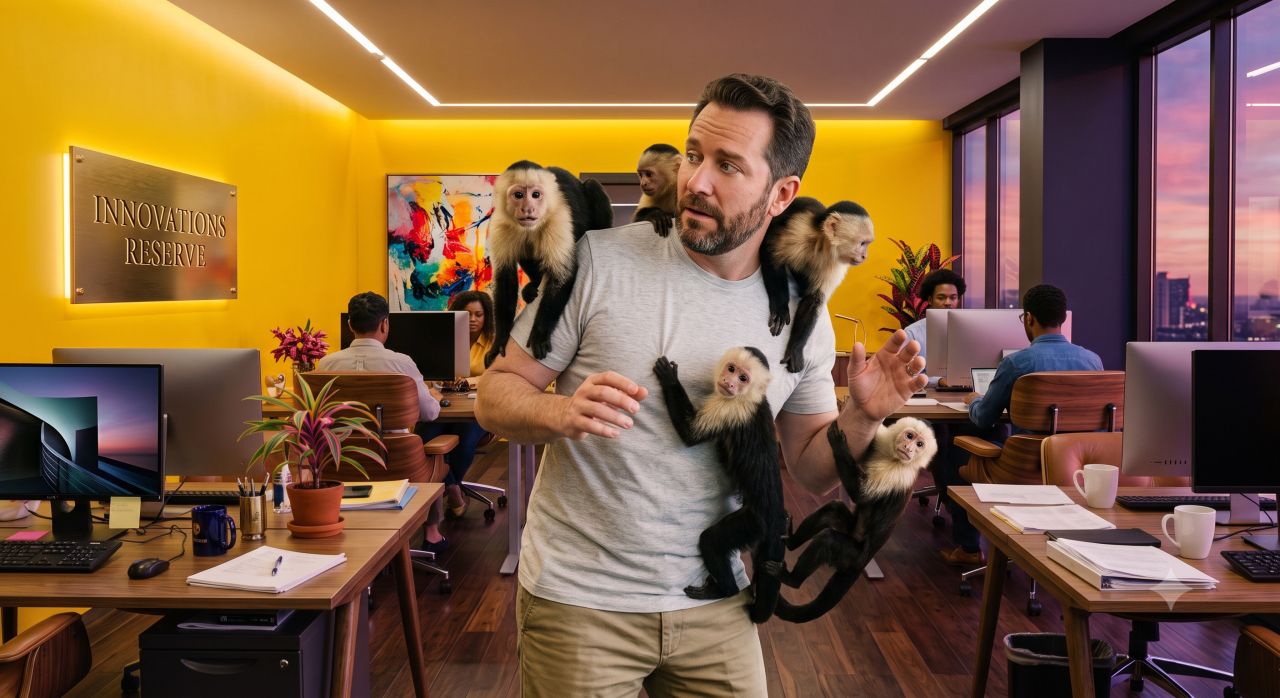
Every team has these wild animals loose amongst them. It's the reason your calendar is full and your own work gets done after 9pm. They are monkeys and you got some sitting on your shoulder right now. "Who's Got the Monkey?" is a 1974 article that became one of Harvard Business Review's best-selling reprints ever. The idea: every task is a monkey. A team member walks in with a problem, asks "Can you review this?", and the monkey jumps from their back onto yours. Say yes enough times and you're the bottleneck for your whole team, feeding everyone's monkeys while your own work starves. In my last post, I showed why it's hard to feel comfortable delegating. This one is about how to think systematically about the levels of delegation. Most people treat delegation as an either/or thing: either I do it, or you do it. It's not. It's a ladder with 5 levels: Level 1: Do nothing unless I tell you to. Level 2: Ask me how to handle anything that comes up. Level 3: Recommend an action, then wait for my approval. Level 4: Do what you think is best, but keep me in the loop. Level 5: Handle it. Report back at our next scheduled check-in. 3️⃣ things I've learned using this ladder over 15 years at Boomerang: 🐒 Most managers are stuck at Level 3 without realizing it. "Bring me a recommendation" feels like delegation, but the monkey still comes back to you for every decision. 🦸♀️ The goal is NOT everyone at Level 5 on everything. Bet-the-company decisions, key relationships, your actual superpowers: some things should stay low forever. The real goal is to have almost nothing permanently at Levels 1 and 2. 💡 Get clarity on which level you are comfortable with for each task-person pair. Even better, communicate it to the person: "You're at Level 3 on this now. By next quarter, I want you at Level 5." Now you're not micromanaging. You're coaching someone up a ladder you can both see. And the same person will sit at different levels for different tasks. Your senior engineer might be Level 5 on architecture and Level 2 on customer communications. And that's totally okay. One more rule from the HBS article: when someone tries to hand a monkey back, either feed it 🍌 (it becomes your priority) or shoot it 🏹 (it's not getting done). Set an explicit max on monkeys you'll feed. This ladder works for AI agents too. "Draft it and I'll approve" is Level 3. Most people never move their AI past it either. Maybe that's okay but just be aware. Do you have clarity on which delegation level each task-person pair is at? Next post: I'll talk about the handoff itself. When the US Army tested how well commanders communicate intent, 2 out of 3 subordinates got it wrong. We'll cover the 7 briefing components that fix it. P.S. The full monkey management system, plus when NOT to delegate, is in episode 21 of Less Busy Lab. Links in comments. #delegation #betterleader ps: no monkeys were harmed in making of this image.
- LINKEDIN · IMAGESince 21 Apr 2026
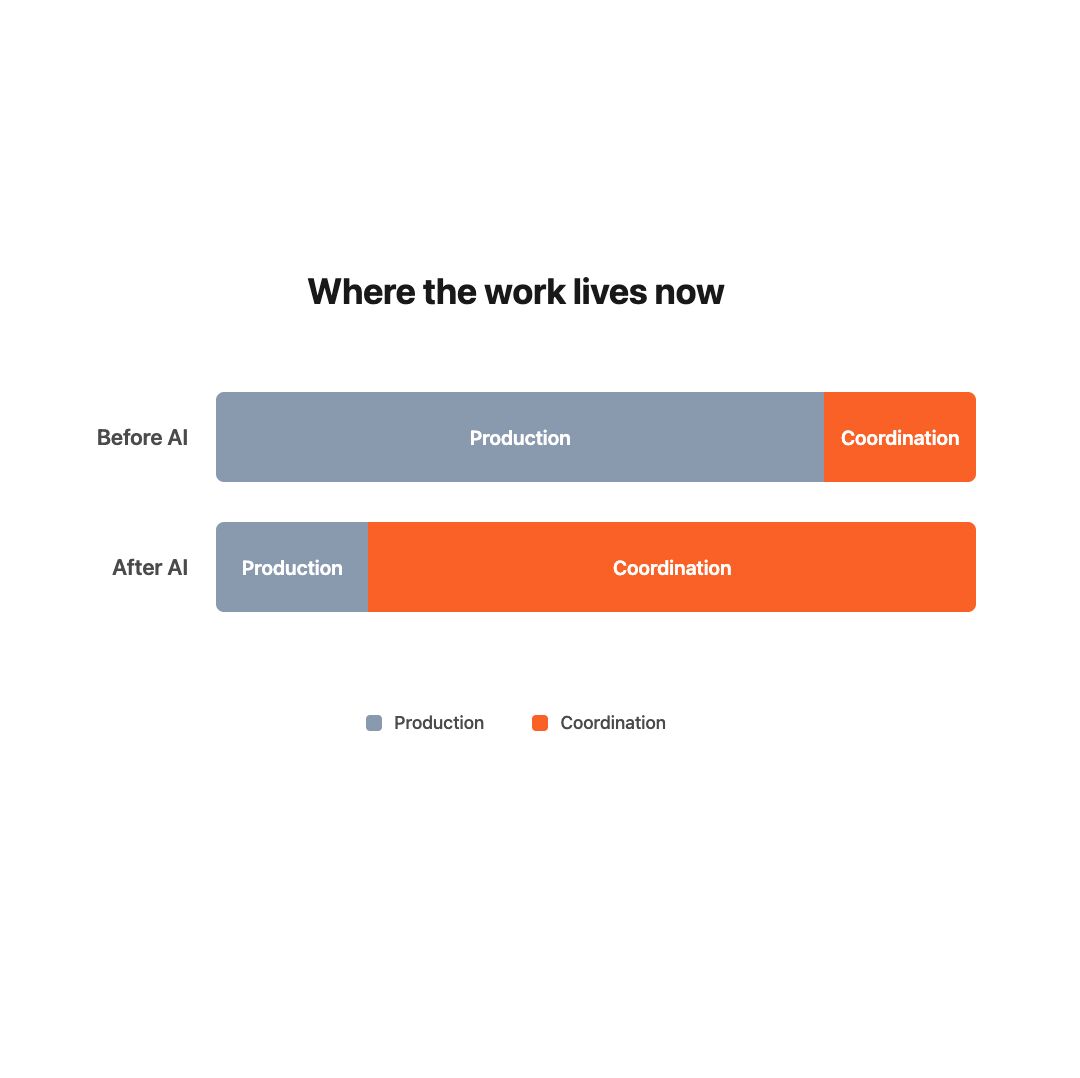
That meeting you hate may keep AI from stealing your job. But only if you run it well. That's my take after reading this great NYT piece this week by the same name (gift link to the full article in comments, def. worth a read). It helped me crystallize something I've been thinking about for a while. Here's the framework: Knowledge work has always had two layers. The production layer — making the thing. Writing the strategy doc, building the deck, running the analysis, writing the code. The coordination layer — deciding which thing to make, getting the client to sign off, building the trust needed for people to actually act on what you produced. For decades, companies treated the coordination layer as overhead; a necessary but pesky tax on the real work. All the investment went into making production faster. Even a lot of Boomerang's work was focused on creating protections from 'deep work' time for you to go code/design/write. AI just finished what decades of software started. It's solving the production layer. The article is full of striking examples such as websites built in a month instead of six, strategy docs done in hours instead of weeks, customer onboarding compressed from six months to two weeks. But here's what nobody's reckoning with: the coordination layer didn't shrink at all. In fact it grew in importance in relation to everything else. That fractional CMO can run marketing for three companies. AI could easily handle the work of a fourth. He can't scale himself to take on the meetings that come with the fourth company. When the production layer was slow, coordination was a small fraction of your week. Now that production is nearly instant, coordination is most of what's left. Even worse there is more to coordinate at a faster rate. It went from overhead to the entire job. This changes what "good at your job" means and I don't think most companies have absorbed it yet. Your value at work used to be the artifact you produced. Now it's the alignment you create between people. What's on the deck doesn't matter. Whether five people leave the room pointed in the same direction does. Which means most companies are now measuring the wrong things, hiring for the wrong skills, and investing in the wrong layer of work. We've spent decades optimizing production. Most companies have never deliberately optimized coordination and thought about what it takes to do it well. The question isn't whether AI will take jobs. It's whether your organization is investing in the layer of work that AI just made the most important. Ask yourself: what percentage of your team's week is production vs. coordination? And which one are you actually managing for? Which one are you investing to optimize? Follow along if you want more of my thoughts on making meetings the highest-leverage part of your week. I'll be sharing insights from my conversations with team leaders.
- LINKEDIN · IMAGESince 30 Mar 2026
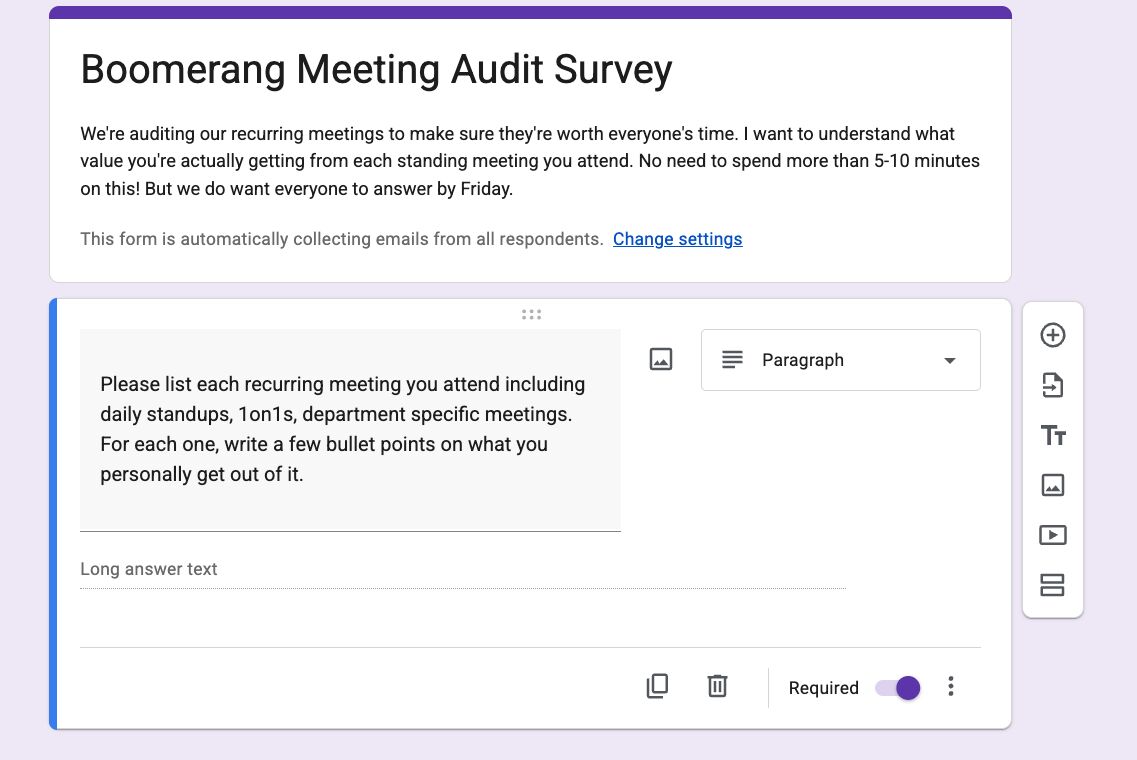
Shopify deleted 12,000 recurring meetings on a New Year's Day. Every single one with 3+ people got nuked. They told teams: try it for two weeks. Add back only what you actually need. It worked. Meeting time per employee dropped 14%. Finished projects jumped 18% at the end of the year. We don't have 12,000 recurring meetings at Boomerang. But I wanted to see if a 20-person team could get the same clarity from a meeting audit. So I sent a dead-simple survey: "list every recurring meeting you attend and write a couple sentences about what you get out of each one". What people didn't mention was more revealing than what they did. Some people completely forgot they were in certain recurring meetings. Didn't even list them. That meeting didn't register in their mind at all. Some said, "someone asked me to cover for them once and I never stopped showing up. I don't get much out of it." And our daily standup, the one meeting we've done every single day for 16 years? Turns out coordination is not this meeting's only value. It's now also the social glue for a fully remote team. People called out the jokes, the banter, the Zoom chat. For a fully remote team, those 10 minutes are the daily water cooler. We cancel the ones that no longer have good reasons, we restructured 2 problematic ones and some people can stop attending some meetings they don't need to! Microsoft found that only 1 in 3 people think they'd actually be missed in most of their meetings. Whether you have 10,000 employees or 20, the pattern is the same. People sit in meetings out of FOMO, not value. Here's how to run your own meeting audit: 1. Survey your entire team with just two simple questions: "what recurring meetings do you attend, and what value do you get from each?" You don't need anything more elaborate than that. You shouldn't even list the meetings so you can see which ones they will forget to list. 2. You run every meeting through this checklist after getting the results: ✅ Are decisions being made? ✅ Is anyone doing something differently because of this meeting? ✅ Are new viewpoints being exchanged or opinions being swapped? ✅ Is there social or team-building value? 3. If it doesn't hit at least one of those, cancel it. 4. If it hits one but should hit another, restructure it. If your meetings mix tactical updates with deep strategic debates, split them up so they serve what you intend them to. How many recurring meetings do you have on your calendar? Which of them will fail all four questions from the checklist? What's stopping you from doing a meeting audit? p.s. Bad meetings cost a 100-person company about $2.5M a year. At 5,000 employees, that's $100M. Shopify built a meeting cost calculator after the purge. A 30-minute meeting with 3 people: $700 to $1,600. p.p.s. If you want the full meeting audit framework and the "Death by Meeting" breakdown, Alex and I went deep on this in the latest Less Busy Lab episode. Link in the comments.
- LINKEDIN · IMAGESince 4 Mar 2026
Which famous French novel was written when its author was "mostly" naked? The reason why is the best procrastination advice I've ever found. In 1828, Victor Hugo agreed to write The Hunchback of Notre Dame for his publisher. He missed the first deadline in April 1829. He didn't deliver a single page. His publisher threatened to sue him. Hugo negotiated an extension to December 1830. He missed that one too and this time, he blamed the July Revolution, said he lost his notes, got two more months. ("Dog ate my homework" excuse is not new!) He had, however, spent the year writing plays, hosting dinner parties, and exploring Paris. His publisher finally issued an ultimatum: deliver by February 1831 or pay 1,000 francs a week in fines. Roughly $13,000 in today's money. Being threatened with a lawsuit didn't work. Two missed deadlines didn't work. 𝘚𝘰 𝘏𝘶𝘨𝘰 𝘵𝘰𝘭𝘥 𝘩𝘪𝘴 𝘷𝘢𝘭𝘦𝘵 "𝘓𝘰𝘤𝘬 𝘢𝘸𝘢𝘺 𝘦𝘷𝘦𝘳𝘺 𝘱𝘪𝘦𝘤𝘦 𝘰𝘧 𝘮𝘺 𝘧𝘰𝘳𝘮𝘢𝘭 𝘤𝘭𝘰𝘵𝘩𝘪𝘯𝘨. 𝘋𝘰 𝘯𝘰𝘵 𝘨𝘪𝘷𝘦 𝘮𝘦 𝘵𝘩𝘦 𝘬𝘦𝘺 𝘶𝘯𝘵𝘪𝘭 𝘵𝘩𝘪𝘴 𝘯𝘰𝘷𝘦𝘭 𝘪𝘴 𝘸𝘳𝘪𝘵𝘵𝘦𝘯!" Wrapped in a gray shawl. Unable to leave or receive guests. Nothing left to do but write. He delivered two weeks early. Victor Hugo couldn't make himself stop procrastinating without removing every other option first. He needed a gimmick. Here are three things that actually work without resorting to that extreme. 1. The 𝗠𝗖𝗜𝗜 𝟯-𝗺𝗶𝗻𝘂𝘁𝗲 𝘀𝗰𝗿𝗶𝗽𝘁: Before you start, answer three questions. What's the best outcome if I do this? What's stopping me? How will I handle that obstacle when it shows up? Researchers call this Mental Contrasting and Implementation Intention. Takes less time than making another cup of coffee to avoid starting. 2. 𝗦𝗼𝗰𝗶𝗮𝗹 𝗰𝗼𝗺𝗺𝗶𝘁𝗺𝗲𝗻𝘁: Tell someone. Anyone. Before Alex ships anything he's been putting off, he schedules a fake check-in with a colleague. Not because they need the update. Because he needs the audience. Research shows accountability to another person jumps follow-through from 43% to 76%. You don't need a productivity app. You need a witness. 3. 𝗦𝗲𝗹𝗳 𝗰𝗼𝗺𝗽𝗮𝘀𝘀𝗶𝗼𝗻: Forgive yourself for yesterday. Students who forgave themselves after procrastinating on an exam procrastinated less on the next one. Self-compassion broke the cycle. Self-criticism deepened it. So if you didn't do the thing yesterday, let it go. Then go do it. You probably can't lock away your clothes and go full Hugo. But you can try one of these three things today. Which one are you starting with? Drop it below. 🎧 Full episode on the science of procrastination in Episode 18 of Less Busy Lab. Link in the comments. p.s. I wrote this post while procrastinating on something else I actually needed to be doing p.p.s I am waiting for the first "well actually" comment on how naked Hugo was. p.p.p.s Hugo was quite eccentric and actually got custom furniture made to write standing. He's way ahead of the standing desk fad.

6 of 57 adsSign up to see every Boomerang ad, filter by format and date, and get alerts on new ones.
See all 57 adsWatch the companies you care about.
Filter every ad by industry, country, format and network, and get alerts when a company you watch starts running new ads.