On air · 1 of 3 networks
BlueDolphin
- bluedolphin.io
- Software (horizontal)
- NL
- 83 employees
BlueDolphin’s ads on LinkedIn, Meta and Google, recorded by adsrunning. Browse the latest here for free. Sign up free to see all 38. Watch BlueDolphin with Starter to get each new one in your feed.
Watchlist with Starter · $49/mo
| Network | Status | Live ads | Nov 2025LinkedIn activity · 52 weeksOct 2026 | Checked | Next step |
|---|---|---|---|---|---|
| Running | 20 | Checked 30 Oct 2026 | See all 38 ads → | ||
| Meta | None recorded | 0 | No active ads recorded on the Meta Ad Library | Checked 18 Oct 2026 | Collect them with the API → |
| Recently | 86 | Ads on the Google Ads Transparency Center | Checked 13 Oct 2026 | Collect them with the API → |
BlueDolphin has 20 live LinkedIn ads. Its Facebook page had no active ads on 18 Oct 2026, and we recorded 86 Google ads on 13 Oct 2026.
Latest ads
- LINKEDIN · VIDEOSince 17 Sept 2026
🚀 The wait is over! AI Navigator is now available. Ask a question in plain language, and AI Navigator answers it straight from your own architecture repository, no digging through views or menus. It picks up right where you left off, handles bigger, more complex questions, and draws on the specific data you've already captured in your questionnaires. That's what makes it more than a chatbot. It's a conversational layer built directly on top of your architecture, and the foundation for deeper reasoning and richer insights still to come. 🔗 Want to see what else BlueDolphin's AI capabilities can do? Learn more here: https://lnkd.in/exwei-nV/?utm_campaign=Boost_Post_BrandAwareness_Sep17,2026&utm_source=linkedin&utm_medium=paid&utm_id=1213287404&hsa_acc=526610407&hsa_cam=1213287404&hsa_grp=899751914&hsa_ad=1568236354&hsa_net=linkedin&hsa_ver=3 Curious to try it yourself? Start a free trial and put AI Navigator to work on your own architecture.
- LINKEDIN · IMAGESince 1 Jul 2026
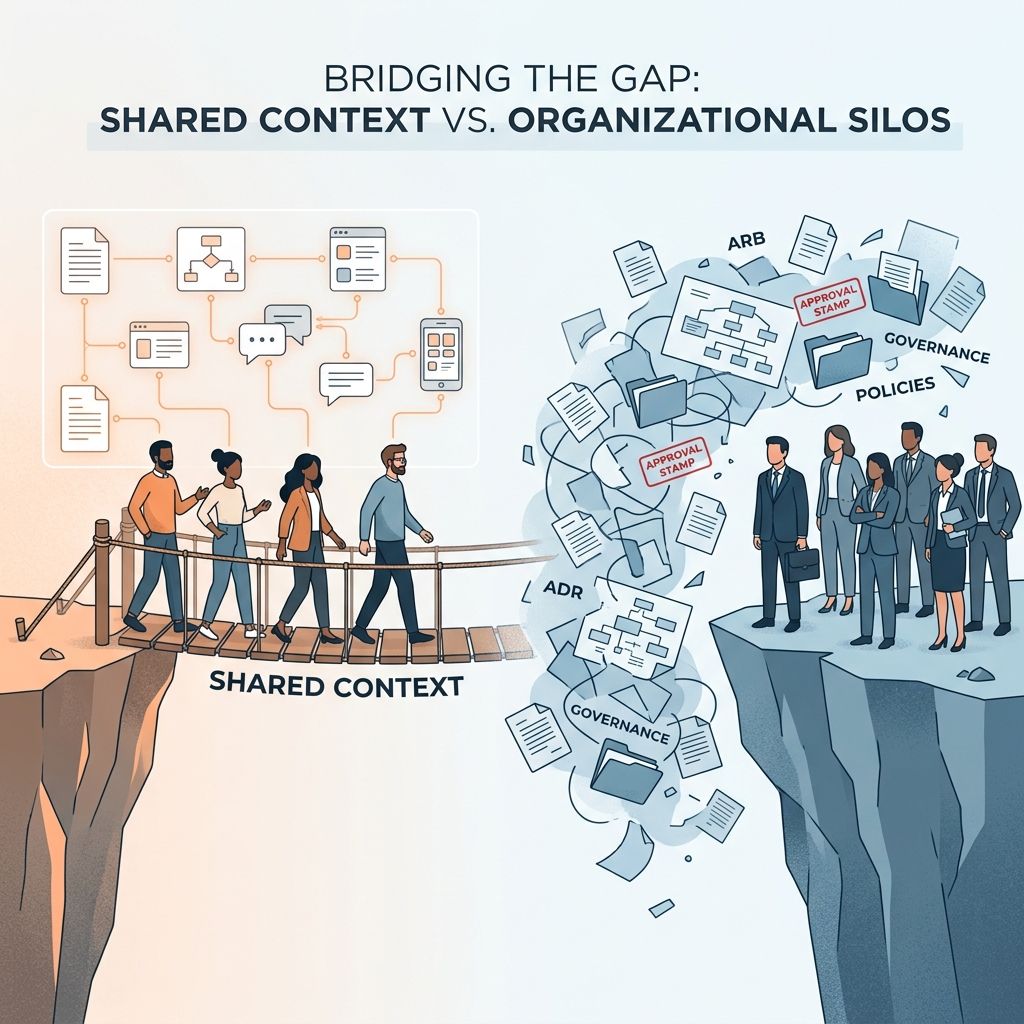
Startups move fast. Enterprises move slow. Enterprises move slower because they have bureaucracy, governance and complexity. That’s the usual explanation. But I’m not sure it’s the real reason. I think the real difference is something else: context visibility. In a startup, decision context is particularly visible. Small team. Every decision is crystal clear. All four team members know exactly how processes work, which apps they’re using, and who said what when. Decisions are made fast because everyone in the room already shares the same context. Whether we go left or right is a simple question in a startup. We bring the team together for a quick call and decide based on information everyone already understands. In enterprises it’s different. Left or right is rarely the real question. First we need to uncover context. Why did we do X years ago? What will be the impact of Y? Is this person aware? Does that person need to be involved? Enterprises try to manage this complexity through architecture. The idea is to centralize information and create structured ways to discuss decisions. So, We introduce Architecture Review Boards. We document decisions in ADRs. We maintain repositories full of models, diagrams and policies. All with the right intention. But very often it turns into something else. ARBs happen every two weeks and regularly ask for additional information, delaying decisions by weeks. ADRs become Word, PowerPoint or Confluence documents created for the sake of a single project, often disconnected from the broader architectural context. Every ADR costs time and effort, but the context behind the decision rarely survives beyond the duration of the project. And the repository itself often becomes a pale reflection of the organization’s real architecture. A place where architecture gets administered as an afterthought, with just enough information to draw diagrams but not enough to answer real questions. And in the next project we ask again: Why did we make this decision two years ago? What will the impact of Y be? Who actually needs to be involved? So the cycle repeats. ARBs ask for more context. Projects start from zero when creating the next ADR. We burn time, context leaks away, and decision-making slows down. Eventually the organization simply stops feeling like a startup. This was already a problem in a world dominated by human labor. But now we are entering a world of agents. Agents run entirely on context. They cannot reason over scattered documents or fragmented repositories. They need living, connected architectural context to operate effectively. So maybe the real role of enterprise architecture is not administering models. It is making decisions and context continuously visible to the entire organization. At the right time. At the right level. In the right format. #EnterpriseArchitecture #EA #AI #Context
- LINKEDIN · IMAGESince 1 Jul 2026
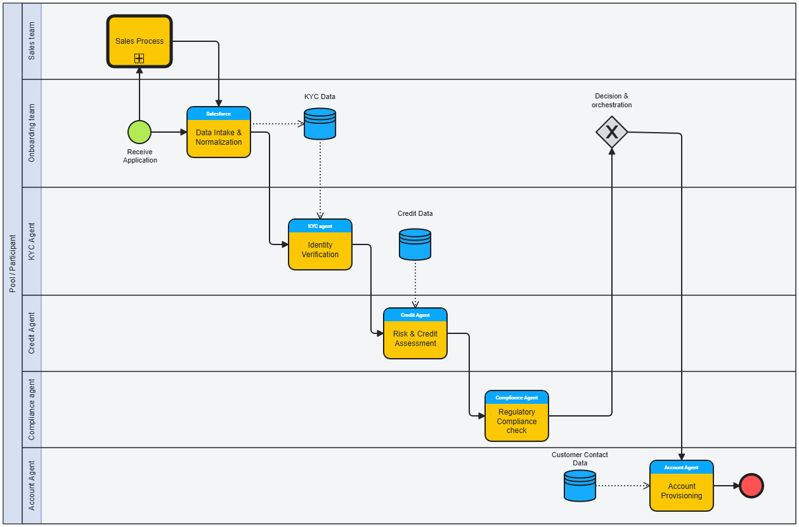
How do you handle agents in your architecture models? AI agents are showing up everywhere over the past few months. They have escaped the prison of PoC's and experiments and show up in production. In real processes. Doing real work. But most architecture models I see, still show very little agents. They live in the shadows. That is slowly but certainly becoming a problem. Agents clearly need to be captured, managed and governed. The fact that they act much more autonomously than for example applications, might even make it much more important to govern them. And governing starts with capturing. Yet ArchiMate, #BPMN and #UML do not yet really give us a clean, standard way to model them today. So everyone is improvising. As we are enhancing and standardizing agent management in #BlueDolphin (e.g. Eric and George doing the hard work here at ValueBlue) we are figuring out how to best capture agents, while not reinventing the wheel or introducing messy isolated concept that will hurt our customers later. Some observations: ⛓️ In BPMN, an agent often acts like both an actor in a swimlane and an application behind a task. ⏹️ In ArchiMate, I see agents modeled as application components, business actors, services or sometimes custom objects. All workable. No standard chosen yet. If you are already running AI agents in production, how are you modeling them today? And what data/info do you capture on an agent to support management and governance of agents? Curious to learn from your experience. #EntepriseArchitecture #EA #AI #Agents #ProcessManagement #DataManagement
- LINKEDIN · IMAGESince 1 Jul 2026
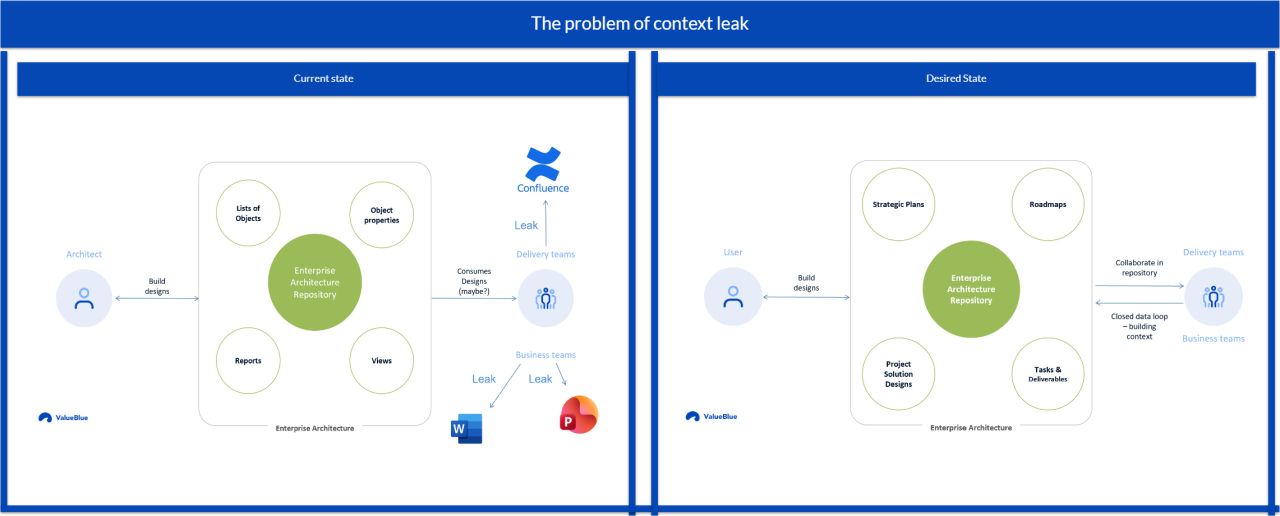
If your architecture leaves the repository, autonomy will too. We are full-on entering the agentic age. Unlike previous waves of innovation, agentic AI is not an assistant layered on top of work. It is a decision maker that acts inside your operating model. And acting properly requires context. Most organizations have moved from assistants to deploying several stand-alone agents. Very few have matured into multi agent systems, let alone autonomous ecosystems that manage entire domains. The limiting factor is not model quality. It is enterprise context. Here is the breaking point I see repeatedly: context leak. Even with a formal EA repository in place, strategy lives in Word documents, solution designs in PowerPoint, roadmaps in separate tools. Screenshots get copied. Diagrams get exported. Decisions get documented outside the system of record and rarely find their way back. Each time that happens, the architectural model drifts. Humans compensate with experience and hallway conversations. Agents cannot. They require structured, machine readable governance and continuously updated context across their full lifecycle, from design to runtime behavior and ongoing evolution. Multi agent collaboration only works when agents share a dynamic architectural backbone that reflects reality, not last quarter’s slide deck. If we are serious about scaling autonomy, we need a single shared repository where business and delivery collaborate on architecture directly, not around it. Not just for human alignment, but because agents depend on digital context. They cannot ask a colleague what changed. If you are serious about moving beyond PoC's with agents and building enterprise ready agents, minimizing context leak is crucial. Starting today. Make your repository the living source of truth. Want to dive deeper? Read the e-book, link is below. Curious what you think, let me know in the comments! #EnterpriseArchitecture #AgenticAI #Governance #OperatingModel #ContextEngineering
- LINKEDIN · VIDEOSince 22 May 2026
💙 We just released my favourite BlueDolphin feature so far. AI is impressive. Until you ask it something that actually requires proprietary context about your organization. It doesn’t know your processes, your applications, your data, or your decisions. So the answers stay generic. We just changed that and I recorded a quick video to show it, because I couldn’t wait to share it. We built AI Navigator inside BlueDolphin, working directly on your architecture. The purpose is not just to answer simple, generic questions like “how many applications do I have” or “what are my three most expensive applications.” It can answer those, but that’s not where it gets interesting. You can also get thet from a simple report. What makes AI navigator unique is that it reasons with you on the topics that actually matter. The kind of questions that normally take days of analysis, alignment, and interpretation. It brings Enterprise Architecture straight to the strategic table. You can ask things like: “Where should we deploy AI agents for real impact?” “Which projects are violating our principles?” “How do we reach EU data sovereignty by 2030?” And it answers based on how your organization is actually built. Not on generic theory, and not on assumptions that don’t apply to your situation. It is grounded in your reality. This is a pretty fundamental shift. Architecture is no longer just about documenting and analyzing after the fact, often in a language no one outside the architecture community really understands. It becomes a live, ongoing conversation that the business can actually participate in. And to some extent, this is where we start delivering on the promise architecture has always had: guiding transformation while ensuring the organization remains coherent and robust. If you’re curious, you can try it for free on BlueDolphin.io. Have fun!
- LINKEDIN · IMAGESince 8 May 2026
Move faster towards your future with insight that’s always up to date. That’s what an AI-native transformation platform like BlueDolphin delivers.

6 of 38 adsSign up to see every BlueDolphin ad, filter by format and date, and get alerts on new ones.
See all 38 adsWatch the companies you care about.
Filter every ad by industry, country, format and network, and get alerts when a company you watch starts running new ads.