On air · 1 of 3 networks
Supercritical
- gosupercritical.com
- Climate & Energy
- GB
- 68 employees
Supercritical’s ads on LinkedIn, Meta and Google, recorded by adsrunning. Browse the latest here for free. Sign up free to see all 66. Watch Supercritical with Starter to get each new one in your feed.
Watchlist with Starter · $49/mo
| Network | Status | Live ads | Nov 2025LinkedIn activity · 52 weeksOct 2026 | Checked | Next step |
|---|---|---|---|---|---|
| Running | 2 | Checked 29 Oct 2026 | See all 66 ads → | ||
| Meta | Not checked | — | |||
| None recorded | 0 | No ads found on the Google Ads Transparency Center | Checked 30 Oct 2026 | Collect them with the API → |
Supercritical has 2 live LinkedIn ads. We recorded no Google ads on 30 Oct 2026.
Latest ads
- LINKEDIN · ARTICLESince 25 Jun 2026
Dr. Mai Bui thinks most SBTi companies are about to make a strategic mistake. Her read: the pre-2035 voluntary period is a window that most companies will waste on cheap avoidance credits. When mandatory procurement kicks in, every signatory hits the same supply wall simultaneously. The companies that start building CDR procurement muscle now will be in a fundamentally different position from those that wait. Mai spent the past year on the SBTi Expert Working Group that developed the carbon removal framework. She's one of the very few people who can explain not just what the standard requires, but why the rules were written the way they were. She also puts V2 in the context of a broader shift from voluntary to compliance markets. SBTi is one signal among many pointing toward mandatory long-lived CDR. Read Mai’s analysis of the new standard and what companies should do about it.
- LINKEDIN · IMAGESince 25 Jun 2026
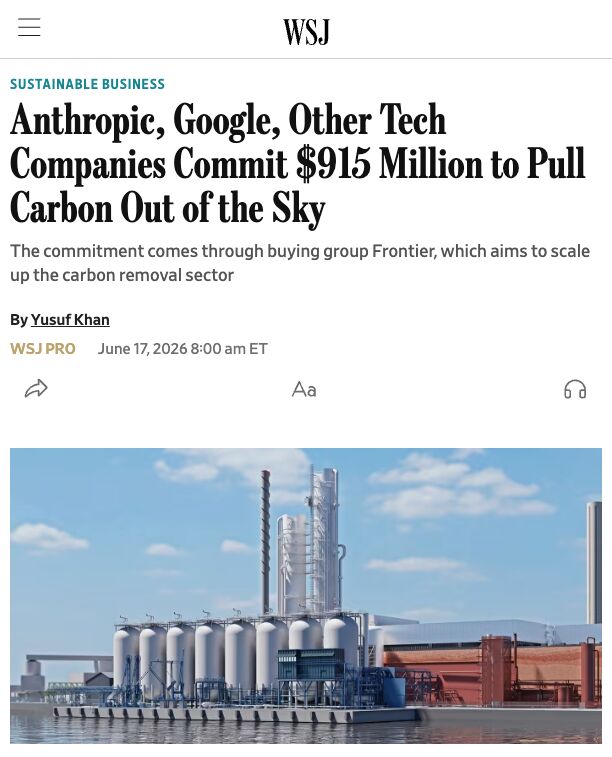
Congratulations to Hannah Bebbington Valori and Frontier! Nearly $1B for carbon removal is a BFD. Carbon removal is graduating from seed stage to growth with this new tranche of funding. Frontier will double down on ~10 companies in this fund vs. the >20 they procured from previously: “We’ve really proven that carbon removal technology can work. Now the question is how cheap can it get, and will demand keep pace?... We’re really thinking about how we use this capital to buy from the highest-potential companies, those who we think are most scalable, most affordable, most efficient.” Frontier specifically wants to purchase from projects that have a clear path to government and compliance support. This is the “baton pass” we’re all looking for. Alongside the recent SBTi update, we’re seeing a transition from voluntary demand to compliance markets. Also, bravo to Anthropic for joining the fold. Welcome!
- LINKEDIN · IMAGESince 25 Jun 2026
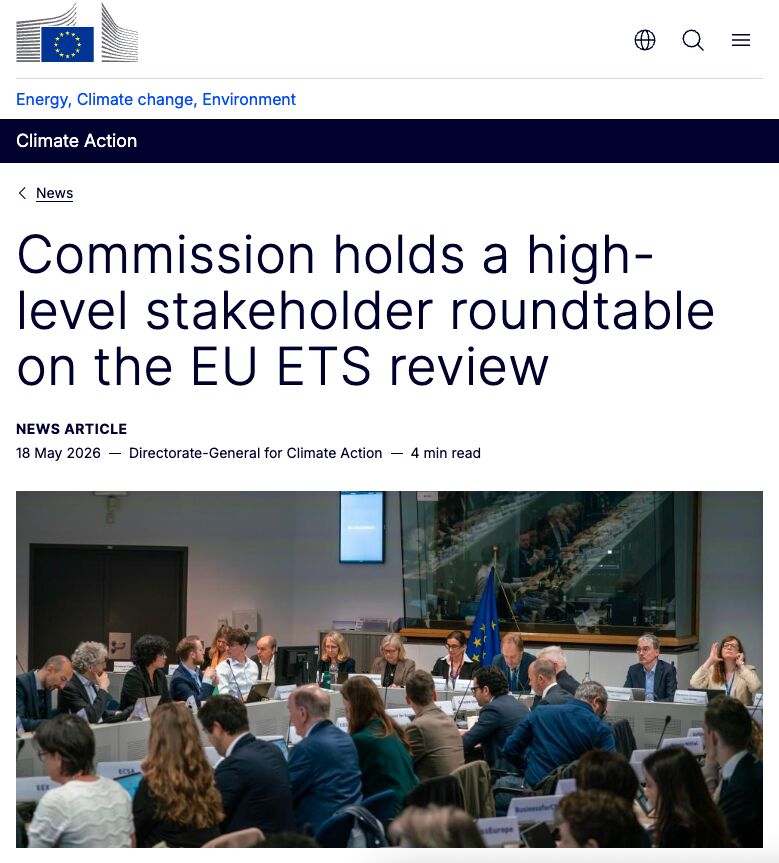
Last week at the #CRCF Days in Brussels, the European Commission launched the CRCF certification recognition process and an EU Buyers Club for carbon removals. The EU CRCF is now moving from legislation into implementation, beginning to bridge voluntary commitments towards compliance. But the discussions revealed one key gap in policy: the lack of clear guidance on how carbon removals count in compliance frameworks. The EU Commission plans to publish their #ETS legislative proposal on 15 July, with plans to integrate permanent carbon removals. Which #CDR pathways will be included is still an open question. Sectoral classification helps justify inclusion of DACCS and BioCCS, which neatly map onto ETS-exposed sectors. Biochar and enhanced rock weathering (ERW) sit better within LULUCF, tied to agriculture and forestry which are not covered by the ETS. Several member states have proposed classifying biochar under LULUCF, and the Commission wants consistency across Europe. The administrative logic makes sense. But it is too binary and overlooks the cross-sector applications of some CDR technologies. E.g., biochar processes can generate biofuels and biochar-enhanced asphalt/cement; mineralisation can produce carbonated materials for low-carbon cement. These are products for ETS-exposed sectors. Meaning sectoral classification tells an incomplete story. I see this more broadly across CDR governance. Policy design based on who is advocating loudest, or how neatly technologies fit into existing regulatory categories. The current policy system may work for the CDR methods available today, but if the framework is too rigid, it will exclude the next generation of approaches looking to enter the market over the coming years. No single pathway gets us to 10 billion tonnes of carbon removals annually by 2050. We cannot afford to sideline one method over another. Pathway agnosticism is harder in practice than in theory. It means resisting the urge to advocate only for the technologies you know best, and it means engaging seriously with methods you might instinctively dismiss. Governance frameworks should evaluate what works based on evidence. The decisions being made right now on CDR ETS integration, policy incentives, quality and reporting standards will define the architecture and growth rate of carbon removal markets for decades. We should make sure those decisions are guided by what the climate actually needs. Recordings and presentation slides of these key EU events are available below CRCF Days: https://lnkd.in/e5gfjVvQ High-level Roundtable on EU ETS Review: https://lnkd.in/eMu_p-UX
- LINKEDIN · ARTICLESince 25 Jun 2026
Superpollutant mitigation can accelerate climate impact alongside durable CDR. That's a good thing—as long as the market gets a few details right. Here's what you need to know ⤵️
- LINKEDIN · IMAGESince 18 Jun 2026
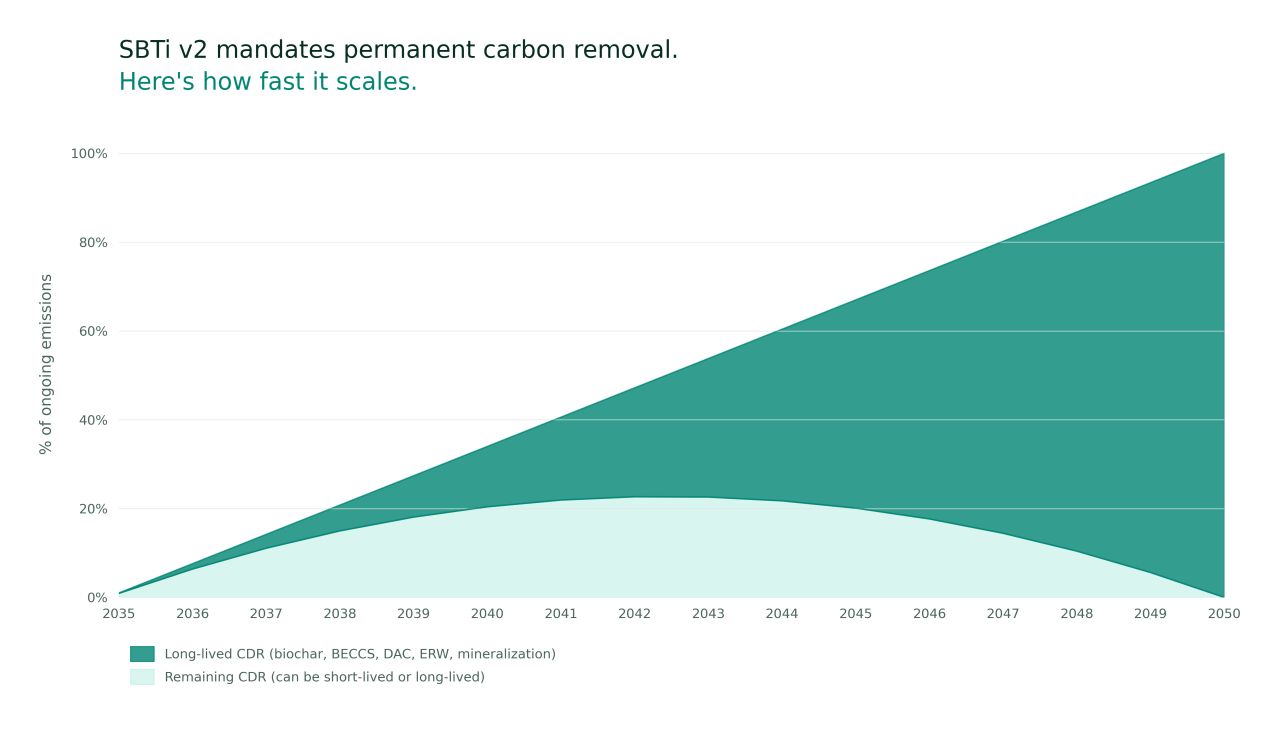
SBTi just published the Corporate Net-Zero Standard v2.0. We built a calculator that shows what it actually means for your company. For the first time, SBTi will require permanent carbon removal. From 2035, companies setting targets under the standard must procure verified removals to offset their ongoing emissions, scaling to 100% coverage by the net-zero year. A rising share must be long-lived, stored for 200+ years through methods including biochar, BECCS, and DAC. We modeled what this looks like in practice. The permanent removal requirement starts at 0.1% of a company's ongoing emissions in 2035, then increases between 250–285x by 2050. A large shipping company's annual requirement reaches four million tonnes. A large automotive company, 1.65 million. The entire permanent CDR market has delivered around 1.5 million tonnes in total to date. The voluntary period before 2035 is a strategic window. Companies that use them to build supplier relationships and secure offtake pricing will be positioned for the mandatory phase. Companies that treat the early years as breathing room will be competing for enormous volumes from a supply base that doesn't yet exist. Our free calculator models your company's obligation and cost across all three SBTi recognition tiers and the mandatory phase at real market prices. Enter your own emissions or explore a sector example. Check it out here: https://lnkd.in/er3nEJWS
- LINKEDIN · IMAGESince 27 May 2026
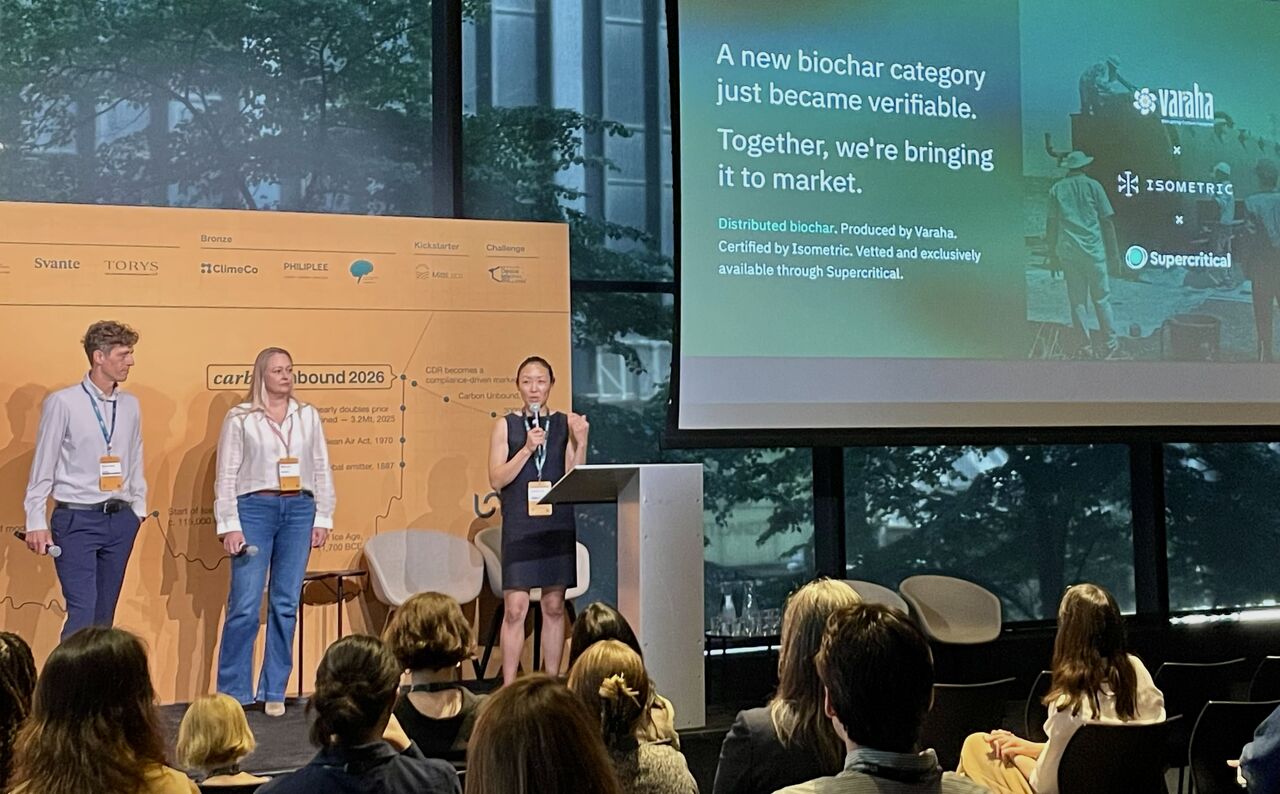
Big news for biochar: Ikarus Janzen, Stacy Kauk, P.Eng., and I announced onstage at Carbon Unbound New York that Supercritical has signed an exclusive agreement with Varaha for a new category of biochar credits, certified under Isometric's Distributed Biochar Module. Biochar quality is a spectrum. Until now, buyers had to choose between industrial biochar (high confidence and rigorous verification, but constrained supply) and artisanal biochar (low costs and high community co-benefits, but harder to verify). Distributed biochar bridges the two, bringing industrial-grade verification to decentralized operations at a more accessible price point and with meaningful co-benefits. Our lead climate scientist, Dr. Genevieve Hodgins, has traveled the world assessing projects in the field, and she contributed to the Isometric protocol that sets the certification standard for this category. I’m a big believer in Varaha. Their operations in India convert invasive species into biochar, returning revenue directly to farmers. Google and Microsoft are already customers. And it's the second-largest CDR project in the world by deliveries. The deal makes Supercritical the exclusive route to market for Varaha's distributed biochar credits, with 10,000 tonnes available in 2026. I’m really proud of our collaboration. Press release and our Critically Speaking newsletter on biochar quality are both in the comments.


6 of 66 adsSign up to see every Supercritical ad, filter by format and date, and get alerts on new ones.
See all 66 adsWatch the companies you care about.
Filter every ad by industry, country, format and network, and get alerts when a company you watch starts running new ads.