On air · 1 of 3 networks
Metal
- metal.ai
- Fintech & Financial Services
- US
- 528 employees
Metal’s ads on LinkedIn, Meta and Google, recorded by adsrunning. Browse the latest here for free. Sign up free to see all 40. Watch Metal with Starter to get each new one in your feed.
Watchlist with Starter · $49/mo
| Network | Status | Live ads | Nov 2025LinkedIn activity · 52 weeksOct 2026 | Checked | Next step |
|---|---|---|---|---|---|
| Running | 39 | Checked 28 Oct 2026 | See all 40 ads → | ||
| Meta | Not checked | — | |||
| None recorded | 0 | No ads found on the Google Ads Transparency Center | Checked 30 Oct 2026 | Collect them with the API → |
Metal has 39 live LinkedIn ads. We recorded no Google ads on 30 Oct 2026.
Latest ads
- LINKEDIN · IMAGESince 13 Oct 2026
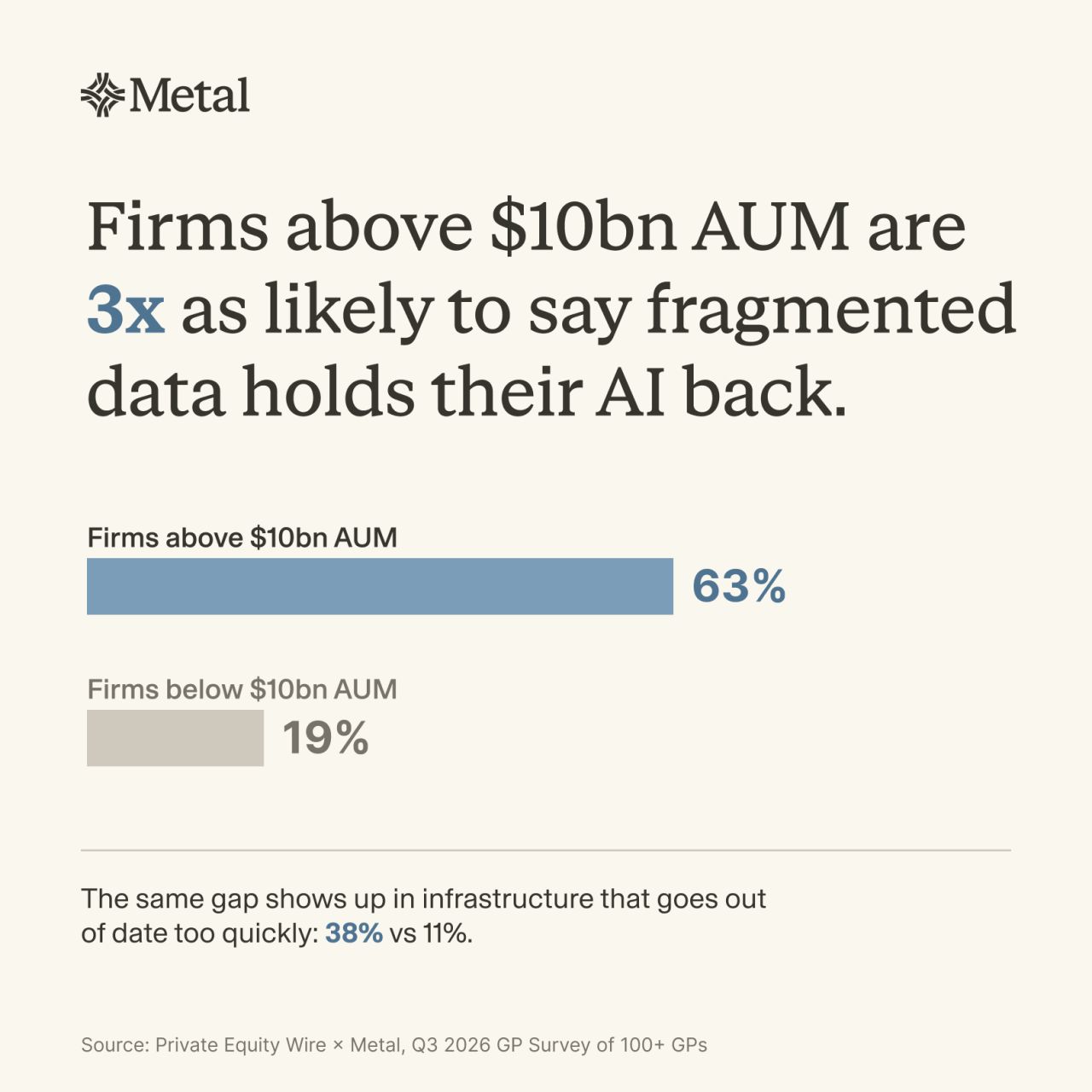
Metal surveyed 100+ GPs with Private Equity Wire® to understand how private market firms are approaching AI. One finding stood out: above $10bn AUM, talent and budget aren’t the constraint. Fragmented data is. That matches what we keep hearing in conversations with private capital firms: better models have made many of them less consistent, not more. These are also the firms most committed to AI. Half of firms above $10bn AUM build their own AI stack, and only 5% are still piloting. Scale spreads a firm’s history across more systems and teams, and each team builds AI on the slice it can see. The result is AI sprawl: no central control, no single source of truth for every agent to read from. Then the models change underneath all of it. 38% of firms above $10bn, and 44% of private credit firms, say their AI infrastructure goes out of date too quickly. That’s the risk the business case misses. A prototype proves a firm can build. Year two means re-validating every workflow for each new model, while aliases, schemas and permissions keep shifting underneath. The decision that matters is no longer build versus buy. It is how a firm dedicates its engineering capacity, and the right answer looks different depending on the firm. The survey makes that clear. The challenges shift with firm size and strategy, from buyout to private credit, from under $10bn to over. Full breakdown in the comments.
- LINKEDIN · IMAGERecorded 20 Sept 2026
Post-investment monitoring shouldn’t surface issues only after they’ve become crises. Metal turns manual, time-consuming portfolio monitoring efforts into customizable AI workflows across the PE investment lifecycle: • Automated IC-Ready analysis across portfolio companies • Red flags surface instantly (that 87% churn spike won't hide) • Value-creation metrics and KPIs tailored to your fund • Full context given in the analysis, not just metrics • Avoid AI hallucinations through one-click source verification See sample report: https://lnkd.in/eEJ3ynC2 #PrivateEquity #PortfolioMonitoring #AIforPE #DueDiligence #InvestmentIntelligence #PEtech
- LINKEDIN · IMAGERecorded 20 Sept 2026
The missing infrastructure layer for private equity—Metal creates a unified system of record across CRMs, data rooms, and documents. Every deal pattern and investment decision is now consolidated, interconnected, and ready to be activated through automated AI workflows.
- LINKEDIN · IMAGERecorded 20 Sept 2026
Metal transforms your fund’s complete investment history into a system of record that delivers actionable intelligence. From diligence through post-investment monitoring, your institutional knowledge powers every decision.
- LINKEDIN · IMAGERecorded 11 Oct 2026
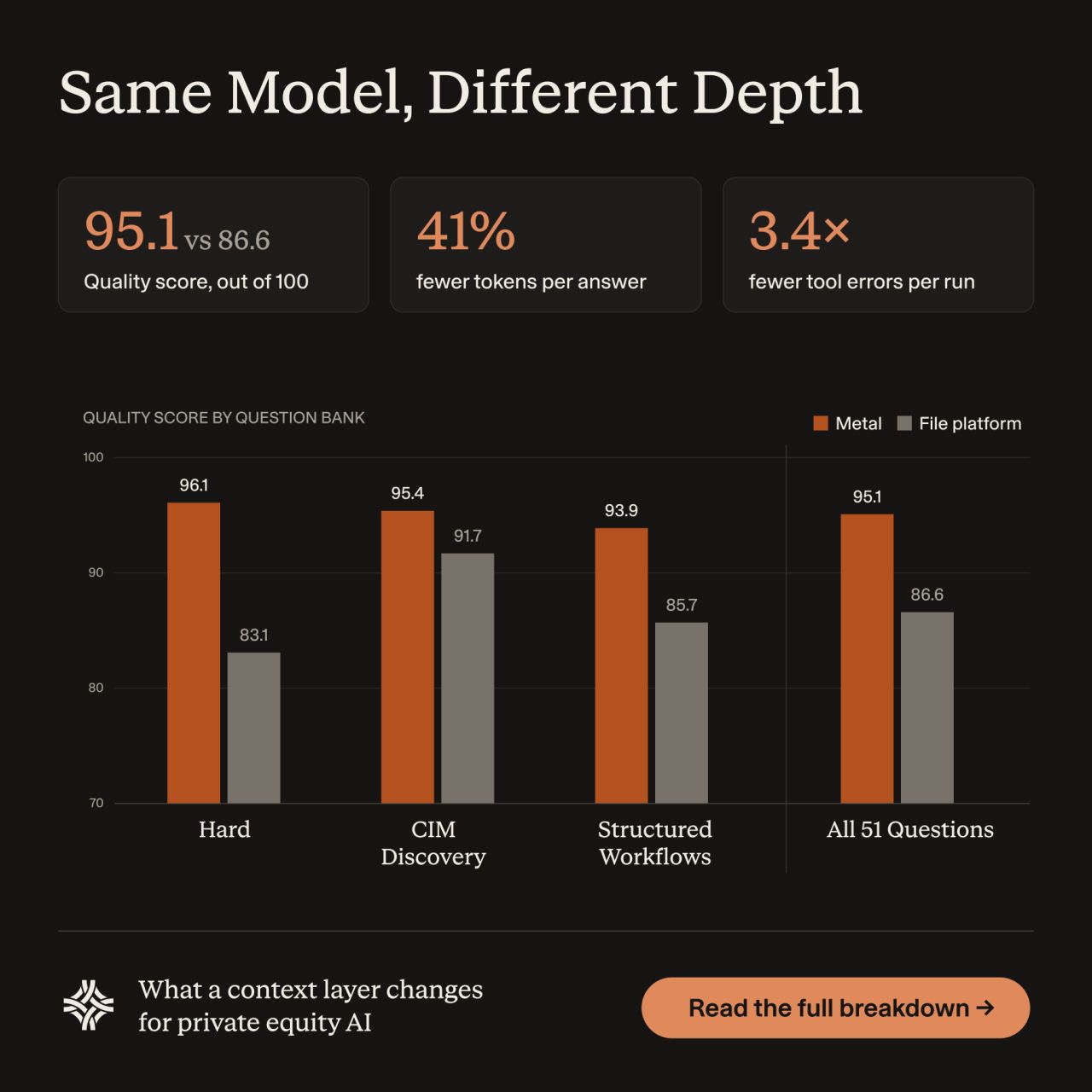
Same AI model. Same agent. 51 real private equity questions. Changing only the data layer lifted the score from 86.6 to 95.1, cut tokens by 41%, and reduced tool errors 3.4× (13.5× on structured workflows). We ran this because in private capital, the edge isn't the model or the workflow. It's your data, and whether AI can understand it. So we connected the same model to two backends through MCP: Metal and a leading enterprise file platform. Here's what we found. The widest gap, up to 50 points, came on four kinds of questions: • Version: which EBITDA, draft or return table controls. A file index treats every version as an equal match. • Time: which period a number belongs to, and when a CIM was actually received rather than when the file was created. • Identity: what a business actually is, across codenames, aliases and duplicate copies. • State: where a deal or screening stands in the pipeline, which no document records. None of these answers sits in a single file. A context layer holds that structure; a file index makes the model rebuild it on every query. The file platform kept pace whenever the answer lived in one set of documents. The gap opened when it didn't. Models will keep getting better. The firms that get the most from them will be the ones whose data is ready. Quick read on the key findings: https://lnkd.in/e-SXzW7A How we ran the test: https://lnkd.in/eivsUuaR
- LINKEDIN · IMAGERecorded 8 Oct 2026
Same models. Same questions. Different Depth. That's the context layer at work.

6 of 40 adsSign up to see every Metal ad, filter by format and date, and get alerts on new ones.
See all 40 adsWatch the companies you care about.
Filter every ad by industry, country, format and network, and get alerts when a company you watch starts running new ads.