On air · 1 of 3 networks
Membrane
- membrane.agency
- Consumer, Retail & E-commerce
- 15 employees
Membrane’s ads on LinkedIn, Meta and Google, recorded by adsrunning. Browse the latest here for free. Sign up free to see all 113. Watch Membrane with Starter to get each new one in your feed.
Watchlist with Starter · $49/mo
| Network | Status | Live ads | Nov 2025LinkedIn activity · 52 weeksOct 2026 | Checked | Next step |
|---|---|---|---|---|---|
| Running | 54 | Checked 28 Oct 2026 | See all 113 ads → | ||
| Meta | Not checked | — | |||
| None recorded | 0 | No ads found on the Google Ads Transparency Center | Checked 30 Oct 2026 | Collect them with the API → |
Membrane has 54 live LinkedIn ads. We recorded no Google ads on 30 Oct 2026.
Latest ads
- LINKEDIN · IMAGESince 19 Feb 2026
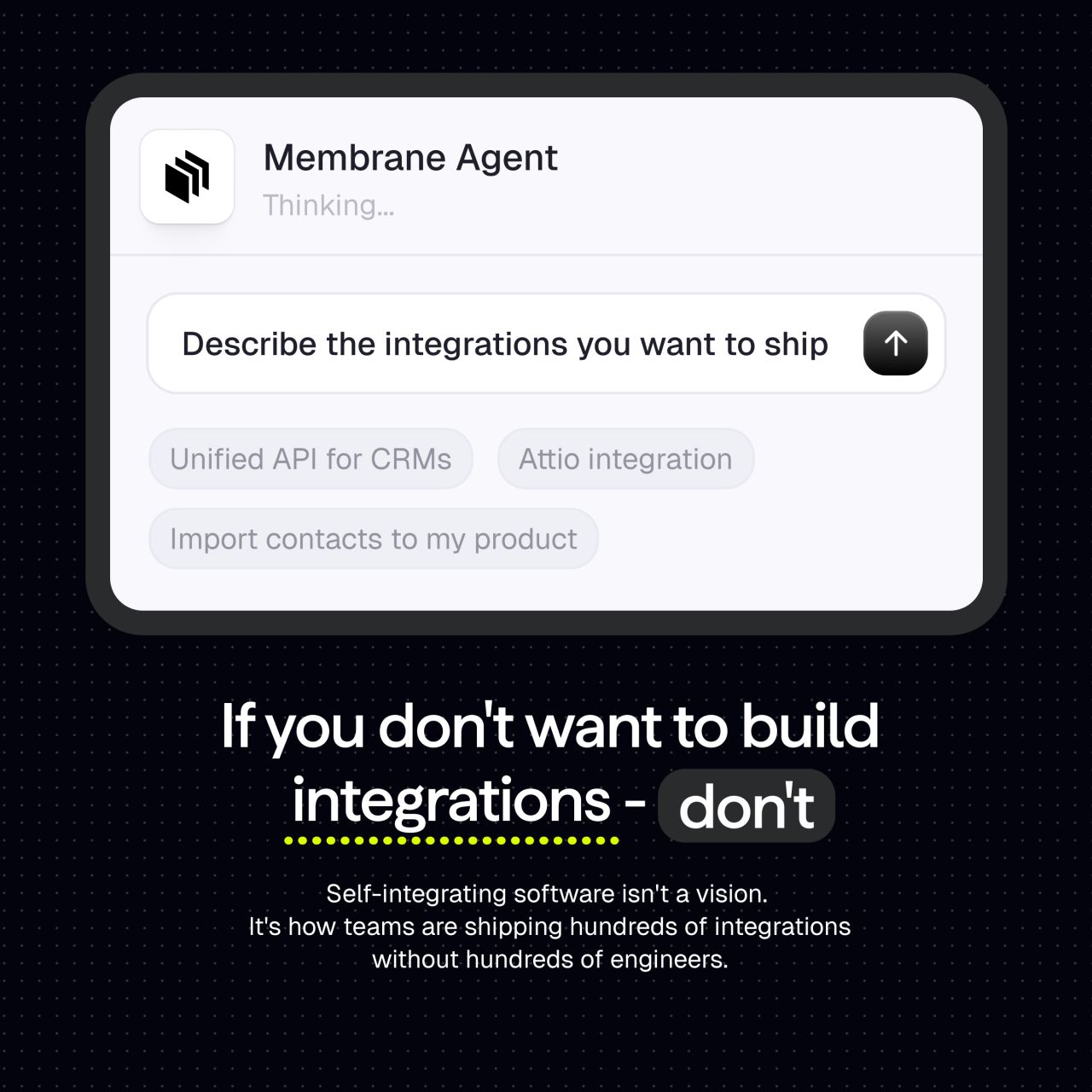
Shipping integrations without building them isn't a vision. It's how teams are shipping hundreds of integrations without hundreds of engineers. Membrane Agent does the work - you own the result.
- LINKEDIN · IMAGESince 19 Feb 2026
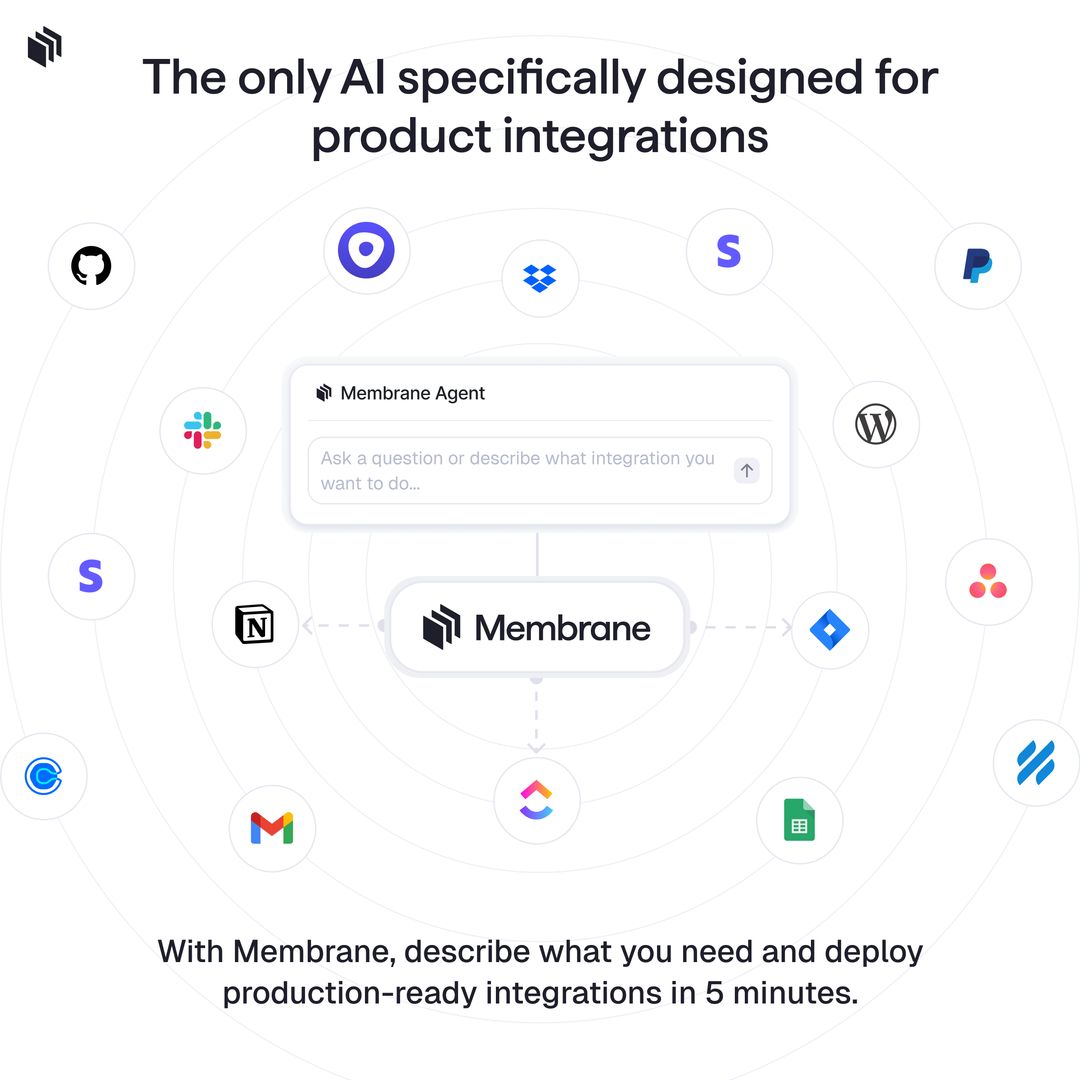
Every app your customers need. Every variant they ask for. Membrane generates product integrations on demand - without growing your team or your backlog.
- LINKEDIN · IMAGESince 19 Feb 2026
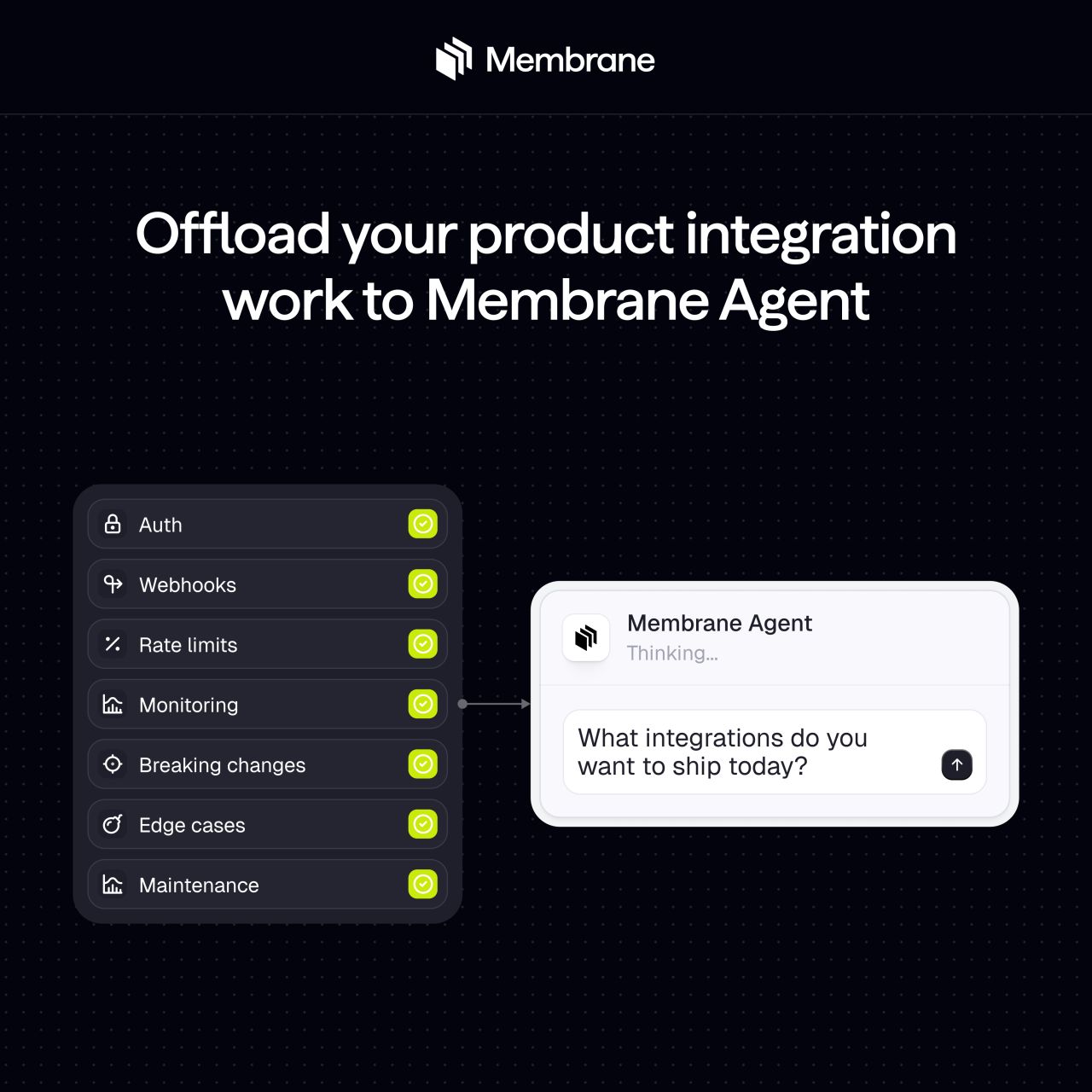
What if your next integration engineer wasn't an engineer at all? Membrane Agent builds, monitors, and maintains integrations autonomously: webhooks, auth, rate limits, breaking changes. And it never takes a day off.
- LINKEDIN · IMAGESince 9 Feb 2026
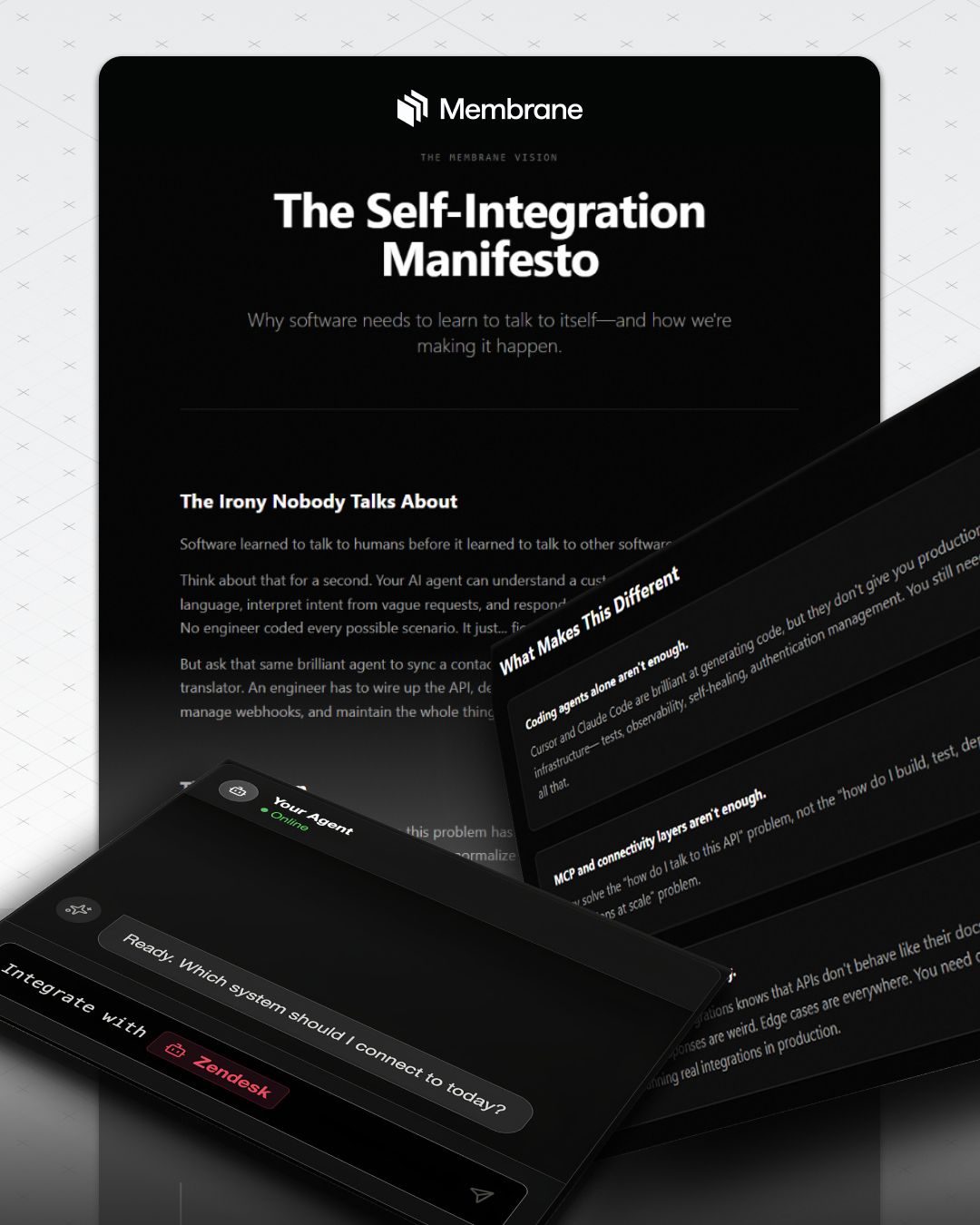
We don’t need more integrations or better integrations. We need software that integrates itself. I believe this is inevitable and will become a standard in a few years. Think about that for a second. Your AI agent can understand a customer's question in any language, interpret intent from vague requests, and respond with nuanced, contextual answers. No engineer coded every possible scenario. It just... figured it out. But ask that same brilliant agent to sync a contact to Salesforce? Suddenly it needs a human translator. An engineer has to wire up Claude Code, create the integration, work to define the data mappings, handle authentication, manage webhooks, and maintain the whole thing as APIs inevitably change. The integration market's answer to this problem has been: more connectors. Better connectors. Connector marketplaces. Unified APIs that normalize everything into the same schema. None of it works. Not really. Pre-built connectors can't cover the long tail. There are thousands of SaaS apps, each with unique APIs, each constantly changing. No library will ever be complete, and the moment it's published, it starts getting stale. Unified APIs sacrifice depth for breadth. They give you the lowest common denominator across apps, which means you lose the custom fields, advanced features, and per-customer variants that make integrations actually useful. And building everything in-house? That's just trading one problem for another. Now you have a team of engineers maintaining integration plumbing instead of building your product. That’s why at Membrane we are already working on self-integration. Self-integration doesn't replace your existing integrations, it augments them. When a user asks your agent to do something with an external app, it first checks your existing integrations and tools. If something's already built, it uses it. No reinventing the wheel. But if there's no integration? Instead of failing or waiting for an engineer, your agent collaborates with a specialized integration-building agent to create the connector it needs..dynamically, in real-time. The new integration is then used exactly like any pre-built tool to fulfill the user's request. From the end-user's perspective, it just works. They don't know or care whether the integration existed before or was created on the fly. That's the magic: infinite coverage without infinite engineering. What do you guys think? If that resonates with you, read more about our take here: https://lnkd.in/e8bDBKmx
- LINKEDIN · IMAGESince 9 Feb 2026
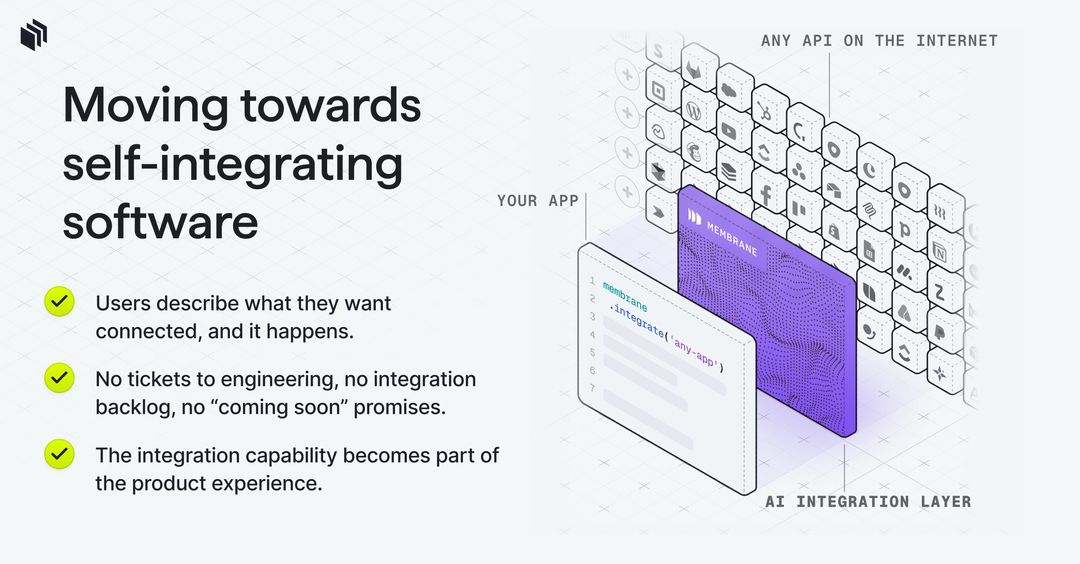
A while back, the team at Linear introduced the concept of Self-Driving SaaS, software that runs itself with AI. We’re now seeing the same evolution happening in another part of the software world: building product integrations. Over the past decade, unified APIs and embedded iPaaS platforms have made it easier to ship integrations faster. But the core problem remains: you still have to build every integration flow for every external app, and those flows are often rigid, limited, and hard to customize. That’s starting to change. We’re entering an era of self-integrating software, systems that can automatically understand, build, and maintain their own integrations. Think of it this way: • You describe what you want (“Sync contacts from our customers' HubSpot to our product whenever they're updated”). • The system figures out how, reading the APIs, generating code, setting up auth, testing, and monitoring. • In the future, when an API changes or fails, it will self-heal and adapt instead of paging a human. This new generation of software combines human intent (what you want to happen) with AI execution (the system that makes it real). If it wasn’t obvious, that’s our vision at Membrane: where every product can understand and connect to any other product, automatically, safely, and continuously. If you want to see what it looks like in practice, check out our website: https://lnkd.in/ecUHzR_Z
- LINKEDIN · IMAGESince 9 Feb 2026
For years, building integrations has been one of the most expensive forms of repetition in software. Every team ends up writing the same connectors, debugging the same OAuth flows, and chasing the same edge-case failures. We’ve treated integrations as engineering projects, when they’re really a form of learned behavior. And now, software can finally remember and reuse that behavior. At 𝗠𝗲𝗺𝗯𝗿𝗮𝗻𝗲, we’ve gathered data on thousands of real-world integrations, not just what API docs say, but how APIs actually behave in production. Our AI is constantly testing, learning, and updating from that data, giving it the world’s deepest context on how integrations really work. Whenever OpenAI, Claude, or others level up, so do we. We continuously remix and fine-tune the latest models, specializing them for integration work. The result is 𝗠𝗲𝗺𝗯𝗿𝗮𝗻𝗲 𝗔𝗴𝗲𝗻𝘁, the AI coding agent built for the terminal and optimized for our Integration Engine. It understands, builds, and maintains the complex web of APIs that power modern software, with the precision and context only Membrane provides. This isn’t about replacing engineers; it’s about giving them leverage. The best developers don’t want to maintain integrations, they want to automate them. 𝗧𝗵𝗲 𝗶𝗺𝗽𝗮𝗰𝘁: ⚡ Weeks compressed into minutes 🔁 Maintenance replaced by learning systems 💡 Engineers focused on product, not plumbing If you want to see what it looks like in practice, check out our website https://lnkd.in/ewWshCBU
6 of 113 adsSign up to see every Membrane ad, filter by format and date, and get alerts on new ones.
See all 113 adsWatch the companies you care about.
Filter every ad by industry, country, format and network, and get alerts when a company you watch starts running new ads.